
 614.224.6226
Geofencing marketing draws a virtual boundary around a real-world place, such as a competitor’s lot, a trade show, a job site or your own storefront. It then shows ads to phones that enter that boundary. It works best for businesses with a physical destination or a clearly defined local audience. It works poorly when the boundary is vague or the offer is wrong for the moment. Results depend less on the technology than on the fence you draw, the message you send and how honestly you measure.
This guide covers how location-based advertising works, where it fits, how pricing is usually structured, how to prove it brought people through the door, and the privacy risks that have already cost other companies dearly.
TL;DR
- Geofencing serves digital ads to mobile devices that enter, or recently visited, a boundary you define around a place.
- It suits local retail, services, events and even B2B targeting (think trade shows and industrial parks), but not every product category responds the same way.
- Count incremental store visits against a control group, not clicks. A 2026 study found a 0.48% visit rate for exposed users versus 0.18% for the control group.
- Location data is sensitive. The FTC has banned data brokers from selling precise location data, so vet your vendor’s consent practices before you spend a dollar.
- Geofencing is one channel. It performs best next to a fast, mobile-friendly site and a clear landing page.
Table of Contents
- What geofencing marketing is, in plain terms
- How a campaign works, step by step
- Does it work? What the evidence shows
- What geofencing costs
- Measuring it honestly
- Privacy and legal risk: the part vendors skip
- Who should and should not use it
- Perspective: where we would start
- Pairing geofencing with the rest of your marketing
- Planning a campaign with Marcy Design
- FAQ
- Sources
What geofencing marketing is, in plain terms
A geofence is a digital perimeter. It can be a few hundred feet around a coffee shop or several miles around an industrial park. When a device with location services enabled crosses it, an ad platform can log that event and serve an ad, either right away or in the days after.
People often lump several location tactics together. Shopify’s overview of location-based marketing separates five: IP targeting (broad), GPS targeting (precise device tracking), geofencing (virtual boundaries around locations), geoconquesting (targeting competitor locations) and beaconing (proximity-based hardware). The practical difference is precision. IP targeting is fine for reaching a metro area. Geofencing and geoconquesting are for driving physical traffic.
So “location-based advertising” is the umbrella, and geofencing is one specific way of doing it.
The three fence types you will actually use
- Your own location. Reach people who visited you, so you can bring them back with an offer or a reminder.
- Competitor or category locations. Reach people who visited similar businesses. This is geoconquesting, and it is the most common reason small businesses try geofencing.
- Events and clusters. Conferences, trade shows, college campuses, industrial parks or a dealership row. These are especially useful for B2B, where a narrow audience is gathered in one place.
How a campaign works, step by step
- Pick a goal you can count. Store visits, calls, booked appointments, form fills or coupon redemptions. Impressions are not a goal.
- Draw the fences. Use tight boundaries around buildings, not wide circles around neighborhoods. A fence that catches people driving past is a fence that wastes budget.
- Choose the audience rule. Real-time (someone is there now) or historical (someone was there in the last 30 days).
- Build the creative. Mobile display, social or video ads, each with one clear offer and one action.
- Send people somewhere that works. A dedicated landing page that loads fast on a phone. Most of the money is lost here.
- Measure against a control. Hold back a comparable group and compare.
If you already run paid search, the logic will feel familiar. Our piece on the half of pay-per-click advertising people forget about covers the landing-page and follow-through side that applies here too.
Does it work? What the evidence shows
Vendor pages are full of big claims, so it helps to look at independent research.
A 2026 study in the International Entrepreneurship and Management Journal tested geofencing aimed at a competitor’s customers. A three-week campaign delivered over one million impressions to 101,179 unique users. The click-through rate was 0.44%, and 488 physical store visits were validated. The exposed group visited at 0.48%, against 0.18% for a control group, a statistically significant lift.
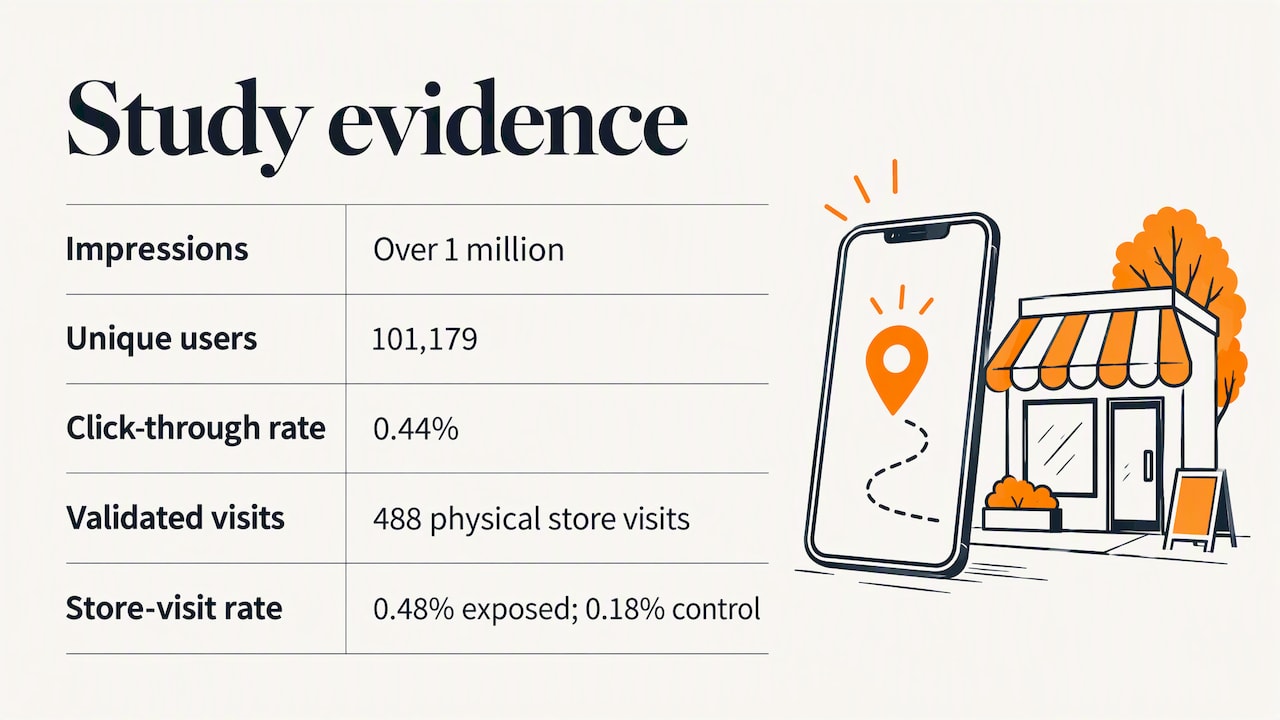
Two things stand out. First, the click rate looks unremarkable, yet the store-visit lift was real. Clicks undersell the channel. Second, the absolute visit rate is small. Geofencing is a steady nudge across many people, not a flood of customers from a few.
Why might precise targeting data matter so much to smaller advertisers? A 2024 NBER working paper studied more than 70,000 advertisers who lost offsite tracking data. It found the median cost per incremental customer rose from $38.16 to $49.93, a 31% loss in effectiveness, and that smaller advertisers were hit hardest. That paper is about offsite tracking in general rather than geofencing alone, but it supports the idea that good targeting signals are worth the most to firms with the least budget to waste.
Product category matters
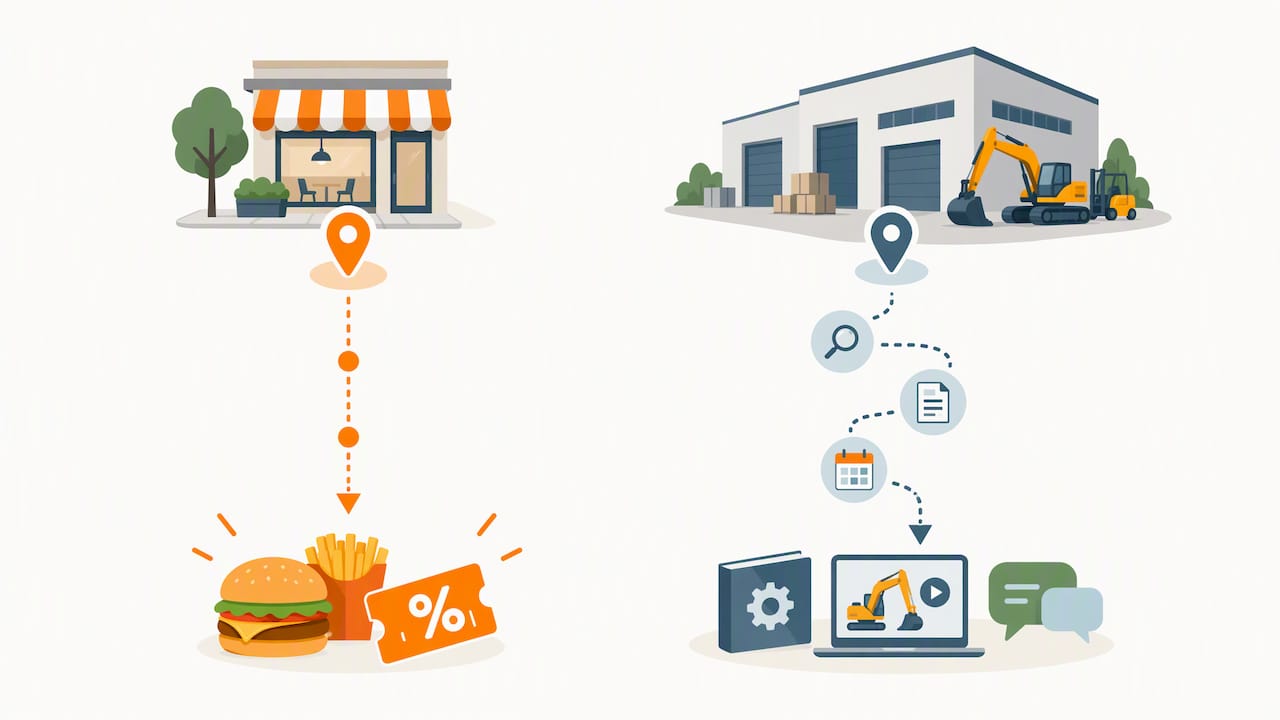
Research in the Journal of the Academy of Marketing Science suggests the effectiveness of location-based mobile marketing depends on how involved buyers are with the product category. Highly personalized messages can backfire by triggering reactance. In practice, a convenience purchase like lunch suits an in-the-moment price offer. A considered purchase, such as industrial equipment, a remodel or a software contract, responds better to a helpful non-price message, such as a guide, a demo or a consultation, than to a discount.
What geofencing costs
We will not quote a number for geofencing, because costs vary by vendor, audience size and how many fences you run, and we have not seen a credible published average. What we can describe is the structure.
- Impression-based billing. Geofencing usually sits inside programmatic display, which is typically sold by the thousand impressions (CPM) rather than by the click.
- Minimums. Platforms and resellers often set monthly spend minimums. Ask for them in writing.
- Management fees. Setup, creative and reporting may be bundled or billed separately.
- Creative and landing pages. Often forgotten in the budget, and often decisive.
When you compare proposals, ask each vendor three questions. What is the all-in monthly cost, including fees? How do you verify that a visit really happened? Can I see the report for a campaign like mine?
A rough sanity check: take your average customer value, estimate how many extra visits a small lift would give you, and see if the math supports the spend. Our digital marketing ROI calculator guide walks through that framing.
Measuring it honestly
The easy trap is counting every visit after an ad as a result of the ad. Many of those people were coming anyway.
Do this instead:
- Use a control group. Keep a comparable audience unexposed and compare visit rates, as the 2026 study did.
- Track the whole path. Impression, click, landing-page behavior, call, form, visit, sale.
- Use unique offers. A dedicated phone number, URL or code gives you something to count that no vendor dashboard can inflate.
- Read reports skeptically. Ask how the vendor defines a visit and how long the attribution window is.
- Look at the right geography. Research on location-based advertising in marketing mix modeling, from a JCDecaux and Route paper, argues that modeling at a fine local level, such as postal district, beats national aggregates. For a local business the lesson is to judge results neighborhood by neighborhood, not as one blended number.
For a wider view on picking metrics, see our guides to startup marketing metrics and evaluating marketing case studies. The second one is useful when a vendor shows you glowing case studies.
Privacy and legal risk: the part vendors skip
Geofencing runs on location data, and location data is the category regulators watch most closely.
In January 2024 the FTC prohibited data broker X-Mode Social and its successor Outlogic from selling sensitive location data. The agency’s business guidance on the case explains that the company compiled location data and sold it to hundreds of clients for advertising and brand analytics. A separate FTC analysis of a proposed consent order involving Mobilewalla criticized keeping collected data indefinitely, far longer than necessary.
The lesson for advertisers: you do not have to be the data broker to be exposed. If your vendor’s data was gathered without clear consent, your brand is attached to it.
On the state side, an IAPP analysis notes that nearly every U.S. state with a comprehensive consumer privacy law treats some form of precise geolocation as sensitive, which generally means opt-in consent and added safeguards. Whether a given law applies to your business depends on where your customers live and on your size, so ask your attorney, not your ad vendor. If you advertise to California residents, for instance, California’s regulations on restrictions on the collection and use of personal information are worth having counsel review.
A practical vendor checklist:
- Where does the location data come from, and how is consent collected?
- Does the vendor sell or share the data beyond your campaign?
- How long is it retained?
- Can the vendor show opt-out handling in writing?
- Will the contract make the vendor responsible for data practices?
Also think about how the ad feels. A message that shows up because someone stood in a competitor’s store can feel invasive. Keep the copy useful and general, not creepy.
Who should and should not use it
A good fit
- Restaurants, clinics, salons, gyms, home services and retailers with foot traffic or a defined service area.
- Event-driven businesses, including exhibitors working a trade show.
- Manufacturers and B2B firms that can name the places their buyers gather, such as industry expos or industrial districts, and that pair the ad with a useful offer like a quote request.
A weaker fit
- Businesses with no physical destination and a very small local market.
- Products where the buyer is nowhere near the location when deciding.
- Companies with a slow, confusing or non-mobile website. Fix that first.
Our view on mobile-first web design in Ohio applies directly. Every geofenced click lands on a phone.
Perspective: where we would start
We have been in business for more than 38 years, and the pattern is consistent. Channels change, but results come from the same things: a clear audience, a message that fits the moment, and a website that finishes the job.
Geofencing is a good example. The targeting gets the attention, but we rarely see it fail because of the fence. It fails when the ad promises one thing and the landing page says another, when the page loads slowly on a phone, or when nobody set up a way to tell a real result from a coincidence.
So our advice to a small business owner is simple. Run it as a test, not a bet. Pick one goal, two or three tight fences and a four-to-eight-week window. Set up a control group and a unique phone number or URL before launch. If the lift is real, grow it. If not, you have learned something cheaply, and you can put the budget into search, remarketing or email, where you may already have warmer audiences.
And treat privacy as a buying criterion, not a footnote. A vendor that cannot explain its data source in two sentences is a vendor to walk away from.
— Greg
Pairing geofencing with the rest of your marketing
Geofencing rarely carries a business on its own. It is strongest as one layer.
- Search and local listings catch people who already know what they want. IP-level and city-level targeting is usually enough here.
- Remarketing brings back people who visited your site. Our article on how to tell if Google remarketing might work for your company helps you decide.
- Social ads extend the same audience. See our take on Facebook marketing.
- Email turns a first visit into a relationship, once someone opts in.
- A sound measurement plan ties it together. Our results-driven digital marketing framework shows how to do that without drowning in dashboards.
If you sell online, the landing experience matters even more. Our guide to ecommerce conversion rate optimization covers what happens after the tap.
Planning a campaign with Marcy Design
If you are weighing geofencing, we can help you work out whether it deserves a place in your plan before you spend on it. We are a Columbus, Ohio agency that handles advertising, digital marketing and web development, lead generation and website design under one roof. That matters here, because the landing page, the offer and the measurement are as important as the fence. Tell us your goal and your service area, and we will give you an honest view of the channel mix. Start a conversation with us.
FAQ
How much does geofencing marketing cost?
It depends on the vendor, the audience size and the number of fences. Most geofencing is sold by impressions, then topped up with setup, creative and management fees, and some platforms set monthly minimums. Ask for an all-in monthly figure and compare it with the value of one new customer.
How do you do geofencing advertising?
Define one measurable goal, draw tight fences around specific places, and choose between real-time and historical audiences. Then build mobile ads with a single offer and send traffic to a fast landing page. Hold back a control group so you can measure true lift.
Is geofencing legal in the US?
Geofenced advertising is not banned outright, but how the location data is collected and used is regulated. The FTC has acted against data brokers that sold sensitive location data, and most states with comprehensive privacy laws treat precise geolocation as sensitive. Ask an attorney about your situation, and choose vendors that can document consent.
What is the difference between geofencing and location-based advertising?
Location-based advertising is the broad category, covering anything that uses where a person is or has been. Geofencing is one method within it, built on virtual boundaries around specific places. Other methods include IP targeting, GPS targeting and beacons.
Does geofencing work for B2B companies?
It can, when buyers gather in identifiable places such as trade shows or industrial parks. Research suggests considered purchases respond better to helpful, non-price messages than to discounts. Pair the ad with a clear next step, like a quote request or a demo.
Sources
- Geofencing in proximity marketing for entrepreneurs (International Entrepreneurship and Management Journal, 2026)
- Behaviorally targeted location-based mobile marketing (Journal of the Academy of Marketing Science)
- NBER working paper w32765 (August 2024)
- Location Based Marketing: Guide, Types, and Tips (Shopify)
- Location Matters (JCDecaux and Route)
- FTC order prohibiting X-Mode Social and Outlogic from selling sensitive location data
- FTC analysis of proposed consent order, File No. 2023196
- IAPP: Updating the map of location privacy safeguards
- Cal. Code Regs. Tit. 11, § 7002