
 614.224.6226
What if your marketing reports showed not just what people clicked, but whether those actions moved them closer to becoming customers? Impressions, visits, and form submissions are easy to track. The harder part is understanding what those numbers mean for business growth. Results driven digital marketing starts with meaningful outcomes, then connects each campaign to the customer actions that support them.
If your channels feel disconnected or a standard form seems like a dead end, you’re not alone. A static form asks everyone for the same information. A guided interactive experience can respond to a person’s answers, making the next step more relevant and easier to complete. That difference can give customers a clearer path and your team more useful signals.
This article offers a practical framework for setting goals, linking marketing activity to business outcomes, and measuring progress. You’ll also see how interactive experiences can support lead capture, onboarding, professional consultations, and assessments, and how completion data can help you improve the customer journey over time.
Key Takeaways
- Use results driven digital marketing to connect campaign activity with business outcomes, not just clicks and impressions.
- Set a clear objective and customer action before choosing campaign channels, landing pages, and calls to action.
- Compare static forms with interactive experiences to decide how much guidance and personalization your audience needs.
- Match guided journeys to customer goals, from lead capture and onboarding to consultations and assessments.
- Measure meaningful progress, including completion rates, then use what you learn to refine the customer journey.
What Makes Digital Marketing Results-Driven, and Which Results Matter?
Results-driven digital marketing connects strategy to a business outcome and the customer actions that contribute to it. Reaching people is only part of the picture. You also need to know whether a campaign helped them take a meaningful next step. Marketing activity is what a business publishes or promotes; measurable progress is what the audience does in response and how that action supports a business goal.
Digital marketing can include several channels and types of activity, but the right measures depend on your objective. A social post may support awareness, while a landing page may encourage an inquiry. Marcy Design connects marketing strategy with purposeful website experiences through its digital marketing approach.
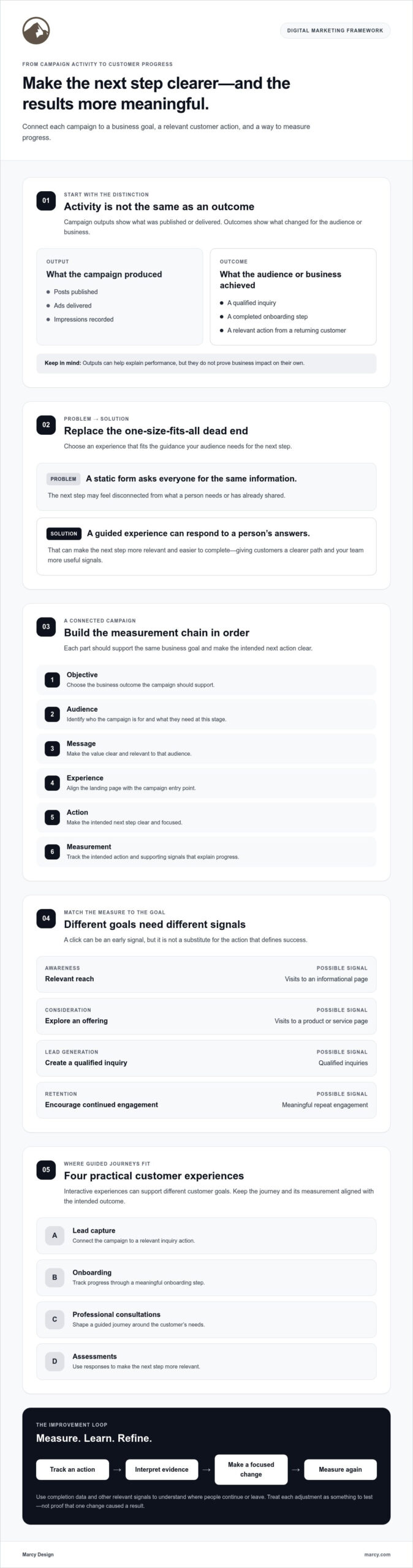
Separate outputs from outcomes. Outputs include posts published, ads delivered, and impressions recorded. They show what the campaign produced. Outcomes show what changed for the audience or business, such as a qualified inquiry, a completed onboarding step, or a returning customer taking a relevant action. Outputs can help explain performance, but they don’t prove business impact on their own.
Choose outcomes before choosing campaign metrics
Name the goal first, then identify an observable customer action connected to it. For awareness, you might assess relevant reach or visits to an informational page. For consideration, look at visits to a product or service page. For lead generation, track qualified inquiries. For retention, measure meaningful repeat engagement. A high click count alone doesn’t show whether visitors were a good fit, found what they needed, or continued their journey.
The same metric can mean different things in different campaigns. A click may be a useful early signal for an awareness effort, but it isn’t a substitute for a completed inquiry when lead generation is the goal. Choose measures that reflect the progress you want.
Build a simple measurement chain
Keep the plan connected from start to finish: objective → audience → message → experience → action → measurement. For example, to generate qualified inquiries, define the intended audience, align the campaign message with its needs, and guide visitors to an experience that makes the next step clear. Then track the inquiry and useful supporting signals, such as landing-page visits or form starts.
Choose one primary outcome for each campaign and a small set of supporting indicators that help explain it. Define terms such as “qualified inquiry” consistently across teams so reports use the same criteria. This makes results easier to interpret and gives you better evidence for deciding what to refine next.
How Does a Results-Driven Digital Marketing Process Work?
A repeatable process keeps the campaign, website experience, and measurement focused on the same business goal. Before selecting a channel, ask what the campaign should help the audience do and how your team will recognize progress. Harvard Business School Online’s guide to an effective digital marketing plan also emphasizes goal setting and audience understanding as foundations for planning.
Set the goal, audience, and baseline
Start with the business question. Are you trying to generate more relevant inquiries, help more customers complete onboarding, or encourage shoppers to explore an ecommerce offer? Define the audience’s needs, decision stage, and likely points of friction. A first-time visitor may need a clear explanation, while someone ready to act may need a direct path to an inquiry or purchase.
Record what’s currently happening if you have a useful baseline. That could include inquiry volume, landing-page actions, or where visitors leave the journey. Don’t invent a benchmark when reliable data isn’t available. A clear starting point helps your team compare observations over time.
Map the campaign from message to measurement
Use this sequence to shape the work:
- Objective: Choose the business outcome the campaign should support.
- Audience: Identify who the campaign is for and what they need at this stage.
- Message: Make the value clear and relevant to that audience.
- Experience: Align the landing page with the promise made in the ad, social post, or other campaign entry point.
- Action: Use a focused call to action that tells visitors what to do next.
- Measurement: Track the intended action, plus supporting signals that help explain progress.
A landing page shouldn’t leave visitors searching for the next step. If a campaign invites people to request information, the page should reinforce that message and make the inquiry action easy to find. If the goal is to explore products, the page and call to action should guide visitors to relevant product information.
Measure, learn, and improve the experience
Review behavior across campaign entry points and the connected website experience. Look beyond visits to see whether people take the intended action, then interpret those signals alongside lead quality or another relevant business outcome. If visitors arrive but don’t continue, consider whether the message, page content, or next step creates friction.
A useful measurement loop is to track an action, interpret the evidence, make a focused change, and measure again. Treat each adjustment as something to test, not proof that one change caused a result. Over time, your observations can inform messaging, channel choices, and experience design. For a coordinated approach, explore Marcy Design’s digital marketing strategy and execution.
Interactive Experiences vs. Static Forms: Which Better Supports Marketing Results?
A static form presents the same fixed questions to every visitor. An interactive experience responds to a person’s answers, guiding them through relevant questions or options. In results driven digital marketing, the better fit depends on what the customer needs to do and what information the business needs. Neither format is automatically right for every task.
A short inquiry may need only a name, contact detail, and clear reason for reaching out. A more involved choice, such as finding the right service or completing an assessment, may benefit from a guided sequence. Harvard Business School’s guidance on measuring marketing effectiveness reinforces the value of matching measures to the customer’s stage and intended outcome.
- Personalization: A static form shows the same fields to everyone. An interactive tool can use answers to present a more relevant next question or recommendation.
- User effort: A short form can be quick to complete. A guided experience may break a complex task into manageable steps, but too many questions can add friction.
- Engagement: Fixed fields collect information directly. Interactive prompts invite visitors to participate, though engagement alone doesn’t prove business value.
- Data collection: Forms capture the details requested. Interactive flows can also reveal preferences or needs through a visitor’s choices.
- Implementation: A simple form may be easier to maintain. A branching experience needs thoughtful question paths, clear logic, and testing across the journey.
When a static form is the simpler fit
Choose a static form when the next step is straightforward and requires little information, such as a basic inquiry. Keep only the fields needed to respond, explain why you’re requesting the information, and make the next step clear. Even a simple form needs accessible design and relevant context. If visitors don’t know what happens after submitting it, the form can still feel like a dead end.
When a guided interactive experience adds value
Use branching questions when a visitor’s answers should shape what they see next. For example, a consultation flow could ask what kind of help someone needs, then guide them to a relevant next step. This can make complex choices easier to navigate by replacing a long list of generic questions with a more tailored path. Marcy Design’s AI-powered digital marketing solutions can complement a thoughtful customer journey.
Test the experience against the outcome that matters. Compare completion rates and lead quality, while watching for signs that visitors abandon the process or provide information that doesn’t support the goal. Treat what you learn as evidence for refinement, not a guarantee that one format will outperform the other in every situation.
Applying Guided Digital Marketing to 4 Customer Journeys
Guided experiences work best when they help people move from a specific need to a useful next step. These four scenarios show how a focused interaction can support customers while giving a business meaningful actions to measure. The right path depends on the audience and goal, so track completion and quality rather than assuming personalization will automatically improve results.
Lead capture
User goal: Find out whether a business can help with a particular need. Interaction: A short sequence asks what the visitor is looking for and gathers relevant context before requesting contact details. Next step: Route the inquiry to appropriate follow-up or information. Measure: Track flow completion, inquiry relevance, and progression to the next action. This can show whether the questions clarify intent or add unnecessary friction.
Customer onboarding
User goal: Understand what to do after becoming a customer. Interaction: A guided welcome experience asks about the customer’s immediate priorities and presents suitable setup information. Next step: Direct them to the relevant onboarding task or resource. Measure: Review completion of the guided steps and whether customers proceed to the intended next action. Keep the path clear, with help available when someone needs a different route.
Professional consultation
User goal: Prepare to discuss a specific challenge or objective. Interaction: A consultation intake asks about the customer’s goals, current context, and areas of interest. Next step: Provide a clear way to submit the request and explain what information to have ready. Measure: Assess intake completion, the relevance of submitted inquiries, and progression to the consultation step. The answers can help organize the conversation around the customer’s needs.
Assessment
User goal: Understand which information or options may fit their situation. Interaction: An assessment uses responses to guide visitors through relevant questions and present a tailored result or information path. Next step: Invite them to explore a relevant page, request more information, or continue their research. Measure: Track completion, engagement with the recommended next step, and the usefulness of resulting inquiries.
These examples put results driven digital marketing into practice by linking each experience to a customer goal and an observable outcome. Compare the evidence over time, then refine questions or next steps where people stall or outcomes fall short. Marcy Design’s digital marketing services connect strategy with campaign and website execution.
Turn the Framework into a Measurable Digital Marketing Plan with Marcy Design
A practical plan starts with a clear business outcome and a customer journey that can support it. Choose an experience that fits the journey, decide how you’ll measure progress, and use what you learn to refine the next step. This keeps marketing activity connected to customer needs instead of treating each channel as a separate effort.
Make the plan fit the business and customer
Match channels and experiences to what your audience needs and where they are in the decision process. Someone comparing ecommerce options may need useful product information, while someone ready to ask about a service may need a direct inquiry path. Keep each interaction focused, and request only the details needed to make the next step helpful.
For Columbus-area businesses, local relevance starts with understanding the customers they serve and the context of their decisions. Marcy Design connects digital strategy with website and marketing execution through marketing services, including web development, advertising campaigns, and ecommerce. Planning these elements together helps align the campaign message with the website experience customers encounter.
Start with a focused improvement cycle
Choose one customer journey and define its intended outcome before making changes. If visitors reach a service page but don’t take the next step, examine whether the page explains the offer clearly, the call to action is easy to find, and the experience works well on mobile. Marcy Design’s website design services can help align page structure with the action you want customers to take.
Measure the experience against the outcome you selected. Consider completion and lead relevance alongside supporting behavior, then use those observations to guide further refinements. Each change is an opportunity to learn, not proof on its own that a specific adjustment caused a result.
Marcy Design brings website, ecommerce, advertising, and digital marketing capabilities together to support purposeful customer journeys. Take the next step and discuss a results-focused digital marketing project with Marcy Design.
Put Your Marketing Plan into Motion
Better marketing decisions start with a clear destination. Define the business outcome, connect it to a customer action, and choose measures that show whether people are moving forward. Then look at the experience itself: a concise form may suit a simple inquiry, while a guided interaction can help customers navigate more involved choices. Measure completion and lead quality, then use what you learn to make thoughtful improvements.
That’s the practical value of results driven digital marketing. Campaigns, channels, and website experiences work better when they support the same customer journey. As a Columbus-based agency, Marcy Design brings web development and ecommerce solutions together with advertising campaigns and social media management, helping businesses connect strategy with digital execution.
You don’t need to overhaul everything at once. Choose one journey, identify its next meaningful improvement, and build from there. Discuss a results-focused digital marketing project with Marcy Design, and take a confident next step toward more measurable growth.
Frequently Asked Questions
What does results-driven digital marketing mean?
Results-driven digital marketing ties marketing activity to clear business outcomes and observable customer actions. Instead of counting posts or clicks alone, a business defines what progress looks like, such as a relevant inquiry, a completed onboarding step, or a customer returning to make another purchase. Measures should fit the goal and journey. Results are most useful when they help the team understand what to improve next.
How do you measure whether digital marketing is working?
Measure whether people take the action your campaign is designed to encourage, then consider whether that action supports a business goal. For lead generation, review inquiry volume and relevance alongside supporting signals such as landing-page visits. For a Columbus business, Marcy Design connects digital marketing with web development, ecommerce, advertising campaigns, and social media management. Compare results with a reliable baseline where available, and use the evidence to guide adjustments rather than relying on one metric to tell the whole story.
Are interactive forms better than static forms?
Neither format is automatically better. The right choice depends on the task and the information needed. A short, static form can work well for a straightforward inquiry with only a few essential fields. An interactive form can guide someone through a more involved decision by adapting questions to their responses. Keep either format focused, accessible, and clear about the next step. Evaluate completion and the relevance of the information collected.
Can interactive marketing experiences improve completion rates?
They can be designed to make a process feel more relevant and manageable, but higher completion rates aren’t guaranteed. A guided experience may break a complex task into steps or show questions that match a visitor’s answers. It can also create friction if it asks too much or feels confusing. Track starts and completions, review where people leave, and assess whether completed interactions lead to useful outcomes. Use those findings to refine the experience.
How can guided digital experiences support lead capture and onboarding?
For lead capture, a guided flow can ask a few relevant questions, gather useful context, and direct an inquiry toward an appropriate next step. During onboarding, it can help a new customer find the information or task that fits their needs. In both cases, avoid unnecessary questions and make the path forward clear. Measure completion, lead relevance, and progression to the next action to understand whether the experience serves customers and the business.
What should a business measure before launching a digital marketing campaign?
Before launch, define the business objective, the customer action that supports it, and one primary outcome to track. Choose supporting indicators that help explain progress, such as page visits or form starts, and decide how the team will define terms like a qualified inquiry. Record a baseline if reliable data is available. Also map the audience, campaign message, landing-page experience, and call to action so measurement follows the customer journey.