
 614.224.6226
What if the best AI marketing tool is the one customers barely notice? The value of ai tools for digital marketing isn’t in a long feature list. It’s in whether a tool helps someone find the right information, take the next step, or get a more relevant experience without adding friction.
Choosing can feel difficult because tool roundups often list features without connecting them to a specific marketing goal. And automation that saves a team time can still feel generic to a customer. Start with a more useful question: which part of the customer journey needs to work better?
This article explains how to evaluate tools by the customer experience and business outcomes they support, then fit promising options into your workflow. You’ll see when guided, interactive experiences can be more useful than static forms, with practical examples in lead capture, onboarding, professional consultations, and assessments. You’ll also learn how to test results and keep human oversight in place, so personalization feels helpful rather than robotic.
Key Takeaways
- Use ai tools for digital marketing to address a defined customer-journey need, not simply to add another feature to your stack.
- Match tool categories to the job at hand, from creating useful content to understanding campaign performance and supporting follow-up.
- Interactive experiences can adapt to customer input, while static content gives every visitor the same experience. Choose the format that best serves the next step.
- Test a tool in a real workflow, compare results with a clear baseline, and keep people involved in reviewing customer-facing interactions.
- Connect technology, design, and marketing so each tool supports a coherent experience instead of becoming a disconnected experiment.
What AI Tools for Digital Marketing Do, and Where They Fit
AI tools for digital marketing are software that assists with or automates specific marketing tasks. They might help a team draft content, organize audience information, or create a guided interaction on a website. The useful question isn’t which tool has the longest feature list. It’s which task needs support and whether the tool fits the way customers move toward a decision.
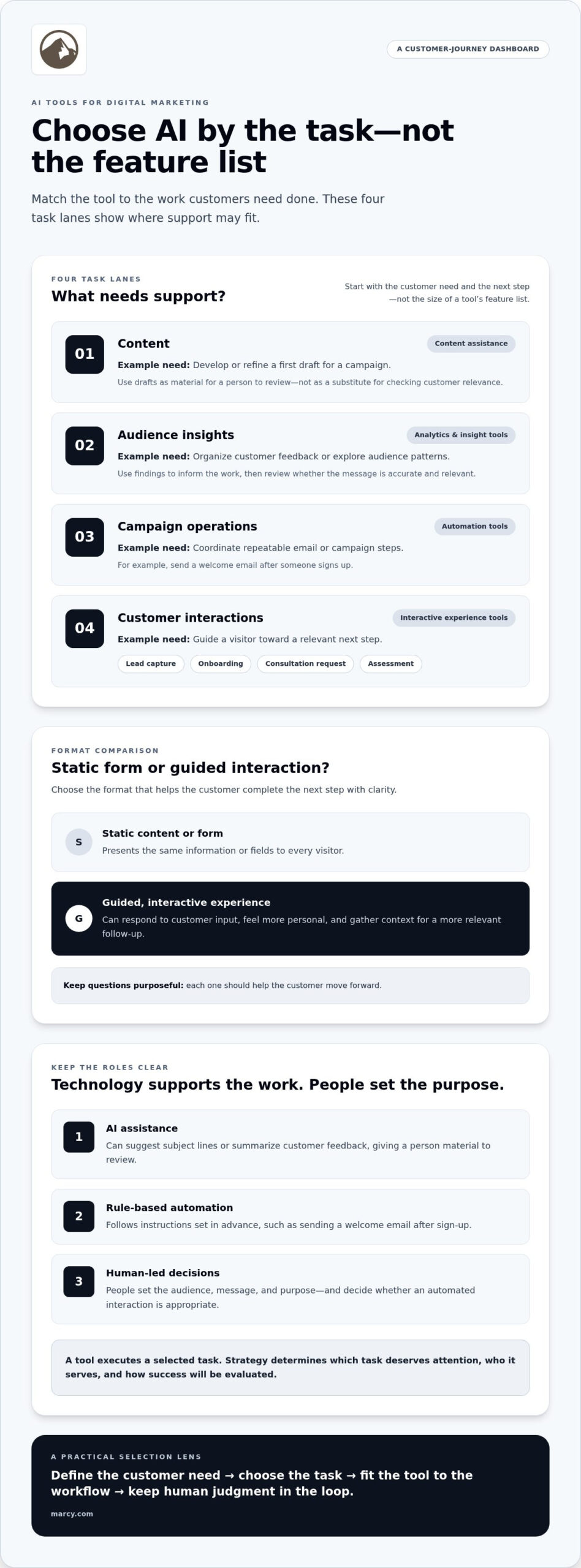
Keep three roles distinct. AI assistance can suggest subject lines or summarize customer feedback, giving a person material to review. Rule-based automation follows instructions set in advance, such as sending a welcome email after someone signs up. Human-led decisions set the audience, message, and purpose, then determine whether an automated interaction is appropriate. Technology can help carry out the work, but people need to decide what matters to customers.
A useful definition: “AI marketing tools support specific tasks and customer interactions, while people provide the judgment that connects those tasks to a meaningful marketing goal.” For background on the field’s concepts and applications, see Artificial intelligence in marketing.
Which digital marketing tasks can AI tools support?
Start with the job to be done, then consider a tool category. These examples show possible uses, not product endorsements or a ranking.
| Marketing task | Example need | Relevant tool category |
|---|---|---|
| Content | Develop or refine a first draft for a campaign | Content assistance |
| Audience insights | Organize customer feedback or explore audience patterns | Analytics and insight tools |
| Campaign operations | Coordinate repeatable email or campaign steps | Automation tools |
| Customer interactions | Guide a visitor through lead capture, onboarding, a consultation request, or an assessment | Interactive experience tools |
These categories describe different jobs, not a required stack. A team that needs clearer campaign drafts may benefit from content assistance. A business trying to make website inquiries more relevant could use a guided interaction instead of a fixed form. Choose based on what the customer needs to do next.
How do tools differ from an end-to-end marketing strategy?
A tool executes a selected task. Strategy determines which task deserves attention, who it serves, and how success will be evaluated. If the goal is to help prospective customers submit more relevant inquiries, for example, map the questions they need answered. Then choose a lead-capture workflow that gathers useful information without making the process feel like unnecessary work.
That’s a focused tool decision, not a complete AI strategy. Keep discovery grounded in the immediate customer and workflow need. Marcy Design connects digital marketing with web development and AI-powered solutions. Its digital marketing work can help bring those elements together rather than leaving them as disconnected experiments. Choose the task first, then assess whether a tool helps people complete it with clarity.
Match AI Marketing Tool Categories to Customer-Journey Stages
A tool category becomes more useful when you connect it to what a customer is trying to do. Someone encountering your brand for the first time needs a clear introduction. A prospect comparing options needs relevant information. A customer ready to act needs a straightforward next step, followed by communication that reflects what they’ve already done. This journey-based view helps teams choose a focused workflow instead of collecting disconnected tools.
AI can support different parts of that process, but it doesn’t make every channel or message appropriate by default. IBM’s overview of AI marketing and its applications provides broader context for how the field can bring together customer experience and marketing operations. Apply that potential to a clear audience need.
Which AI tools support discovery and consideration?
At the awareness stage, content and research tools can help a team explore topics, organize campaign ideas, and prepare draft material for review. The goal is to give prospective customers a useful starting point, not simply to publish more. For example, a team promoting a service could use content assistance to develop initial educational topics, then check them against customer questions and business priorities.
During consideration, analytics tools can help organize available audience or campaign information, while content tools can support materials that explain options and next steps. These tools can inform the work, but they don’t replace audience understanding or a strategic review of whether a message is accurate and relevant. A visitor who has read a comparison guide, for instance, may be better served by a focused consultation invitation than by another general awareness message.
Which tools support conversion and ongoing engagement?
Near conversion, interactive experiences can respond to customer input. A guided assessment or consultation intake can ask relevant questions and direct visitors toward a suitable next step. Unlike a static form that presents the same fields to everyone, a guided flow can make the experience feel more personal and gather context for a more relevant follow-up. Keep questions purposeful, and make sure each one helps the customer move forward.
After someone takes action, automation tools can organize routine follow-up, such as sending an appropriate onboarding message or routing a response into the next stage of a campaign. The sequence should reflect what the customer has already shared, rather than making them repeat themselves. When tools can share useful context, information from an earlier touchpoint can shape the next communication. If systems don’t connect directly, a simple handoff with a clear owner can still help maintain continuity.
Choose the tool that helps customers take their next useful action, not the one that adds the most activity to your marketing stack. This keeps selection grounded in the customer experience. For organizations coordinating content, campaigns, and customer touchpoints across channels, Marcy Design’s digital marketing services can help connect those efforts around a coherent journey. Start with one point of friction, then build only the workflow needed to address it.
Interactive AI Experiences vs. Static Marketing: What Changes?
A static marketing asset presents the same message and next step to everyone. An interactive experience lets a visitor respond, then uses that input to shape what appears next. The difference isn’t simply a button or animation. It’s whether the customer’s participation affects the path through the experience.
That can change how people engage and what a business learns. A fixed page may explain several options at once, leaving visitors to work out which details matter to them. A guided experience can reveal information in stages based on earlier choices. This can make the path feel more relevant and help visitors avoid sorting through details that don’t apply to their needs.
| Experience | Customer participation | Potential value |
|---|---|---|
| Static asset | Visitors view the same content or complete the same fields | Consistent information presented in a simple, predictable format |
| Interactive experience | Visitors make choices that shape what they see next | A more tailored path and responses that can provide useful context |
Interactivity isn’t automatically an improvement. Too many prompts can make a simple task feel complicated, and a response that ignores a visitor’s choices can feel impersonal. Treat engagement and completion as outcomes to test, not promises. Compare the guided experience with the existing version, and check whether it helps people understand their options and finish the intended task.
When can a guided interactive experience serve customers better?
A guided format can help when visitors face several paths and need a clearer way to identify what’s relevant. For instance, a service website could ask someone to select a goal, then reveal information related to that choice instead of presenting every detail at once. The interaction gives the visitor a more active role and can help the business understand which topics matter. Make each prompt purposeful and the next step clear.
Use ai tools for digital marketing to support the experience only where they add value, such as helping shape a response around a visitor’s stated preferences. Design the journey around the person’s task first. If a static page already answers the question clearly, adding interaction may create friction rather than improve the experience.
Where should human judgment remain central?
People should remain responsible for the experience’s purpose, brand voice, and decisions that require context or sensitivity. Review customer-facing content for accuracy and tone, and check whether responses genuinely reflect a visitor’s choices. A polished answer can still be generic or misleading. Human review helps catch those gaps and maintain a consistent, respectful experience.
Marcy Design integrates AI-powered solutions into digital business strategies. Use technology to make a well-designed journey more responsive, while people remain accountable for the judgment and care behind it.
How to Select and Test AI Marketing Tools in a Real Workflow
Choosing a tool is only the start. The real test is whether it helps a defined task fit smoothly into the customer journey and your team’s day-to-day work. A focused pilot gives you evidence before broader adoption. Use this sequence to keep the decision practical:
- Define the task. Identify a specific friction point, such as sorting incoming inquiries or preparing a first draft for a campaign.
- Map the journey. Note what the customer is trying to do, what happens before and after the task, and where a delay or unclear step occurs.
- Choose a tool category. Select assistance, analytics, automation, or an interactive experience based on the job, not a feature trend.
- Run a focused pilot. Use one audience and workflow, with a named team member responsible for oversight.
- Review and decide. Compare observed results with a baseline, then keep, adjust, or stop the pilot before expanding it.
Set a baseline before introducing the tool. If the aim is to improve lead quality, note how qualified responses are currently identified. If the goal is to make a process easier to finish, record where people complete or leave the existing workflow. Choose measures that reflect the task and customer experience. Don’t assume a change is an improvement simply because the tool produces more activity.
What should a focused AI marketing pilot include?
Keep the test narrow: define the audience, the task, and the customer-facing outcome. For example, a team might test whether an AI-assisted workflow helps prepare more relevant follow-up for a particular inquiry type. Assign a human owner to review outputs, handle exceptions, and monitor the effect on the team. Compare the pilot with the baseline without assuming a particular uplift.
Before expanding, review the handoffs. Does the output reach the right person or system? Is it clear who corrects an error? Does the customer have to repeat information? These checks show whether a tool fits the workflow, not just whether it can perform a task on its own.
How can teams assess fit without creating tool overload?
Check whether the tool supports an existing priority or introduces another process to manage. Consider staff time, learning needs, review steps, and the effort asked of customers. A tool that saves drafting time but requires extensive checking may not suit that task. An interactive feature adds value only if its questions help a visitor move forward.
Keep a tool when it improves a defined task responsibly. The benefit should be clear, the workflow should have an owner, and human review should remain appropriate for the output. If the pilot works, consider where else the process could help. If it doesn’t, refine the task or choose a different category before adding more software. For support connecting AI capabilities to a purposeful workflow, explore Marcy Design’s AI integration services.
Build a Customer-Centered AI Marketing System with Marcy Design
A strong customer journey rarely depends on one clever tool. It takes a coordinated experience: useful content introduces the business, a clear digital experience helps people explore, and thoughtful follow-up supports their next decision. Marcy Design brings web development, ecommerce, AI-powered solutions, advertising, and social media management together as connected disciplines. The right mix depends on the audience, the business goal, and the point in the journey that needs attention.
What does a connected AI marketing experience involve?
Start with the customer need, not the technology. If visitors need help choosing a product, an ecommerce experience might pair clear product information with guided prompts that help them narrow their options. If prospective clients need to explain their goals before speaking with someone, a focused inquiry flow can gather relevant details and support more useful follow-up. Content, interactive steps, and ongoing communication should feel like parts of the same conversation.
That consistency depends on how the pieces work together. Web development shapes the digital environment where customers interact with a business. Marketing brings the right messages and campaigns into that experience, while AI can support selected tasks or interactions. Marcy Design’s website design services can help create a digital experience that supports the customer journey across devices and marketing touchpoints.
There isn’t one formula for every organization. A business may need to improve how a campaign leads visitors to a relevant page; another may need an easier way to guide customers through an ecommerce decision. The goal is a coherent system, not a collection of features. For teams exploring ai tools for digital marketing, connect each technology choice to a real customer need and a clear role in the broader experience.
What is a practical next step for Columbus businesses?
Choose one journey or task to improve. Look for where customers hesitate, repeat information, or struggle to find the next step. Then describe the audience, what they need, and what a better experience should help them do. This gives a planning conversation a useful starting point, whether the opportunity involves a website, ecommerce, campaign messaging, social media, or an AI-supported interaction.
As a Columbus-based creative agency, Marcy Design helps businesses connect digital and marketing work with purposeful AI capabilities. Bring one customer journey or marketing task into focus, including the audience, business goal, and digital experience involved. A clear starting point makes it easier to shape the right combination of design, technology, and marketing. Start a conversation about AI-powered solutions for your marketing goals.
Make Your Next Marketing Move Customer-First
The next step doesn’t need to be a sweeping overhaul. Choose one moment where a customer could use clearer guidance, then consider how a thoughtful digital experience could help. A small, deliberate improvement gives your team a practical starting point for making future marketing decisions with purpose.
AI tools for digital marketing are most valuable when they help your business serve people more thoughtfully, not simply do more. Keep customer needs in view as your approach evolves, and use real experience to guide what you improve next. Marcy Design is a Columbus-based creative agency with a history dating to approximately 1986, bringing established experience to evolving digital and marketing challenges.
Ready to shape a more useful customer journey? Talk with Marcy Design about your AI marketing goals and explore a practical next step for your business. Your next improvement can start with one clear idea.
Frequently Asked Questions
Can AI marketing tools work for a small business with a lean team?
Yes. A lean team can use ai tools for digital marketing to support one recurring task without rebuilding its whole process. For example, a small business might use AI to draft a first version of a monthly customer update, then have one team member edit and approve it. Start with a task that already takes time, keep responsibility clear, and avoid adding workflows the team can’t maintain.
Do AI marketing tools need access to customer data to be useful?
No. Some tasks, such as drafting general campaign ideas or organizing public information, may not require customer records. If personalization depends on customer details, identify exactly what information is needed and why before using it. Keep inputs limited to what supports the task, and avoid placing personal or sensitive details into a tool unless your business has assessed how that information should be handled.
How can a business keep AI-generated marketing content accurate and on-brand?
Give the tool clear source material, then make human review part of the publishing process. A short reference document with approved service descriptions, audience language, and brand tone can help reduce guesswork. Before content goes live, check names, claims, links, and calls to action against current business information. If a draft sounds unlike your brand, revise it rather than treating fluent writing as proof of accuracy.
Can AI tools help qualify leads without making the experience feel impersonal?
Yes, if questions are relevant and the next step responds to the answers. For example, an inquiry flow could let a visitor choose the type of help they’re seeking, then ask only a useful follow-up question. Explain why you’re asking, keep the language welcoming, and make it easy to reach a person. For a Columbus business, a thoughtful handoff can make a digital inquiry feel connected to a real local team.
How do AI marketing tools fit with a business’s existing website?
They can support specific website tasks without requiring the site to be replaced. A business might add a guided question flow to an existing service page or use an AI-assisted process to help staff prepare responses to website inquiries. First identify where visitors need help, then consider how the tool fits the site’s design, content, and current way of handling requests.
What should a team do when an AI tool produces inaccurate or generic output?
Pause the affected content or interaction before it reaches more customers. Check whether the input was incomplete, the instructions were unclear, or the task needs more human judgment. Correct the material using reliable business information, then review a fresh sample before putting the workflow back into use. Keep a note of the issue and its fix so the team can spot the same pattern next time.
How often should a business review its AI marketing workflows?
Review them on a regular schedule that fits the workflow, and sooner when the offer, audience, website, or customer questions change. A campaign assistant may need checking before each new campaign, while an established internal drafting process may be reviewed less often. Look at a sample of outputs and customer responses, confirm the workflow still has a clear owner, and adjust it when the experience no longer serves its purpose.