
 614.224.6226
A sound digital marketing budget starts with your revenue goal and what a customer is worth to you, not with an industry percentage. Use the percentages as a sanity check, then split the money across channels in proportion to what each one proves it can deliver. Below you’ll find the benchmarks worth knowing, a step-by-step way to set the number, a worked example, and how to keep reallocating once campaigns are live.
TL;DR
- Benchmarks put marketing at roughly 7% to 10% of company revenue. Treat that as a reference point, not your answer.
- Work backward from your break-even cost per lead or sale. If you acquire customers below that line, you have room to spend more.
- A 70-20-10 split (proven, promising, experimental) keeps most of the money on what works while leaving room to learn.
- Review spend monthly, or weekly for paid media, and move money toward the lowest cost per result.
- Budget for the foundation too: a website that converts and tracking that tells you the truth.
Table of Contents
- What a digital marketing budget actually covers
- What companies typically spend
- Why a percentage of revenue is the wrong starting point
- How to set the number: a six-step method
- A worked example
- How to split the budget across channels
- Keep reallocating after launch
- Find savings before you ask for more
- Can smaller businesses measure what works?
- AI and the pressure to do more with the same money
- Our perspective
- Build the plan with a team that handles both sides
- FAQ
- Sources
What a digital marketing budget actually covers
It is easy to count only ad spend. A complete budget has four parts:
- Media: what you pay platforms such as search and social ads.
- Services: agency or freelancer fees for strategy, management, creative and reporting.
- Assets: your website, landing pages, photography, video and written content.
- Tools and measurement: analytics, email and CRM software, call tracking, testing.
The first line moves fastest and is the easiest to cut. The third is the one that decides whether the first pays back. Sending paid traffic to a slow or confusing site wastes media money, which is why we plan assets and media together.
What companies typically spend
Two credible benchmarks give you a range.
The Gartner 2025 CMO Spend Survey found marketing budgets flat at 7.7% of company revenue, the same as 2024. The 2024 figure had dropped from 9.1% in 2023.
The CMO Survey 2026 topline report reports marketing as a share of the overall company budget with a mean of 9.64% and a median of 7%. The spread is wide: respondents ranged from 0% to 27.33%.
Two things follow from those numbers:
- The typical company lands near 7%, but plenty sit far above or below it.
- These figures cover all marketing, not only digital. Your digital line is a slice of that total.
If you spend well under 7% and want to grow, you are probably underinvesting. If you spend far above it, ask whether you have a specific reason, such as a launch, a new market or a young brand. A percentage tells you where you stand. It does not tell you what to do next.
Why a percentage of revenue is the wrong starting point
A fixed percentage ignores your margins, your sales cycle and your customer lifetime value. A business with 70% gross margins and repeat customers can afford to pay far more for a lead than one with thin margins and one-time sales. Guidance on allocating spend makes the same point: spending by industry average, without looking at your own profitability, often wastes resources.
That is why we suggest using percentages as a ceiling and floor for sanity, and building the real number from your goals. If you want a longer look at the reasoning, our piece on why marketing budgets matter in Columbus covers the local angle.
How to set the number: a six-step method
1. Start with the revenue goal
Write down the new revenue you need from marketing this year, not total revenue. If you already have steady referral business, that part doesn’t need marketing dollars.
2. Work out what a customer is worth
Use average first-order value, or lifetime value if customers come back. Multiply by gross margin, because margin is what pays for marketing.
3. Find your break-even cost
The break-even acquisition cost is the most you can spend to win a customer without losing money. The research here is consistent: calculate the break-even cost per lead or sale first. If your actual acquisition cost stays below it, there is room to scale. If it sits above it, fix the offer, the website or the targeting before adding budget.
4. Work backward through your funnel
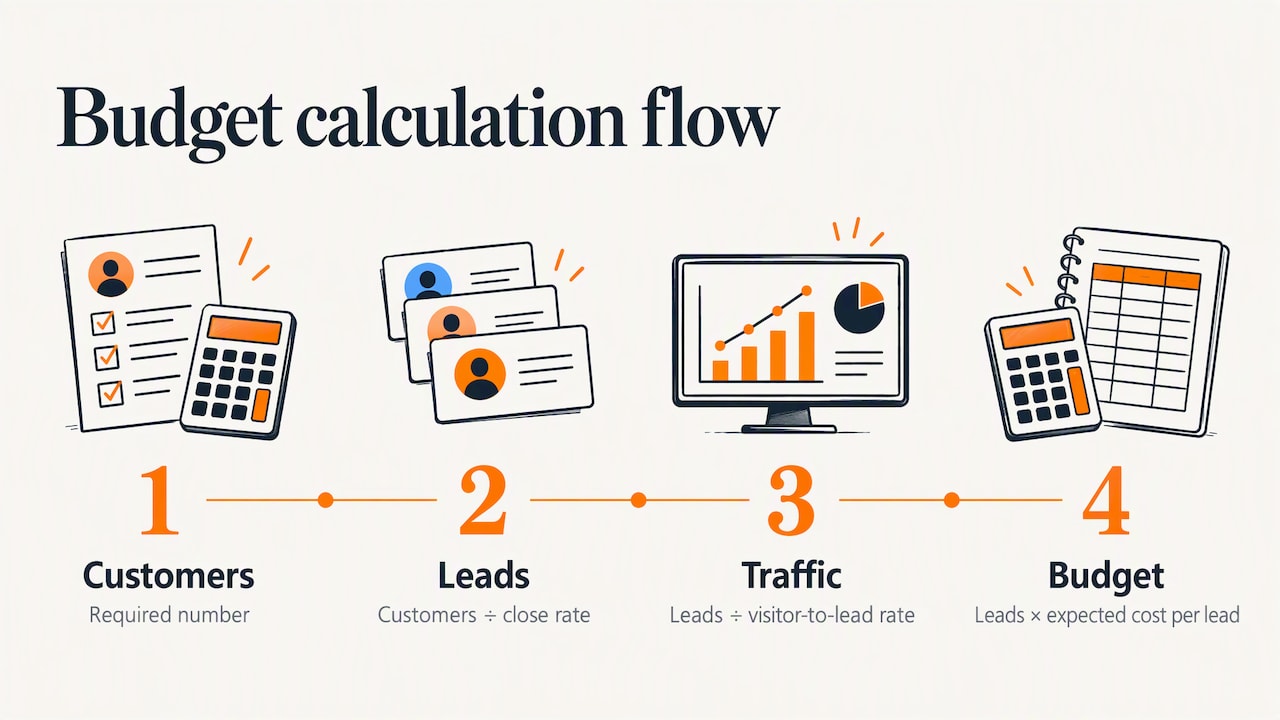
Take the number of customers you need, divide by your close rate to get the number of leads, and divide by your visitor-to-lead rate to get the traffic. Multiply leads by an expected cost per lead. That gives a bottom-up budget.
5. Compare it to the benchmark
If your bottom-up number is 3% of revenue, ask whether the goal is realistic. If it is 20%, ask whether a phased plan makes more sense. Finance teams tend to trust budgets that reconcile both directions, from the top down (a share of revenue) and from the bottom up (cost per result).
6. Add a testing reserve and set a review date
Hold back part of the total for experiments and put review dates on the calendar before you spend a dollar.
A worked example
Here is an illustrative case, not a client result. A Columbus-area manufacturer with $5,000,000 in annual revenue wants $400,000 in new revenue from marketing.
| Input | Value |
|---|---|
| Average first-order value | $20,000 |
| Gross margin | 40% |
| Margin per customer (first order) | $8,000 |
| Customers needed | 20 |
| Lead-to-customer close rate | 20% |
| Leads needed | 100 |
| Assumed cost per lead | $400 |
| Bottom-up marketing spend | $40,000 |
On first-order margin alone, the company can spend up to $8,000 per customer before losing money, and the plan assumes $2,000 per customer ($40,000 divided by 20). That leaves a wide cushion, which is the signal to consider scaling. A top-down check helps too: $5,000,000 at 7.7% is $385,000 for all marketing, so $40,000 for this specific growth push is well within the benchmark.
Change the inputs and the answer changes. If the close rate is 10%, you need 200 leads and the same cost per lead doubles the spend to $80,000. That is why guessing is expensive and tracking close rates pays for itself.
How to split the budget across channels
The 70-20-10 rule
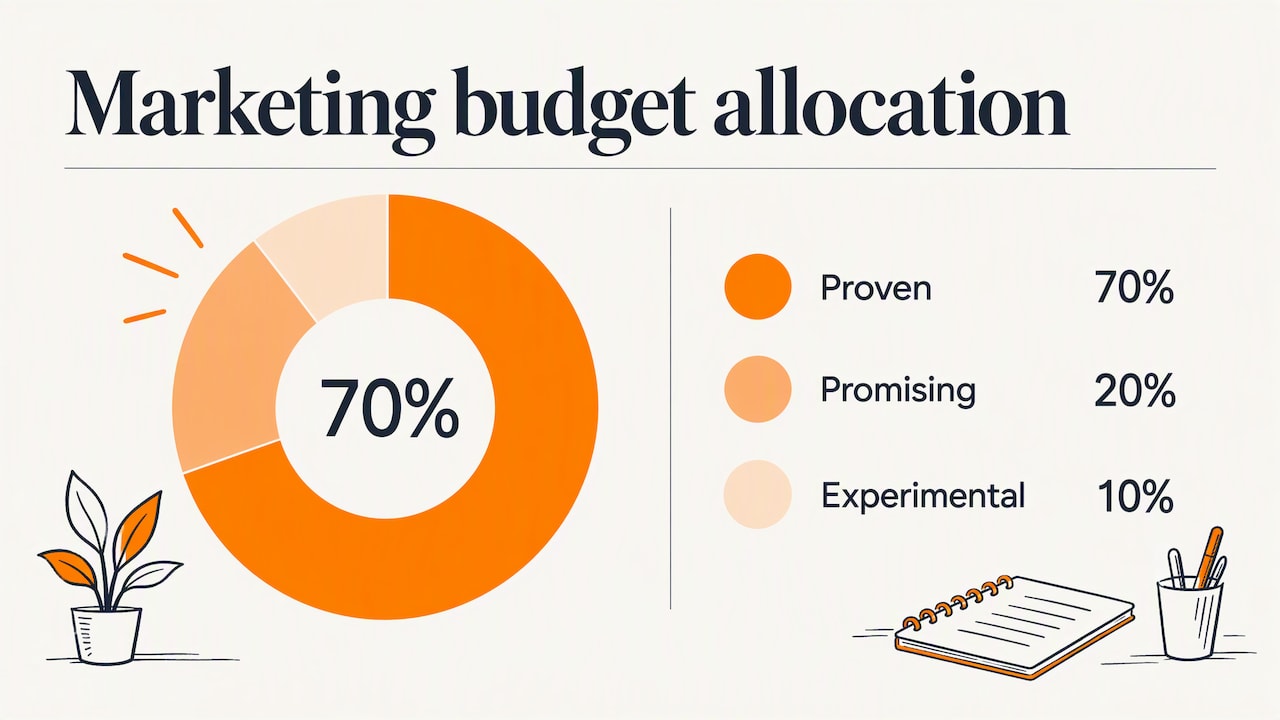
One widely used framework puts 70% toward proven, high-performing efforts, 20% toward emerging strategies and 10% toward high-risk experiments. It balances steady returns with the innovation that keeps you from stagnating.
For a small or mid-sized business, we would translate it like this:
| Bucket | Share | Typical use |
|---|---|---|
| Proven | 70% | Search ads, SEO, email to your existing list, retargeting |
| Promising | 20% | A second ad platform, video, a new landing page set |
| Experimental | 10% | A new channel, AI-assisted creative, a new audience |
If you have no proven channels yet, because you are new or have never tracked results, reverse the logic. Start with one channel built on strong fundamentals and expand after you see data. Our guide to digital advertising channels explains why starting with search and one platform tends to work better than spreading thin.
Matching channels to your goal
- You need leads now: put the most into paid search and a landing page built to convert. Our lead generation work centers on this.
- You want durable, lower-cost traffic: invest in SEO and content, knowing it takes months to compound.
- You sell online: budget for site speed, product pages and platform integration before you buy more traffic.
- You have an email list: email is usually the cheapest revenue you can add, so fund it properly.
Don’t forget the foundation
A common mistake is to spend 100% of the budget on media and 0% on the website those ads land on. If your site is outdated, slow or hard to use on a phone, the cost per lead rises on every channel. Earmark part of the first-year budget for the site itself, then shift toward media once it converts.
Keep reallocating after launch
An annual split set in January and never touched is how budgets go stale. Teams that perform best re-evaluate weekly or monthly based on marginal cost per result: they reduce spend on underperforming campaigns and move that money to the ones with the lowest cost per result.
A simple rhythm:
- Weekly: check paid campaigns for cost per lead and obvious waste, such as irrelevant search terms.
- Monthly: compare channels on cost per qualified lead and cost per customer, not clicks.
- Quarterly: revisit the 70-20-10 split and promote experiments that worked.
- Annually: rebuild the budget from the goals, not from last year’s numbers.
Watch out for cost per lead that looks great but never closes. Tie reporting to your CRM or at least to a tracked phone line so you know which leads became customers.
Find savings before you ask for more
Before asking for a bigger budget, look for waste in the current one. Zero-based budgeting means every expense is justified from scratch rather than by habit. McKinsey describes this zero-based approach to marketing, and practitioners often report finding savings of 10% to 25% in individual categories that can be moved into higher-performing work.
A quick audit for a smaller company:
- List every recurring marketing charge: software, directories, ad accounts, agency retainers.
- Mark which ones you can tie to a lead or sale.
- Pause or cancel what you can’t tie to anything, and reassign the money.
Can smaller businesses measure what works?
Bigger companies have long run experiments to see which marketing truly caused sales. That is getting more accessible: Google’s measurement team notes that incrementality tests can now start at about $5,000, down from far higher minimums. If you spend meaningful money on one platform, a test like this can show whether the conversions it reports would have happened anyway.
It isn’t for every budget. If you spend a few thousand dollars a year, simpler checks, such as pausing a campaign for two weeks and watching leads, are more realistic.
AI and the pressure to do more with the same money
Budgets have stopped growing as a share of revenue, so marketing leaders are leaning on automation and analytics to get more from existing spend, automating content production and performance measurement. For a small company, that usually means modest steps: faster first drafts, better reporting, smarter audience testing. We cover practical options in AI marketing strategy for small business. Put AI experiments in the 10% bucket until they prove themselves.
Our perspective
We have been in business for more than 38 years, and the budget conversations we have had with owners and leadership teams tend to go the same way. The first number someone proposes comes from last year or from a competitor. The better number comes from asking what a customer is worth and what the company can afford to pay to win one.
Three opinions we hold firmly:
- Fund the whole chain. Ads, website, content and follow-up work as a system. A weak link wastes the money spent on the strong ones.
- Start narrower than you want to. One or two channels done well, with tracking, teach you more than six channels done thinly.
- Treat the budget as a living plan. The first version is a hypothesis. The data you collect in the first 90 days should change it.
If you want our take on how businesses should approach this, we have written about how businesses set marketing budgets and about getting more from your advertising budget.
— Greg
Build the plan with a team that handles both sides
A budget is only useful if the website, the campaigns and the measurement are built to work together. Marcy Design is a Columbus, Ohio agency that covers website design, SEO, lead generation, advertising, email and branding under one roof, so the budget you set doesn’t get split across vendors who don’t talk to each other. If you’d like a second opinion on a number you already have, or help building one, start with our services overview or reach out through marcy.com.
FAQ
How much should a small business spend on digital marketing?
There is no single right figure. Benchmarks cluster around 7% to 10% of revenue for all marketing, and your digital share is part of that. Start from your break-even cost per customer and the number of customers you need, then check the result against the benchmark.
What is the 70-20-10 rule in digital marketing?
It is a split of your budget: 70% to proven channels, 20% to promising ones and 10% to high-risk experiments. It keeps most of the money on reliable returns while still funding learning. If you have no proven channels yet, begin with one well-tracked channel and add the others as data arrives.
How do I allocate a marketing budget across channels?
Rank channels by cost per qualified lead or sale, not by clicks. Put the largest share into the lowest-cost channels that can still absorb more money, then review monthly and move dollars from weak campaigns to strong ones. Keep part of the budget for your website, since every channel depends on it.
How often should I revisit my digital marketing budget?
Check paid campaigns weekly, compare channels monthly and revisit the overall split each quarter. Rebuild the budget from your goals once a year rather than adding a percentage to last year’s total.
Sources
- Gartner 2025 CMO Spend Survey: marketing budgets flatlined at 7.7% of revenue
- Gartner Marketing Symposium day 1 highlights, 2024
- The CMO Survey topline report, 2026
- How to allocate marketing budget across channels, Decision IQ
- The complete guide to marketing budget allocation, Funnel
- Zero-based approach to marketing budgets, McKinsey
- Experimentation and the value of marketing, Think with Google