
 614.224.6226
The best AI marketing tools for a small business are the ones that solve a real bottleneck, from tailoring email and repurposing social content to monitoring conversations and sentiment. A practical AI marketing strategy for a small business pairs those tools with clear goals and human review. Social monitoring and sentiment analysis can help reveal what customers are responding to and where your messaging may need to shift.
It’s easy to focus on producing more content, but understanding how people respond leads to better marketing decisions. This guide compares practical AI tool categories, explains how to choose tools for your team, and shows how social listening can turn customer feedback into useful insight. You’ll also learn how AI can support email, content, and campaign planning without replacing your judgment.
Key Takeaways
- Match AI tools to your biggest marketing bottleneck, such as drafting content, tailoring emails, or scheduling social posts.
- Use AI-generated blogs, emails, and social content as a starting point, then review the copy before publishing.
- Turn social monitoring and sentiment analysis into practical signals about customer concerns, reactions, and messaging opportunities.
- Choose tools that fit your workflow and handle customer data responsibly, then use what you learn to guide marketing decisions.
What Are the Best AI Marketing Tools for Small Business?
The right tool depends on the task: drafting, design, email, or social publishing. Start by identifying one marketing bottleneck, then choose a tool that addresses it. An AI marketing strategy for a small business might use ChatGPT to outline a weekly blog post. Add your expertise, verify the facts, and edit the draft before publishing.
For email marketing, AI tools can tailor subject lines and body copy to customer behavior. They can also adjust delivery schedules to match when recipients are most likely to open messages. Use these features to shape a campaign around audience interests, then review the final email for accuracy and tone. Semrush reported that 68% of businesses saw higher content marketing ROI after using AI in its 2024 report.
For visuals, Canva Magic Studio can help create social media assets and explore design options. Prepare a brief that defines your audience, message, and format, then check that each visual fits your brand. An AI marketing strategy for a small business can also repurpose a blog post as an Instagram caption, TikTok script, and LinkedIn update. Tailor each version to its platform.
- Content: Use ChatGPT for blog outlines, draft copy, and campaign ideas; fact-check and edit before use.
- Visuals: Use Canva Magic Studio to develop creative assets for different social formats.
- Publishing: Choose a social media platform that schedules and deploys campaigns across accounts.
- Email: Apply behavior-based personalization and delivery timing to make messages more relevant.
Static lead forms show every visitor the same fields. An interactive form can guide someone through relevant questions based on earlier answers, creating a more personal experience that may encourage engagement and completion. Before investing in tools, define your market and marketing plan, as the U.S. Small Business Administration advises. A focused digital marketing plan can keep platforms, content, and campaigns aligned with your audience.
AI-powered social media monitoring and sentiment analysis
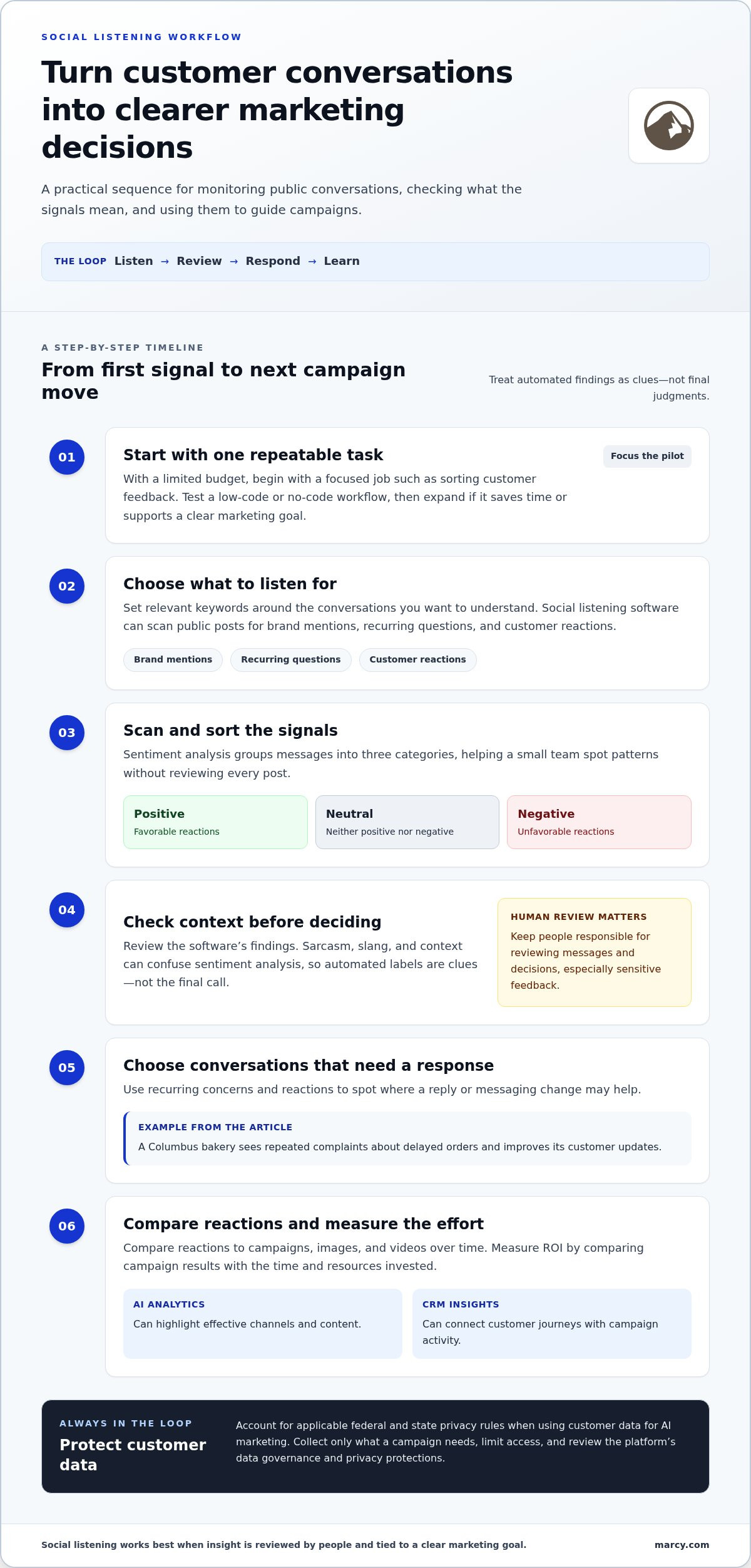
Social listening software scans public conversations for brand mentions, recurring questions, and customer reactions. Sentiment analysis sorts messages into positive, neutral, or negative categories, helping small teams spot patterns without reviewing every post. For example, a Columbus bakery might see repeated complaints about delayed orders and improve its customer updates.
Start with relevant keywords, review the software’s findings, and decide which conversations need a response. Compare reactions to campaigns, images, and videos over time. In an AI marketing strategy for a small business, treat automated insights as clues, not final judgments. Sarcasm, slang, and context can confuse sentiment analysis.
In the United States, businesses should account for applicable federal and state privacy rules when using customer data for AI marketing. Collect only what a campaign needs, limit access, and review the platform’s data governance and privacy protections.
How much do AI marketing tools cost? It depends on features, data volume, connected accounts, and subscription terms. Compare these factors with the tasks a platform can automate before choosing one.
With a limited budget, begin with one repeatable task, such as sorting customer feedback or drafting social replies. Test a low-code or no-code workflow, then expand if it saves time or supports a clear marketing goal. This keeps an AI marketing strategy for a small business focused on practical results.
Measure ROI by comparing campaign results with the time and resources invested. AI analytics can highlight effective channels and content, while CRM insights can connect customer journeys with campaign activity.
Risks include inaccurate sentiment labels, generic content, and mishandled customer data. Keep people responsible for reviewing messages and decisions, especially before responding to sensitive feedback or using personal details.
A focused AI-powered marketing workflow can connect social listening insights to campaign decisions.
Marcy Design: Website Design
Marcy Design helps small businesses put their marketing strategy into action with professional website design. Turn campaign messaging and customer insights into a clear online experience, with pages that guide visitors to the information or action they need.
For businesses selling online, Marcy Design’s ecommerce solutions can support the customer journey. AI-powered solutions can bring AI into your digital business strategy, while marketing materials help campaigns maintain a consistent visual identity. These services can give your tools and content a stronger home online.
Contact Marcy Design to discuss your website and marketing needs.
Build Your Next Marketing Move
Turn your next marketing idea into a focused experiment. Choose one customer need, define what a useful response looks like, and use the results to plan your next step. That keeps an AI marketing strategy for a small business tied to real customer needs, not technology for its own sake.
When your website needs to support that strategy, Marcy Design offers website design, ecommerce solutions, and AI-powered solutions. These services can shape a digital experience around how customers discover, explore, and engage with your business.
Start with the opportunity that matters most to your business, then make a plan to act on it. Contact Marcy Design to discuss your next step. With a clear goal and a thoughtful approach, you can keep moving forward with confidence.
Frequently Asked Questions
Can I use AI if I don’t have a technical background or an IT team?
Yes, no-code tools let you build useful workflows without programming. For example, a guided onboarding form can ask new customers about their goals and show relevant next steps, unlike a static checklist that gives everyone the same instructions. Start with a simple process, such as organizing common questions, and review the results before relying on them.
How does AI help with customer retention and loyalty?
AI can help businesses make follow-up more relevant by organizing customer preferences and interactions. For example, an assessment could ask customers what they need, then direct them to suitable resources or offers. That personalized experience can be more useful than a generic message sent to everyone. Keep human support available for customers who need individual help.
How is AI being used to grow small businesses?
AI can help small businesses respond to prospects and improve the path from initial interest to service. A lead capture form can ask visitors relevant questions, then route their details for follow-up. For a professional consultation, an intake experience can gather goals in advance, helping the conversation focus on the prospect’s needs from the start.
What should I automate first?
Choose a repetitive task with a clear purpose and an easy review step. For example, automate the sorting of routine inquiries or send onboarding information after a customer signs up. A guided onboarding flow can tailor instructions to a customer’s selections, while a static message gives everyone the same steps. Review the workflow regularly and refine it when customers get stuck or need extra help.