
 614.224.6226
Small business SEO is the work of making your website easy for Google to understand and easy for nearby customers to choose, so you show up when people search for what you sell. For most small businesses the order is the same: fix the basics of your site, claim and complete your Google Business Profile, build pages around the services and places you actually serve, collect honest reviews, and measure leads rather than rankings. Professional help in the US typically runs from a few hundred to a couple thousand dollars a month, and the rest of this guide shows what drives that range and how to tell whether a quote is fair.
TL;DR
- Start with the free, high-impact work: a crawlable site, clear page titles, one page per core service, and a complete Google Business Profile.
- Local SEO is its own track. Google weighs relevance, distance and prominence, and you cannot pay for a better local ranking.
- In a 2023 survey of 439 SEO providers, average local SEO pricing was $1,557 per month, with agencies averaging $1,819 and freelancers about $1,150.
- Judge any provider on scope, reporting and honesty. A guaranteed first-place ranking is a reason to walk away.
- Track calls, form fills and booked jobs from organic search, not just traffic.
Table of Contents
- What small business SEO actually is
- The priority order for a small business
- Local SEO vs. general SEO: which do you need?
- How much does SEO cost for a small business?
- How to judge an SEO provider’s quote
- Our perspective
- Work with us on your search visibility
- A realistic first 90 days
- FAQ
- Sources
What small business SEO actually is
Google describes SEO as helping search engines understand your content and helping people find your site and decide whether to visit it. That is the whole idea, and it is less mysterious than most pitches make it sound. According to Google’s own SEO Starter Guide, following good practices makes a site more likely to appear in results, but it does not guarantee indexing or a first-place ranking.
For a small business, the practical definition is narrower: optimizing your online presence so that people searching for what you sell can find you. Semrush separates this broader work from local SEO, which focuses on location-specific searches and customers in a physical area. Most small businesses need both. A plumber in Hilliard cares about “water heater repair near me.” A regional manufacturer cares about buyers searching for a specific part or capability, with no neighborhood attached.
Why it matters when your budget is small
SEO earns traffic without paying for each click. HubSpot notes that it can generate organic traffic without ad spending and help you compete, drive engagement and sales, and build a customer base. That compounding quality is the appeal: a well-built service page keeps working month after month, while an ad stops the day you stop paying.
Local visibility is where the stakes are clearest. Yelp’s small business guide cites a BrightLocal survey finding that 61% of consumers use search engines and other online resources to discover local businesses. If you are not in those results, a large share of nearby shoppers never meet you.
SEO is not the only path, and it is slow. If you want to understand where a site can get by without it, we wrote about that in how a business website can succeed without SEO. For the fundamentals, our primer on what SEO is and why it matters covers the vocabulary.
The priority order for a small business
Most small business owners ask what to do first. Here is the order we would work in, drawn from Google’s guidance and our own project experience.
1. Make sure Google can reach and read your site
Pages that cannot be crawled and indexed cannot rank. Google’s starter guide puts accessibility for crawling and indexing first. Check these basics:
- Your important pages load on phones and are not blocked from search engines.
- Your navigation is logical, so a visitor (and a crawler) can get from the home page to any service in a couple of clicks.
- URLs are descriptive, such as
/services/commercial-hvac, not/page?id=482. - Every page has a clear, unique title that says what the page is about.
A site built on a weak foundation makes every later SEO dollar work harder for less. That is why we treat website design and SEO as connected jobs rather than separate ones.
2. Build one page per core service and per key location
Semrush recommends focused service and location pages, with relevant terms in titles, descriptions, URLs, headings and body copy. In practice, a single “Services” page listing everything rarely competes. A dedicated page for each service you want to be hired for, written for the customer’s question, usually does.
If you serve several communities, resist the urge to clone a page and swap the town name. Write something true for each place: projects you have done there, questions customers there ask, how you get to them. Google’s guidance is to create useful, reliable content that anticipates the words your customers use. Thin duplicates do the opposite.
Our guide to on-page SEO and to business website SEO optimization goes deeper on titles, headings and copy.
3. Claim and complete your Google Business Profile
For any business with customers in a service area or a storefront, this is the highest-return free task. The SBA advises local businesses to claim and manage their Google listing, and Google says local results are driven mainly by relevance, distance and prominence.
Fill in every field: categories, hours, services, service area, photos, a real description. Keep your name, address and phone number identical on your site and everywhere else you are listed. We keep a current walkthrough in our Google Business Profile optimization checklist.
4. Earn reviews the right way
Reviews feed the “prominence” part of local ranking. The SBA recommends following up with customers for testimonials. Be careful how you ask, though. The SBA notes that many review sites, including Google, prohibit incentivizing reviews or setting up onsite review stations at your place of business, and that incentivized reviews may violate review-site terms, FTC rules and state regulations. Send a follow-up text or email after the job with a direct link, and leave it at that. No discounts, no gifts in exchange.
5. Get listed where your customers and peers already look
The SBA suggests listing yourself in local and niche directories, such as chambers of commerce and the Better Business Bureau, and correcting any inaccurate information you find. Beyond directories, links from local organizations, suppliers, industry associations and press all support prominence. For a Central Ohio business, that might be your local chamber, a trade association, or a nonprofit you sponsor.
6. Measure leads, not just rankings
Rankings move around by person, place and day. What pays the bills is the phone ringing and forms arriving. Semrush recommends tracking leads and organic traffic, and we would add one step: ask every new customer how they found you and record it. Set up call tracking and form tracking so you can see which pages produce inquiries.
Local SEO vs. general SEO: which do you need?
Use this quick comparison to decide where to put your effort.
| Situation | Main focus | What matters most |
|---|---|---|
| Storefront or service-area business (restaurant, contractor, clinic, salon) | Local SEO | Google Business Profile, reviews, consistent listings, location pages |
| Regional or national seller of products or services (ecommerce, manufacturer) | General SEO | Service and product pages, content that answers buyer questions, technical health |
| Both (a local business that also sells online or ships) | A blend | Local profile plus strong service and product pages |
Investopedia makes the same point from the owner’s side: SEO makes your offerings easier to find, and local SEO specifically helps reach nearby customers, especially for brick-and-mortar businesses.
One fact worth remembering: Google states there is no way to pay for a higher local ranking. Anyone selling you “guaranteed local placement” is selling something Google says does not exist. The work is providing complete, accurate information and earning real prominence.
Our short piece on three easy ways to optimize your site for local search is a good companion if you want a quick start.
How much does SEO cost for a small business?
The most useful published benchmark we found is a 2023 survey by Ahrefs of 439 SEO providers. It reported average local SEO pricing of $1,557 per month, with agencies averaging $1,819 and freelancers about $1,150. It also found that 42% of SEOs charge between $250 and $1,000 per month.
Treat those numbers as a reference point, not a quote. They come from one survey of providers at one point in time, and your price will depend on your market and goals.
| Provider type | Average monthly local SEO price (Ahrefs 2023 survey) |
|---|---|
| Agency | $1,819 |
| Freelancer | about $1,150 |
| All providers | $1,557 |
What moves the price
Packages differ more in scope than in label. These are the factors that typically separate a $500 retainer from a $2,500 one:
- Competition. Ranking for a term in a crowded metro takes more work than in a quiet niche.
- Number of locations and service lines. Each one needs pages, profiles and tracking.
- Site condition. A site with crawl problems, slow pages or a poor structure needs repair before growth work pays off.
- Content volume. Writing new service pages, articles and case studies is labor, and quality costs more than quantity.
- Link and citation work. Outreach, local sponsorships and directory cleanup take time.
- Reporting and strategy. Real analysis and regular calls cost more than an automated dashboard.
- Who does the work. Agencies bring a team (strategy, writing, development, design) and freelancers usually bring one person’s skills.
We do not publish a fixed SEO price, because the right scope depends on your site and your market. We scope each engagement after looking at where you stand.
Project work vs. monthly retainer
Most providers offer either a one-time project (an audit, a site restructure, a Google Business Profile cleanup) or an ongoing monthly retainer. A project suits a business with a clear list of fixes and someone in-house to keep up the content. A retainer suits a business that wants steady publishing, monitoring and improvement. Many owners start with an audit and a cleanup, then move to a smaller retainer.
How to judge an SEO provider’s quote
A price alone tells you little. Google’s guidance on hiring an SEO offers a useful checklist of what to ask. Among the questions it suggests: can they show examples of previous work, do they follow Google’s Search Essentials, what results and timeframe do they expect and how do they measure success, and will they share every change they make to your site.
Add these checks to the list:
- Ask for the deliverables in writing. How many pages written or improved per month? Which profiles managed? What reporting, and how often?
- Ask what they will do in the first 90 days. A real plan names specific fixes, not just “optimization.”
- Ask how they measure success. Look for leads, calls and revenue-linked metrics, not only keyword positions.
- Check references. Google suggests asking past clients whether the SEO was useful and easy to work with.
- Be careful with access. For an audit, Google advises granting read access to Search Console at first, not write access.
- Watch for guarantees. Google’s guidance is blunt: if someone guarantees first place, find someone else.
- Own your accounts. Your Google Business Profile, analytics and website should be in your name, never the provider’s.
Also weigh how well the provider understands your business. Google suggests asking about experience in your industry and your city or country, and notes a good SEO should ask questions about what makes your business unique and how customers find you. If they send a template without asking about your customers, that tells you what the monthly fee buys.
Can you do it yourself?
Sometimes. Google says that if you run a small local business, you can probably do much of the work yourself, and recommends starting with the SEO starter guide. The trade-off is time. If you have a few hours a week and a simple site, the free tasks above will take you far. If you have several locations, an ecommerce catalog, or a site with technical problems, professional help usually pays for itself faster.
Our perspective
After more than 38 years of working with businesses in Columbus and beyond, we have watched search change many times, and the same pattern holds. Businesses that win in search are the ones with a good website, a clear message and real customers saying good things about them. SEO amplifies that foundation. It does not substitute for it.
That is why we do not treat SEO as a separate trick. We approach it alongside design, development, content and measurement, because a fast, clear, well-organized site that answers a buyer’s questions is what Google is trying to reward in the first place. We have written about this from several angles, including why Google sometimes seems to ignore your keywords and five ways to improve your business website.
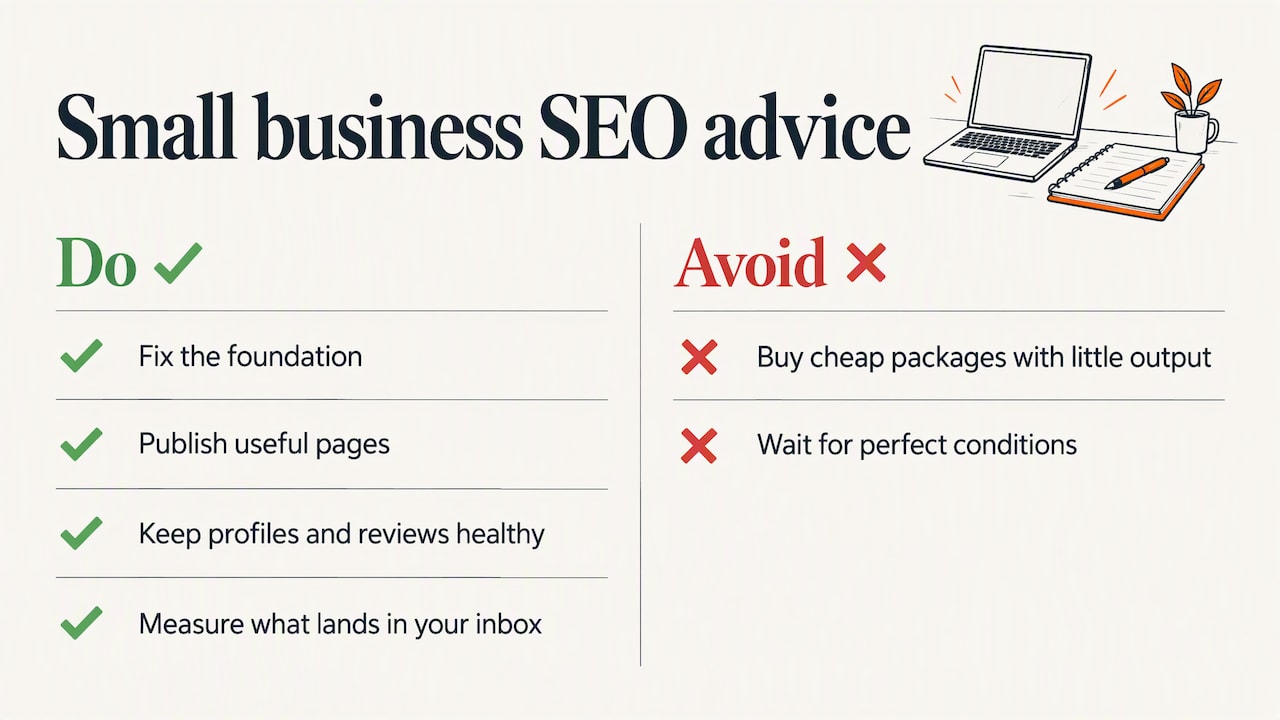
Our advice to a small business owner is to resist two temptations. One is buying a cheap monthly package that produces a report and little else. The other is waiting for perfect conditions. Fix the foundation, publish useful pages, keep your profile and reviews healthy, and measure what lands in your inbox. For manufacturers, nonprofits and veteran-owned businesses, where the buyer’s research is specific and the sales cycle is longer, we tailor pages to the questions those buyers actually ask.
— Greg
Work with us on your search visibility
If you would rather have a team handle this, our SEO solutions cover the pieces covered above: site structure, on-page work, local profile management and reporting tied to leads. Because we also design and build websites, we can fix problems at the source instead of asking you to coordinate multiple vendors. If your goal is more inquiries, our lead generation service connects search traffic to the forms and follow-up that turn visits into customers. Contact us and we will look at where your site stands before recommending a scope.
A realistic first 90 days
Here is how a sensible plan unfolds, whether you do it yourself or hire it out.
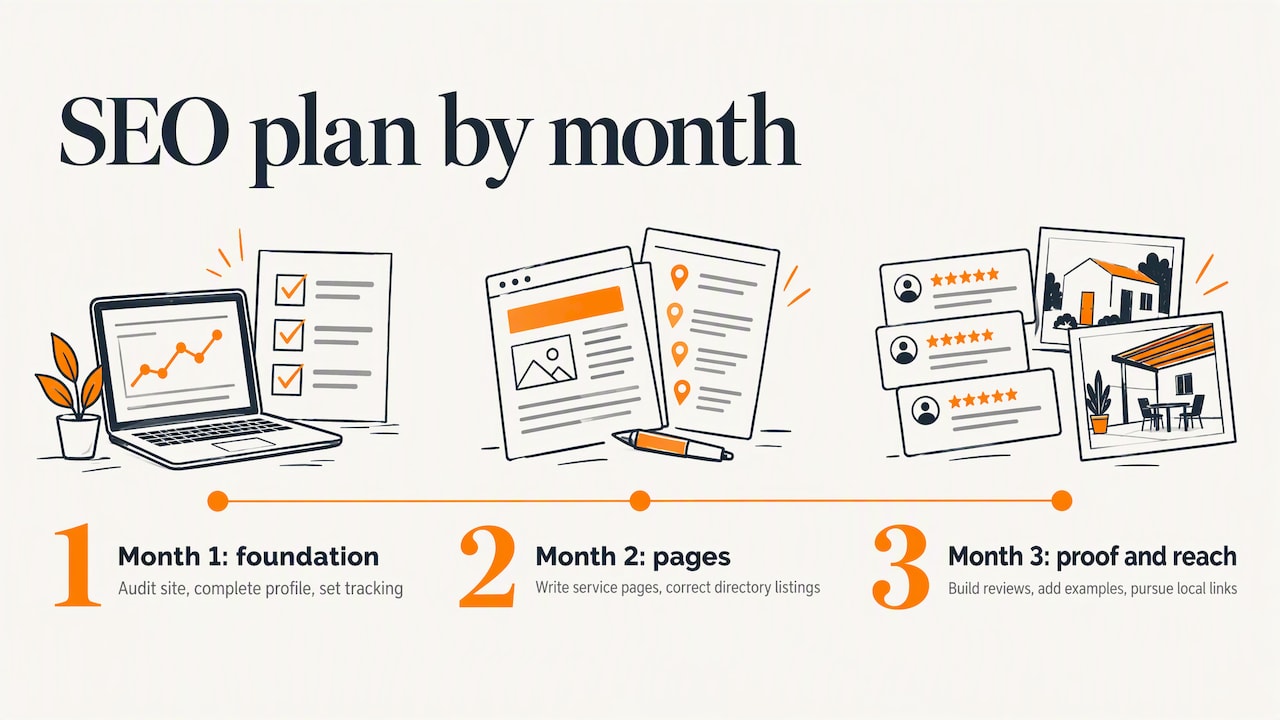
Month 1: foundation. Audit the site for crawl and indexing problems, fix titles and URLs, claim and complete your Google Business Profile, and set up tracking for calls and forms.
Month 2: pages. Write or rewrite your top three service pages around real customer questions. Add location detail where you truly serve those places. Clean up directory listings so your name, address and phone number match everywhere.
Month 3: proof and reach. Start a steady, rule-following review request routine. Add project examples and testimonials to service pages. Pursue a few local links from organizations you already work with.
Expect to wait. Google is clear that good practices make ranking more likely, not certain, and results from new pages generally build over months rather than days. Judge progress by inquiries and by whether the right pages are being indexed and viewed.
FAQ
How much is SEO per month for a small business?
In a 2023 Ahrefs survey of 439 providers, local SEO averaged $1,557 per month, with agencies at $1,819 and freelancers around $1,150. About 42% of SEOs charged between $250 and $1,000. Your actual price depends on competition, site condition, the number of locations and how much content is involved.
What should an SEO package include?
At minimum: an initial audit, fixes to titles, URLs and site structure, service or location page work, Google Business Profile management, and regular reporting on leads and organic traffic. Ask for the monthly deliverables in writing so you can compare quotes on scope, not just price.
Is local SEO different from regular SEO?
Yes. Local SEO targets searches tied to a place and relies heavily on your Google Business Profile, reviews and consistent listings. General SEO focuses on your site’s pages ranking for broader searches. Many small businesses need both.
How long does SEO take to work?
There is no fixed timeline, and Google does not guarantee rankings. Technical fixes and profile improvements can help sooner, while new content and reputation typically build over several months. Ask any provider how they measure progress and when you should expect to see it.
Sources
- SEO Starter Guide: The Basics, Google Search Central
- Do you need an SEO? Tips for hiring an SEO, Google Search Central
- Tips to improve your local ranking on Google, Google Business Profile Help
- 10 Local Marketing Strategies That Work, U.S. Small Business Administration
- 10 Tactics to Get More Positive Reviews for Your Business, U.S. Small Business Administration
- SEO Pricing: How Much Does SEO Cost? 439 People Polled, Ahrefs
- Small Business SEO: What It Is & How to Get Started, Semrush
- What Is Small Business SEO?, HubSpot
- SEO Essentials Every Small Business Owner Should Know, Investopedia
- A small business SEO guide to getting discovered online, Yelp for Business