
 614.224.6226
What if your website stopped being a cost center and started acting like your most productive employee? Many business owners feel the sting of high bounce rates on service pages and contact forms that no one ever fills out. It’s a common struggle to see users get lost in complex navigation while your competitors seem to capture every lead. You deserve a digital presence that reflects the quality of your work, which is why mastering conversion centered web design is no longer optional.
This strategic guide will teach you how to transform your site into a high-performance sales engine. We’ll move beyond static layouts to explore the psychology of user action and the benefits of guided experiences. You’ll learn how to replace traditional, friction-heavy forms with interactive tools that achieve higher completion rates and generate superior lead quality for your business. The goal is simple: turn passive visitors into active partners.
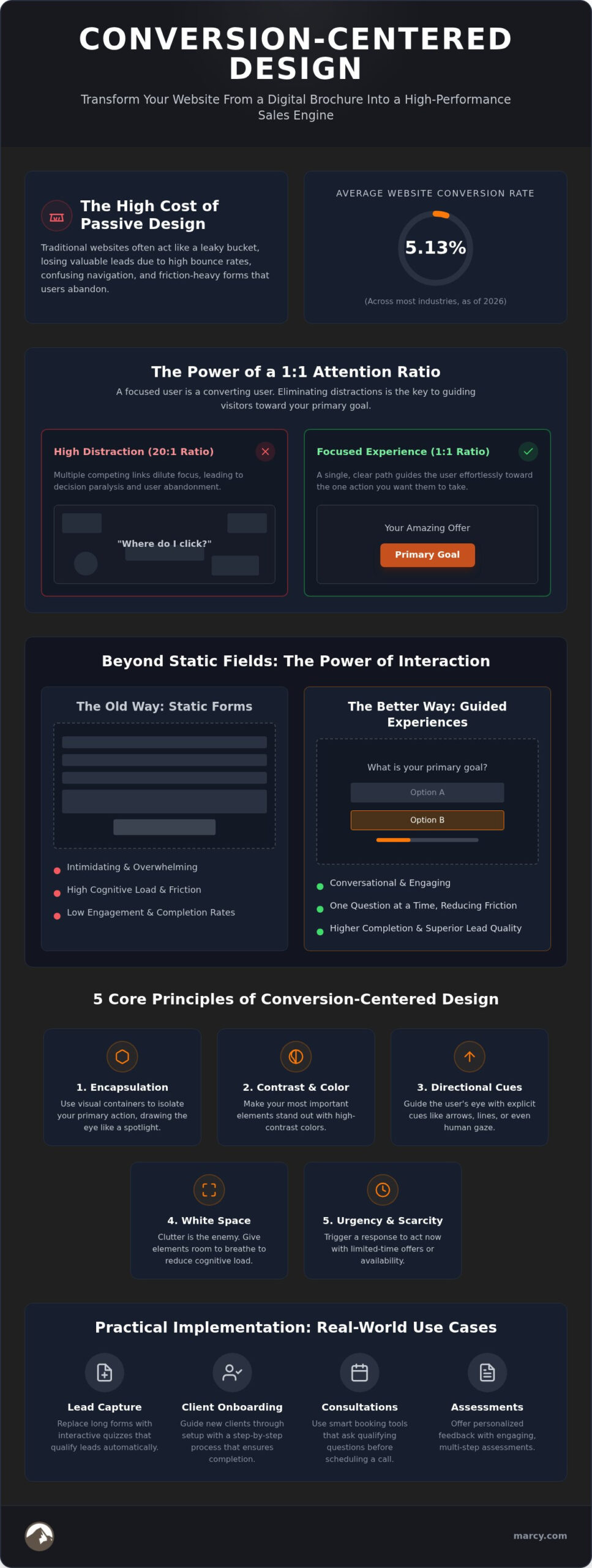
With the average website conversion rate hovering around 5.13% as of 2026, achieving growth requires a bold, data-driven approach. We’ll provide a clear roadmap for redesigning for ROI; highlighting how AI-powered personalization and mobile-first design can modernize your funnel. From onboarding processes to professional assessments, discover how to build a website that truly performs and scales with your vision.
Key Takeaways
- Master the 1:1 attention ratio to eliminate distractions and turn your site into a high-performance sales engine.
- Implement the core principles of conversion centered web design to guide users effortlessly toward your primary business goals.
- Discover why interactive guided experiences significantly outperform traditional static forms by increasing user engagement and personalization.
- Learn practical ways to streamline lead capture and client onboarding processes for measurable improvements in ROI.
- Understand how blending time-tested design principles with modern AI innovation keeps your brand competitive through 2026.
What is Conversion Centered Web Design and Why Does It Matter?
Your website shouldn’t just be a digital brochure. It needs to be a closer. Conversion centered web design is a strategic framework focused on one thing: getting the visitor to take a specific, measurable action. While traditional design often prioritizes aesthetics, CCD prioritizes performance. It’s the difference between a pretty storefront that people walk past and a high-energy salesperson who knows exactly how to close the deal. With the average website conversion rate sitting at just 5.13% across most industries, every visitor who leaves without engaging represents a wasted investment.
Consider the “Attention Ratio” concept. In a perfect world, every page has a 1:1 ratio. This means there is only one primary goal for every one link available. When you give users twenty different places to click, you dilute their focus. High-performance website design eliminates this noise. By narrowing the path, you guide the visitor toward the finish line. This methodology is a core component of Conversion rate optimization; it ensures that your marketing spend isn’t just buying traffic, but building a pipeline.
The Psychology of User Action
Users don’t read websites; they scan them. Most visitors follow specific visual paths to find information quickly:
- F-Pattern: Common for text-heavy pages where users scan the top and then the left side.
- Z-Pattern: Typical for visual pages where the eye moves across the header, down diagonally, and across the bottom.
If your layout is cluttered, you trigger decision paralysis. This psychological hurdle happens when too many choices lead to no choice at all. For professional services, simple design produces higher completion rates because it respects the user’s time. A guided experience that asks one question at a time is far more effective than a massive, intimidating wall of text.
The High Cost of Static, Passive Design
A static website is a leaky bucket. You might be driving thousands of visitors through paid ads, but if your page is passive, those leads are slipping through the cracks. Modern users are fast-paced and impatient. They don’t want to dig through complex navigation to find a contact form. Traditional sites often fail because they wait for the user to do the work. CCD flips the script. It uses interactive elements to engage the visitor immediately. For a local Columbus business, implementing these principles plugs the holes in your marketing funnel and ensures your digital presence works as hard as you do.
The 7 Core Principles of Conversion Centered Design in 2026
Design isn’t just about aesthetics; it’s about engineering outcomes. In 2026, the The 7 Principles of Conversion-Centered Design provide a scientific framework to guide visitors toward specific actions. These principles ensure your message isn’t just seen, but acted upon. By applying these rules, you move away from guesswork and toward a predictable model of growth. Conversion centered web design turns your site into a focused tool where every pixel has a purpose.
- Encapsulation: Think of this as a visual container. It uses boxes or borders to isolate your primary call-to-action, drawing the eye like a spotlight.
- Contrast and Color: Your most important button shouldn’t blend in. Using a high-contrast color makes your goal unmistakable against your brand palette.
- Directional Cues: Arrows, lines, or even the gaze of a person in a photo can point directly at your form or button.
- White Space: Clutter is the enemy of conversion. Giving your message room to breathe reduces cognitive load and keeps the user focused on the value proposition.
- Urgency and Scarcity: Highlighting limited-time offers or exclusive availability triggers a natural psychological response to act now.
Visual Hierarchy and Directional Flow
Effective conversion centered web design creates a clear path for the user. It’s not enough to have a beautiful site; you need a hierarchy that dictates what the user sees first, second, and third. High-impact marketing materials play a crucial role here. They build visual trust through professional consistency. If you’re ready to refine your digital footprint, exploring Marcy Design’s website design services can help you align your brand’s look with its performance goals.
Social Proof and Trust Indicators
Trust is the currency of the web. In the professional services industry, 52.6% of conversions often come from phone calls, which means users need to feel secure before they reach out. Testimonials and reviews act as the “try before you buy” of the digital world. They reduce buyer anxiety by showing that others have already succeeded with your brand. Integrating local Columbus authority, such as regional awards or community partnerships, builds instant trust. It proves you aren’t just a faceless entity, but a stable, dedicated partner in the local market. This social validation is the final push many users need to complete their journey.
Beyond Static Fields: The Power of Interactive Guided Experiences
Static websites are becoming relics of the past. In 2026, high-performance digital strategy requires more than just a “Contact Us” page. It demands a conversation. Traditional conversion centered web design has evolved from simple landing page layouts into dynamic, interactive journeys. Why? Because users no longer want to be sold to; they want to be guided. Interactive tools like assessments and calculators outperform traditional forms because they provide immediate value. This shift is a key component of Successful Conversion-Centered Design, where the focus is on the user’s immediate needs rather than just the business’s data collection.
Static Forms vs. Interactive Consultations
Think about the last time you saw a form with ten required fields. You probably felt a wave of hesitation. That’s friction. Now, compare that to a multi-step guided assessment that asks one question at a time. The latter feels like a consultation, not an interrogation. Interactive elements give something back to the user, such as a customized score or a personalized recommendation, which builds trust before you even ask for an email address. AI-driven tools personalize the user journey by analyzing intent in real-time, delivering the exact answer a prospect needs at the moment they need it. This methodology is at the heart of our AI powered digital marketing solutions, ensuring your site acts as a smart consultant 24/7.
Engagement through Personalization
Personalization isn’t just a buzzword. It’s a performance necessity. By using conditional logic, you can tailor your website’s experience to match specific user segments. If a visitor is interested in website design, they shouldn’t be forced to navigate through unrelated service options. Delivering relevant content faster reduces bounce rates and keeps users engaged. This level of precision is why AI referral traffic is currently converting at an average of 5.8%, outperforming traditional organic search. If you’re looking for more ways to optimize your funnel, check out our guide on how to improve website conversion rate. Transitioning to a guided experience isn’t just about being modern. It’s about achieving the higher completion rates that drive your business forward.
Practical Implementation: Real-World Conversion Use Cases
Moving from theory to execution requires a shift in perspective. You’ve seen the principles; now you must apply them to your unique business model. Conversion centered web design isn’t just about landing pages. It’s about every touchpoint where a user interacts with your brand. By transforming passive pages into active engines, you create a seamless path from curiosity to commitment. This process starts with re-evaluating your most basic interactions, such as lead capture and initial consultations. Results matter, and your site should be your hardest-working employee.
Traditional “Contact Us” pages are often where leads go to die. They’re generic and uninspiring. Instead, consider using value-first assessments. These tools provide immediate feedback to the user, such as a digital maturity score or a project cost estimator. By providing value before asking for contact info, you establish brand authority. You also pre-qualify leads. This ensures your team spends time on prospects who are the right fit, rather than chasing dead ends. It’s a more efficient way to grow and scale your operations.
Optimizing the Onboarding Process
For complex, service-based businesses, the initial handshake is critical. A messy onboarding process creates immediate buyer’s remorse. Step-by-step guidance reduces this friction. By breaking down a complex entry process into manageable, interactive steps, you keep the user engaged. A clear onboarding flow does more than just capture data; it builds long-term customer loyalty. When users feel guided and supported from the first click, they’re more likely to remain partners for years to come. Clarity is the ultimate competitive advantage.
Lead Generation for Columbus Businesses
Local markets require a specific, personalized touch. If you’re targeting the Central Ohio area, your strategy needs to reflect regional trust and authority. Effective lead generation website design leverages local expertise to build instant rapport with your audience. High-impact assessments tailored to the Columbus market can drive significant market share. Whether you’re a law firm or a professional consultancy, your site should speak the language of your local community while utilizing world-class performance principles.
Ready to see these principles in action for your own brand? If you’re looking to turn your site into a high-converting asset, explore our website design services and let’s start building your sales engine today.
Partnering for Performance: The Marcy Design Approach
Marcy Design brings a unique perspective to every digital project. We’ve spent 40 years refining our craft right here in Columbus. This legacy allows us to stay grounded while we embrace the future of the web. In 2026, conversion centered web design requires a delicate balance of human psychology and advanced automation. We don’t just build sites that look good; we build sites that generate measurable revenue. By integrating AI website integration services, we ensure your business stays ahead of the curve and anticipates user needs before they even arise.
Mobile performance is the foundation of modern success. With more than half of all web traffic coming from handheld devices, a flawless experience is no longer a luxury. Our approach to mobile responsive web design ensures that your conversion funnel remains intact, regardless of how your customers find you. For Columbus businesses, this local dedication means you have a partner who understands the regional market and the specific expectations of Ohio consumers. We’re not just a vendor. We’re a neighbor invested in your prosperity.
Our Results-Oriented Design Philosophy
Every project begins with a deep dive into your current performance. We look at the hard data to find the leaks in your bucket and identify where users are losing interest. Our roadmap takes you from this initial audit to a high-converting launch. This isn’t a one-size-fits-all solution. It’s a tailored strategy designed for measurable growth and long-term stability. We’re committed to professional excellence and local innovation. By focusing on ROI rather than just surface-level aesthetics, we transform your digital presence into a powerful business asset that scales with your ambitions.
Ready to Transform Your Digital Presence?
Stop settling for a static brochure that sits idle. Your website should be a dynamic salesperson that works 24/7 to close deals. It’s time to move beyond the limitations of traditional design and embrace the science of sales. We invite you to a professional consultation to audit your current conversion rates and identify hidden growth opportunities. Let’s build something that truly performs for your business. Contact us today to start your strategic growth journey and see what 40 years of expertise can do for your bottom line.
Elevate Your Digital Strategy for 2026
Your website is more than an online business card; it’s the engine of your business growth. By mastering conversion centered web design, you move beyond the limitations of passive pages and start engaging users with intent. You’ve learned that replacing static forms with interactive, AI-powered guided experiences isn’t just a trend. It’s a strategic necessity to reduce friction and build trust. Whether you’re streamlining a complex onboarding process or refining local lead capture, the goal is always clear: measurable results.
Marcy Design has been serving the Columbus community since 1986. We blend decades of experience with cutting-edge expertise in AI-powered conversion tools and high-impact strategic advertising campaigns. We understand that your success depends on a digital presence that performs as well as it looks. Don’t let potential leads slip through the cracks of an outdated layout. It’s time to transform your site into a high-performance sales engine that works for you every hour of the day.
Ready to turn your website into a sales engine? Contact Marcy Design today!
The future of your business is digital, and with the right roadmap, that future looks incredibly bright.
Frequently Asked Questions
What is the difference between UX design and conversion centered design?
UX focuses on the overall feeling and ease of use, while conversion centered web design focuses on a single, measurable business goal. UX makes the journey pleasant; CCD makes sure the journey ends in a sale. Think of UX as the comfortable seating in a showroom and CCD as the salesperson who closes the deal. Both are essential, but CCD is what directly impacts your bottom line.
How do I know if my website needs a conversion-focused redesign?
High bounce rates and dead contact forms are the clearest indicators. If traffic is steady but leads have stalled, your design is passive. A performance-focused audit reveals where users get lost in complex navigation. Our long-standing work with Columbus businesses shows that a proactive shift to a guided experience prevents lead decay and secures your market position.
Can conversion centered design work for B2B professional services?
Yes, it’s highly effective for B2B where trust and pre-qualification are paramount. Instead of a generic contact field, B2B sites benefit from interactive consultations or assessments. These tools provide immediate value to the prospect while gathering high-quality data for your team. For Columbus professional services, where 52.6% of conversions come from phone calls, CCD ensures those calls are from pre-qualified, high-intent leads.
What is a good conversion rate for a business website in 2026?
As of May 2026, the overall average conversion rate across industries is 5.13%. However, specific sectors perform differently. The Professional Services industry averages 6.1%, while Marketing and Advertising sees roughly 6.2%. If your site is performing below these benchmarks, it’s a sign that your user journey needs optimization. Aiming for these industry standards ensures your digital presence remains competitive in a fast-paced market.
How does mobile responsiveness affect my website’s conversion rate?
Mobile responsiveness is the bedrock of conversion because over 50% of web traffic now comes from mobile devices. If your site is difficult to navigate on a phone, you’ll lose half your potential leads instantly. A flawless mobile experience reduces friction. It ensures your call-to-action is always accessible. In 2026, a mobile-first approach is a requirement for high-performance lead generation.
Do I need AI to implement conversion centered web design?
AI is not strictly required but it significantly enhances conversion centered web design by enabling real-time personalization. AI referral traffic is currently converting at 5.8%, which is higher than direct or organic search. Using AI-driven tools allows you to tailor the user experience to individual intent. This level of automation replaces static friction with a smart, guided journey that adapts to every visitor’s specific needs.
How long does it take to see results from a conversion design update?
Most businesses see measurable improvements in engagement and lead quality within 30 to 90 days. Some technical changes provide immediate boosts to speed and usability. However, psychological shifts in user behavior take time to track. Continuous A/B testing is essential. This ongoing optimization ensures your website stays aligned with evolving market trends and maintains a high ROI over the long term.