
 614.224.6226
Connected TV advertising delivers video ads to internet-connected TVs, smart TV apps, streaming devices, and game consoles, pairing big-screen impact with digital targeting and measurable outcomes. The campaigns that work today run through programmatic buying and rely on standards like the Open Measurement SDK (OM SDK) for reporting you can trust. That combination is why it belongs in your media mix.
TL;DR:
- Streaming accounted for 43.8% of U.S. TV time in March 2025, while buyers expected 47% of CTV inventory to be biddable in 2025.
- Choose direct insertion orders for guaranteed placement, private marketplaces for curated bidding, or open auctions for scale, with stronger verification and brand safety checks.
- Prioritize ads stitched into streams before playback for premium inventory, and require suppliers to support OM SDK, viewability, deduplication, and conversion reporting.
- Use consented first party or contextual data, honor opt outs, and avoid sensitive categories; clean rooms support matching without exposing raw customer files.
- Run a CTV flight only when strong video creative, website tracking, and enough budget to learn are ready; otherwise, fix those gaps first.
Table of Contents
- What connected TV includes and how it differs from linear and mobile video
- How CTV ads are delivered and bought
- CTV ad formats and placements you can use
- Measurement, attribution, and the standards to require
- Costs, pricing models, and how buying method shapes CPM
- A step-by-step checklist to plan, buy, and optimize a CTV campaign
- How CTV fits inside an omnichannel media mix
- The CTV advertising ecosystem: platforms, publishers, and DSPs
- Privacy rules and their effect on CTV targeting and measurement
- CTV challenges and how to address them
- Why we think small businesses can win with CTV
- How we can help with your CTV campaign
- FAQ
- Sources
What connected TV includes and how it differs from linear and mobile video
Connected TV (CTV) covers any television that reaches the internet: smart TVs, streaming sticks and boxes like Roku or Fire TV, and gaming consoles. Viewers watch apps on those screens, and advertisers buy the ad breaks inside them.
People often use CTV and OTT (over-the-top) interchangeably, but they are not identical. OTT describes video delivered over the internet to any screen, including phones and laptops. CTV is the subset watched on a television. Linear TV, by contrast, is the scheduled broadcast or cable feed, where everyone in a market sees the same ad at the same time.
Much CTV inventory sits in AVOD (ad-supported video on demand) services and FAST (free ad-supported streaming TV) channels. Viewers there tend to lean back, watch on a large screen, and sit through full ad pods, which is a very different setting from scrolling a phone. Streaming now holds a big share of viewing: [Nielsen reports streaming reached 43.8% of overall U.S. TV time](https://www.nielsen.com/insights/2025/connected-tv-transforming-advertising-trends/) in March 2025.
How CTV ads are delivered and bought
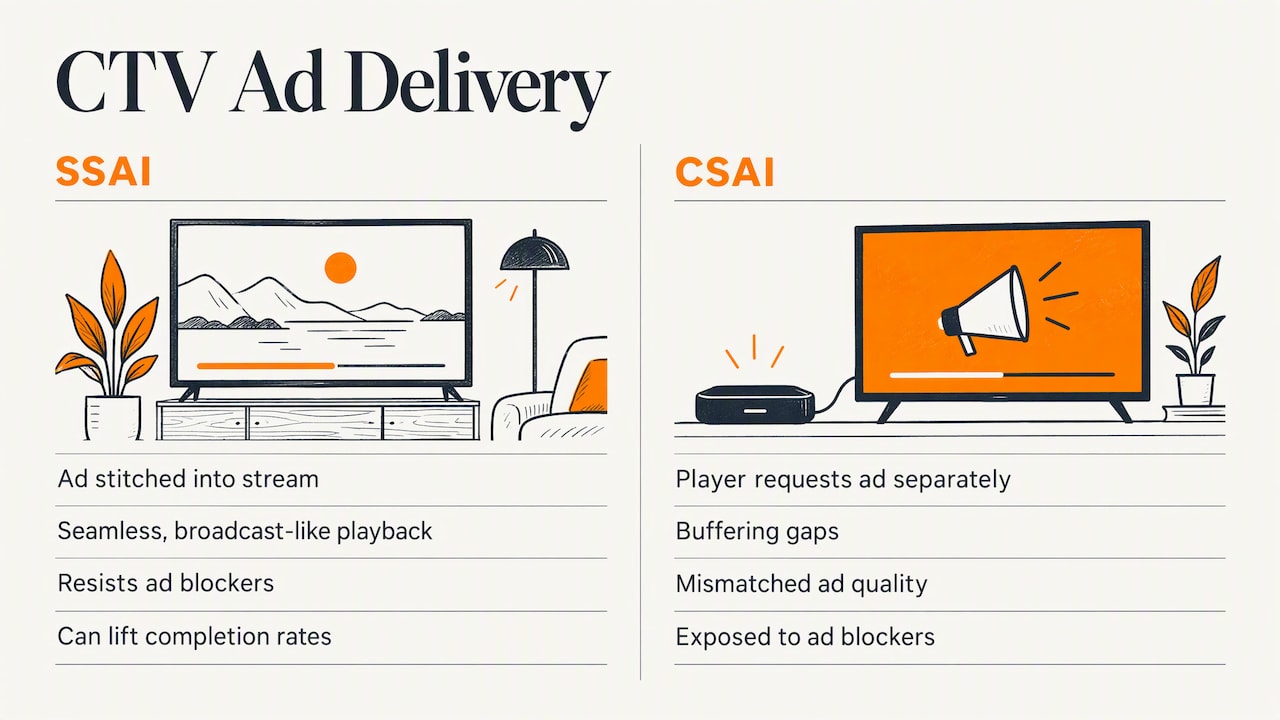
Delivery comes in different forms. With server-side ad insertion (SSAI), the ad is stitched into the video stream before it reaches the device, so playback feels like broadcast TV. Lightcast explains that SSAI resists ad blockers and tends to lift completion rates. For publishers, AWS notes that server-guided approaches can cut startup time and total cost of ownership.
Client-side ad insertion (CSAI) works differently: the player on the device calls for the ad separately. That can create buffering gaps, mismatched ad quality, and exposure to ad blockers. You still see CSAI on some apps and older devices, but it is less common on premium inventory. IAB Tech Lab guidance recommends advertisers prioritize SSAI for premium inventory because it supports seamless playback and reliable measurement signals.
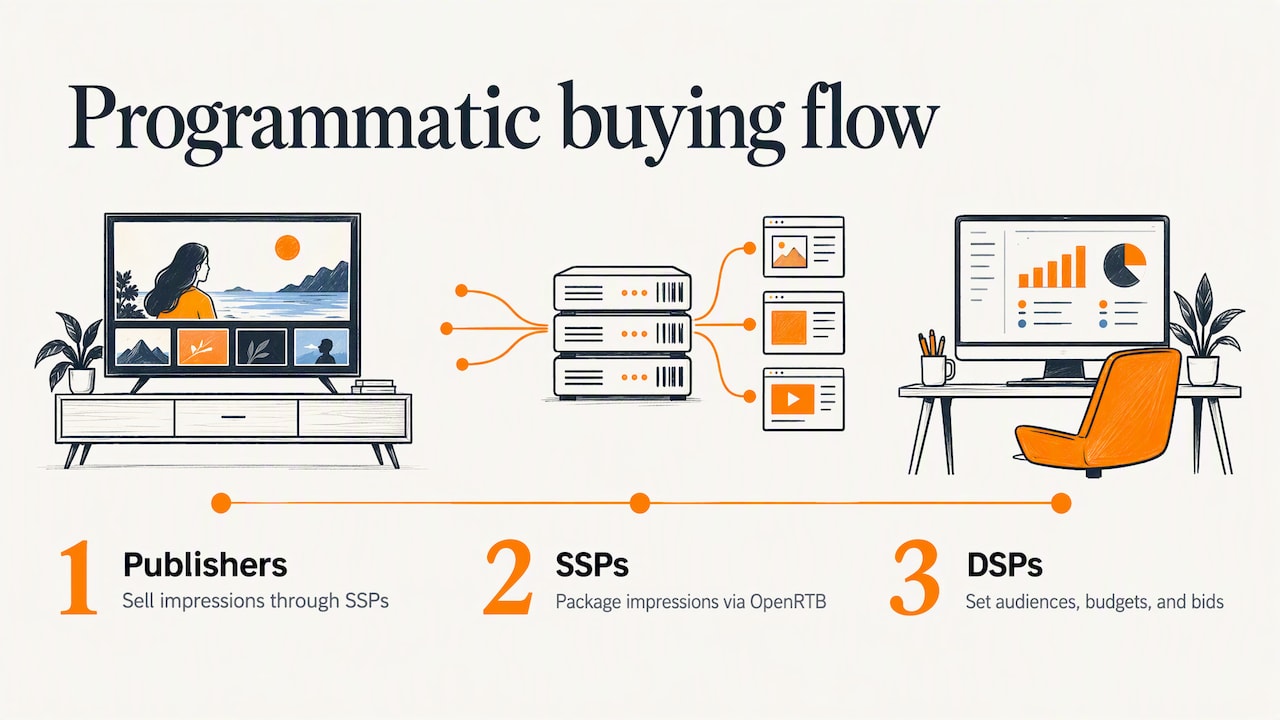
On the buying side, programmatic flows connect demand-side platforms (DSPs) to supply-side platforms (SSPs) using OpenRTB, with podded bidding so multiple ads can compete for a single break. The IAB Tech Lab CTV programmatic guide maps the specs to delivery, targeting, verification, and fraud use cases. Inventory is shifting toward bidding: the 2025 IAB Digital Video Ad Spend & Strategy report finds buyers expected 47% of CTV inventory to be biddable in 2025.
CTV ad formats and placements you can use
Most campaigns start with in-stream video, but CTV offers more than the classic spot. Pick formats to match the goal:
- Pre-roll and mid-roll: Video spots in podded breaks. Prioritize a strong first few seconds and completion.
- Pause-screen ads: Static or lightly animated placements when a viewer pauses, suited to awareness with little creative cost.
- Home-screen tiles: Prominent placements on the device or app launch page, good for reach and launches.
- Interactive and shoppable units: QR codes, remote-driven end cards, and tap-to-learn overlays that connect the screen to action. Samsung Ads introduced interactive formats at NewFronts 2025, a sign of where platforms are heading.
Brand awareness usually favors full-length in-stream video and home-screen placements. Direct-response goals fit better with interactive end cards and shoppable formats that give viewers something to do right away.
Measurement, attribution, and the standards to require
Measurement is the weak point in many CTV plans. Nielsen notes that only 32% of global marketers measure media spend holistically across digital and traditional channels, and it argues converged measurement is essential for judging effectiveness. IAB Tech Lab materials also call measurement the top challenge in programmatic CTV.
The OM SDK is the practical answer. It standardizes signals such as screen state and view duration across apps, which helps verify that an ad actually played and fights device spoofing. Ask suppliers for these items before you buy:
- OM SDK support across the apps and devices in your buy
- Viewability aligned to MRC-style definitions
- Cross-device deduplication so households are not double-counted
- Clean-room or standardized reporting for conversions and attribution
- Content taxonomy signals for brand suitability
Costs, pricing models, and how buying method shapes CPM
CTV is typically bought on CPM, the price per thousand impressions. Premium streaming content and big-screen formats usually carry higher CPMs than many other digital channels, since viewers are engaged and ads are hard to skip. We do not quote a single price here because rates vary widely by inventory, audience, and season.
Your buying method sets the trade-off between control and scale:
- Direct insertion order (IO): Guaranteed placement on named content, with the most control and often the highest price.
- Private marketplace (PMP): Curated, biddable inventory from selected publishers, balancing quality and flexibility.
- Open auction: Maximum scale and price discovery, with more need for verification and brand-safety checks.
Interactive formats and top-tier content tend to push pricing up. As more inventory becomes biddable, programmatic access keeps widening for advertisers of every size, including those with modest budgets.
A step-by-step checklist to plan, buy, and optimize a CTV campaign
- Set the business objective and KPIs. Decide whether you want brand lift or conversions, then map audiences to CTV segments.
- Build your audiences. Choose first-party onboarding, household targeting, or contextual segments, and set frequency caps.
- Require OM SDK support. Confirm it with every supplier and pick a measurement partner before launch.
- Choose your buying method. Match direct IO, PMP, or open auction to your need for control versus scale.
- Develop big-screen creative. Tell the story visually, front-load the brand, and add a clear next step such as a QR code or short URL.
- Launch an initial flight. Run long enough to gather clean data before changing anything.
- Check KPIs and test creative. Review delivery, completion, and outcomes, then A/B test creative and refine audiences on a steady cadence.
Our advertising lessons from big-stage campaigns cover the creative thinking that applies here, and getting more from your advertising budget is useful when you weigh buying methods.
How CTV fits inside an omnichannel media mix
Lean on CTV when you need premium video reach with digital precision, and keep linear TV or social when your audience or goal favors them. The strongest plans combine channels rather than choosing one.
Try sequential messaging: introduce the brand on CTV, then follow with social or search ads to people who were exposed. You can also use CTV exposure to trigger digital retargeting and measure the incremental reach CTV adds beyond linear. None of it works without unified measurement, so exposures are deduplicated and you avoid counting the same conversion twice. For background on how video sits among online channels, see our note on what to love about internet advertising.
The CTV advertising ecosystem: platforms, publishers, and DSPs
Several groups make up the ecosystem. Publishers and platforms own the screens and content: device makers like Samsung, operating systems and streaming services, and FAST channel operators. They sell ad inventory directly or through SSPs.
SSPs sit on the supply side, packaging impressions and passing them to buyers through OpenRTB. On the demand side, DSPs let advertisers set audiences, budgets, and bids across many publishers at once. The Trade Desk positions its DSP around programmatic precision and unified measurement across channels, and Viant describes a similar omnichannel approach to activating audiences on CTV.
Large retailers and walled gardens also sell CTV. Amazon Ads offers a guide covering definitions, metrics, and its own activation paths. Alongside these sit identity providers, clean rooms, measurement and verification vendors, and ad servers.
For a small or mid-size advertiser, the practical question is access. Self-serve DSPs and managed-service partners now make it possible to start without a large upfront commitment. Whichever route you take, ask which inventory is SSAI, which supports OM SDK, and which is open auction versus curated. The answers tell you how much of your spend lands on quality content with reliable reporting.
Privacy rules and their effect on CTV targeting and measurement
Privacy law shapes what data you can use. In the U.S., state laws such as the California Consumer Privacy Act (CCPA) give people rights over how their data is collected, shared, and sold, including opting out. In Europe, the General Data Protection Regulation (GDPR) sets strict rules on consent and lawful use of personal data. If your campaign reaches viewers covered by either, work with legal counsel to confirm how your data flows comply.
For CTV, the effect is practical. Collect first-party data with clear notice and consent, and make sure partners honor opt-outs. Clean rooms help here, since they let you match and measure audiences without handing over raw customer files.
CTV already lives mostly outside the browser cookie world. Targeting relies on household and device signals, content context, and logged-in or consented identity rather than third-party cookies. That makes first-party data and contextual targeting more valuable, and it makes standardized measurement a safer path than stitching together unverified identifiers.
A few habits keep you on solid ground: document your data sources, ask vendors how they handle consent and opt-out signals, and avoid targeting that depends on sensitive categories. Privacy-friendly measurement usually trades some individual-level detail for aggregate, modeled results, so set expectations with your team before launch. Treat compliance as part of planning, not a final check, and revisit it as rules and platform policies change.
CTV challenges and how to address them
CTV is strong but not frictionless. Technical issues come first: different devices, apps, and ad servers behave differently, which can cause inconsistent playback or missing reporting. Favoring SSAI inventory and requiring OM SDK support reduces many of these problems, and IAB Tech Lab’s guide covers delivery, verification, and fraud together.
Ad fraud is the second concern. Device spoofing, where fake traffic pretends to be a real television, has been a known problem. Standardized signals from OM SDK help, so do verification partners, supply-chain transparency, and sticking to curated or PMP deals when you are unsure about an open-auction source.
Viewer attention is the third. A big screen does not guarantee that anyone is watching closely, since people share the room, look at their phones, or step away. Combat this with creative that grabs attention early, sensible frequency caps, and ad lengths that suit the content.
Finally, fragmented measurement makes results hard to compare across publishers. Insist on consistent reporting, deduplicate across channels, and decide up front which metrics matter. If you do those few things, most CTV pitfalls become manageable.
Why we think small businesses can win with CTV
We recommend CTV when a business has strong video creative, working tracking on its website, and enough budget to run a flight long enough to learn from. If those are missing, we fix them first. We care most about measurable results, so we tie CTV to the website and lead-generation work that turns attention into inquiries.
— Greg
How we can help with your CTV campaign
Our team supports CTV campaigns with video production, creative, media planning, and conversion-focused lead generation and tracking setup. An engagement starts with your goals and audience, then covers creative, buying, and measurement. Contact us to request a consultation.
FAQ
How much does connected TV advertising cost?
CTV is usually bought on CPM, and rates vary with inventory, targeting, and season. Premium content and interactive formats generally cost more than open-auction inventory. Direct deals cost more than programmatic buys, so your method of buying matters as much as your budget.
How can I advertise on connected TV?
You can buy through a DSP, a platform’s own ad tools, or an agency that manages it for you. Start by setting your goal and audience, then choose a buying method and confirm OM SDK support. The 2025 IAB Digital Video Ad Spend & Strategy report notes that self-serve tools are growing.
What are some examples of connected TV advertising?
Common examples include a pre-roll spot inside a streaming app, a pause-screen ad, and a home-screen tile. Interactive end cards with a QR code, like those Samsung Ads showcased, are another. Each fits a different goal, from awareness to direct response.
How do connected TV ads work?
Ads are inserted into streaming video, often server-side, so they play like broadcast breaks. Advertisers target audiences through a DSP, which bids on impressions offered by publishers through SSPs. Measurement signals such as OM SDK then confirm what was actually seen.
Sources
Audience building on CTV starts with your own data. You can onboard first-party records, such as customer lists, through identity providers or a clean room, which lets you match audiences without exposing raw data. LiveRamp describes how identity solutions let advertisers activate first-party data in CTV.
Identity matching can work in different ways. Deterministic matches rely on known identifiers like a logged-in account or email, so they are precise but smaller in scale. Probabilistic approaches infer household or device links from signals such as IP address and device patterns, so they reach further but with less certainty.
You can also target by context, using content taxonomy and genre, or at the household or device level. Because TV is a shared screen, household targeting is often a better fit than person-level claims. Frequency management matters here: without deduplication across linear and streaming, the same home can see your ad too many times. Nielsen’s audience planning commentary notes that viewing is fragmented across devices, so data partners and collaboration help align plans with business goals.