
 614.224.6226
The main digital advertising channels are search, social, display, native and programmatic, video and connected TV, retail media, email and CRM, content, affiliate and partnerships, and mobile or in-app. One rule picks between them: match the channel to your buyer’s funnel stage and audience. Use intent-driven channels to convert and attention-driven channels to build awareness. Below you’ll find formats, KPIs, and a way to prioritize.
TL;DR:
- For paid search, target transactional queries your business can fulfill, match each ad group to a landing page, and install conversion tracking before spending.
- For marketplace sales, fix product titles, images, and inventory data before buying sponsored placements; compare advertising cost with product margin, not revenue alone.
- Native ads tend to earn more clicks, while display ads build brand recognition and perceived site trust; label sponsored content clearly in every campaign.
- Attribution models favor different channels, so compare more than one and use regional holdouts or conversion lift tests to estimate which ads add sales.
- Keep most early spending on proven channels, and test one new option at a time; scale it only after results repeat.
Table of Contents
- What each digital advertising channel does at a glance
- Search marketing: organic SEO and paid search
- Social media and influencer marketing: where awareness meets consideration
- Display, native, and programmatic advertising
- Video and connected TV: storytelling at scale
- Retail and marketplace advertising: reaching shoppers at the shelf
- Email marketing and CRM-driven ads
- Content marketing and native editorial approaches
- Mobile and in-app advertising
- Measurement, attribution, and KPIs across channels
- How to pick and prioritize channels for your business
- What the FTC and research say about native and influencer disclosure
- How to integrate multiple digital advertising channels into one campaign
- Targeting and segmentation best practices for each channel
- Budget allocation models and optimization for multi-channel spending
- Adapting creative assets and messaging for each channel
- Technology and tools behind digital advertising: DSPs, DMPs, and ad verification
- Where we land: audience first, tools second
- Our digital advertising channel services
- FAQ
- Sources
What each digital advertising channel does at a glance
Before the details, here is the map. Think of channels as jobs on a funnel, not as a menu to sample evenly. A multi-funnel approach puts search at the bottom for intent, social and video at the top for awareness, and retail media where shoppers are ready to buy in categories like consumer packaged goods and electronics.
- Top of funnel (awareness): social video, connected TV, display, and programmatic. Example format: a short video or a banner. Primary KPI: reach, impressions, or view rate.
- Middle of funnel (consideration): native ads, content marketing, influencer posts, and paid social retargeting. Example format: an in-feed sponsored article. Primary KPI: engagement and assisted conversions.
- Bottom of funnel (conversion): paid search, retail media, email, and CRM audiences. Example format: a shopping ad or a cart-recovery email. Primary KPI: conversion rate, cost per acquisition, or return on ad spend.
- Cross-funnel: affiliate, partnerships, and mobile or in-app ads, which can play any role depending on the offer.
If you are new to paid media, start with search and one social platform. If you sell physical products, add retail media early. If your sales cycle is long, put content and email ahead of display.
Search marketing: organic SEO and paid search
Search is the clearest intent-capture channel because the person typed what they want. It splits into two tracks. Organic SEO earns unpaid placement by making pages useful and technically sound. Paid search (also called SEM or PPC) buys placement through auctions, using text ads, shopping ads, and call extensions.
Search wins when queries are high-intent and transactional: “emergency plumber near me,” “buy running shoes size 11,” “CRM software pricing.” It struggles when nobody knows your category exists yet, because no one is searching for it. That is a job for social or video.
The core KPIs are organic traffic, click-through rate, conversion rate, cost per acquisition, and return on ad spend. Watch conversion rate first. A cheap click that never converts is the most common way search budgets leak.
Quality matters as much as bid size. Google weighs relevance and landing page experience, so a stronger score can lower your costs, as we explain in our piece on why a stronger Google Ads score can make or break a campaign.
A starter checklist for launching:
- Pick transactional keywords tied to a product or service you can actually fulfill today.
- Write ad copy that repeats the searcher’s language, and send each ad group to a matching landing page.
- Set up conversion tracking for calls, forms, and purchases before spending a dollar.
- Add negative keywords weekly from the search terms report cutting irrelevant clicks.
- In parallel, fix the SEO basics: page speed, clear titles, and one page per core topic. Our SEO solutions cover this work.
Pro Tip: Run paid search on your best-converting keywords first, then use that data to decide which topics deserve long-term SEO content.
Social media and influencer marketing: where awareness meets consideration
Social platforms let you reach people before they are searching. Paid social usually takes these forms: in-feed image and video ads, stories and reels placements, carousel ads, lead-generation forms, and retargeting ads shown to past visitors. Audience mix differs by platform. Platform audience data, such as YouTube viewership, helps you check whether your buyers actually gather where you plan to spend.
Influencer marketing adds a trusted voice. A creator posts or films your product, and followers treat it more like a recommendation than an ad. That trust comes with an obligation: the FTC has said influencers are responsible for making sponsorship disclosures clear, and it published disclosure guidance for online influencers with example language and placement advice. Brands should put disclosure requirements in every creator contract.
KPIs to monitor:
- Reach and impressions, to confirm you are getting in front of enough people
- Engagement rate, to see whether the creative resonates
- Cost per click, for traffic-driven goals
- View-through conversions, which count buyers who saw but did not click
Quick tests that often produce early wins:
- Test creative angles (problem, benefit, social proof) against one audience before testing many audiences.
- Start with a narrow interest or lookalike audience, then widen once the creative proves itself.
- Show a short video to everyone, then retarget viewers with a direct offer.
- Give every influencer a unique code or link so you can track their contribution.
Platform rules shift often, and we cover current tactics in our guide to the new rules of Facebook marketing.
Display, native, and programmatic advertising
Display ads are banners and rich media placed around content. Native ads match the look of the page they appear on, such as a sponsored article in a news feed. Programmatic is not a format at all but a way of buying: software auctions and places ads automatically across many sites and apps.
The trade-off between display and native is real. Research summarized by Michigan Ross found that native ads often get higher click-through rates because they resemble surrounding content, while display ads tend to draw more visual attention, build stronger brand recognition, and leave readers with a higher perception of the site’s trustworthiness.
Native ads earn more clicks, while display ads earn more brand recognition and site trustworthiness, according to peer-reviewed research on native advertising in online news. Pick the format that fits the goal: clicks or recall.
Programmatic options, at a high level:
- Open exchange: the widest inventory, the least control over placement quality.
- Private marketplace: invitation-only inventory from selected publishers, with more transparency.
- Demand-side platforms (DSPs): the software marketers use to bid, target, and report across those sources.
Practical tips:
- Build creative for the placement. A banner needs one idea and one clear call to action.
- Use placement and site exclusion lists to keep ads away from poor-quality inventory.
- Label native ads clearly as paid. Prominent labeling protects both click performance and brand perception.
- Cap how often one person sees your ad to avoid wasted impressions.
Video and connected TV: storytelling at scale
Video comes in two broad groups. Short-form social video runs in feeds, stories, and reels, and it is quick, skippable, and built for thumb-stopping hooks. Long-form video and connected TV (CTV, which includes streaming apps on smart TVs and over-the-top, or OTT, services) offers lean-back viewing with less skipping and a bigger screen.
Use video and CTV when the goal is brand storytelling, broad reach, or demonstrating something that is hard to explain in text. CTV audiences continue to grow, as U.S. connected TV penetration data and the count of connected TV users show, which strengthens the case for streaming video in brand-focused campaigns.
Metrics that matter:
- View rate and completed views, to judge whether the opening earns attention
- Cost per completed view, to compare placements fairly
- Brand lift testing, which surveys exposed and unexposed groups to measure recall and consideration
- Assisted conversions, because video rarely closes the sale alone
Creative and measurement tips:
- Put the brand and the hook near the start on social, and plan for sound-off viewing with captions.
- Make separate cuts for each platform instead of resizing one master file.
- On CTV, tell a fuller story, since viewers are watching on a large screen with fewer distractions.
- Pair video exposure with search and retargeting, then watch whether branded search volume rises during the flight.
Video production quality shows. If you need help with the creative itself, our team handles video production and digital marketing under one roof.
Retail and marketplace advertising: reaching shoppers at the shelf
Retail media places your ads on a retailer’s own properties: Amazon, Walmart, and other retail media networks. The shopper is already in buying mode, which makes this a conversion-focused channel for product-led businesses and a different animal from open-web advertising.
Typical formats:
- Sponsored product ads: your listing promoted inside search results and category pages
- Sponsored brand ads: a banner with a logo and several products at the top of results
- DSP placements: off-site or on-site display and video using the retailer’s shopper data
Retail ads should be a priority when buyers discover products directly on a marketplace, when your category is inventory-driven, or when your competitors already crowd the results page. The IAB’s guidance points to retail media for direct conversion in categories like consumer packaged goods and electronics.
KPIs to track:
- Advertising cost of sales (ACoS), the ad spend divided by the ad-attributed sales
- Conversion rate on the listing page
- Return on ad spend, compared with your margin rather than revenue alone
Catalog and feed basics prevent wasted spend:
- Fix titles, images, and bullet points before advertising. Weak listings convert poorly no matter how much you bid.
- Keep inventory data accurate so you never pay for clicks on out-of-stock items.
- Match keyword bids to margin: protect profitable products, and pause the ones that lose money after fees.
- Review search terms weekly and add negatives for irrelevant queries.
Email marketing and CRM-driven ads
Email is an owned channel: you reach people who already gave you their address, with no auction in between. That makes it strong for conversion and retention, and for turning a one-time buyer into a repeat customer. CRM data extends its reach, because the same list can be uploaded to paid platforms to build matched audiences, suppress existing customers from ads, or find lookalikes.
Common formats include newsletters, automated flows such as welcome series and cart recovery, promotional sends, and audience-match campaigns on social and search platforms. If you are weighing whether remarketing fits, our article on telling if Google remarketing might work for your company is a good start.
KPIs: open rate, click-through rate, conversion rate, and lifetime value uplift. Treat open rate with caution, since privacy features on some email clients inflate it. Clicks and revenue per send tell the truer story.
Segmentation and testing practices:
- Start with behavior: new subscribers, recent buyers, lapsed customers, and cart abandoners each need different messages.
- Test one variable at a time, such as subject line, send time, or offer, and run each test to a meaningful sample.
- Automate the flows that pay for themselves first: welcome, abandoned cart, and post-purchase.
- Prune inactive subscribers regularly to protect deliverability.
Content marketing and native editorial approaches
Content marketing builds assets you own: blog posts, guides, white papers, webinars, and gated downloads. These support SEO, because every useful page is a chance to rank, and they nurture leads in the middle of the funnel by answering questions before a salesperson ever speaks to the buyer.
High-performing formats tend to be the ones that solve a specific problem: a pricing explainer, a comparison guide, a checklist, or a template. Gated assets work when the content is valuable enough to justify an email address, and when the form asks for only what sales really needs.
There is a trade-off between owned content and sponsored native placements. Owned content compounds over time and costs little per visit once published, but it takes months to gain traction. Sponsored editorial placements deliver an audience quickly and borrow a publisher’s credibility, yet the traffic stops when the budget does. Many teams use sponsored placements to distribute their best owned pieces.
Metrics to follow:
- Engagement and time on page, which show whether the content is actually read
- Assisted conversions, which credit content that influenced a sale without closing it
- Organic traffic growth to the content cluster
- Lead quality from gated assets, not just volume
Concrete habits that help:
- Build content around the questions your sales team hears most.
- Update your best-performing pages periodically instead of only publishing new ones.
- Add a clear next step to every piece, whether a related guide, a demo, or a signup.
- Distribute each piece through email, social, and, where budget allows, native placements.
Pro Tip: Before writing anything new, check which existing pages already earn traffic but convert poorly. Improving those usually beats starting from scratch.
Mobile and in-app advertising
Mobile advertising covers two environments: mobile web, where banners and search ads run in the browser, and in-app, where ads run inside apps. The money follows the attention, and global mobile advertising revenue figures are one reason mobile deserves a place in your channel mix.
Common in-app formats:
- Rewarded video: users opt in to watch an ad in exchange for an in-app benefit
- Interstitials: full-screen ads shown at natural pauses
- Native in-app ads: units that match the app’s design
- Mobile web banners: standard display units sized for small screens
Targeting works differently than it used to. Privacy changes have limited the identifiers that once let advertisers follow a single device across apps, so contextual targeting, first-party data, and aggregated measurement carry more weight now. Plan for less user-level precision and more modeled results.
Core KPIs:
- Cost per install, for app acquisition
- Engagement, such as sessions per user
- In-app conversion, such as a first purchase or signup
- Retention, because an install that vanishes in a week has little value
Measurement and setup practices:
- Integrate your measurement SDK and test every conversion event before launch.
- Keep creative assets in the sizes each network requires, and refresh them often to fight ad fatigue.
- Make sure your mobile landing pages load fast and work with one thumb. Our notes on separating truth from details in mobile web design cover what to check.
Measurement, attribution, and KPIs across channels
Measurement decides what you scale and what you cut, so settle it before spending. Map each KPI to the objective of the channel, not to a single universal number.
- Awareness: reach, impressions, view rate, and brand lift.
- Consideration: engagement rate, time on site, and assisted conversions.
- Conversion: conversion rate, cost per acquisition, return on ad spend, and customer lifetime value.
Attribution models decide which touchpoint gets credit for a sale. Last-click credits the final touch and flatters search and email. First-click credits the discovery touch and flatters social and display. Multi-touch and data-driven models spread credit, but they depend on tracking that is increasingly incomplete. No model is the truth. Each is a lens with a known bias, and comparing two lenses is more honest than trusting one.
The most reliable fix is experimentation. Geo tests, where you advertise in some regions and hold out others, and conversion-lift tests, where a platform withholds ads from a control group, measure incrementality: what happened that would not have happened without the ads.
Hygiene tips for cross-channel reporting:
- Use consistent UTM naming so every campaign lands in the right bucket.
- Reconcile platform-reported conversions against your own sales or CRM data monthly.
- Report on a shared set of metrics, with the same date windows, across all channels.
- Document tracking changes, because a broken tag can look like a performance drop.
Pro Tip: Keep a single running log of every test, its hypothesis, and its result. Teams that do this stop repeating the same failed experiments.
How to pick and prioritize channels for your business
Use a one-page framework and answer five questions in order: What is the objective? Who is the audience and where do they spend time? Which funnel stage is weakest? What resources (budget, creative, team time) do you actually have? How will you measure success? The answers usually point to two or three channels, not ten.
Heuristics help. Keep most of the early budget on proven intent channels, and reserve a smaller slice for testing one new channel at a time. Scale only after a test has produced a repeatable cost per result. For help on the budget side, see our advice on never wasting another dollar on advertising.
A sample campaign plan:
- Planning: set goals, install tracking, build landing pages, and audit existing campaigns.
- Launch: launch search plus one awareness channel with several creative variations each.
- Optimize: cut the weakest ads, shift budget to winners, and add email or retargeting to catch return visitors.
- Review: run an incrementality test, review results against the goal, and decide what to scale.
An agency engagement makes sense when you lack time to manage campaigns weekly, when tracking is unreliable, when several channels need to work together, or when spend has outgrown in-house skill.
| Planning step | What to decide |
|---|---|
| Objective | One primary goal such as leads, sales, or awareness |
| Audience | Who you reach and where they spend time |
| Funnel stage | The weakest stage to fix first |
| Measurement | One KPI per channel and a test plan |
For a first test, define the audience, the creative angle, the single KPI, and a fixed budget in writing before launch.
What the FTC and research say about native and influencer disclosure
Native and influencer ads work partly because they blend in, which is exactly why regulators watch them. The FTC expects disclosures to be clear and conspicuous, and its guidance on native advertising for businesses stresses that relying on a platform’s built-in tools does not remove the advertiser’s legal responsibility. The same guidance indicates that repeated labeling may be needed.
For children, the bar is higher. The FTC’s staff perspective, Protecting Kids from Stealth Advertising in Digital Media, recommends clear separation between entertainment and advertising, and disclosures that are timely, verbal and written, and repeated where necessary.
Native ads lift click-through rate while display ads lift brand recognition and perceived site trustworthiness, and prominent labeling helps preserve both, according to the Michigan Ross summary of the research. Choose format by goal, then label it honestly.
Practical steps:
- Place the disclosure where the audience consumes the content, not in a footer or buried hashtag block.
- Repeat it during long videos and streams, using both a spoken and an on-screen cue.
- Write disclosure requirements into creator briefs and check posts after they go live.
- Align with each platform’s own branded-content policies as well as the law.
This is general marketing guidance, not legal advice. For high-stakes campaigns, review the FTC materials directly and consult counsel.
How to integrate multiple digital advertising channels into one campaign
Channels perform best when they share one story and one set of audiences. Treat the campaign as a single journey with different channels carrying the buyer between stages, instead of running separate campaigns that never talk to each other.
Start with one message and one offer. Every channel should express the same core promise in its own format: a short video on social, a direct headline in search, a detailed page behind a native ad. When someone sees the video, then the search ad, then the email, the repeated idea does the persuading.
Next, connect the audiences. Feed website visitors into retargeting lists. Upload customer emails to exclude existing buyers from acquisition ads and to build lookalike groups. Use search term data to find language your social and display copy should borrow. Let video viewers become a retargeting pool that sees a conversion-focused offer.
Then sequence the exposures. A simple pattern: awareness video and display reach new people, retargeting catches the engaged ones with proof such as reviews or case studies, and search and email close the deal. Cap frequency so the same person does not see one ad too many times.
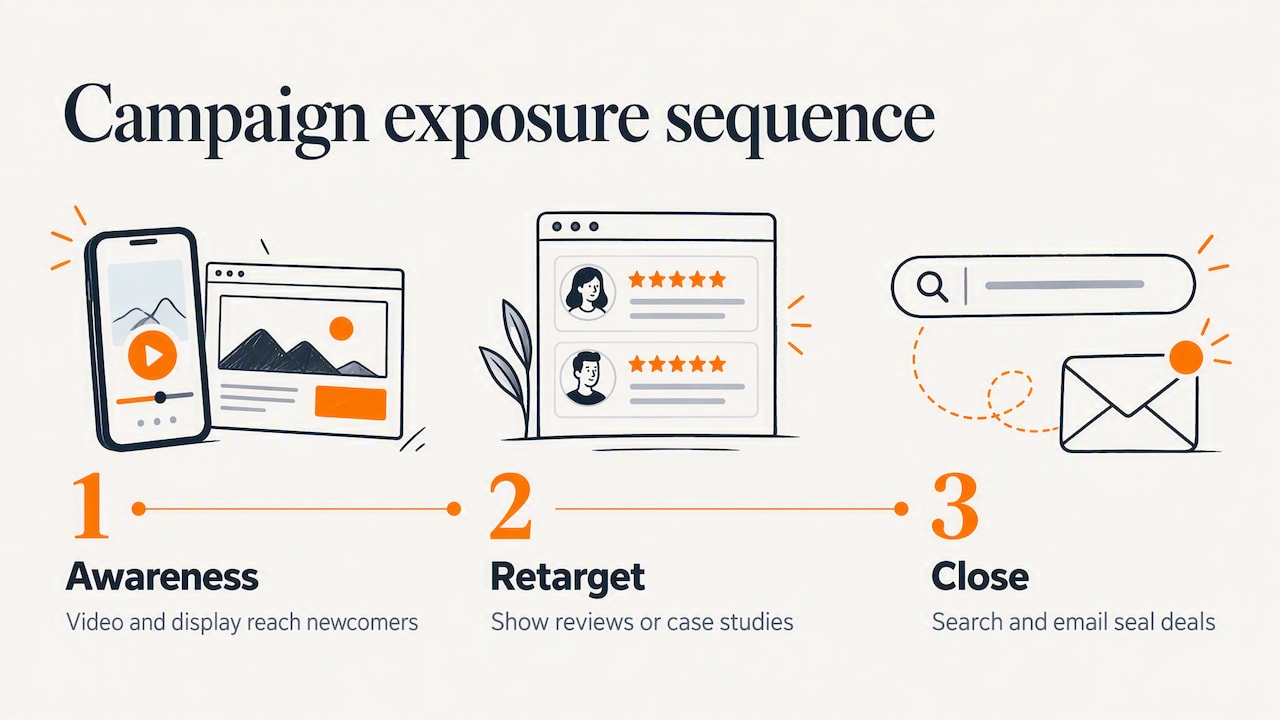
Finally, unify measurement. Use shared UTM conventions, one reporting view, and a single source of truth for conversions, so credit is not claimed by three platforms for the same sale. Hold a short weekly review where one person owns the cross-channel picture and can move budget between channels.
Targeting and segmentation best practices for each channel
Each channel offers different levers, so segmentation should follow what the channel does best.
Search: target by intent, not demographics. Group keywords by theme and buyer stage, match the ad to the query, and use audience layers such as past visitors to adjust bids.
Social: target by interest, behavior, and lookalike audiences built from your best customers. Keep audiences large enough for the platform to learn, and exclude recent purchasers.
Display and programmatic: lean on contextual placement, which targets the page topic instead of the person, along with first-party audiences and site exclusion lists.
Video and CTV: combine household or demographic targeting with content genre. Sequence messages so viewers who finish one spot see the next chapter.
Retail media: target by shopper behavior on the retailer, such as category browsing, competitor product views, and past purchases of your brand.
Email and CRM: segment on lifecycle stage, purchase history, and engagement, and use that same data to suppress or personalize ads elsewhere.
Mobile and in-app: use app category, device, and contextual signals, and plan for less user-level detail as privacy controls tighten.
Across every channel, a few rules hold. Start broad enough for the platform’s algorithm to find patterns, then narrow with evidence. Keep a clean exclusion list so you stop paying to reach existing customers. Respect privacy: collect consent, use first-party data you earned, and avoid sensitive targeting categories that platforms or regulations restrict. Review segment performance monthly, because the audience that worked last quarter may be saturated now.
Budget allocation models and optimization for multi-channel spending
There is no universal split, but a few models give a defensible starting point. The most practical is a core-and-test model: put the larger share on channels with proven, measurable returns (often search and email for conversion), and reserve a smaller share for testing awareness channels and new formats. Revisit the split every quarter based on results, not habit.
A second model works backward from the funnel. If the top of your funnel is thin, shift money toward reach channels such as video and social. If traffic is plentiful but sales are weak, move money into retargeting, email, and conversion rate fixes before buying more traffic.
A third model is margin-based, used heavily in retail media. Allocate more to products with healthy margins and stock, and cap spend on items that barely break even after ad costs.
Optimization techniques that apply to all three:
- Marginal returns: when adding budget to a channel stops improving results, you have hit diminishing returns. Move the next dollar elsewhere.
- Reallocate on a schedule: weekly for small shifts, monthly for bigger ones, so you react to trends and not to noise.
- Test incrementality: hold out regions or audiences to learn which channels truly add sales.
- Watch blended metrics: judge total cost per acquisition and revenue, not just each platform’s own report, which tends to overcount.
- Protect a learning budget: ad platforms need enough conversions to optimize, so spreading money too thin across channels can hurt all of them.
If you are unsure where to begin, start with your lowest-risk, highest-intent channel and expand from there.
Adapting creative assets and messaging for each channel
One idea, many expressions. The message stays consistent, while the format, length, and tone change with the setting and the viewer’s mindset.
Search: short, literal, and matched to the query. The headline should echo what the person typed, and the ad should promise what the landing page delivers.
Social: lead with a visual or verbal hook right away. Use native-feeling creative, such as phone-shot video, user content, and captions, because polished ads often look like ads and get scrolled past.
Display and native: display needs one image, one idea, and a clear call to action, since attention is brief. Native ads should read like useful content, with a headline that offers value and a clear paid label.
Video and CTV: tell a complete mini-story. Make short cuts for feeds and longer cuts for streaming, and design for sound-off viewing with captions.
Retail media: the listing is the creative. Strong images, accurate titles, reviews, and clear benefits sell more than any banner.
Email: a specific subject line, one main call to action, and a layout that renders on small screens.
Mobile and in-app: big tap targets, minimal text, and fast load.
Build a creative system instead of one-off ads. Produce a master concept, then break it into a set of sizes, lengths, and copy variants. Test one element at a time, such as the hook, the offer, or the image, and retire creative when frequency climbs and results fall. Strong photography and video give you more raw material to adapt, which is why we often shoot for several channels in one session through our brand management and creative photography work.
Technology and tools behind digital advertising: DSPs, DMPs, and ad verification
You do not need every tool, but you should know what each one does so you can ask good questions of vendors and agencies.
Demand-side platforms (DSPs) are the buying tools. They let you set targeting, bids, and budgets and purchase impressions across many publishers and exchanges. Programmatic display, video, and CTV usually run through a DSP.
Data management platforms (DMPs) and their modern successors, customer data platforms, store and organize audience data, from site visits to CRM records, so you can build segments and push them to ad platforms. As third-party identifiers fade, first-party data tools matter more.
Ad verification and brand safety tools check whether your ads were viewable, were seen by real people instead of bots, and ran next to appropriate content. They help you spot fraud and wasted spend, and they back up claims to clients or leadership.
Analytics and tag management tools track what people do after the click. A tag manager keeps tracking code organized, and an analytics platform ties campaigns to site behavior and revenue.
Attribution and measurement platforms compare channel contributions and support lift and incrementality studies.
Creative and testing tools help produce, version, and test ad variations quickly.
Practical advice for choosing: begin with the tools your ad platforms and analytics already provide, add specialized software only when a specific gap costs you money, and ask vendors how they handle data ownership, reporting transparency, and fees. Tools do not replace strategy. A sophisticated stack running the wrong audience or a broken conversion event simply wastes money faster.
Where we land: audience first, tools second
In our client work, we start with the buyer, not the channel. Before we touch a campaign, we ask who is buying, what moves them from first awareness to a signed contract, and how we will know it worked. That order is why our plans rarely look identical from one client to the next.
We track lead quality and conversion lift, not just clicks and impressions. A campaign that delivers many form fills from the wrong people is a failure we would rather catch early than late. Measurement comes first: tracking set up, goals defined, and a plan for what we will scale or cut.
My own view is that most teams over-invest in new channels and under-invest in fixing the ones they already run. A tighter landing page, cleaner tracking, or a better follow-up email usually beats adding another platform. The shiny channel gets the meeting; the boring fix gets the revenue.
If you do one thing after reading this, audit your conversion tracking. Confirm that every form, call, and purchase is counted correctly and tied to its source. Everything else in this guide depends on that.
— Greg
Our digital advertising channel services
If you would rather hand this work to a team that has done it before, we can plan and run it with you. Our digital marketing and advertising services are tailored to what you need:
- Need more qualified leads? Our lead generation work builds the landing pages, forms, and follow-up that turn clicks into conversations.
- Want to capture high-intent searches? Our SEO solutions and paid search management go after the queries your buyers already type.
- Building awareness across social, video, and email? We handle strategy, creative, and reporting together so messages stay consistent.
- Selling online? Our ecommerce web applications and marketplace advertising support put products in front of ready shoppers.
We bring our experience to bear on measurable results. Request a proposal at Marcy, and we will show you which two or three channels deserve your first dollar.
FAQ
What are the main types of digital marketing channels?
The main types are search (SEO and paid search), social media, display and native advertising, video and connected TV, email, content marketing, affiliate marketing, retail media, and mobile or in-app advertising. Many lists, such as Coursera’s overview of digital marketing channels, group them in similar ways.
What are examples of digital marketing channels?
Examples include Google search ads, Instagram and TikTok campaigns, banner ads on news sites, YouTube pre-roll video, streaming TV ads, Amazon sponsored products, and email newsletters. Each reaches people at a different point in their buying process.
How do I choose which digital advertising channels to use?
Match the channel to your audience and funnel stage. Use search and email to capture buyers who are ready now, and social, video, and display to reach people who do not yet know you. Start with two or three channels, set one KPI for each, and add more only after a test pays off.
Is native or display advertising better?
It depends on your goal. Research finds native ads tend to earn more clicks, while display ads build stronger brand recognition and site trust, as the Michigan Ross summary explains. Use native for traffic and display for awareness.
Sources
- Do Native Ads Work Better Than Traditional Online Ads? It Depends On What You’re Looking For | Michigan Ross
- Iab