
 614.224.6226
A realistic website project timeline runs from about 2 to 4 weeks for a basic site to 8 to 28 weeks for ecommerce, with most midsize business sites landing at 4 to 8 weeks of build time, according to a 2026 survey of more than 300 web development companies. Those numbers cover the build itself. Add the time your team needs to supply content and give feedback, and a professional redesign often lands closer to three to six months. This guide walks through each phase, what happens in it, how long it usually takes, and where schedules slip.
TL;DR
- Typical build times: basic site 2 to 4 weeks, midsize business site 4 to 8 weeks, ecommerce 8 to 28 weeks, custom web application 8 to 16 weeks.
- Phases overlap, so the durations of individual phases do not simply add up to your launch date.
- Most delays come from content, approvals and hidden dependencies, not from design or code.
- Build a 15 to 20% buffer into every milestone and name one decision-maker who signs off for your side.
- Reserve the last 3 to 5 days for final checks, fixes and launch.
Table of Contents
- What a website project timeline actually is
- The phases of a website project
- How long each phase takes
- Timelines by type of website
- Why websites run late
- How to keep your project on schedule
- The launch window
- A sample 12-week schedule
- Our perspective
- Plan your project with Marcy Design
- FAQ
- Sources
What a website project timeline actually is
A website timeline is a schedule that lays out milestones and tasks in order, with a deadline for each, from the first conversation to the day the site goes live. Atlassian’s project planning guidance describes a timeline as covering tasks, milestones, dependencies and start and end dates for the whole project.
The dependencies are what make it useful. Design cannot be approved before wireframes are, and development cannot finish before content exists. A simple way to build one:
- Meet the stakeholders and agree on goals, capacity and who approves what.
- Break the work into tasks, and split anything longer than about five days into smaller pieces so slips show up early. ONES recommends this rule of thumb for Gantt-style plans.
- Assign an owner and a deadline to every task.
- Put the tasks in order and mark which can run in parallel.
- Add buffer.
The phases of a website project
Providers slice the process differently. Capterra’s overview lists information gathering, planning, design, content creation, development, testing, launch and maintenance. ClickUp groups the same work into five: planning and discovery, design and development, testing and QA, launch, and maintenance. Whatever the labels, a custom website design process has seven working stages:
- Discovery and goals. Business objectives, audience, competitors, and what the site must do.
- Planning and information architecture. Sitemap, page list, scope, budget and schedule.
- Wireframes. Layout and navigation without color or imagery.
- Visual design. Look, typography, imagery and interactive states.
- Content creation. Copy, photography and video, written and gathered in parallel with design.
- Development. Building the templates, CMS, integrations and, for stores, the catalog and checkout.
- Testing and launch. QA, fixes, DNS changes and post-launch monitoring.
Maintenance follows launch and is ongoing rather than a phase with an end date. If you want to see how an agency walks clients through these stages, our three-part series covers part one, part two and part three.
How long each phase takes
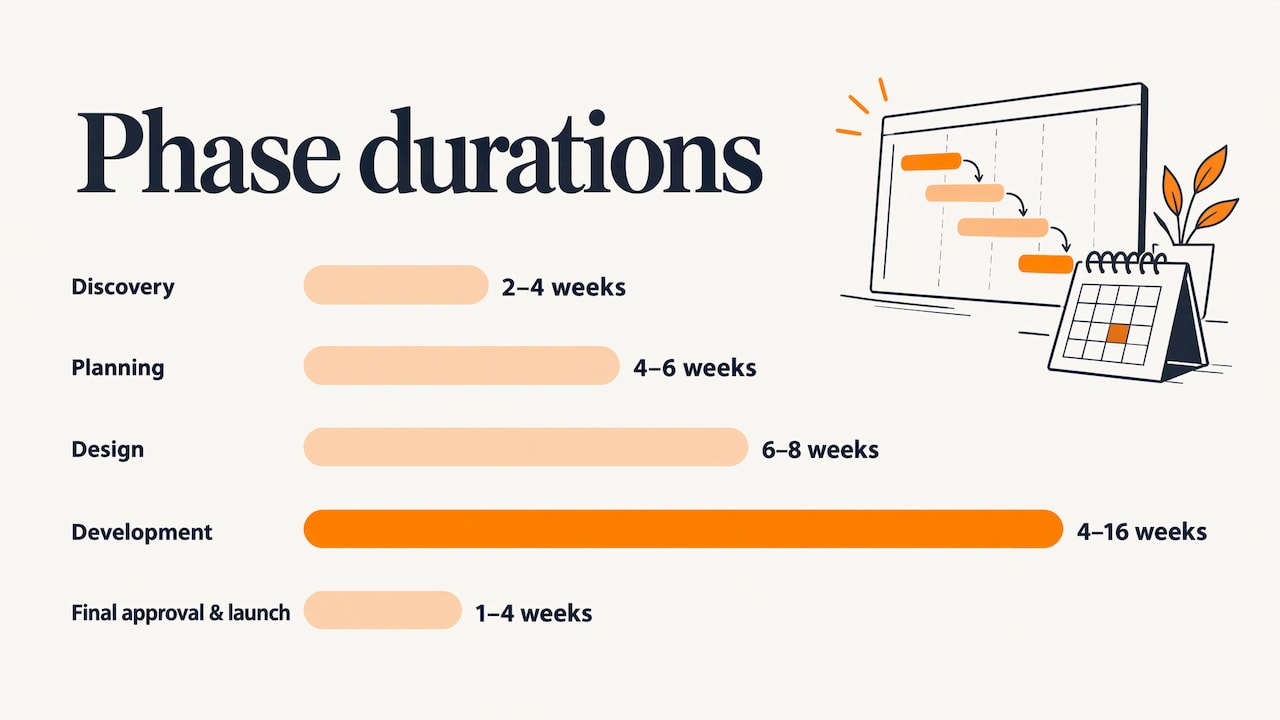
There is no single correct number, but published ranges agree on the shape. The table below combines ranges from a university web team that publishes its redesign workflow and from the 2026 Shopify guide.
| Phase | Typical duration | Source |
|---|---|---|
| Discovery | 2 to 4 weeks | University of Arkansas WEBFirst |
| Planning | 4 to 6 weeks | University of Arkansas WEBFirst |
| Design | 6 to 8 weeks | University of Arkansas WEBFirst |
| Development | 4 to 16 weeks | University of Arkansas WEBFirst |
| Final approval and launch | 1 to 4 weeks | University of Arkansas WEBFirst |
| Goal setting and IA planning | 1 to 3 weeks | Shopify |
| Low-fidelity wireframes | 1 to 2 weeks | Shopify |
| High-fidelity wireframes | 2 to 3 weeks | Shopify |
| Web development | 4 to 10 weeks | Shopify |
| Launch and final QA | 3 to 5 days | Shopify |
The university figures describe a full redesign that can take six months or more. The Shopify figures describe small to midsize sites. Both are useful: the first shows what a content-heavy site with many stakeholders looks like, the second what a focused business site looks like.
Faster estimates exist too. Bluehost’s guide puts design at 5 to 15 days, content creation at 7 to 20 days and development at 10 to 30 days for a simple site. At the other end, HubSpot says a professionally built and deployed site can take five to six months, with development alone running one to two months, or three to four if the client keeps adding changes. The gap between those estimates is mostly scope and responsiveness, not talent.
Timelines by type of website
The Shopify guide summarizes the survey of web development companies this way:
| Project type | Typical timeline |
|---|---|
| Basic website | 2 to 4 weeks |
| Midsize business website | 4 to 8 weeks |
| Ecommerce website | 8 to 28 weeks |
| Custom web application | 8 to 16 weeks |
What moves a project up or down this scale:
- Page count and templates. A 10-page brochure site and a 150-page manufacturer catalog are different projects.
- Functionality. Quote forms, customer portals, product configurators and third-party integrations each add development and testing.
- Ecommerce scope. Product volume, shipping rules, tax settings and payment setup stretch the schedule. If a store is on your list, our custom ecommerce guide for small business covers what to plan for.
- Website or web app. If you are unsure which you need, this comparison of a web app and a website will help you scope before you schedule.
- Redesign versus new build. Redesigns add content audits and redirect planning.
Why websites run late
In most late projects, the designers and developers were not the bottleneck. Waiting was. Common causes:
- Content arrives late. Copy, photos, team bios and product data are the classic holdup. Development can be finished while the site still sits empty.
- Approval loops. Each round of feedback restarts a mini-cycle. Three reviewers who disagree add weeks.
- Scope creep. New pages and features added mid-build push everything behind them.
- Hidden dependencies. Magnetic’s project timeline guide points to things like a legal review that takes 10 business days, third-party API documentation, or brand guidelines held by someone on vacation for two weeks.
- Critical path slips. On a typical build, the critical path runs from discovery through wireframes, client approval, visual design, approval, front-end development, CMS integration, content migration, QA and go-live. The same guide notes that a wireframe delay of three days delays go-live by three days unless something else is compressed.
How to keep your project on schedule
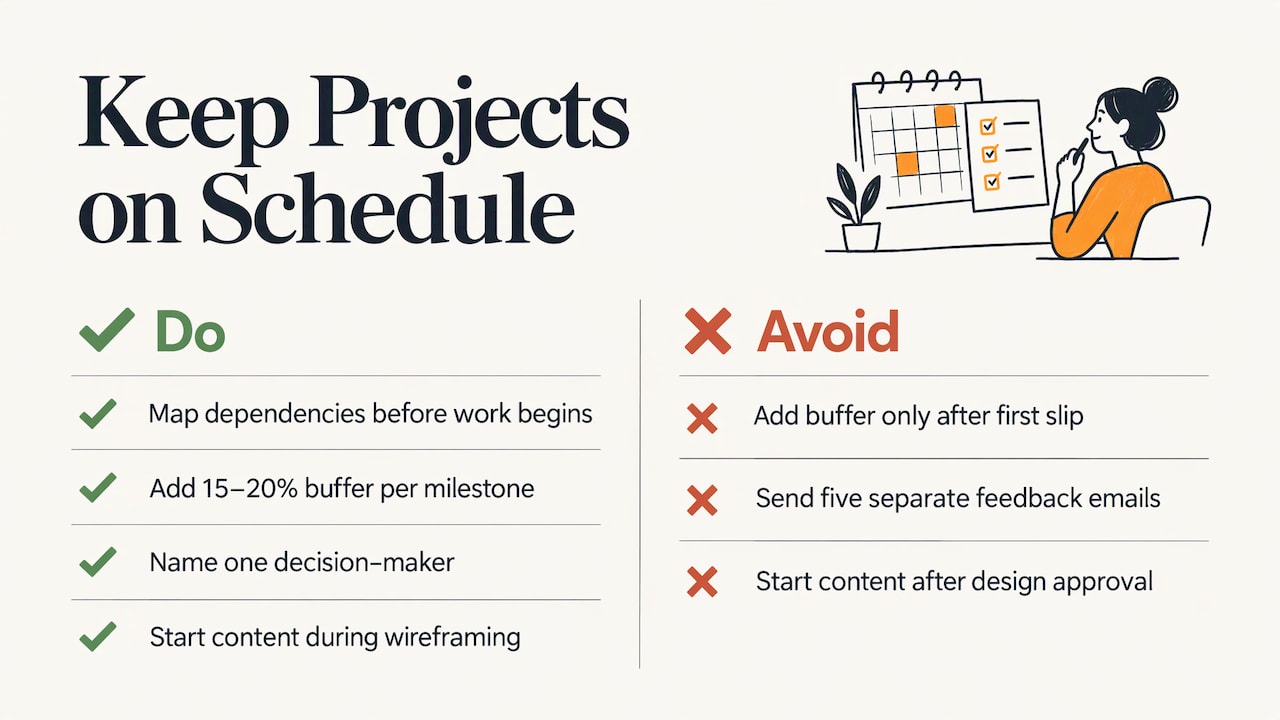
Map dependencies before work begins. ClickUp’s Manasi Nair argues that drawing out which tasks block others is where launch dates are won or lost.
Add a buffer. The same guide recommends a 15 to 20% time buffer on each milestone from day one, rather than adding it after the first slip. On a 12-week plan, that is roughly two extra weeks spread across the milestones.
Sign a scope brief. Teams that ship on time tend to work from an agreed scope, with clear limits on what is included in maintenance afterward.
Name one decision-maker. Feedback should arrive consolidated, not as five separate emails. Set a response window, such as two or three business days, for each review.
Start content early. Begin writing and photography during wireframing, not after design is approved. Our web design and marketing services include professional writing, photography and video, so content can run alongside design instead of behind it.
Agree on milestones. Four checkpoints cover most projects, as Tivazo’s planning guide lists them: wireframe approval, design sign-off, development completion and launch.
The launch window
Launch is a sequence rather than a single switch. Bitbox’s launch guide frames it as: prepare hosting, build and test on a temporary domain or staging site, plan DNS changes, run a pre-launch QA pass, update DNS, then run a post-launch QA pass.
Shopify recommends reserving three to five days for final checks, fixes and launch, and notes that domain changes can take up to 48 hours to take effect worldwide. For stores, that includes placing test orders to confirm checkout, shipping charges and order notifications.
A practical launch checklist:
- Confirm you own the domain and hosting accounts.
- Test every form, phone link and checkout flow.
- Map old URLs to new ones with redirects if this is a redesign.
- Confirm HTTPS works, the sitemap is submitted and analytics is recording.
- Check the site on current desktop and mobile browsers.
- Freeze content and code changes a week or so before go-live.
- Watch availability, errors and form submissions closely for the first few days.
After launch, plan for upkeep. Our guide to what a website maintenance plan includes explains what to expect.
A sample 12-week schedule
This is an illustration for a midsize business site, built from the ranges above, not a promise for any specific project.
| Weeks | Work | Your team’s job |
|---|---|---|
| 1 to 2 | Discovery, goals, sitemap | Interviews, access to analytics and brand assets |
| 3 to 4 | Wireframes | Consolidated feedback, wireframe approval |
| 4 to 7 | Visual design, content drafting | Design sign-off, copy and photo delivery |
| 6 to 10 | Development and CMS setup | Content review, product or service data |
| 10 to 11 | Testing and fixes | Test forms, links and pages |
| 12 | Launch and monitoring | Final approval |
Notice the overlaps: content starts before design ends, and development begins before every page is final. That is how phases compress without cutting quality.
Our perspective
In our 38 years of building websites, the schedule has rarely been decided by the technology. It has been decided by how clear the goals were on day one and how quickly decisions were made afterward.
We tailor each project to the business: a manufacturer with a large product catalog needs a different plan than a nonprofit with a donation flow or a small company that needs leads. That is why we start with discovery and a written scope, then keep design, content and development moving in parallel wherever we can.
Our advice is to treat the timeline as a shared document. When the agency and your team both know who owes what by which date, launches land on time and the site is built around measurable business results, not a deadline alone.
Greg
Plan your project with Marcy Design
If you are mapping a project now, we can help you turn these ranges into a schedule that fits your business. Marcy Design is a Columbus, Ohio agency that handles custom website design, web development, ecommerce, SEO, hosting and the content that fills a new site, so one team can keep every phase connected.

Tell us what you are building on our website design page, and we will talk through scope, milestones and what a realistic launch window looks like for you. If you are weighing budget at the same time, see our look at website redesign costs under $10,000.
FAQ
How long does it take to build a website?
A basic site typically takes 2 to 4 weeks and a midsize business site 4 to 8 weeks of build time, per the 2026 survey cited by Shopify. Ecommerce runs 8 to 28 weeks and custom web applications 8 to 16 weeks. Slow content and approvals can double those numbers.
What are the main web design phases?
Discovery, planning, wireframes, visual design, content creation, development, and testing and launch. Maintenance continues afterward. Several phases overlap, which keeps total duration shorter than the sum of the parts.
What should I have ready before a project starts?
Have your goals, a rough list of pages, brand assets, access to your current domain, hosting and analytics, and one person with authority to approve work. Starting the copy and photography early saves the most time.
Can a website launch faster than the typical timeline?
Often, yes, when scope is narrow, content is ready and feedback comes quickly. Cutting testing is the wrong way to speed up. Reserve the last three to five days for final checks.
Sources
- How Long Does It Take to Build a Website? (2026), Shopify
- Project Flow Overview, University of Arkansas WEBFirst
- Guide to the Website Development Process, Capterra
- How Long Does It Take to Build a Website in 2026?, Bluehost
- How Long Does it Take to Build a Website?, HubSpot
- How to Create Project Timelines That Work, Magnetic
- Website Project Management: Plan, Build, Launch on Time, ClickUp
- How to Create a Project Timeline, Atlassian
- How to Plan Your Website Development Project with a Gantt Chart, ONES
- How to Create a Website Project Plan, Tivazo
- How to Launch a Website: DNS, SSL, and Go-Live, Bitbox