
 614.224.6226
A content marketing strategy is a written plan for what you publish, who it helps, where it appears and how you will know it is working. Build it in this order: set a business goal, define the audience, audit what you have, choose topics and formats, schedule them, distribute them and measure the results. This guide walks through each step, then shows how pillar pages, topic clusters, a content calendar and distribution channels fit together.
TL;DR
- A content marketing strategy answers three questions: why you create content, who it is for, and how it supports a business goal.
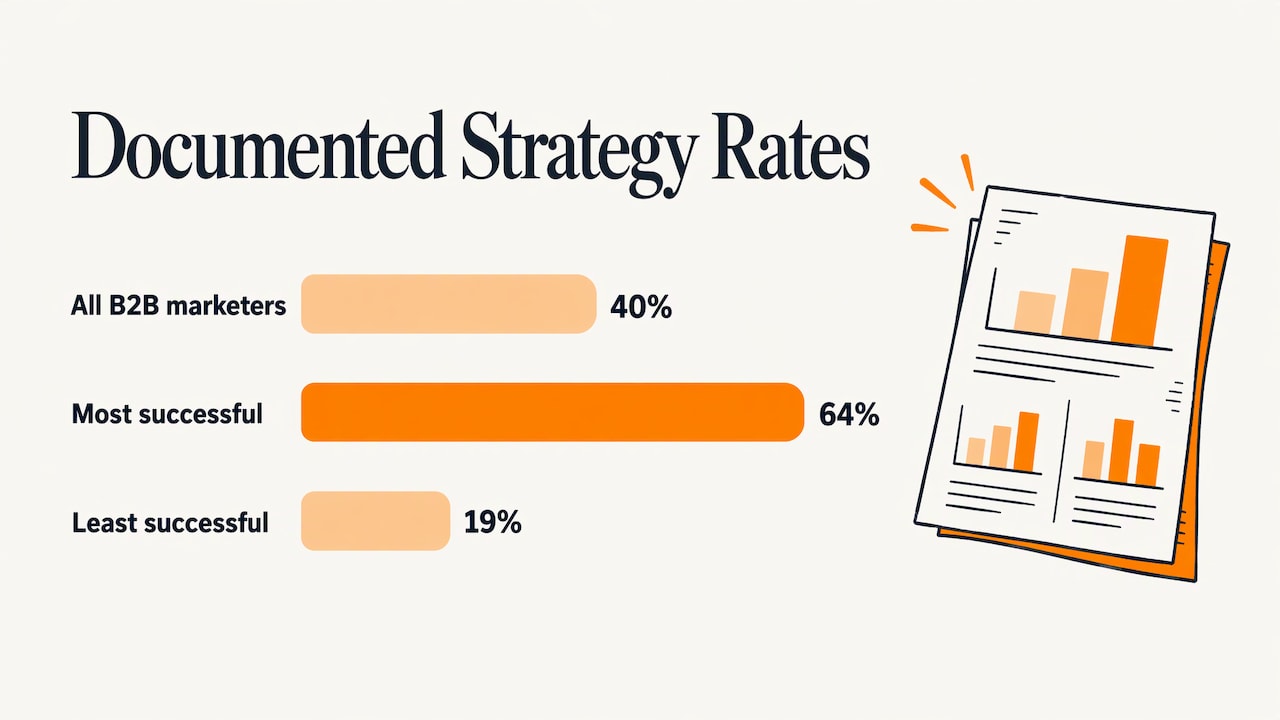
- Write it down. In one B2B benchmark report, 64% of the most successful marketers had a documented strategy, against 19% of the least successful.
- Follow seven steps: goal, audience, audit, topics and formats, calendar, creation and distribution, measurement.
- Organize your site into pillar pages and cluster posts that link to each other, and give every distribution channel one job.
- Judge content by what visitors do (leads, sign-ups, sales conversations), not by traffic alone.
Table of Contents
- What a content marketing strategy is
- Why a documented strategy pays off
- Build your strategy in seven steps
- Pillar pages and topic clusters
- Content calendar ideas that keep you consistent
- Content distribution channels
- How to measure content marketing
- Perspective
- Put your content strategy to work with Marcy Design
- FAQ
- Sources
What a content marketing strategy is
Think of it as the “why” behind everything you publish. The Content Marketing Institute describes it as why you are creating content, who you are helping, and how you will help them in a way no one else can. Organizations typically use content to build an audience and reach at least one of three outcomes: more revenue, lower costs or better customers.
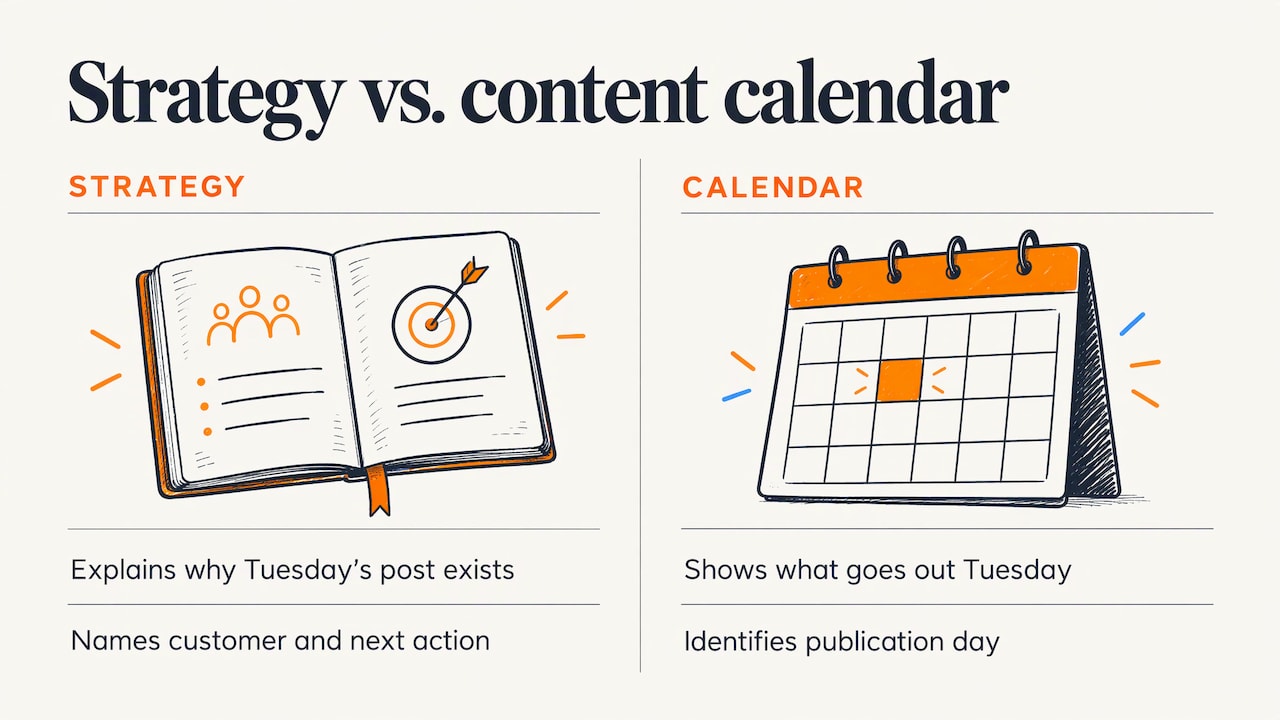
A strategy is not the same as a content calendar. The calendar says what goes out on Tuesday. The strategy says why Tuesday’s post exists, which customer it serves and what you want that customer to do next. A calendar without a strategy produces a lot of posts and very little business.
For a small or mid-sized company, a good strategy fits on a few pages. It names one or two business goals, a clear primary audience, three to five themes you can credibly own, the formats and channels you will use, who is responsible, and the handful of numbers you will review each month.
Why a documented strategy pays off
Most marketers now say they have one. The Content Marketing Institute’s B2B trends report for 2026, based on 1,015 B2B marketers mostly in North America, found that 97% have a content strategy. Of those surveyed, 61% reported improvement, and 74% of those credited strategy refinement. The same report lists the biggest challenges: creating content that prompts a desired action (40%), limited resources (39%) and measuring effectiveness (33%).
Those three challenges are exactly what a written plan addresses. A defined goal tells you which action content should prompt. A priority list tells you where limited time and budget go. A short list of metrics tells you what to measure.
The gap between documented and undocumented is wide. The 2023 B2B benchmark report found that 40% of all B2B marketers had a documented strategy, compared with 64% of the most successful and 19% of the least successful. The Content Marketing Institute adds that people with a documented strategy are far more likely to consider themselves effective, feel less challenged and are better able to justify a larger share of the marketing budget for content.
Build your strategy in seven steps
The major frameworks differ in wording but agree on the sequence. Harvard Business School Online lays out seven steps, HubSpot also uses seven, and Semrush uses eight by splitting creation from distribution. The version below keeps what a small business team can realistically run.
Step 1: Set a goal tied to the business
Start with the result you need, not the content you want to make. “Get more traffic” is not a goal. HubSpot’s example of a SMART goal is increasing organic blog traffic by 20% in a quarter by publishing two SEO-optimized posts per week. It is specific, measurable and has a deadline.
For a B2B company, the goals that usually matter are qualified inquiries, proposal requests, booked consultations or ecommerce orders. Pick one primary goal. A second one is fine. Five means none of them get done.
Step 2: Define the audience
Write down who you are helping, using real data. HubSpot advises using CRM data or buyer-persona research to understand the audience. If you have no CRM, use your last 20 customers: what job titles did they hold, what problem sent them looking, what did they search for, what objections did they raise on the sales call?
Those objections are your best content topics. A manufacturer’s buyer may ask how long a redesign takes, how a new site affects existing search rankings or how ordering will work online. Each question is an article.
Step 3: Audit what you already have
Before you create anything, list your existing pages, posts, case studies, brochures and videos. Mark each one as keep, update, merge or retire. Most companies find that a few older pages already bring in most of their search traffic and that several topics are covered three times in slightly different ways.
The audit also shows your gaps. If you have plenty of content for people who already know you and none for people comparing options, that is where new work goes first.
Step 4: Choose topics, formats and your angle
Pick three to five themes that sit where your expertise meets customer questions. Then pick formats. Harvard Business School Online’s guidance is that the right format is the one that lets you tell your story and suits your target customer. Written guides suit search. Video suits products that need to be seen. Case studies suit long, risky buying decisions.
Content should also highlight what makes you different, because your competitors are chasing the same customers. A generic “5 tips” article could come from anyone. A walkthrough of how you actually solved a customer’s problem could only come from you.
Keyword research belongs here. For each theme, list the phrases customers type, check which ones fit your goal, and group them. Those groups become the pillar and cluster structure described below.
Step 5: Build the calendar and assign owners
Turn topics into a schedule with names and dates. The next sections cover calendar mechanics. The key rule is to plan only what the team can sustain. Six strong pieces a month beat twelve rushed ones.
Step 6: Create, publish and distribute
Creation is where most strategies stall, so decide your workflow up front: who drafts, who reviews, who approves, who publishes. If AI tools are part of your process, build the review steps in. Our guides on AI content workflows and an AI content creation framework for small business cover how to do that without losing your voice.
Publishing is half the job. Every piece needs a distribution plan before it goes live, covered below.
Step 7: Measure and refine
Review results monthly against the goal from step 1, and revisit the whole strategy at least once a year. If a theme brings traffic but no leads, change the call to action or the topic. If a format consistently outperforms, make more of it.
Pillar pages and topic clusters
A pillar and cluster structure is how you turn a pile of posts into something search engines and readers can navigate. HubSpot explains that content is organized into topic groups, each anchored by a pillar page that covers the topic broadly and links to blog posts targeting related long-tail keywords. The cluster posts link back to the pillar.
Search Engine Land describes it as a hub and spokes model. The pillar page defines the main topic and the reader’s intent. The cluster pages explore closely related subtopics in depth. Contextual internal links with descriptive anchor text connect them. Backlinko adds that this structure helps search engines understand how your content relates, which should help rankings.
A simple example
Say you sell custom ecommerce to manufacturers. Your pillar could be a complete guide to B2B ecommerce. Cluster posts would cover pricing models, account-based ordering, integrations and site design. Our own pieces on B2B ecommerce strategy and B2B ecommerce web design are the kind of cluster content that supports a pillar like that.
What makes a pillar page work
HubSpot’s pillar page guidance recommends:
- A definition of the topic in the first section.
- A bulleted or numbered table of contents.
- A more specific, topic-related keyword in each subheading.
- An overview of each subtopic rather than an exhaustive treatment, since the depth lives in the cluster pages.
Semrush adds that effective pillar pages are evergreen, easy to scan, mix in formats such as video or infographics, use relevant calls to action and link out to cluster pages that link back. Pillar pages need updating, so put a review date in your calendar.
Local and service businesses can apply the same idea geographically. Our guide to location pages for SEO shows how to build pages for each market you serve.
Content calendar ideas that keep you consistent
A calendar is where the strategy becomes routine. The American Marketing Association’s toolkit is a spreadsheet-based planner with yearly, monthly and weekly views and a content repository. You do not need special software, though. A spreadsheet works if it tracks date, channel, format, topic, goal, owner and status, which is the setup CMO Owls recommends.
Ideas for what to put in it
- One goal per month. Dedicate each month to a single objective, such as lead generation in one month and customer education in the next.
- Real demand. Source topics from search data, sales call questions and support tickets.
- Customer stories. Case studies, before-and-after results and project walkthroughs.
- Seasonal hooks. Planning cycles, trade shows, budget season and slow periods in your industry.
- Updates. Schedule refreshes of your best-performing older pages alongside new posts.
- Behind the scenes. Team, process and photography or video from real projects.
How often to publish
Search Engine Land’s content calendar guide gives baseline frequencies: blog posts two to three times a week, social media daily, and newsletters weekly or monthly depending on resources. Treat these as a ceiling for well-staffed teams. A small team should choose a pace it can hold for a year.
One technique helps most. CMO Owls’ Michelle Joseph recommends making one substantial piece and cutting it down for each channel rather than starting from a blank page each day. A single guide can become a short video, several social posts, an email and a handful of quotes for a sales deck.
To keep the mix balanced, one editorial planning guide suggests spacing rules: at least two days between posts in the same pillar and at least 60 days between posts targeting the same keyword. That prevents the calendar from drifting into repetition.
Content distribution channels
Publishing without distribution is the most common waste in content marketing. HubSpot sorts channels into three groups:
| Channel type | What it includes | Best for |
|---|---|---|
| Owned | Website, blog, email newsletters, social accounts, push notifications | Reaching people who already know you and converting visitors |
| Earned | Media mentions, backlinks, social shares, podcast appearances, community posts | Authority and reach beyond your audience |
| Paid | Sponsored content, paid social, PPC ads pointing to content | Speed, and testing which topics resonate |
Hootsuite names social media, search, influencers and creators, and email as core channels, and reports that 61% of consumers said they found a new brand or product on social media in the past year. Its advice is practical: choose channels based on your goal and audience, give each channel a job, and measure against that job. For example, track backlinks and brand mentions if the job is authority, and clicks and referrals if the job is traffic.
For most B2B companies, a workable starting set looks like this:
- Search for people actively looking for answers, served by pillar and cluster pages.
- Email for nurturing leads and customers, using your best content as the backbone of a regular send.
- LinkedIn or the social network where your buyers are for reach and credibility.
- Sales conversations, where the right article or video answers an objection and shortens the cycle.
Start with two or three channels and do them well before adding more.
How to measure content marketing
The Content Marketing Institute’s measurement framework groups metrics into five stages. The examples below are drawn from it.
| Stage | Example metrics |
|---|---|
| Awareness | Website traffic, social impressions, video views, search visibility |
| Engagement | Organic search clicks, social engagement rate, scroll depth, downloads |
| Consideration | Direct subscribers, return visitors, content shares, brand search increase |
| Conversion | Lead form completions, content-assisted conversions, sales cycle length |
| Retention and advocacy | Customer content engagement, expansion revenue, retention rate |
You do not need all of them. Pick one or two per stage that match your goal. Then follow HubSpot’s Ramona Sukhraj, who advises tracking what traffic does, not just how much there is: a post with 10,000 visits and no conversions is worth less than one with 1,000 visits and 50 email sign-ups.
Search results take time. Give new content a few months before judging it, and look at trends rather than single weeks.
Perspective
We have spent more than 38 years helping businesses in Columbus and beyond build their brands, and the pattern we see most often is simple: companies publish content before they decide what it is for.
A strategy does not need to be elaborate. It needs a goal, a customer you understand and a website that turns attention into a conversation. That last part matters as much as the content itself. A great article on a slow, confusing site wastes the effort that went into it, which is why we treat content, design, development and SEO as one job rather than four.
Our approach is to start from the business result, then choose the mix of writing, photography, video, email and search work that gets there, and measure it. For manufacturers, nonprofits, veteran-owned businesses and growing small companies, the best content is the kind only you could write, because it comes from what you actually know and do.
Greg
Put your content strategy to work with Marcy Design
If you would rather have a team build and run this with you, we offer digital marketing, professional writing, photography, video production, SEO solutions and lead generation from our Columbus, Ohio office. We build the strategy around your goals, then create the content and the website it points to.

To talk through your situation, book a free consultation. You can also read how we think about content marketing.
FAQ
What are the 7 steps in creating a content strategy?
The steps are: define goals, identify your target audience, audit existing content, choose topics and formats, build a calendar, create and distribute content, and measure and optimize. Harvard Business School Online uses a very similar seven-step sequence. Frameworks from other publishers reorder or split a step or two, but the logic is the same.
How long should a content marketing strategy be?
Long enough to answer who, what, why and how, and short enough that your team reads it. For most small businesses that means a few pages covering the goal, audience, themes, formats, channels, owners and metrics. Write it down and revisit it at least once a year.
What is the difference between a pillar page and a topic cluster?
The pillar page is the broad, central guide to a topic. The topic cluster is the whole set: the pillar plus the detailed posts that cover subtopics and link back to it. Search Engine Land calls this a hub and spokes model.
Which content distribution channels should a small business start with?
Start with two or three: search through your own site, email to your leads and customers, and one social network where your buyers spend time. Give each a clear job and measure it against that job. Add paid promotion once you know which topics resonate.
Sources
- Developing a Content Marketing Strategy, Content Marketing Institute
- B2B Content and Marketing Trends: Insights for 2026, Content Marketing Institute
- 2023 B2B Content Marketing Benchmarks, Budgets and Trends
- How to Create a Content Strategy That Drives Results, Harvard Business School Online
- How to build a content marketing plan in 7 steps, HubSpot
- The ultimate guide to creating a content marketing strategy, Semrush
- How to Structure Your Editorial Calendar with Pillar and Cluster, HubSpot
- Topic clusters and pillar pages for SEO, Search Engine Land
- Pillar Pages: How to Create One, Backlinko
- How to Create a Pillar Page, HubSpot
- What Is a Pillar Page and How to Create One, Semrush
- Content Marketing Editorial Calendar Toolkit, American Marketing Association
- How to Create a Content Calendar, CMO Owls
- How to make a content calendar, Search Engine Land
- Editorial mix: how to plan a balanced content calendar, Wavefront
- Content distribution strategy, Hootsuite
- 5-Step Content Marketing Measurement Framework, Content Marketing Institute