
 614.224.6226
Video marketing for business works when each video has one job, one audience and one next step. Start with a goal such as more qualified inquiries, pick the two or three video types that serve it, publish them where your buyers already spend time, and measure the result against that goal. A professionally produced video that lives on your own website and in your sales conversations usually earns more than a dozen clips posted at random.
This guide is written for owners and marketing leads at small businesses, manufacturers, nonprofits and ecommerce companies who want a plan they can act on, not a theory lecture. It covers strategy, video types and ideas, distribution and measurement, and what drives the cost of a marketing video.
TL;DR
- Video marketing means using video to reach business goals: explaining what you sell, building trust and moving buyers toward a call or a purchase.
- A strategy is a short plan: goal, audience, video types, channels, and the numbers that show whether it worked.
- Begin with an explainer or product demo, a company story video and customer testimonials. Add more only when those are working.
- Distribute through channels you own first (website, email), then social and paid placements where your buyers are.
- Budget depends on length, locations, people on camera, script, editing and how many versions you need, so scope before you shop.
Table of Contents
- What video marketing is and why it pays off
- Build a video marketing strategy in six steps
- Types of marketing videos and when to use each
- Business video ideas that fit your situation
- Video distribution: where to publish and how to choose
- Measuring results
- What affects the cost of a marketing video
- Our perspective
- Work with Marcy Design on your video marketing
- FAQ
- Sources
What video marketing is and why it pays off
Video marketing is the use of video content to promote a business, product or service and to support goals such as engagement, traffic and sales. Adobe’s guide to video strategy describes it as a way to build human connection, bring in organic traffic and support conversions, and notes that video conveys emotion in a way text struggles to match.
For a business buyer, that matters in practical ways. A purchasing manager comparing three machining shops, a school board comparing software vendors, or a homeowner choosing a contractor all want to know who they would be dealing with and whether the company is real. A two-minute video answers that faster than a page of copy. Search Engine Journal’s overview of video marketing points out that, with strong storytelling and the right platforms, video can help a business reach more people, stand out in a crowded market and build thought leadership.
The point is not to “do video” because competitors do. It is to remove the specific doubts that stop a prospect from contacting you.
Build a video marketing strategy in six steps
A video marketing strategy is a plan for what you will make, who it is for, where it will run and how you will judge it. It does not need to be long. One page is enough, and it can change as you learn.
1. Set a goal you can measure
Pick one primary goal per video or campaign. Common ones: more contact form submissions, more qualified quote requests, more product page conversions, more event registrations or donations. TechTarget’s video strategy guide recommends SMART goals: specific, measurable, achievable, realistic and time-bound. “Generate 20 more quote requests from the website in six months” is a goal. “Get more exposure” is not.
If you are not sure how to tie marketing activity to revenue, our guide to measuring marketing ROI walks through the logic.
2. Define the audience and the question they are asking
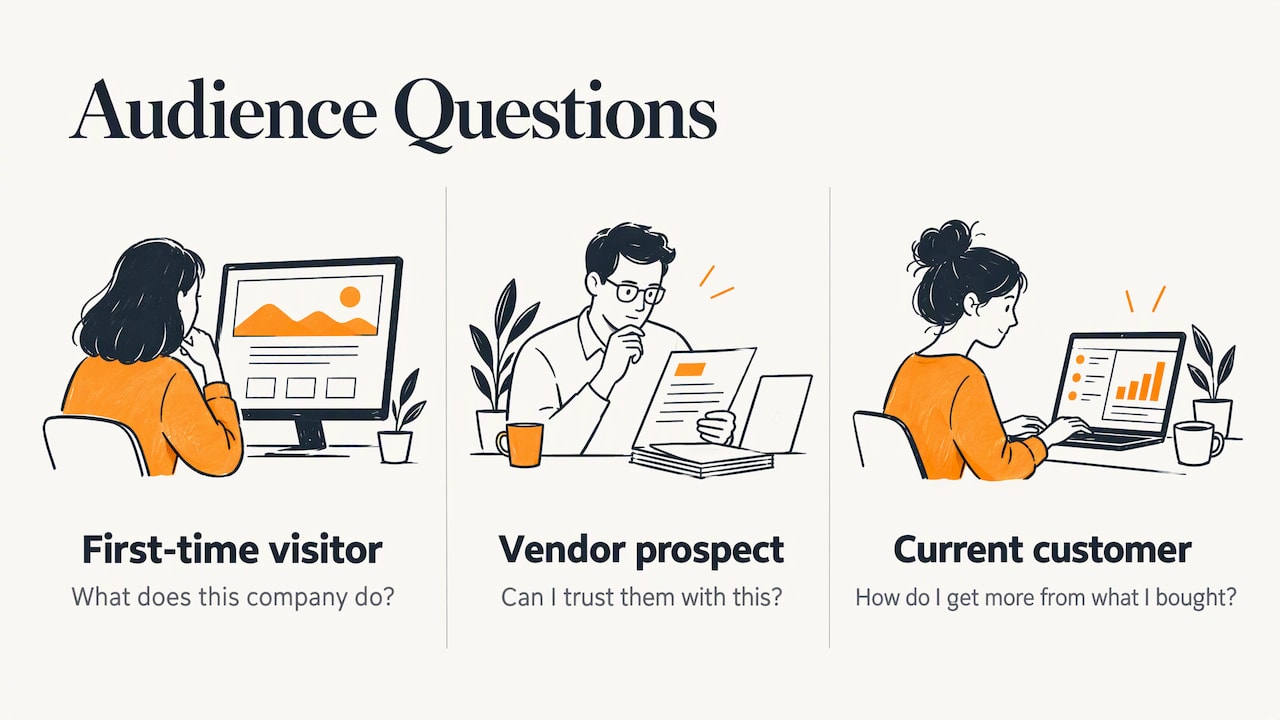
Write down who the video is for and the one question on their mind at that moment. A first-time visitor asks, “What does this company do?” A prospect comparing vendors asks, “Can I trust them with this?” A current customer asks, “How do I get more from what I bought?” Each needs a different video.
For B2B companies, the audience is often several people: the user, the technical reviewer and the person who signs. A manufacturer might make one video for engineers showing capabilities and tolerances, and another for executives showing delivery reliability and customer outcomes.
3. Choose video types that fit the goal
Match the format to the stage of the buying journey. The next section gives a table. Resist making ten formats at once. Two or three done well beat ten done thinly.
4. Plan the message, script and call to action
Every video needs a single clear action at the end: call, request a quote, download a spec sheet, book a demo. Write the script around the viewer’s problem, not your company history. Keep it as short as the message allows. A product explainer might run 60 to 90 seconds; a customer story can run a little longer because viewers who stay are already interested.
Plan for reuse at this stage. One shoot day can produce a full-length video for your website, a 30-second cut for social, a short clip for email and stills for sales materials, but only if you plan the shots for all of them in advance.
5. Decide where the videos will live
Choose channels before you shoot, because they affect format: vertical for social feeds, horizontal for websites and YouTube, captioned for sound-off viewing. The distribution section below covers how to choose.
6. Decide how you will measure success
Name the numbers before launch and the date you will review them. More on this in the measurement section. A strategy does not have to be perfect on day one. MarketingProfs notes that it can evolve, and that a framework simply helps you start in the right direction.
For how video fits into the wider plan, see our content marketing strategy guide.
Types of marketing videos and when to use each
The right type depends on where the viewer is in their decision. This table matches formats to goals.
| Video type | Best for | Typical placement | Example for a B2B company |
|---|---|---|---|
| Brand or company story | Building trust, showing people and values | Home page, About page, LinkedIn | Founders and team explain how the company started and what it stands for |
| Explainer | Clarifying what you do or sell | Home page, service pages, ads | A 90-second walkthrough of your service and who it is for |
| Product demo | Helping buyers evaluate | Product pages, sales emails | Equipment or software shown in use, with real results |
| Testimonial | Reducing perceived risk | Service pages, proposals, social | A customer describes the problem, the work and the outcome |
| Educational or how-to | Attracting searchers, proving expertise | YouTube, blog posts, email | A short guide to choosing the right material or vendor |
| Behind the scenes | Humanizing the business | Social, careers page | A tour of the shop floor, studio or office |
| Live video | Real-time engagement | LinkedIn, Facebook, YouTube | A Q&A with your engineers or a launch event |
This list of formats matches the standard set that marketing publishers describe: brand, live, testimonial, educational, demo, explainer and behind-the-scenes videos. Which to start with is a judgment call, but the first video many experts suggest is a plain explainer, so that new visitors do not leave your site unsure what you do. A company story video with real team members on camera comes close behind, because buyers often decide on emotion and then justify the choice with logic.
Business video ideas that fit your situation
Ideas get easier when you start from the questions your sales team hears. Here are concrete starting points by type of organization.
Small businesses with a local customer base
- A “meet the owner” video that explains why you started the company and what you promise customers.
- A short tour of how a typical project goes from first call to finished work.
- Two or three customer testimonials filmed on location, in the customer’s own words.
- Answers to the five questions you get asked most before every sale.
Manufacturers and industrial companies
- A capabilities video showing equipment, certifications in practice and quality checks.
- A process video following one part from order to shipment, which shows reliability better than a claim can.
- Customer case studies that name the problem, the solution and the measurable result.
- Short technical explainers for engineers, hosted on the relevant product page.
- A video brochure for trade shows and sales follow-up. A video brochure puts a short film into a physical piece you can hand to a prospect.
Ecommerce companies
- Product demos on each key product page, showing size, use and details photos cannot.
- Unboxing or setup videos that cut down on returns and support questions.
- Short social clips pointing to bestsellers and seasonal items.
Nonprofits
- A mission video showing the people you serve and what a donation or volunteer hour accomplishes.
- Impact updates for donors, sent by email.
- Event recaps and volunteer stories that make the next event easier to fill.
If you want one place to begin, put a well-made video on your most visited page. Our article on adding video to your website explains why that placement does so much work, and a look at an ultimate business website video shows the idea in practice.
Video distribution: where to publish and how to choose
A video nobody sees does nothing. Distribution is the plan for getting each video in front of the people it was made for. Channels fall into three groups:
- Owned: your website, email list and your own social profiles. You control these and they cost the least to use.
- Paid: ads on social platforms and YouTube, or sponsored placements. Paid reach lets you target a defined audience quickly.
- Earned: shares, mentions and embeds by customers, partners and the press. You cannot buy these, but good testimonial and educational videos encourage them.
How to choose channels
The Content Marketing Institute advises basing the distribution plan on your audience, testing videos on the platforms they use, and concentrating on the channels that attract them, hold their attention and prompt a response to your call to action. In practice:
- Start on your website. Visitors who have already found you are the warmest audience you have. Place the explainer near the top of the home page and demos or testimonials on the pages where decisions happen. Fast-loading, well-built pages matter, and our website design work treats video placement as part of the layout, not an afterthought.
- Use email. A short video in a sales follow-up or customer newsletter reaches people who already know you.
- Pick one or two social platforms. For B2B, LinkedIn is the usual home for thought leadership and company stories. YouTube suits how-to and educational content that people search for. Facebook and Instagram suit local businesses and consumer-facing ecommerce. Our social media services page describes how campaigns across these platforms come together.
- Add paid promotion to proven videos. Put budget behind a video once it has shown it holds attention organically.
A simple distribution routine
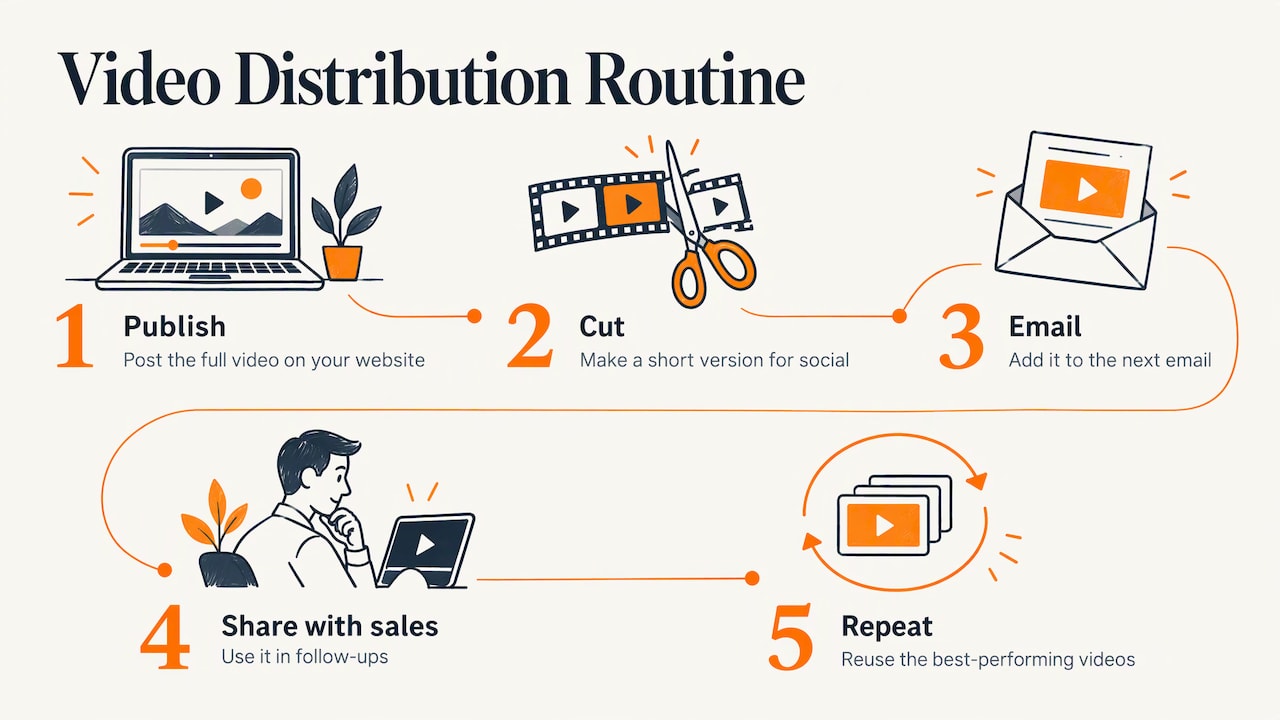
For each new video: publish the full version on your website, cut a short version for social, add it to the next email, and share it with your sales team so they can use it in follow-ups. Repeat the best-performing videos rather than constantly making new ones.
Measuring results
Measure against the goal you set, not against vanity numbers. A sensible set of metrics:
- Reach and views: how many people saw it.
- Watch time and completion rate: whether viewers stay, and where they drop off. If most people leave at ten seconds, the opening needs work.
- Engagement: likes, comments and shares, useful mainly as a sign the message resonates.
- Click-through rate: how many viewers clicked your call to action.
- Conversions: form submissions, calls, purchases or donations that followed a view.
- Return on ad spend: for paid videos, revenue or leads produced for each dollar spent.
Check day-one performance, then review weekly or monthly depending on how fast the campaign moves. Change one thing at a time, such as the thumbnail, the first five seconds or the call to action, so you know what caused any change. Ask your sales team, too: “I watched your video” in a first call is data that analytics will not show.
If you want help connecting video numbers to lead and revenue reports, our lead generation services are built around that link.
What affects the cost of a marketing video
There is no single price for a marketing video, because the scope varies so widely. A talking-head testimonial shot in one hour is a different project from a multi-location brand film with animation. The main cost drivers are:
- Length and complexity: more minutes and more scenes mean more shooting and editing.
- Script and concept development: the planning stage that keeps the video focused and on message.
- Crew, equipment and locations: lighting, audio, camera operators and travel.
- People on camera: staff, customers or hired talent, plus scheduling.
- Graphics, animation and music: motion graphics, captions and licensed tracks.
- Versions and formats: cutting a long video into vertical clips, short cuts and captioned versions.
- Distribution: hosting, embedding on your site, and any paid promotion.
Planning saves money. A clear script, a shot list and a single round of consolidated feedback reduce reshoots and editing hours. Ask for a quote based on a written scope, and decide in advance how many finished versions you need. To discuss a specific project, you can talk to our team about video production in Columbus, Ohio.
Our perspective
Video is most valuable when it is part of the business website and the sales process, not a separate project that gets posted once and forgotten. In more than 38 years of building brands, websites and marketing programs, we have seen that the work that performs is the work that starts with the customer’s question and ends with a clear action.
That is why we treat video as one piece of a connected plan: the website where it lives, the search visibility that brings viewers to it, the social and email channels that carry it, and the reporting that shows what it produced. A beautiful film that is hard to find or has no call to action does not help the business. A focused two-minute video on the right page, tied to a measurable goal, can.
For small businesses, manufacturers, ecommerce companies and nonprofits, our approach is tailored solutions and user-focused design with measurable business results in mind. We plan the video around your goal first, then produce it so that it serves your website, your sales team and your campaigns.
Greg
Work with Marcy Design on your video marketing
Marcy Design is a Columbus, Ohio-based agency with more than 38 years in business and over 230 awards. We offer video production, video brochures, website design, SEO, social media and lead generation, so your video, the page it sits on and the campaign that promotes it can be planned together. Explore our video production work, or see everything we do on the Marcy Design home page.

Tell us what you want video to achieve, and we will help you shape a plan around it.
FAQ
How much does a marketing video cost?
It depends on length, script, crew, locations, people on camera, graphics and the number of versions you need. A simple testimonial costs far less than a multi-location brand film. The most reliable way to get a number is to write down your goal, audience and where the video will run, then request a quote against that scope.
Which platform is best for video marketing?
The best platform is the one your buyers already use. Your own website and email are the strongest starting points. For B2B, LinkedIn suits company stories and thought leadership, YouTube suits educational and how-to content, and Facebook and Instagram suit local and consumer-facing businesses.
What is a video marketing strategy?
It is a plan that sets out your goal, your audience, the types of video you will make, the channels you will publish on and the metrics you will use to judge results. Keep it to a page and update it as you learn what your audience watches.
What kind of video should a business make first?
Most businesses should start with an explainer that shows what you do and who it is for, placed on the home page. A company story video with your real team and a customer testimonial are strong next steps because they build trust with new prospects.
Sources
- A full-funnel approach to video marketing strategy (Adobe)
- Video Marketing: An In-Depth Guide For Every Business Owner (Search Engine Journal)
- Create a video marketing strategy in 10 steps (TechTarget)
- How to Create a Video Marketing Strategy (MarketingProfs)
- How To Create a Video Strategy for Now and the Future (Content Marketing Institute)