
 614.224.6226
Omnichannel marketing means every channel your customer touches, your website, email, social media, ads, phone and showroom, works as one connected experience instead of separate campaigns. The customer’s history travels with them, so a visitor who browsed a product on your site sees a relevant email, not a generic one, and the salesperson they call already knows what they looked at. For a small business or a manufacturer, the starting point is almost always the same: a website that is built to connect to everything else.
TL;DR
- Omnichannel marketing links your channels so the customer experience stays consistent and context carries from one touchpoint to the next. Multichannel marketing simply runs several channels side by side.
- You do not need every channel. Small companies do better with a short, audience-relevant mix, connected well, than with a presence everywhere.
- The website is the hub: it captures the data, hosts the offer and receives the traffic from email, search, social and ads.
- Pick one or two measurable goals before launch, and compare results channel by channel against a baseline.
- Build in stages: audit, map the journey, connect data, then add channels.
Table of Contents
- What omnichannel marketing means
- Omnichannel vs. multichannel marketing
- The five qualities of a good omnichannel experience
- The omnichannel customer journey
- Omnichannel marketing examples
- Why it pays: benefits and what to expect
- How a small business builds an omnichannel strategy
- A sensible order of work
- Common mistakes
- The three-three-three rule
- How Marcy Design can help
- FAQ
- Sources
What omnichannel marketing means
The word sounds like jargon, but the idea is practical. McKinsey describes omnichannel marketing as integrating physical stores, websites, social media, email, apps, text messages and other spaces so customers are served according to their preferences and needs, with a unified, consistent experience throughout.
Two parts of that definition matter most for a business owner:
- Integration. The channels share information. What a customer does in one place shapes what they see in the next.
- Consistency. The brand, offer, pricing and tone are the same whether the customer finds you on Google, in an email or at your front desk.
If your email newsletter promotes one offer, your Facebook page promotes another, and your website shows a third, you are marketing in several places. You are not marketing omnichannel.
Omnichannel vs. multichannel marketing
This is the question most readers arrive with. According to McKinsey, multichannel marketing tends to revolve around products, and its channels are not linked, so the customer experience often differs by channel. Omnichannel revolves around the customer and links the channels together.
| Multichannel | Omnichannel | |
|---|---|---|
| Starting point | The product or the channel | The customer and their journey |
| Channels | Run separately | Connected, sharing data |
| Message | Often differs by channel | Consistent, adapted to each channel |
| Customer switching channels | Starts over | Picks up where they left off |
| Success measured by | Results per channel | Results across the whole journey |
The Nielsen Norman Group, a research firm focused on user experience, puts it plainly: being present on every channel is no longer enough. Multichannel is not omnichannel. The difference lies in designing the right experience on each channel and designing the handoffs between them.
The five qualities of a good omnichannel experience
The same NN/g article names five components of a successful omnichannel experience. They make a useful checklist for a small team:
- Consistent: a cohesive experience across all channels.
- Optimized: each channel is suited to its device and context, so a phone page is not a shrunken desktop page.
- Seamless: moving from one channel to another is effortless.
- Orchestrated: personalized interactions arrive at the right time, without the customer asking.
- Collaborative: channels can work at the same time, for example using your phone to sign in on a desktop site.
Most small businesses are already decent at the first one and weak at the third. A customer fills in a quote form, then gets a sales call that asks them to repeat everything. That is the gap omnichannel work closes.
The omnichannel customer journey
The customer journey is the path from first hearing about you to buying, and then to coming back and recommending you. A common five-stage model, described by a customer-experience technology company, looks like this:
| Stage | Typical channels |
|---|---|
| Awareness | Search, social media, ads |
| Consideration | Website, reviews, email, chat |
| Decision | Ecommerce checkout, app, store, text message, phone |
| Retention | Email, text, support, app messages |
| Advocacy | Reviews, referrals, social media, loyalty programs |
Customers do not move through these stages in a straight line. They jump around, and a prospect may interact with a company many times before buying. The practical job is to make sure the next touchpoint knows what happened at the last one.
Here is what that looks like for a company selling to other businesses, such as a regional manufacturer:
- A purchasing manager searches for a part and lands on a product page (search, awareness).
- They download a spec sheet and give an email address (website, consideration).
- A short email sequence follows with related products and a case study (email, consideration).
- They request a quote through a form, and the sales rep sees the pages they viewed and the sheet they downloaded (decision).
- After delivery, a follow-up message offers reorder options (retention).
None of this requires exotic technology. It requires one place where the customer’s actions are recorded and a plan for what happens next.
Omnichannel marketing examples
Examples from large companies show the principle. Examples from small ones show how to apply it.
Large brands
- Chase. Marianne Lake, CEO of consumer and community banking at JPMorgan Chase, said in June 2026 that omnichannel is the winning answer in the U.S., describing how branches lift digital production and vice versa.
- CarMax. In August 2025 the retailer repositioned its brand around omnichannel, replacing a 20-year tagline so it could stand apart from rivals that are either online-only or brick-and-mortar, and stressing that customers can move between store and online shopping as they prefer.
A local retailer
A U.S. small-business guide from PayPal outlines a retailer using an online store, mobile app, social media, email, in-store digital signage, pickup, loyalty, customer support and remarketing together. In plain terms: a shopper sees a post, visits the site, leaves a cart, gets a reminder email, picks the item up in store, and later earns loyalty rewards for it.
A service company or manufacturer
For a company with long sales cycles, the same logic looks different but works the same way:
- Search ads and organic search bring buyers to a service or product page.
- A form captures the lead and routes it to a named person.
- Email follows up with content matched to what the lead viewed.
- Social and retargeting ads keep the brand in front of people who visited but did not inquire.
- The sales team records every conversation where marketing can see it.
The common thread is a shared record of the customer, not a long list of platforms.
Why it pays: benefits and what to expect
The American Marketing Association reports benefits including stronger loyalty, personalization, convenience, better customer service and higher spending, and cites 41% higher purchasing among multi-channel consumers than single-channel buyers. The AMA also notes that service improves when customer history is available across channels, because staff can resolve issues without making customers repeat themselves.
The work involved is real, and it is mostly organizational rather than technical:
- Unifying data. Customer information often sits in separate tools: the website, the email platform, the accounting system.
- Keeping messages consistent. Someone has to own the brand voice and offers across channels.
- Older systems. Legacy software may not share data easily.
- Rushed technology purchases. Buying a platform before deciding the plan is the common mistake.
Measurement deserves its own warning. IAB Europe’s October 2024 omnichannel guide points out that last-touch attribution can undervalue channels that assist a sale without closing it, and that unifying touchpoint data into a single source of truth supports a fuller view of the customer. In practice: do not judge your social posts only by the sales that come directly from them.
How a small business builds an omnichannel strategy
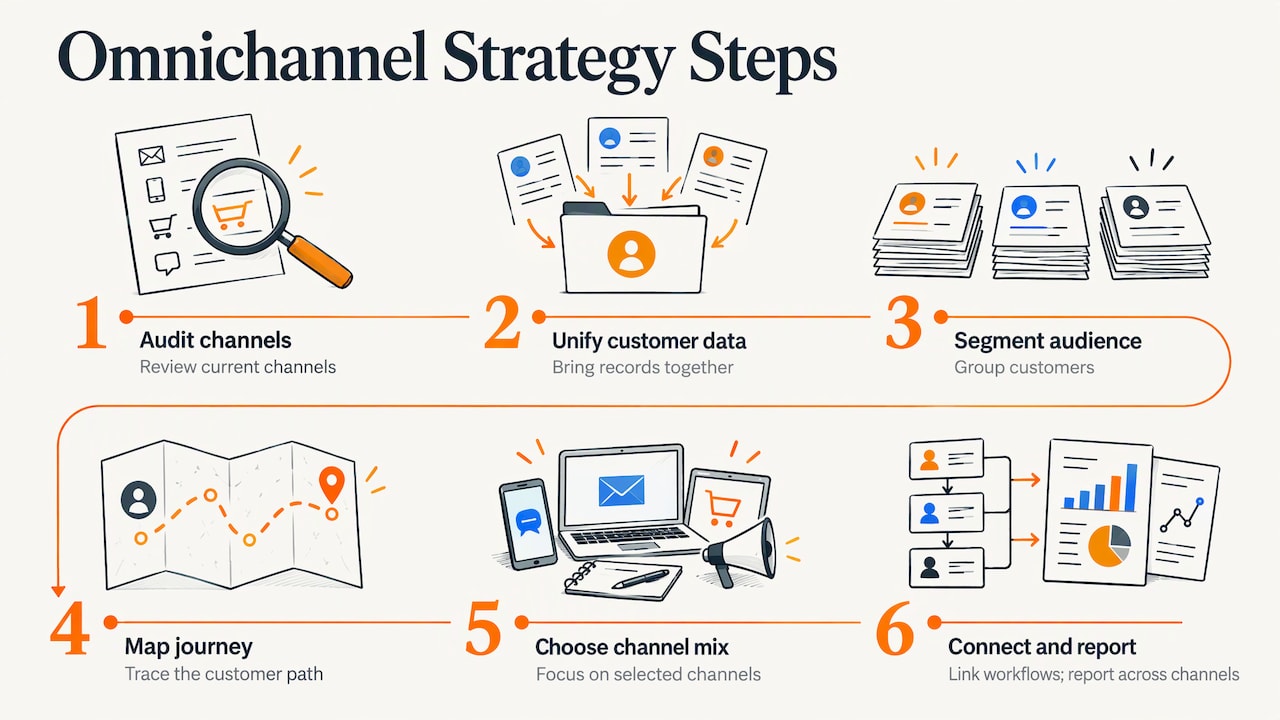
The core steps are consistent across the guidance available: audit your channels, unify customer data, segment your audience, map the journey, choose a focused channel mix, connect your workflows and set up cross-channel reporting. Here is how to apply them without a large team.
1. Audit what you already have
List every place a customer can find or contact you: website, Google Business Profile, social accounts, email list, phone line, trade shows, printed materials. Note what each one says, who maintains it and where its data goes. Most companies find mismatched hours, outdated offers and forms that go nowhere.
2. Map the journey before choosing channels
Write out the moments when your customers discover you, compare options, buy, need support and come back. Then mark the friction: a slow quote response, a checkout that fails on phones, a brochure with a different price than the website. Fix the friction before adding anything new.
3. Make the website the hub
Every other channel points to it, and it records what visitors do. That means fast pages that work on phones, clear offers, forms that capture the right details and pages that match the ads and emails sending traffic. If you sell products, the shopping experience is the decision stage of your journey, which is why custom ecommerce for small business belongs in this plan. If you sell to other businesses, B2B ecommerce features that matter for manufacturers covers what buyers expect to find online.
4. Choose a short channel mix
Small teams do best by picking channels based on where their audience actually is and building connections one at a time rather than covering everything at once. A sensible first mix for many companies is search, email, one social platform and one paid channel. For help choosing the paid channel, see how digital advertising channels start with search and one platform. To understand how the two main paid options complement each other, read about the difference between search and social advertising.
5. Keep the message consistent, the format native
The offer, brand voice and visuals should match everywhere. The format should fit the channel: a long explanation belongs on a web page, a reminder belongs in a text or short email. If you suspect your campaigns drift apart, how consistent your advertising is from one campaign to the next is a good test.
6. Connect the workflows
Decide what triggers what. A form submission triggers an email and a task for a salesperson. A cart left behind triggers a reminder. A purchase triggers a thank-you and, later, a reorder prompt. Write each trigger down in a sentence before building it. If you are weighing two of the most common channels, email marketing versus social media explains where each fits.
7. Measure with one or two goals
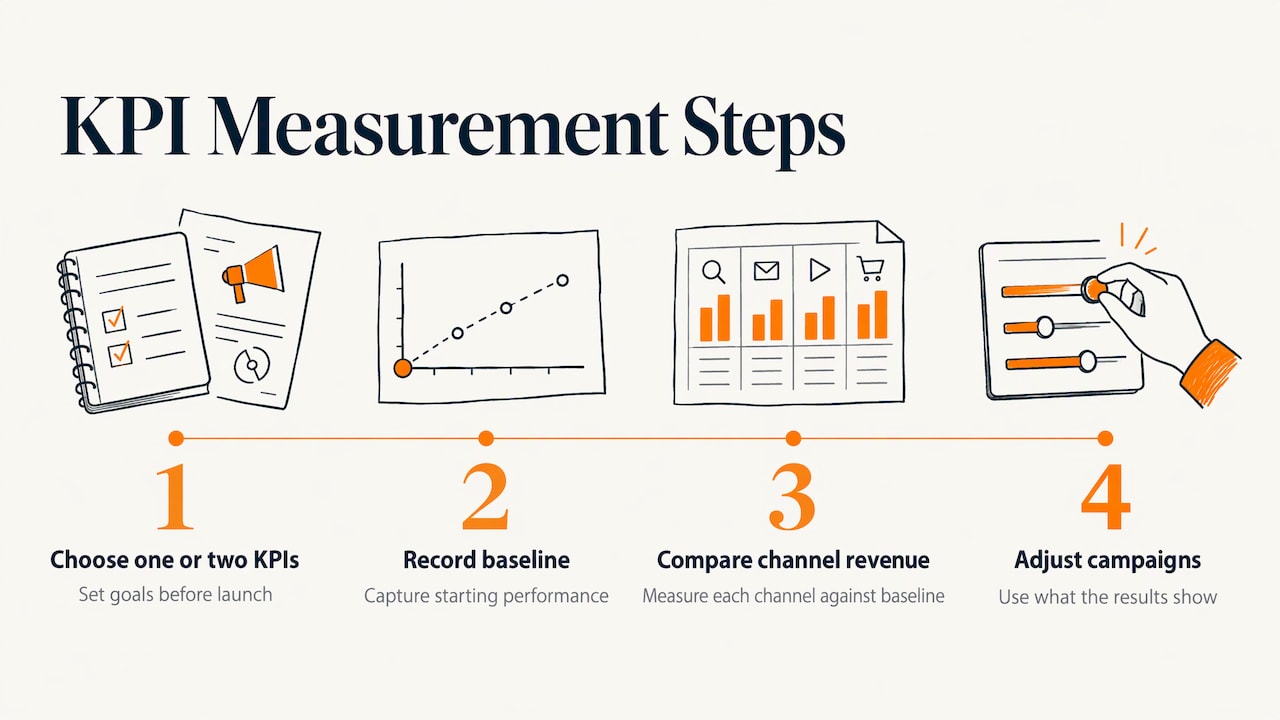
Choose one or two KPIs (key performance indicators, the numbers that tell you whether the plan is working) before launch. Common choices for the stages above include customer acquisition cost, customer lifetime value, retention rate, engagement rate and average order value. Record a baseline first, then compare each channel’s contribution to revenue against it, and adjust campaigns on what you see.
A sensible order of work
Owners often ask what to do first. This sequence keeps the spending proportionate:
| Phase | Focus | Outcome |
|---|---|---|
| 1 | Website, forms, tracking, search visibility | A hub that captures and records visitors |
| 2 | Email and lead follow-up | Every inquiry gets a relevant, timely reply |
| 3 | Social and paid ads aimed at the hub | Traffic arrives on pages that match the message |
| 4 | Retargeting, loyalty or reorder campaigns | Past visitors and customers come back |
| 5 | Cross-channel reporting | One view of what is working |
Search visibility belongs in phase 1 because it feeds the awareness stage. If it is unfamiliar, what SEO is and why it is important is the place to begin.
Common mistakes
- Starting with tools instead of a plan. A platform cannot fix an unclear journey.
- Treating each channel as its own project. Separate owners and separate goals produce separate experiences.
- Copying one message everywhere. Consistent does not mean identical. A social post and a product page do different jobs.
- Ignoring the offline step. The phone call, the trade show and the showroom are part of the journey. Give staff the same information the website has.
- Measuring only the last click. It hides the channels that started the sale.
The three-three-three rule
Readers sometimes ask about the “3-3-3 rule” in marketing. There is no single official definition. One common version limits a plan to three core messages, three audience segments and three channels, which fits the advice above: a short, focused mix beats a scattered one.
Our view: the website decides whether channels connect
We have been building websites and marketing programs for more than 38 years, and the pattern is steady: companies rarely have too few channels. They have channels that do not talk to each other, and a website that was never designed to be the center of them.
That is why we start with the site. A custom website built around your customers’ journey gives every other channel somewhere to send people, something to measure and a place to continue the conversation. Branding keeps the message consistent, search and advertising bring the right visitors, email and social keep them engaged, and lead generation turns interest into a conversation with your team.
We design and build the website, and we also handle the marketing that feeds it. For a small business or a manufacturer, that means one team looking at the whole journey, not three vendors each optimizing a corner.
Greg
How Marcy Design can help
Marcy Design is a Columbus, Ohio, web design and marketing agency with more than 38 years in business and over 230 awards. We cover the pieces an omnichannel plan needs: website design, ecommerce, SEO, lead generation, email marketing, social media, advertising, branding and video, as well as AI-powered website and marketing solutions. We also offer specialized website services for veteran-owned businesses and nonprofit organizations.
If you want the pieces planned together, see our full list of services, or start with lead generation if your priority is turning website visitors into conversations with your sales team.
FAQ
What is the difference between omnichannel and multichannel marketing?
Multichannel marketing uses several channels, but they run separately and the customer experience often differs from one to the next. Omnichannel marketing links those channels around the customer, so context and messaging carry across them.
What is an omnichannel customer journey?
It is the full path a customer takes across touchpoints before and after a purchase, with their context carried forward at each step. A common model runs from awareness through consideration, decision, retention and advocacy.
How many channels does a small business need?
Fewer than most owners expect. Start with the channels your audience already uses, such as search, email and one social platform, and connect them well before adding more. A short mix that shares data works better than a wide one that does not.
How do you measure omnichannel marketing?
Choose one or two goals before launch, record a baseline, and track results by channel and across the journey. Customer acquisition cost, retention rate, average order value and customer lifetime value are common measures. Remember that last-click reporting can undervalue channels that assist a sale.
Does a manufacturer need omnichannel marketing?
Yes, because industrial buyers research online, compare suppliers, request quotes and reorder across several touchpoints. A site with clear product information, lead capture, follow-up email and a record shared with sales covers the essentials.
Sources
- What is omnichannel marketing? McKinsey
- Customer Journeys and Omnichannel User Experience, NN/g
- The Omnichannel Customer Journey, CSGI
- Why Digital Leader Chase is Ramping Up Marketing for its Expanding Branch System, The Financial Brand
- CarMax ditches longtime tagline, repositions brand around omnichannel, Marketing Dive
- Omnichannel Marketing Tips for Small Businesses, PayPal
- What is Omnichannel Marketing? American Marketing Association
- Omnichannel Guide, IAB Europe, October 2024