
 614.224.6226
AI helps local SEO most when it handles the slow, repetitive work: finding the searches your neighbors actually type, drafting first versions of profile and page copy, and spotting gaps in your listings. It does not replace the basics. Google says the same SEO fundamentals apply to its AI features, with no special files, schema or optimizations required. So the winning approach is simple: get your local foundation right, use AI to move faster, and have a person check everything before it goes live.
TL;DR
- Local visibility still rests on an accurate Google Business Profile, consistent business details across the web, real reviews and a useful website.
- Use AI for research, drafting and auditing. Do not use it to publish unreviewed copy, mass-produce location pages or write reviews.
- Google has no separate checklist for AI Overviews or AI Mode. Pages must be indexed and eligible for normal snippets, and appearance is never guaranteed.
- Fake or generated reviews are a legal risk in the United States, not just an SEO risk.
- A short monthly routine, with a human approving every output, beats a burst of automated content.
Table of Contents
- What AI for local SEO actually means
- Get the foundation right before you add AI
- Where AI genuinely saves time
- A simple monthly workflow
- Reviews: where AI helps and where it crosses the line
- Local content: scale carefully
- What AI search changes, and what it does not
- Comparing tools without chasing features
- Risks to manage
- Perspective
- Work with a team that does both
- FAQ
- Sources
What AI for local SEO actually means
Local SEO is the work of making your business easier to find when people search for something near them: “accountant near me,” “HVAC repair Dublin Ohio,” “print shop in Westerville.” Google’s local results weigh relevance, distance and prominence, and nothing about AI has removed those three ideas.
“AI for local SEO” covers two different things, and it helps to keep them apart:
- AI as your assistant. You use language models and analysis tools to research keywords, draft copy, summarize reviews, audit listings and plan content.
- AI as the searcher. People now get local answers from AI summaries and chat-style assistants, which pull from the same business information you already publish.
The second one matters because of how those systems work. According to Search Engine Land’s analysis of AI local search, AI platforms aggregate and summarize structured data from local sources, and proximity, reviews, directory listings and accurate profile information still count. The same piece found that 93% of the unique domains used as sources were business websites, which makes your own site one of the most important inputs you control.
In short, the work did not change in kind. It changed in speed, and in how many places your information gets read.
Get the foundation right before you add AI
AI amplifies whatever you feed it. If your business name is written three ways across the web or your hours are out of date, automation will spread the mess faster. Start here.
Your Google Business Profile
This is the single most important local asset for most small businesses. Google’s guidelines for representing your business ask you to use your real-world name consistently, give an accurate address or service area, and choose the fewest categories needed to describe your core business. The same page prohibits content that is low quality, irrelevant or distracting, and anything that exposes private or confidential information.
A practical checklist:
- Claim and verify the profile, then complete every field that applies to you.
- Use one business name, exactly as customers see it on your sign, storefront or invoices.
- Pick a precise primary category, and add secondary ones only when they describe real core services.
- Keep hours, phone number and service area current, including holiday hours.
- Add real photos of your work, team and location, and refresh them regularly.
We walk through each field in more depth in our Google Business Profile optimization checklist.
Consistent name, address and phone number
AI-driven recommendations lean on agreement between sources. Search Engine Land describes this as cross-source corroboration: the more trusted places that state the same facts about your business, the more confident a system can be in repeating them. Pick one official version of your name, address, phone number, website and hours, then make every directory, social profile and industry listing match it.
A website that states the facts plainly
Your site should say, in plain text, what you do, where you do it and how to reach you. Add LocalBusiness structured data, which can describe your business hours, departments and more. Google’s guidance on AI features lists crawlability, internal links, useful text, page experience and matching structured data as things that remain important. If you need a refresher on the page-level work, our guides to on-page SEO and business website SEO optimization cover it.
Where AI genuinely saves time
Once the foundation holds, these are the tasks where AI earns its place. They follow the workflow outlined in Search Engine Land’s piece on AI-driven local SEO tactics.
1. Finding local search demand
AI can surface long-tail, location-specific searches that a quick brainstorm misses, and group them by intent: commercial (“emergency plumber near me”), informational (“why does my water heater leak”) or navigational (a search for your brand). For a Columbus-area business, that might mean separating the people who want a quote in Hilliard from those researching a problem in general. Each group needs a different page.
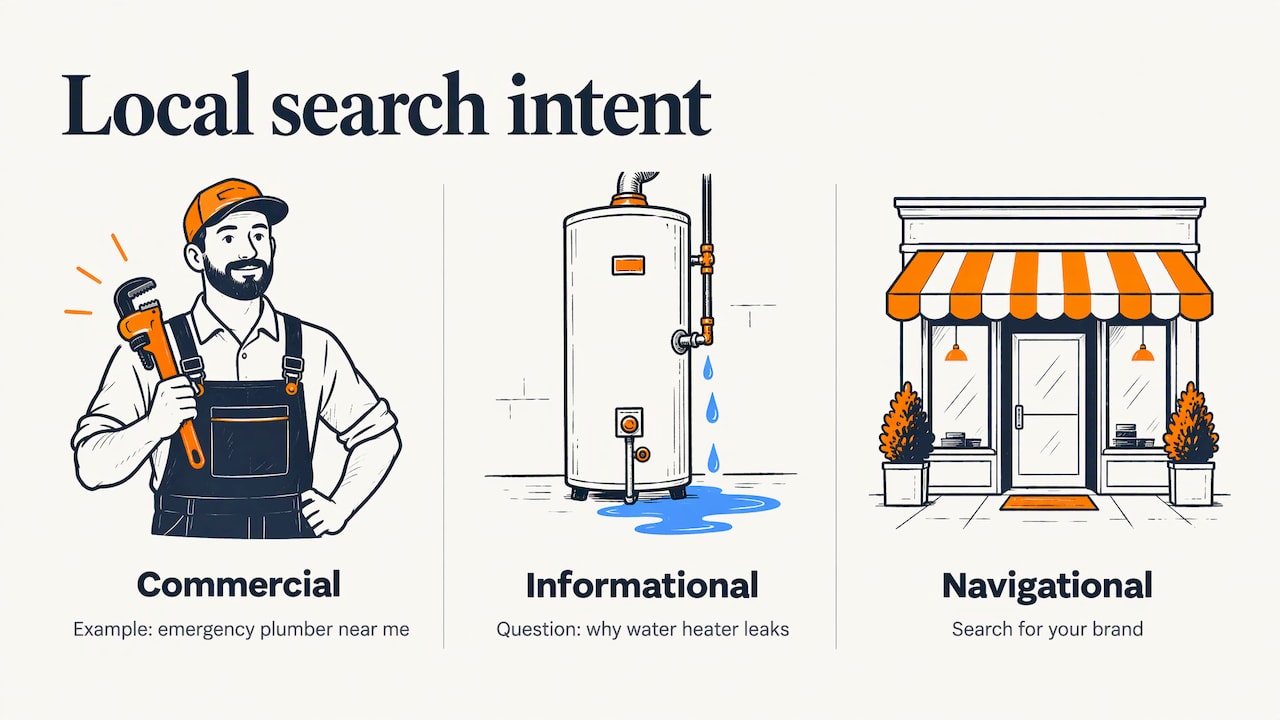
Ask the tool for questions customers ask before they buy, then check them against your own call logs and email inquiries. Your real customer language beats any generated list.
2. Competitor and content gap analysis
Feed AI the pages of the three or four businesses that appear when you search your main service in your city. Ask what topics they cover that you do not, what questions they answer and how their service pages are organized. You are looking for gaps where you have real expertise and they have thin pages.
3. Drafting profile descriptions, posts and page copy
AI is good at a first draft. Give it facts it cannot invent: your services, your service area, years in business, the types of customers you serve, one or two specific projects. Ask for three versions in your tone, then edit hard. Keep what sounds like you and cut the generic phrases.
A prompt that works better than “write a description for my business”:
Here are our five core services, the towns we serve, and two customer problems we solve every week. Draft a 750-character Google Business Profile description in plain, friendly language. Do not mention awards, rankings or years in business unless I provide them.
That last line matters, because models tend to add flattering claims that you cannot support.
4. Auditing citations and listings
AI-assisted tools can compare how your business appears across directories and flag differences in name spelling, suite numbers or phone formats. Treat the output as a to-do list. Someone on your team still has to log in, correct the listing and confirm it saved.
5. Summarizing reviews
Paste in a batch of your own reviews and ask for recurring themes: what customers praise, what causes friction, which services they mention by name. Those themes tell you what to emphasize on your service pages and in your profile, and what to fix in operations.
A simple monthly workflow
You do not need a large program. This routine fits into a few hours a month:
- Week 1: verify the basics. Check your Business Profile for accuracy, answer new questions, add recent photos.
- Week 2: research. Use AI to pull new local questions and phrases, then pick one or two to answer in depth.
- Week 3: write and review. Draft with AI, then have a subject expert rewrite and fact-check. Add something only you can add: a photo, a local example, a quote from a technician.
- Week 4: listings and reviews. Audit one set of directories, reply to new reviews and look at what customers are saying.
The key is step three. Everything AI drafts passes through a person who knows your business.
Reviews: where AI helps and where it crosses the line
Reviews are a major local signal, and also the area where shortcuts cause real harm.
Fine uses:
- Drafting replies you then personalize. Respond consistently, thank people by name and address specifics.
- Spotting patterns in feedback.
- Writing a polite follow-up message that asks happy customers to leave a review, sent only to people who actually bought from you.
Not fine:
- Generating fake reviews, or asking a tool to “write ten five-star reviews.”
- Posting reviews under invented names.
- Responding to harassing or fake reviews with arguments. Report them to Google instead.
The legal side is clear. In 2024 the Federal Trade Commission announced action against a tool that generated reviews, alleging the output could contain specific details unrelated to users’ input and deceive consumers. The agency’s message was that using AI does not exempt deceptive marketing from the law. For a small business, the safe rule is that every review on your profile comes from a real customer who had a real experience.
Local content: scale carefully
The temptation with AI is to generate a page for every suburb and every service combination. A business serving Dublin, Hilliard, Grandview and Westerville could produce dozens of near-identical pages in an afternoon. Don’t.
Google’s guidance on generative AI says it is fine to use AI for content when it is useful and original, but generating many pages without adding value may violate its scaled content abuse policy. The same page advises you to manually review AI output, since generative models can hallucinate, including in copy, metadata, structured data and image alt text. Its separate guide to optimizing for generative AI features warns that producing many low-value pages for query variations is not a durable way to gain visibility, and favors first-hand experience, unique viewpoints and clear organization.
So what does a good local page contain that AI cannot supply on its own?
- A specific project you completed in that area, with photos.
- Local details: regulations, building types, seasonal problems, nearby landmarks customers recognize.
- Real staff names and what they handle.
- Answers to questions your team hears on the phone.
- Clear next steps and contact information.
If a page for one town could swap in another town’s name and still read the same, it is not ready. Write fewer pages, and make each one worth reading.
What AI search changes, and what it does not
People increasingly ask conversational questions, and the results come as a synthesis rather than a list of ten links. Search Engine Land’s Benu Aggarwal describes this as a move from a ranked-list era to a recommendations era, where businesses need entities that are clearly defined and connected across the web.
For a small business, that translates into a few durable habits:
- Be easy to describe. One sentence that states what you do and where, repeated consistently on your site, profile and directories.
- Be present where information is gathered. Your website, your Business Profile and the main industry directories relevant to your trade.
- Be nearby and well reviewed. Distance and reputation still influence who gets recommended.
- Be indexable. Google says a page must be indexed and eligible for regular Search snippets to appear in AI Overviews or AI Mode, and that appearance is not guaranteed.
Notice what is missing: no trick, no hidden file, no secret prompt. If a vendor promises a special AI optimization that Google does not mention, ask them to point to the documentation.
Comparing tools without chasing features
Software in this space falls into a few types. Compare them on the criteria that affect your results:
| Tool type | What it does | What to check before buying |
|---|---|---|
| Listing and citation managers | Audit and sync your business details across directories | Which directories it reaches, whether changes are actually pushed or just reported, what happens if you cancel |
| Review request and reply tools | Send review requests, centralize replies, flag new reviews | Whether requests go only to real customers, how replies are approved, platform policy compliance |
| Local rank trackers | Show where you appear for searches from specific locations | Grid or neighborhood-level reporting, how often it refreshes, whether the data is exportable |
| AI writing assistants | Draft posts, descriptions and outlines | Whether you can supply your own facts, how easy it is to review and edit, no auto-publishing |
| General SEO suites | Keyword research, site audits, competitor views | Local features included, learning curve, whether you will use more than a small share of it |
A small business with one location often does fine with a well-managed Business Profile, a clean website, a review process and a basic listing audit. Add tools when you can name the specific job each one will do.
Risks to manage
- Inaccurate output. Models state wrong hours, services and claims with confidence. Verify every fact against your own records.
- Generic copy. Text that could describe any competitor earns little trust from customers or search systems.
- Policy violations. Keyword-stuffed business names, extra categories and irrelevant posts can put your profile at risk under Google’s guidelines.
- Privacy. Do not paste customer personal information, private emails or confidential contracts into public AI tools.
- Inconsistency. Different tools producing different versions of your description leaves a muddled picture of your business. Keep one approved master copy.
- Over-automation. Auto-posting and auto-replying remove the human judgment customers can sense.
If you are also exploring AI on your site itself, such as a chat assistant for inquiries, see our AI chatbot integration guide for local businesses.
Perspective
We have built websites and marketing for businesses for more than 38 years, and the pattern is consistent: tools change, fundamentals compound. Every few years a new technology arrives with a promise that the old rules no longer apply. Then the businesses with accurate information, a clear website and real customer proof keep winning.
AI is a real advantage for a small team, and we use it that way: to research faster, draft faster and catch problems earlier. But the judgment stays with people. A technician’s story about a flooded basement in Grandview is worth more than a thousand generated words about “quality service.” Your website is the source that AI systems and customers both read, so it should be accurate, fast and written by someone who knows the work.
Our advice is to build the foundation first, then add AI where it removes busywork. Keep your best people on what only they can say.
Greg
Work with a team that does both
If you would rather not piece this together yourself, we can help. Marcy Design is a Columbus-based web design and marketing agency, and our SEO solutions cover the site, content and visibility work that local search depends on. We also offer AI-powered website and marketing solutions, and our approach is tailored to each business instead of a template.

If your website is the weak link, our website design team can build a site that states your services, locations and contact details clearly. If you want more inquiries from the traffic you already have, look at our lead generation work. Or talk to us about your project and we will tell you where we would start.
FAQ
Can AI rank my business in the local map results?
Not by itself. Local results depend on relevance, distance and prominence, and those come from your profile, reviews, listings and website. AI can speed up the work behind them, but it cannot move you closer to the searcher or manufacture reputation.
Do I need special optimization to appear in AI Overviews or AI Mode?
Google says no. Its documentation states that the same SEO fundamentals apply, with no extra files, schema or special tactics required. Make sure your pages are indexed, your Business Profile is accurate and your content is useful.
Is it okay to use AI to write my website and Business Profile copy?
Yes, if the result is accurate, original and helpful to customers, and a person reviews it before publishing. Google does not oppose AI-generated content on its own, but it does target mass-produced pages that add no value. Add your own examples, photos and local knowledge.
Can I use AI to write reviews or respond to them?
Use it to draft replies that you edit and personalize, never to create reviews. In the United States, the FTC has taken action over a tool that generated reviews, and it has said AI does not exempt deceptive marketing from the law. Ask real customers for real reviews.
How long should the monthly AI routine take?
For a single-location business, a few hours a month is a realistic start: a profile check, one researched content piece, a listing audit and review replies. Add more only after you see which tasks improve your inquiries.
Sources
- AI Features and Your Website, Google Search Central
- Google Search’s Guidance on Generative AI Content
- Google’s Guide to Optimizing for Generative AI Features
- Guidelines for representing your business on Google
- Local Business (LocalBusiness) Structured Data, Google Search Central
- Why local SEO is thriving in the AI-first search era, Search Engine Land
- How to boost local SEO: 4 AI-driven tactics that get results, Search Engine Land
- AI and local search: The new rules of visibility, Search Engine Land
- FTC Announces Crackdown on Deceptive AI Claims and Schemes