
 614.224.6226
To measure marketing ROI, subtract your marketing cost from the profit your marketing created, then divide by that cost. Multiply by 100 for a percentage. The hard part is deciding what counts as “created by marketing” and waiting long enough for sales to show up. This guide covers the formula, a worked example, the attribution models, and how to read the result.
TL;DR
- Marketing ROI is (return from marketing minus marketing cost) divided by marketing cost. Use gross profit rather than raw revenue, or the result looks better than reality.
- Count every cost: ad spend, tools, production, and the staff time and overhead behind the campaign.
- Set one business goal, a baseline and a measurement window before you launch. Do not change the method halfway through.
- Attribution models split credit differently, and none is the single truth. Compare more than one view.
- Read ROI alongside spend level. The return on your last dollar matters more than the average.
Table of Contents
- What marketing ROI actually measures
- The formula, step by step
- Set up measurement before you spend
- Attribution models: who gets the credit?
- Delayed conversions and incomplete tracking
- How to read the number
- Common traps
- Measuring ROI by what you are buying
- A simple monthly routine
- Our perspective
- Put measurement into your next project
- FAQ
- Sources
What marketing ROI actually measures
Marketing ROI compares the business value your marketing generates with what it cost. Ipsos MMA defines it as the business return generated by marketing investment relative to what was spent. A more formal definition comes from a 2014 Marketing Science Institute report. It describes marketing ROI as the dollar estimate of incremental financial value from identifiable marketing spend, less its cost, as a percentage of that spend.
The word “incremental” is the one that matters. Some of your sales would have happened anyway through repeat customers, referrals and word of mouth. A clean ROI figure credits marketing only with what it added.
ROI is not ROAS
ROAS, return on ad spend, is a channel-level efficiency number. It tells you how much platform-attributed revenue each ad dollar produced. ROI goes further. Shopify’s 2026 comparison puts it this way: ROAS looks at gross revenue, while ROI accounts for profitability after product costs, shipping, fees and operating expenses. A campaign can post a strong ROAS and still lose money once costs are counted. Use ROAS to tune ads day to day. Use ROI to decide whether the whole effort is worth funding.
The formula, step by step
The basic version is simple. Salesforce’s guide gives it as (marketing value minus marketing cost) divided by marketing cost, times 100 for a percentage. Ipsos MMA illustrates it with a $1 million investment and $3 million in attributed revenue, which gives 200% ROI.
That revenue-based version is a fine starting point, but it flatters you. The American Marketing Association recommends a profit-based variant it calls net marketing contribution: multiply the revenue increase due to marketing by gross margin, subtract the marketing investment, and divide by the investment.
A worked example
Say a Columbus manufacturer spends $20,000 on a quarter-long campaign. Sales tracking shows $80,000 in incremental revenue, and the company’s gross margin is 40%.
| Method | Calculation | Result |
|---|---|---|
| Revenue-based | ($80,000 − $20,000) ÷ $20,000 | 300% |
| Profit-based | ($80,000 × 0.40 − $20,000) ÷ $20,000 | 60% |
The same campaign reads as 300% or 60%, depending on the method. The profit-based number is the one your finance lead will trust, because it reflects what the company actually kept. If your margin is thin, the gap gets wider.
What belongs in the cost side
Most underreported ROI comes from an incomplete cost line. Amazon Ads notes that hidden costs include staff time and wages, production costs and overhead, not just media spend. Build a cost list before the campaign starts:
- Media or ad spend
- Creative production: design, photography, video, copywriting
- Software and tracking tools
- Agency or freelancer fees
- Internal time, at a loaded hourly rate
If you want a ready-made structure, our digital marketing ROI calculator guide walks through the inputs.
Set up measurement before you spend
Most ROI problems start before launch. By the time results are in, it is too late to find out you never recorded a baseline. Four decisions come first.
- One business outcome. Pick “qualified quote requests” or “online orders,” not “awareness.” If you can’t name the outcome, you can’t compute a return.
- A baseline and a target. Record the last three to six months of leads, sales or conversions for the channel. Then set a target that is realistic given your budget.
- One or two primary KPIs. Everything else is supporting detail. Too many headline metrics lead to cherry-picking.
- A measurement window. Choose it based on your sales cycle, not your reporting calendar.
Then set up the plumbing. Use consistent UTM tags on every campaign link. Put conversion tracking on the actions that matter, such as form submissions, calls and purchases. Pass lead source into your CRM, so a closed deal can be traced to the campaign that started it. Ruler Analytics recommends carrying UTM parameters and click IDs into the CRM so you can judge cost per closed sale rather than platform-reported leads. For a manufacturer or service firm with a long sales cycle, that difference is large. A lead is not revenue.
The IAB’s attribution primer adds a warning: changing KPIs or attribution methods mid-campaign creates gaps in your data. Decide your method, write it down, and keep it for the full window.
Attribution models: who gets the credit?
Attribution answers a narrower question than ROI: which touchpoints earned credit for a conversion. A buyer may see a social post, click a search ad, read an article and then fill out a form after an email. Each model divides that credit differently.
| Model | How it credits | Where it misleads |
|---|---|---|
| Last touch | All credit to the final interaction | Tends to overcredit retargeting and branded search |
| First touch | All credit to the first interaction | Ignores everything that happened after discovery |
| Linear | Equal credit to every touchpoint | Treats low-intent and high-intent interactions as equal |
| Time decay | More credit to recent touchpoints | Can undervalue awareness activity |
Each row reflects Ipsos MMA’s description of the models. None of them is wrong, and none is complete. The IAB is blunt that no attribution strategy gives a single perfect truth about campaign success. A practical habit for a small business is to look at the same campaign through two models, say first touch and last touch. If a channel looks great in one and poor in the other, you’ve learned it plays a specific role: it opens conversations or it closes them.
Delayed conversions and incomplete tracking
B2B buyers rarely convert the day they click. The IAB notes that upper-funnel investments may produce sales days or weeks later, so daily reporting can misjudge campaigns whose returns haven’t matured. Cometly suggests a reporting buffer matched to your sales cycle: if the typical click-to-close period is 45 days, wait at least that long before final decisions. It also recommends comparing cohorts at equal data maturity, such as week-four results at 30 days against week-eight results at 30 days. That way a younger campaign isn’t mistaken for a weaker one.
In practice:
- Treat recent numbers as directional until they mature.
- Compare like with like: same age, same sales stage.
- Make your sales team log where each lead came from. A sales conversation often reveals what tracking missed.
When user-level tracking has gaps, larger programs can add modeling. Marketing mix modeling uses historical spend, revenue and seasonality to estimate channel contribution without following individuals. BCG reports that 46% of surveyed marketers use marketing mix modeling, incrementality testing and multi-touch attribution together, and treat none of them as definitive. For a small business, the same idea scales down. Run a simple holdout, such as pausing a campaign in one region or for one period, and see what happens to sales.
How to read the number
A single ROI figure is an average, and averages hide the decisions that matter. Take a 10% ROI. Mathematically, every $1 spent returned $1.10, so $10,000 of spend produced $1,000 of net gain. Whether that is good depends on your alternatives, your margin and whether the work builds lasting assets such as a website, a brand and an email list.
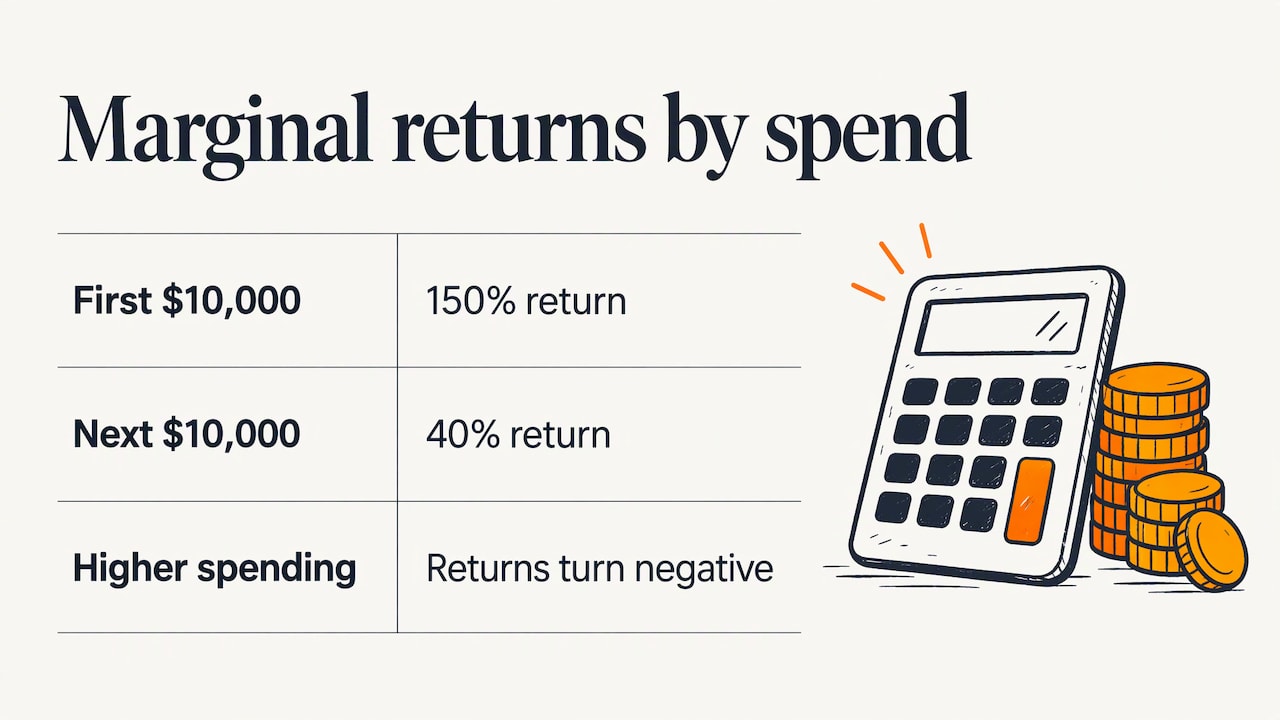
The bigger issue is that returns change with spend. The AMA explains that customer response commonly shows diminishing returns. In its hypothetical search campaign, the first $10,000 returns 150%, the next $10,000 returns 40%, and higher spending turns negative. The AMA’s advice is to look at marginal ROI, the return on the last dollar spent. It helps you see whether a channel is underfunded, overfunded or about right. BCG reports that one financial-services firm that adopted marginal ROI as a shared finance and marketing metric improved efficiency by about 10%.
Also keep in mind what the Marketing Science Institute report points out. Marketing is usually expensed in the period it is spent and rarely tied up in inventory or fixed assets, so comparing it to other ROI figures in the company takes care. Don’t hold a brand-building program to the same short-window test as a promotional email.
Common traps
- Counting revenue as return. Use gross profit where you can.
- Ignoring organic baseline. Credit marketing only with what it added beyond your baseline.
- Reporting too early. A 45-day sales cycle can’t be judged in 10 days.
- Vanity metrics as outcomes. Impressions and followers support the story, but they are not the return.
- Switching methods midstream. It makes before-and-after comparisons meaningless.
For more on weighing these trade-offs, see our piece on whether it is ever acceptable to lose money on an advertising campaign. If you are earlier in planning, how to set and split your digital marketing budget is the natural companion.
Measuring ROI by what you are buying
Different investments need different windows and different proxies.
Paid ads. Short windows work, with cost per qualified lead and cost per closed sale as the key figures. Watch for diminishing returns as budgets rise.
SEO and content. These compound over months. Track qualified organic leads and the revenue from them, and judge them over quarters, not weeks. Our overview of SEO solutions explains what we track and why.
Your website. A redesign changes conversion rate across every channel at once, so measure before and after on the same traffic. We cover this in measuring web design ROI.
Email and lead generation. These are easy to tie to CRM outcomes. A clear lead generation framework makes the source of each lead obvious.
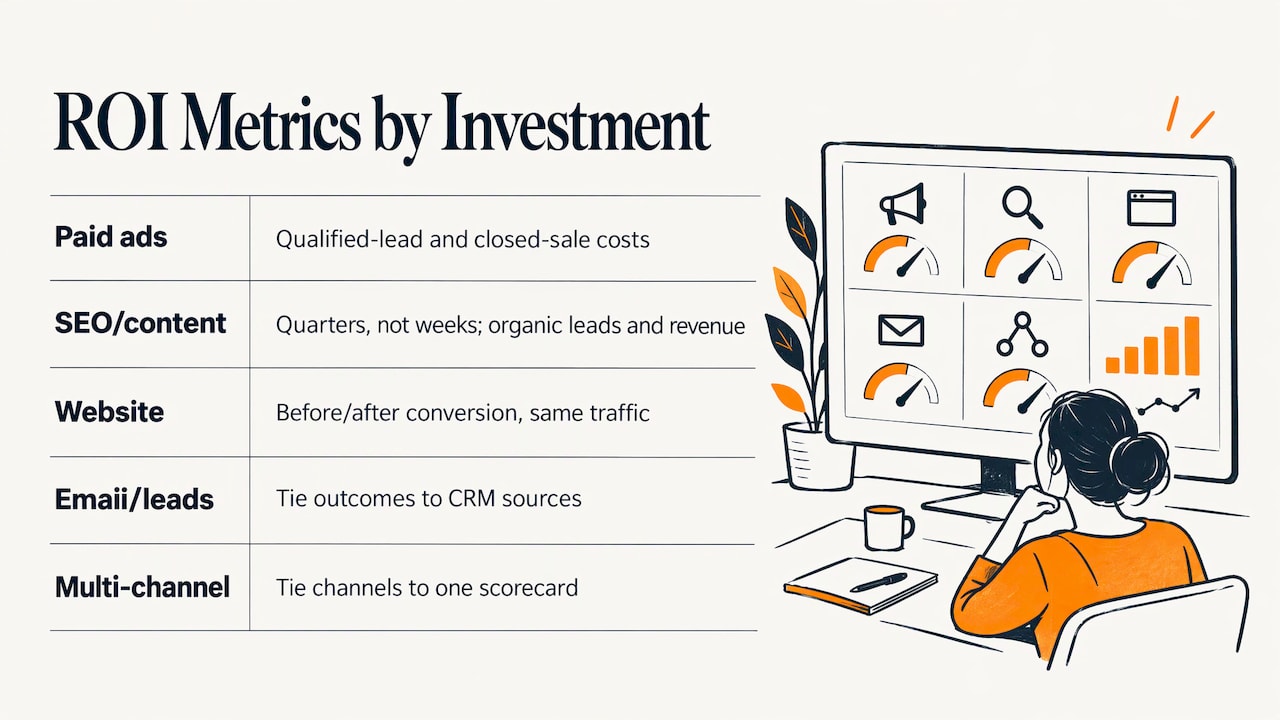
When results come from several channels, a practical framework for results-driven digital marketing helps you tie them to one scorecard.
A simple monthly routine
- Pull spend by channel, including internal time and production costs.
- Pull leads and closed revenue by source from your CRM.
- Compute profit-based ROI for campaigns whose window has closed.
- Mark younger campaigns as “maturing” and don’t judge them yet.
- Check marginal return: what did the last increment of budget add?
- Decide: shift, hold or scale. Write down the reason.
A one-page version of this is enough for most small and midsize companies. The habit matters more than the tooling.
Our perspective
After more than 38 years of building websites and marketing programs for companies across industries, we have seen the same pattern. The businesses that get the most from marketing are not the ones with the fanciest dashboards. They are the ones that decided, before spending anything, what a win looks like in dollars.
We design our work around measurable business results. That means the website, the campaigns and the tracking are planned together, so a form fill, a call or an order can be traced back to what produced it. It is much harder to fix measurement after launch than to build it in.
We also like to treat ROI as a decision tool rather than a report card. A number tells you where the next dollar should go. When the website converts better, the ads, the SEO and the email all return more. That is why we look at the whole path from first click to signed contract, not at one channel in isolation.
Greg
Put measurement into your next project
If you want ROI built into your marketing from the start, we can plan the tracking, the website and the campaigns as one system. Our team covers website design, SEO, lead generation and digital marketing, with measurement in mind from the first conversation.

Tell us about your goals on marcy.com and we will help you define what a return looks like for your business.
FAQ
What is a good marketing ROI?
It depends on your margins, your sales cycle and what the spend builds. A positive profit-based ROI means the campaign more than paid for itself. Compare against your alternatives, including what the same budget would earn on another channel, and read the figure alongside marginal return.
What does a 10% ROI mean?
It means that after covering the marketing cost, you earned 10% of that cost as net gain. For $10,000 of spend, that is $1,000. Whether it is acceptable depends on your margin and on the lasting value created, such as search rankings, a stronger site or a larger email list.
How long should I wait before judging a campaign?
Wait at least as long as your typical time from first click to closed sale. If that is 45 days, treat results before then as directional. Compare cohorts of equal age so newer campaigns aren’t unfairly judged against mature ones.
Which attribution model should a small business use?
Start with last touch and first touch side by side. Last touch shows what closes deals, and first touch shows what starts conversations. Keep the same models for the entire campaign, because switching mid-campaign creates gaps in your data.
Sources
- Ipsos MMA: What Is Marketing ROI
- Marketing Science Institute: Marketing Return on Investment report, 2014
- Shopify: ROAS vs. ROI
- Salesforce: Marketing ROI guide
- American Marketing Association: Using Return on Marketing Investment Effectively
- Amazon Ads: What is Marketing ROI
- Ruler Analytics: Measuring marketing with a long sales cycle
- IAB: Digital Attribution Primer 2.0
- Ipsos MMA: What Is Marketing Attribution
- Cometly: Conversion lag reporting
- BCG: Six Steps to More Effective Marketing Measurement