
 614.224.6226
B2B lead generation is the work of finding companies that could buy from you, earning their attention, capturing their contact details and qualifying them until a salesperson can have a real conversation. It works when four things line up: a clear picture of your ideal customer, a website and content that attract that customer, a simple way to score who is ready, and fast, relevant follow-up. This guide walks through each piece in the order you would build it.
TL;DR
- Start with an ideal customer profile and a target account list. Every channel you pick later depends on it.
- Inbound (search, content, referrals) is cheaper over time but slow to build. Outbound (direct outreach) is faster to start. Most companies need both.
- Score leads on fit and intent, and agree with sales on what counts as qualified and how quickly someone follows up.
- Your website is the hub. A generic “Contact Us” form wastes traffic that a useful offer would capture.
- Nurture with relevant content and timely human contact, because buyers mix digital self-service with conversations with reps.
Table of Contents
- What B2B lead generation actually involves
- Step one: define who you want
- B2B lead generation strategies that work for small and mid-size companies
- Inbound vs. outbound leads
- Qualify before you chase
- Marketing and sales need a shared definition
- B2B lead nurturing: a workflow you can build this month
- Measure what leads to revenue
- Perspective: a website that does the selling
- Build the system with Marcy Design
- FAQ
- Sources
What B2B lead generation actually involves
A lead is a person or company that has shown interest or fits the profile of a buyer, and you have a way to contact them. Lead generation is the system that produces those contacts and sorts them. One widely used four-stage description of the process runs like this:
- Define your ideal customer profile (ICP) and target account list. Industry, company size, location, the problem you solve and who signs off on the purchase.
- Attract and capture leads. Content, search, ads, events, outreach and referrals bring people in. Forms, calls and replies capture who they are.
- Score and qualify. Separate prospects who fit and show buying behavior from those who do not.
- Nurture and hand off. Qualified leads get targeted follow-up until they are ready for a sales conversation.
The same guide points out that only about 5% of B2B buyers are in the market in any given quarter. That has a practical meaning: if you only chase people who are ready today, you miss the other 95%, who will be ready later and will remember who helped them. A good program captures current demand and keeps future buyers warm at the same time.
Lead generation versus demand generation
Demand generation builds awareness and interest across a market: thought leadership, brand work, broad content. Lead generation converts some of that interest into named contacts you can follow up with. They overlap, and a small company rarely needs to run them as separate departments. What matters is that awareness work ends in a clear next step for the reader.
Step one: define who you want
Most weak lead programs fail before the first email goes out. “Any business that needs our services” is not a target. Write down:
- The industries and company sizes where you win and keep clients.
- The job titles that feel the pain and the ones that approve budget. In B2B these are often different people.
- The trigger events that create need: a new location, a rebrand, a slow website, a new product line, a leadership change.
- The deal size and sales cycle you can sustain.
Then build a list of real companies that match. For a regional manufacturer, that might be 150 distributors within a few hours’ drive. For a services firm, it might be owner-led companies in a certain revenue band. A short, accurate list beats a large, vague one every time.
B2B lead generation strategies that work for small and mid-size companies
You do not need every channel. Pick two or three you can run consistently.
Your website and search
Search is one of the highest-intent sources there is. Buyers who type a specific need into Google, such as a service plus a category, are already looking. Search, organic and paid, is a top-intent lead source for small companies for exactly that reason, and ranking for those terms puts you in front of active prospects.
What the visitor finds next matters as much as the ranking. A page that only says “Contact Us” asks a stranger to commit before they trust you. Offer something worth trading an email address for: a pricing guide, a planning checklist, a short diagnostic or a calculator. Salesforce recommends high-value lead magnets and forms that feed directly into your CRM so someone can follow up right away.
We cover the design side in more depth in our guides to lead generation website design and why lead generation is a website essential. If search is the channel you are weighing, our SEO solutions page explains how we approach it.
Content that answers buying questions
B2B buyers research before they talk to anyone. Write the pages they look for: how to choose a provider, what a project involves, how to compare options, what mistakes to avoid. Each piece should end with a relevant next step, not a generic sales pitch. Content is slow, but it compounds: a good page keeps producing leads long after it is published.
Email is where you keep the 95% warm. Send useful, specific messages to people who have opted in, segmented by industry or the offer they downloaded. Short sequences that educate first and ask second outperform constant promotion. Sales emails to cold contacts are a different tool, covered under outbound below.
Referrals and partnerships
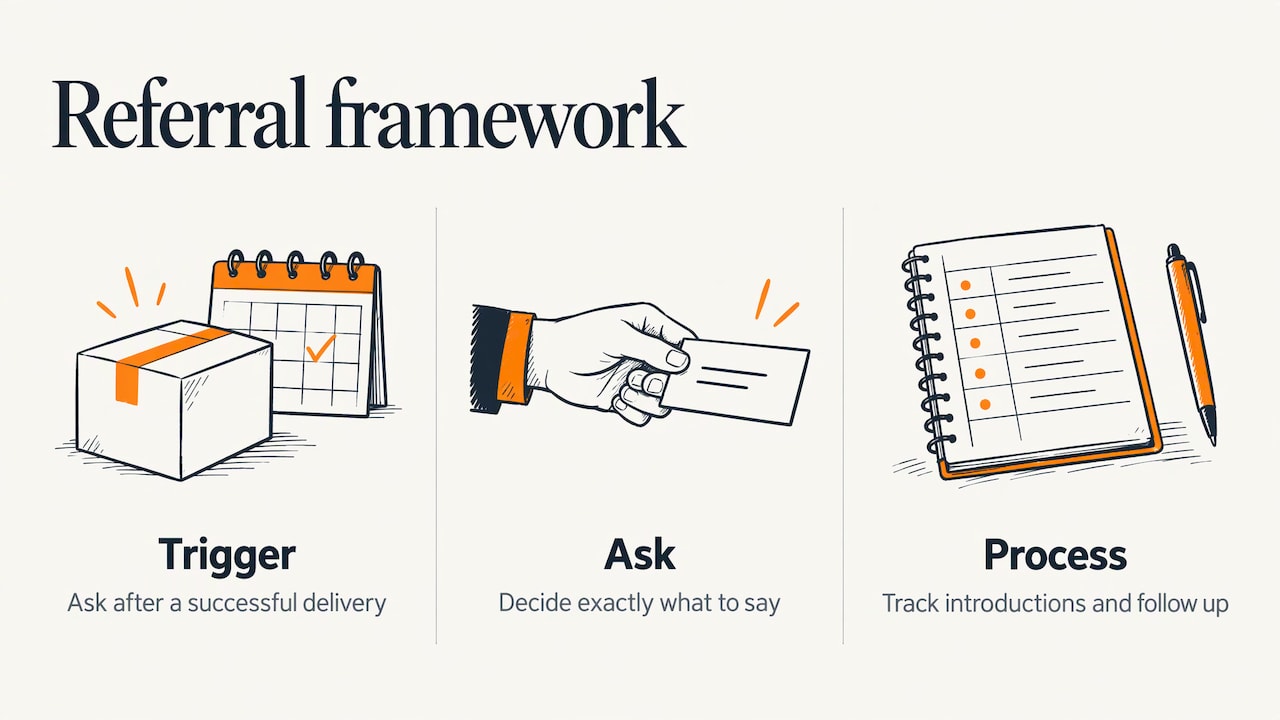
Referrals are often the most underused source. A simple system has three parts: a trigger (when do you ask, for example after a successful delivery), an ask (what exactly do you say), and a process (who tracks the introduction and follows up). That is the three-part referral framework small businesses can set up in an afternoon. In a HubSpot survey of 347 small-business salespeople, inbound marketing ranked first as a source of qualified leads at 64%, with referrals next. Strategic partnerships with complementary, non-competing firms work the same way: you each introduce the other to clients you already serve well.
Social and professional networks
For most B2B firms, LinkedIn does the heavy lifting: company page updates, founder or expert posts, and direct messages that follow a real connection. Post what a buyer would find useful, not just announcements. Use social to start conversations, then move them to email or a call.
Events and trade shows
Industry events, local chamber meetings and trade shows still produce high-quality conversations, especially for manufacturers and nonprofits. The failure point is follow-up. Decide before the event how every contact will be tagged, scored and contacted within days.
Paid advertising
Pay-per-click search ads give you fast data on which keywords and messages produce inquiries, long before organic rankings arrive. We have written about using pay-per-click to test your SEO ideas. Send ad traffic to a dedicated page with one clear offer, not your home page.
Inbound vs. outbound leads
Inbound means prospects come to you: they find your content, search results, referrals or social posts. Outbound means your team starts the conversation with accounts that match your ICP, through email, calls or direct messages.
| Inbound | Outbound | |
|---|---|---|
| How it works | Pull: prospects find you | Push: you contact prospects |
| Lead temperature | Warmer, higher intent | Colder at first |
| Fit with your ICP | Can vary | Controlled, since you pick the list |
| Speed | Slower, often months to build steady flow | Faster access to decision-makers |
| Cost over time | Usually lower per lead | Usually higher per lead, more rejection |
| Best for | Long-term compounding pipeline | New markets, niche or high-value accounts |
The ZoomInfo comparison of the two approaches reaches the same balance: inbound usually wins on cost per lead, while outbound can put you in the room sooner for high-value or niche targets. A separate analysis from Outreach adds that outbound makes pipeline math predictable, because you can model how many emails, calls and meetings turn into pipeline dollars.
For a company with a small team, a sensible split is to build the inbound foundation (website, search, content, referrals) while running a focused outbound effort against your 50 to 100 best-fit accounts. Outbound brings meetings this quarter. Inbound brings leads next year without paying for each one.
Qualify before you chase
Not every inquiry deserves a sales call. Lead scoring gives each lead a number based on two things: fit and intent. Fit is how closely the company and contact match your ICP. Intent is behavior that signals active interest: visiting a pricing or service page more than once, downloading a buyer’s guide, replying to an email, requesting a proposal.
Keep it simple at first:
- High fit, high intent: call quickly.
- High fit, low intent: nurture with content and check in.
- Low fit, high intent: reply politely, and qualify further before spending sales time.
- Low fit, low intent: keep in a newsletter list or leave out.
Marketing and sales need a shared definition
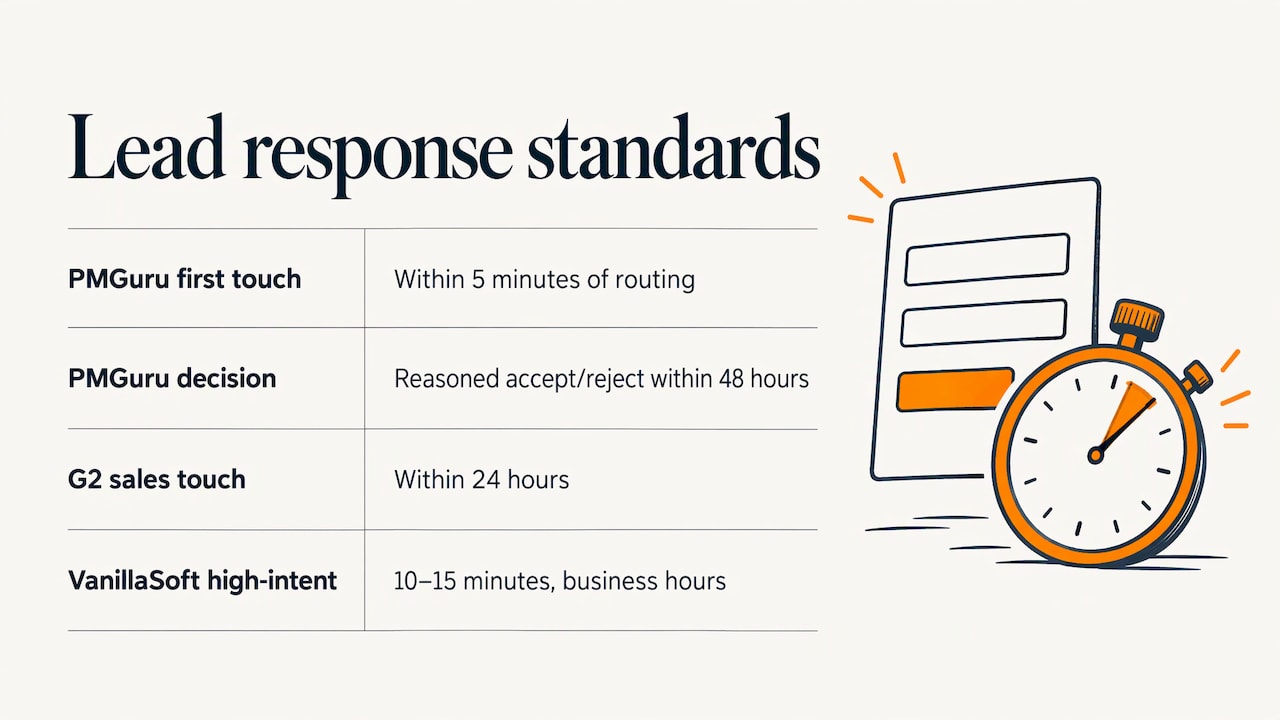
Leads leak between marketing and sales when nobody agrees on terms. In week one, define what a marketing-qualified lead is, what a sales-qualified lead is, and what specific reasons allow sales to reject a lead, rather than just labeling it a bad lead. That is the handoff alignment PMGuru recommends. It also suggests an example rule: first contact attempted within 5 minutes of routing, and accept or reject with a reason within 48 hours.
Your numbers can differ. G2’s example is that every marketing-qualified lead gets a sales touch within 24 hours, with marketing re-engaging if there is no reply. VanillaSoft gives 10 to 15 minutes during business hours for high-intent leads. Pick a standard you can actually meet, write it down and track it.
B2B lead nurturing: a workflow you can build this month
Nurturing is relevant, useful follow-up that moves a qualified lead toward a conversation. After qualification, targeted content such as email sequences and educational resources moves people from the middle of the funnel toward sales.
A simple workflow:
- Trigger. A lead downloads a guide or submits a form. Tag it with the topic and the source.
- Immediate response. An automatic confirmation with the resource, plus a note from a real person’s address.
- Education sequence. Three to five emails over a few weeks, each answering one question a buyer in that situation has: scope, process, timeline, what good looks like.
- Behavior rules. If a lead keeps returning to your pricing or services pages, route them straight to a salesperson for a call and a personal email. VanillaSoft describes this kind of rule, where behavior re-ranks leads in real time.
- Handoff. When the lead meets your definition of sales-ready, the salesperson gets the full history: what they read, downloaded and asked.
- Re-engagement. If the lead goes quiet, marketing resumes with fresh content rather than letting the contact go cold.
If you sell to wholesale buyers or retailers, a dedicated approach to nurturing qualified wholesale buyers can extend the same idea to matched buyers by category and market.
Buyers want both self-service and people
Nurturing should not be all automation. Gartner’s 2025 survey of 645 B2B buyers found that 67% prefer a rep-free buying experience, yet 69% prefer to validate AI-generated insights with sales reps. Buyers research alone, then want a person at the moments that matter. Make your content self-explanatory, and make your people easy to reach at the decision points.
Consistency counts too. In Gartner’s B2B Buying Report, buyers were 2.8 times more likely to complete a high-quality deal when they saw high information consistency between a supplier’s website and its representatives. Your site, emails and sales conversations should tell the same story, with the same offers and the same language.
Measure what leads to revenue
Counting form fills is easy and often misleading. Track these instead, by channel:
- Leads that meet your qualified definition, not total leads.
- Response time from inquiry to first human contact.
- Conversion from qualified lead to proposal, and from proposal to signed contract.
- Cost per qualified lead and cost per won client.
- Sales cycle length.
Review monthly and move effort toward the channels that produce clients, not just inquiries. Give a new channel at least a full sales cycle before judging it, especially content and search.
Perspective: a website that does the selling
We have been building websites and marketing programs for more than 38 years, and the pattern is consistent: companies do not have a lead problem so much as a handoff problem. Traffic arrives, the site gives visitors nothing to do except call, and the leads that do come in sit unanswered.
Our view is that lead generation starts with the website. It should be designed around the buyer’s questions, with clear offers, fast forms and clean paths into the CRM. Search, email, advertising and outreach then work harder because they all lead somewhere that converts.
We also believe in tailored solutions. A manufacturer selling to distributors needs a different funnel than a nonprofit seeking donors or a service firm chasing local owners. That is why we pair design, development, SEO and marketing under one roof, and measure the work by business results, not by how many pages we launched.
Greg
Build the system with Marcy Design
If you would rather have a team build and run this with you, that is what we do. Our lead generation services combine website design, SEO, email marketing, advertising and content so that every channel feeds a site designed to convert. Our four-step approach to online lead generation shows how the work is laid out, and our piece on the business website sales funnel shows how the pages connect.
Selling to other businesses online? Our B2B ecommerce web design guide covers the specific demands of complex catalogs and account-based buying. To talk about your own goals, contact Marcy Design and tell us who you want to reach.
FAQ
How do I generate B2B leads on a small budget?
Start with the channels that cost time rather than money: referrals, a website with a real offer, and a focused list of 50 to 100 best-fit accounts you contact personally. Add search content over time, since it compounds. Spend on paid ads only once you have a landing page and a follow-up process that works.
What is the difference between B2B lead generation and demand generation?
Demand generation builds awareness and interest across a market. Lead generation captures named contacts from that interest and qualifies them for sales. Most small companies run them together: awareness content that ends in a clear offer and a form.
Is inbound or outbound better for B2B?
Neither wins everywhere. Inbound leads tend to arrive warmer and cost less over time, but take months to build. Outbound reaches chosen accounts faster, with more rejection and higher cost per lead. Use outbound for quick meetings with high-value targets and inbound for steady growth.
How fast should we follow up with a new lead?
As fast as you can reliably sustain. Published examples range from 5 minutes for sales to attempt first contact, to 10 to 15 minutes for high-intent leads, to a sales touch within 24 hours for marketing-qualified leads. Choose a rule, assign an owner and track whether you meet it.
Sources
- What Is Lead Generation? A Complete B2B Guide for 2026
- Inbound vs. Outbound Sales: Key Differences
- Outbound vs. inbound sales: Which is better?
- Small Business Lead Generation: How to Attract Customers
- Lead Generation for Small Business: The Complete Guide
- How 347 Small Business Salespeople Generate Their Best Leads
- What Is Lead Nurturing? Top 5 Techniques That Actually Work
- How to Automate Lead Nurturing Workflows
- Marketing-to-Sales Handoff: Fix the Pipeline Leak
- Gartner Survey Finds 69% of B2B Buyers Turn to Sales Reps to Validate AI-Generated Insights
- Gartner B2B Buying Report