
 614.224.6226
Most U.S. website redesigns range from low-cost template refreshes to custom agency builds, with enterprise projects costing substantially more. Those bands usually cover design, development and basic content migration, while copywriting, photography, integrations and hosting are often billed separately. Your next step: define your page count and required integrations, then ask for fixed-scope quotes.
TL;DR:
- Clutch’s samples put many projects below $10,000, while agency design work often costs $10,000 to $49,999, and enterprise builds can exceed six figures.
- Count unique page templates, not just pages: fifty pages using three layouts can cost less than fifteen pages requiring individual designs, development, and testing.
- Choose fixed pricing when deliverables and page counts are clear; agency hourly rates commonly cluster around $100 to $149, and evolving scopes risk overruns.
- Ecommerce adds catalog cleanup, checkout work, payment and shipping connections, migration testing, and ongoing platform fees, so budget above a similar brochure site.
- Require every proposal to list inclusions, exclusions, change order terms, testing, and post launch charges; approved copy and images can reduce migration and revision work.
Table of Contents
- What does a website redesign cost by project scope?
- Which cost drivers do agencies actually charge for?
- How do agencies, freelancers and templates price redesigns?
- What does an ecommerce redesign add to the budget?
- How long does a redesign take, and which phases cost the most?
- What should a redesign proposal include?
- How can you lower the cost without hurting results?
- How do you justify the cost to stakeholders?
- Which questions should you ask agencies before signing?
- What separates a successful redesign from an expensive one?
- How do we help you get a scoped estimate?
- FAQ
- Sources
What does a website redesign cost by project scope?
Think of your project in three bands, then adjust for the line items that push it up. Clutch’s pricing data shows that many web design projects it reviewed cost less than $10,000, while average project costs in some samples run to tens of thousands of dollars. Its design-agency data adds that UX/UI and web design work often falls between $10,000 and $49,999 for many agencies.
Here is how that translates into scopes you can recognize:
- Template or builder refresh: A new theme, your existing content moved over, and light branding changes. This is the low end, often under $10,000, and it suits a simple brochure site that mainly needs a modern look.
- Small business redesign with customizations: A custom design across roughly 10 to 30 pages, a few unique page templates, a handful of forms and basic search engine setup. This is where much of agency work lands, in the low five figures.
- Mid-market redesign: A larger site with several custom templates, a CRM connection, gated content or a customer portal. Budgets move up through the middle of the agency range.
- Enterprise build: A large site, multiple audiences, complex integrations and strict governance. Industry guides describe these projects as capable of exceeding six figures depending on page count, integrations and complexity.
A few line items commonly bump a project up a band:
- Custom integrations with CRMs, inventory systems or internal APIs
- Large content migrations that need cleanup, redirects and reformatting
- Original photography, video or custom illustration
- Accessibility remediation on a site that was never built with it in mind
One caution from practitioners: pricing tends to be bimodal. Some projects are inexpensive template refreshes and others are expensive bespoke builds, and mid-range quotes can mislead if the scope behind them is vague. A price only means something when you know what it buys.
Which cost drivers do agencies actually charge for?
Agencies price time. Anything that consumes designer, developer or strategist hours shows up in your quote, so knowing the biggest consumers helps you decide what to prioritize or cut.
- Page templates, not page count. Fifty pages built from three templates cost far less than fifteen pages that each need their own layout. Every unique template needs design, development and testing.
- Custom features and integrations. A contact form is cheap. A client portal, a booking engine or a two-way CRM sync is not, because each needs planning, build time and ongoing testing.
- Content work. New copy, SEO fixes and migrating old pages all add hours. A site with years of outdated posts takes longer to sort than a lean one.
- Creative production. Custom graphics, photography and video are priced separately from layout and code.
- Technical architecture. Your CMS choice, hosting setup, performance targets, security hardening and accessibility requirements all shape development effort.
- Team composition. Senior strategists may cost more per hour than execution staff. Practitioner analysis notes that agencies often bill senior-level hourly rates of $120 to $200 or more while delegating execution to mid-level or junior people.
Pro Tip: Ask every vendor to list the number of unique page templates they have priced. If two quotes differ wildly, mismatched template counts are the usual reason.
How do agencies, freelancers and templates price redesigns?
The pricing model changes who carries the risk, so it matters almost as much as the number itself.
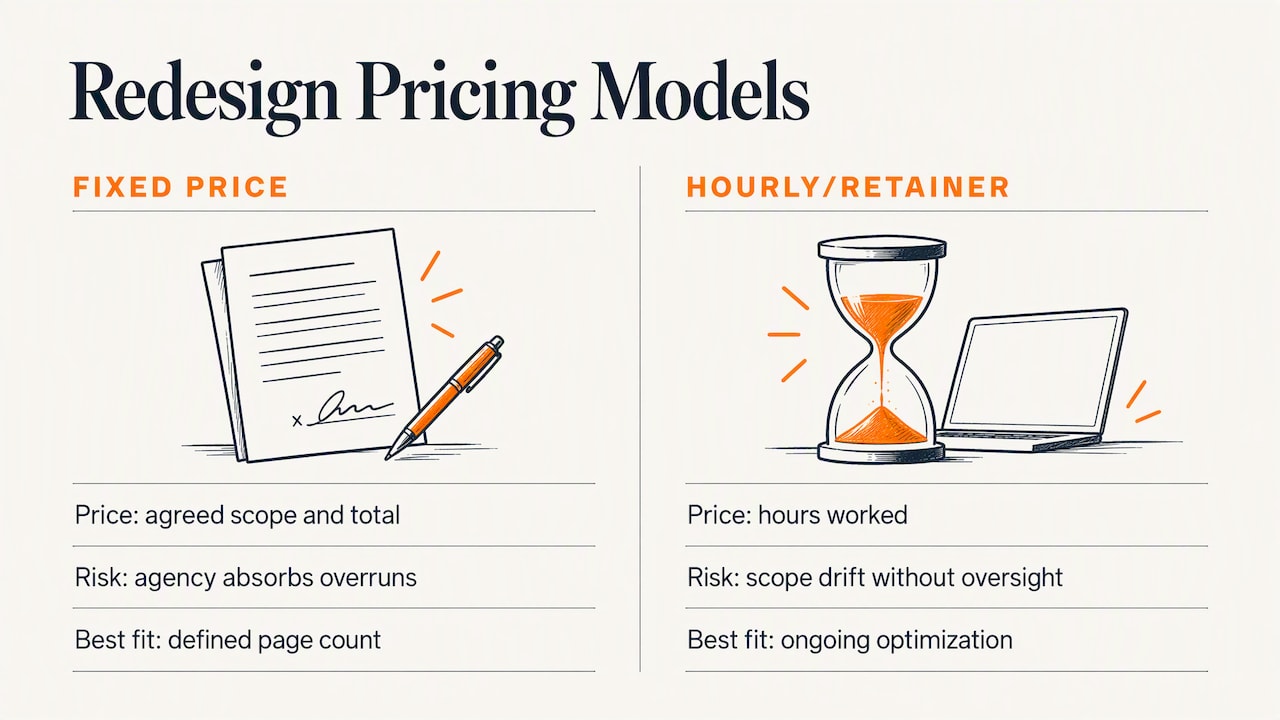
Fixed-price agency projects. You agree on a scope and a total, and the agency absorbs overruns inside that scope. Change requests outside it become change orders. This model fits redesigns with clear requirements and a defined page count.
Time-and-materials or retainers. You pay for hours worked, often with an estimate and a cap. Clutch data indicates agency hourly rates commonly cluster around $100 to $149, depending on scope and geography. This suits evolving projects, but it exposes you to scope drift if no one is watching the clock.
Freelancer hourly or package pricing. A skilled freelancer can be an excellent fit for a small site with limited integrations. The trade-off is capacity: a freelancer covers design, code and QA, so timelines can stretch and coverage during absences is thin.
Template or builder refresh. Often lower cost and faster to launch, with limited room for custom functionality. Hybrid models, where a designer customizes a template, sit between this and a full custom build.
Prefer fixed price when you can define deliverables precisely. Prefer hourly or retainer when the work is exploratory, such as ongoing optimization after launch.
What does an ecommerce redesign add to the budget?
An online store carries everything a brochure site does, plus work that touches revenue directly. That is why ecommerce redesigns usually price above brochure-style projects of similar page counts.
- Catalog size and data cleanup. A large product catalog means mapping fields, fixing inconsistent titles and descriptions, and rebuilding category structures.
- Checkout customization. Custom checkout flows, subscriptions, bundles and tiered pricing take real development time.
- Payment and shipping integrations. Each gateway, tax tool or shipping carrier connection needs configuration and testing.
- Platform fees. Commerce platform subscriptions, app costs and transaction fees continue after launch and belong in your annual budget, not just the project quote.
- Migration and testing. Moving orders, customers and URLs without breaking search rankings or purchase flows requires careful testing, which extends the timeline.
Plan on a higher band than a similarly sized brochure site, and ask any vendor how they will protect your existing orders and product URLs during the move.
How long does a redesign take, and which phases cost the most?
Most projects move through the same sequence:
- Discovery and strategy: goals, audience, competitive review, sitemap
- Wireframes and UX: page layouts and user flows
- Visual design: look, typography and components
- Development: building templates, features and CMS setup
- Content migration: moving and rewriting pages
- QA and launch: testing across devices, redirects, go-live
- Post-launch support: fixes, monitoring and training
Small sites often wrap up in a couple of months, mid-sized projects take longer, and enterprise builds can run through most of a year, since approvals and integrations stretch the calendar. Design and development consume the largest share of budget, while hosting, maintenance and optimization continue after launch. Compressing the schedule raises cost, because agencies must pull more people onto your project at once or charge rush fees. Our article on why business websites take longer than expected explains where delays typically start.
What should a redesign proposal include?
A good proposal makes comparison easy. Look for these core inclusions: strategy, UX, visual design, development, CMS setup and launch support. Then watch for add-ons that are often priced separately.
- Copywriting: a per-page or per-project fee, usually the most underestimated line
- Photography and video: priced by shoot day or deliverable
- Accessibility remediation: scoped by the number of templates and issues found
- Integrations: priced individually by complexity
- Hosting and third-party subscriptions: typically billed monthly or annually, outside the project fee
- Maintenance retainers: ongoing updates, security patches and support
Payment terms commonly follow milestones, such as a deposit up front, a portion at design approval and the balance at launch. Ask which items sit inside the fixed fee and which are estimates, since that distinction is where surprises hide.
How can you lower the cost without hurting results?
You can cut spend by deciding where custom work matters and where it does not.
- Phase the project. Launch a lean version with your highest-value pages, then add features later. Our piece on upgrading your business website in stages covers this approach.
- Use templates for ordinary pages. Reserve custom design for the homepage and key conversion pages.
- Prepare your content early. Delivering approved copy and images on time shrinks migration and revision effort.
- Enforce scope discipline. Agree on a change-order process before work starts.
- Negotiate milestone payments. Tie money to deliverables, and cap hourly exposure where hours are involved.
Pro Tip: Cut pages and features, not discovery. Skipping planning is the most common way a cheaper project becomes a more expensive one.
How do you justify the cost to stakeholders?
Executives respond to a payback story, not a design pitch. Pick a few measurable KPIs: conversion rate, average order value, organic traffic, page speed and lead quality. Then model a modest scenario. That $50,000 in added annual revenue can be compared directly against a project cost. Those inputs are illustrative, so use your own analytics.
- Tie every budget line to a KPI it should move
- Show a conservative and an expected case
- Include ongoing costs, not just the launch fee
On taxes, IRS technical guidance explains that costs for purchased or acquired software are generally capitalized and often amortized over 36 months, while some training and routine maintenance are deductible. A separate IRS ruling indicates that development of machine-readable code may be currently deductible, while template selection and implementation are generally capitalized. Treatment depends on how the work is classified, so confirm with a tax advisor. Our guide to signs it’s time to refresh your website can help you frame the timing.
Which questions should you ask agencies before signing?
Use the same questions with every vendor so proposals compare cleanly.
- What exactly are the deliverables, and what counts as acceptance?
- How are change orders priced and approved?
- Can you show results from similar projects in scope and industry?
- Who owns the source files, and will we get full CMS admin access?
- What does post-launch support cost, and what response times apply?
Red flags include vague scopes, no testing plan, no references and a refusal to put the page and template count in writing.
What separates a successful redesign from an expensive one?
In our experience, the redesigns that pay off start with discovery and a short list of measurable goals, because the money is easiest to waste when no one agrees on what the site is for.
— Greg
How do we help you get a scoped estimate?
We design and build custom websites, ecommerce stores and web applications, and we handle accessibility, hosting and SEO under one roof. A scoped discovery from an experienced team reduces risk, because your page count, integrations and goals are defined before anyone writes a line of code. Explore our website design service, or see how we approach ecommerce builds.
Request a proposal or schedule a discovery call at Marcy and we will return a scoped estimate tied to your actual requirements.
FAQ
How much should I charge to redesign a website?
Charge based on scope, not a flat rate. Agencies commonly bill hourly rates that cluster around $100 to $149, and a fixed price should reflect page templates, features and content work.
How much will a website redesign cost in 2026?
Expect a wide spread. Many projects in Clutch’s samples cost under $10,000, while agency work with custom features commonly falls in the five-figure range and enterprise builds go higher.
How much does it cost to design a website in the US?
It depends on whether you choose a template, a freelancer or an agency. Design-agency data shows many agencies land between $10,000 and $49,999 for UX/UI and web design.
How much does it cost to update an existing website?
A targeted update costs far less than a full redesign. Refreshing a few templates, fixing content and improving speed can often be scoped as a phase of a larger plan.