
 614.224.6226
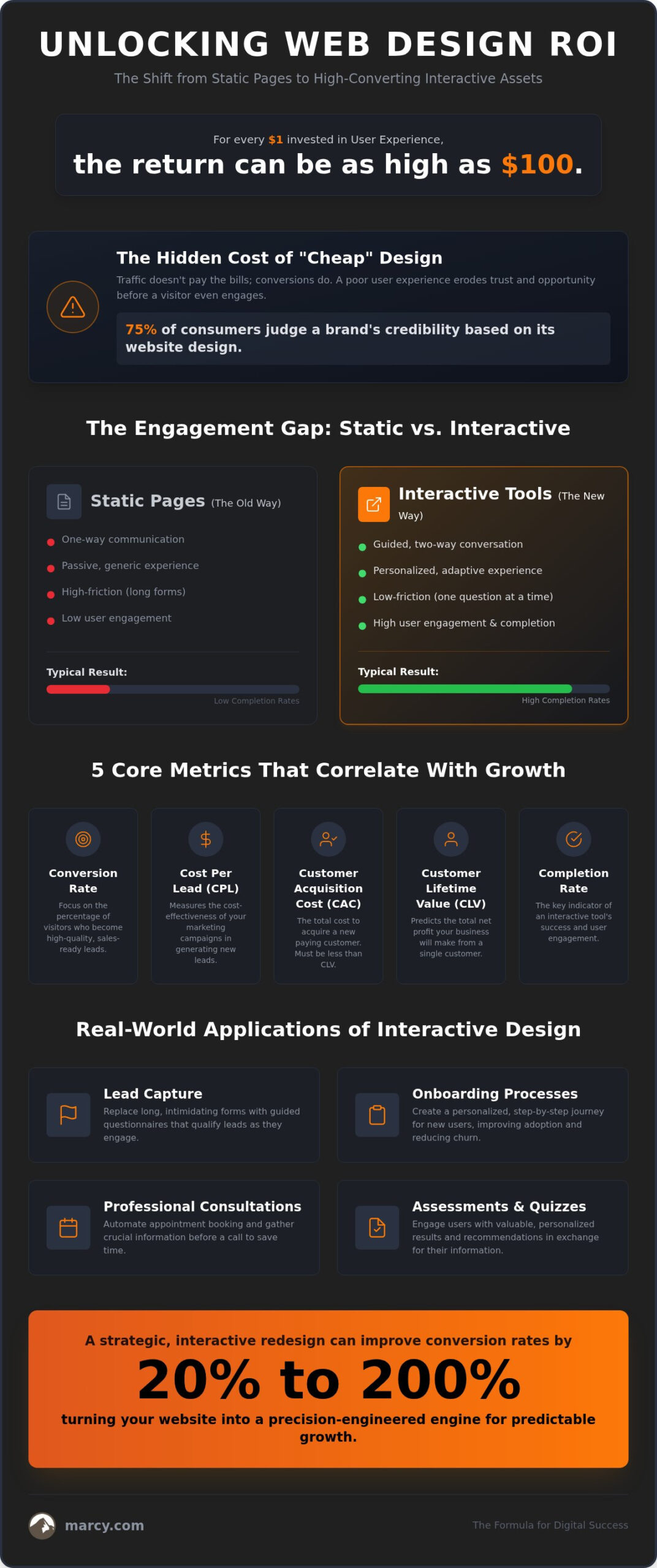
Did you know that for every $1 invested in user experience, the return can be as high as $100? It’s a staggering figure, yet many businesses still struggle with high bounce rates on expensive landing pages. You’ve likely felt the frustration of watching traffic climb while your bank balance stays the same. Traffic doesn’t pay the bills; conversions do. If you’re finding it difficult to connect specific design choices to your sales data, you aren’t alone. Most leaders recognize their website is their most important revenue driver, but they lack a clear framework for measuring web design roi in 2026.
We’re here to change that. As veteran innovators, we’ve seen how a strategic redesign can improve conversion rates by 20% to 200%. You’ll learn how to quantify the financial impact of your digital presence and shift from static web pages to high-converting interactive assets. This guide moves beyond vague metrics to provide a concrete roadmap for digital growth. We will explore how AI-powered solutions and guided experiences, like interactive professional consultations and lead capture tools, outperform traditional static forms. By the end of this article, you’ll have a clear formula to turn your website into a precision-engineered engine for better lead quality and predictable success.
Key Takeaways
- Define ROI as net profit and identify the five essential growth metrics that move beyond simple traffic numbers.
- Learn why interactive tools drive higher engagement and completion rates compared to traditional, static landing page fields.
- Follow a straightforward, two-step formula for measuring web design roi to accurately quantify your site’s financial impact.
- Understand how AI-powered solutions reduce your sales cycle by delivering personalized experiences that adapt to visitor behavior.
- Review real-world use cases for lead capture and professional consultations that transform your website into a high-converting asset.
Understanding the Fundamental Pillars of Web Design ROI
At its core, ROI is the net profit your website generates compared to the total cost of its creation and maintenance. It isn’t just a design metric. It’s a financial one. While many agencies focus on how a site looks, we focus on how it performs. 91% of marketing teams report that their website drives more revenue than any other channel. If your digital presence isn’t your top salesperson, you have an asset problem. Understanding the Fundamental Pillars of Web Design ROI requires looking past vanity metrics like page views or impressions. These numbers can be deeply misleading. A million visitors mean nothing if they don’t buy or book a consultation.
Success looks different depending on your business model. For ecommerce brands, the value is direct revenue from transactions. For service-based firms, the value is indirect, measured through lead generation and qualified inquiries. Regardless of your industry, your website must function as a 24/7 strategic sales asset. It doesn’t take sick days; it doesn’t miss follow-ups. It should be a tireless engine for measuring web design roi through clear, trackable outcomes.
Beyond Aesthetics: The Business Case for Strategic Design
Professional website design does more than please the eye. It builds immediate trust. 75% of consumers judge a brand’s credibility based on its website design. If your site looks dated or functions poorly, you’re losing leads before they even read your first paragraph. This is the hidden cost of “cheap” design. A low-cost site often leads to brand erosion and high bounce rates that eventually cost more in lost opportunities than a professional build would have cost upfront. Strategic design aligns every layout choice with specific Key Performance Indicators (KPIs) to ensure your investment pays off.
Defining Tangible vs. Intangible Design Returns
Tangible returns are the numbers you can take to the bank. These include increased sales, higher lead volume, and reduced customer support costs because users can find answers themselves. Intangible returns are subtler but equally vital for long-term growth. In the Columbus market, standing out as a local authority builds a legacy of trust and brand recognition. A high-performance digital presence offers a “long tail” value. It continues to attract and convert users years after the initial launch, provided it stays updated. By focusing on both tangible sales data and intangible brand authority, you create a comprehensive framework for measuring web design roi that reflects the true health of your business.
Key Metrics for Tracking Digital Performance in 2026
Tracking the right numbers is the difference between a guess and a strategy. Effective measuring web design roi starts with shifting your gaze from vanity numbers to financial indicators. In 2026, we focus on five core metrics that actually correlate with business growth: conversion rate, cost per lead (CPL), customer acquisition cost (CAC), customer lifetime value (CLV), and the completion rate of interactive tools. These figures tell the real story of your site’s health. If your CAC is higher than your CLV, your design isn’t just underperforming; it’s costing you money. We use heatmaps to identify exactly where users drop out of your funnel, allowing us to fix friction points before they erode your profits.
Modern performance tracking also leverages AI powered digital marketing solutions to predict user behavior before a click even happens. By analyzing patterns in how visitors navigate your site, AI can help you adjust layouts in real-time to maximize engagement. When you master these data points, measuring web design roi becomes a predictable part of your monthly reporting rather than a quarterly guessing game.
Conversion Rates and Lead Generation Quality
Quality always beats quantity. A 2% conversion rate of high-quality, sales-ready leads is far more valuable than 10% junk traffic that wastes your team’s time. You need to track the specific source of your most profitable customers to understand which design elements are doing the heavy lifting. In 2026, a significant portion of this traffic is mobile. Implementing mobile responsive web design is no longer optional; it’s a primary driver of mobile conversion ROI. If your mobile experience is clunky, your lead quality will plummet as frustrated users abandon the process.
User Engagement and Behavior Analytics
Time on page is a legacy metric that often lies. A user might spend five minutes on a page because they’re confused, not because they’re interested. We look for meaningful interaction. Are they using your assessment tools? Are they engaging with your onboarding process? Identifying ‘friction points’ like long, static forms can save a failing campaign. Research into the business value of design shows that design-led companies outperform their peers by nearly two to one. By setting up specific goal tracking in modern analytics platforms, you can see exactly which interactive elements are driving completions. If you want to see how these metrics look in a live environment, you can explore our strategic approach to performance design.
Interactive vs. Static Design: The Engagement Gap
Static web pages are the digital equivalent of a paper brochure. They’re passive, non-responsive, and increasingly ignored by a 2026 audience that expects immediate, personalized value. The gap between a static site and an interactive one is where your profit lives. While static fields just sit there, interactive tools engage the user through a “psychology of the click.” This concept relies on micro-commitments. By asking a user to answer a simple question or select an option, you lower the barrier to entry and build momentum toward a final conversion. This shift is critical for measuring web design roi because interactive elements provide data at every step of the journey, not just at the end.
Interactivity transforms your website from a storage space for information into a guided experience. Think of it as a digital concierge. Instead of a user hunting for what they need, the site asks them what they’re looking for and delivers it instantly. This level of engagement leads to significantly higher completion rates. When a user feels like a process is tailored to their specific needs, they’re far more likely to finish it. It’s a fundamental shift from “telling” the user about your company to “showing” them how you solve their specific problems.
Why Static Contact Fields Are Failing Your Brand
Form fatigue is a conversion killer. We’ve all seen generic “Contact Us” pages with five mandatory fields and a “Submit” button. These static fields offer zero immediate value to the prospect. Why should they give you their phone number for a generic “we’ll call you later” promise? Beyond the lack of value, outdated design signals a lack of innovation. If your website looks like it hasn’t changed since 2018, prospects will assume your service or product is equally stagnant. High bounce rates on these pages are a clear sign that your traditional forms are failing your brand’s bottom line.
The Power of Personalization in Lead Capture
Personalization is the gold standard for high-converting sites. For many Columbus firms, we’ve implemented interactive onboarding processes that replace the old “get a quote” form. These tools act as professional consultations, providing instant feedback or a preliminary assessment in exchange for user data. This creates a fair trade: value for information. Your strategic advertising campaigns will perform significantly better when they land on an interactive page that continues the conversation started in the ad. Whether it’s a lead capture assessment or a guided onboarding flow, these tools are essential for measuring web design roi because they turn anonymous traffic into qualified, engaged prospects with a clear intent to buy.
How to Calculate Your Website’s Financial Impact
Calculating the financial return of your digital presence shouldn’t require an advanced degree in accounting. To start measuring web design roi, you first need a clear view of your total investment. This figure includes your initial website design costs, hosting, content production, and any ongoing digital marketing expenses. Once you’ve identified the total cost, you must calculate the total gain generated over a set period, such as a fiscal year. This gain includes direct sales and the calculated value of new leads. Finally, factor in operational savings. If your site uses automated lead capture or onboarding tools to replace manual labor, those saved employee hours represent a direct boost to your bottom line. For example, an automated assessment tool that replaces a thirty minute introductory call can save hundreds of hours annually.
The Basic ROI Formula for Digital Assets
The standard formula is straightforward: (Total Gain – Total Investment) / Total Investment. This gives you a percentage that represents the efficiency of your spend. For a truly accurate picture, you must adjust for variable costs like advertising campaigns and social media management. If these expenses fluctuate monthly, use an average to keep your ROI calculations grounded in reality. Many businesses fail because they treat marketing and design as separate buckets; however, they are intrinsically linked. ROI is the ultimate measure of design success because it transforms your website from a line-item expense into a high-performing business asset.
Factoring in Customer Lifetime Value (CLV)
Looking only at the first transaction often leads to a massive underestimation of your website’s value. A high-impact site builds the trust necessary for customer retention and long-term referrals. This is where Customer Lifetime Value (CLV) comes into play. If a single lead captured today turns into a client who stays for five years, that initial design choice has paid for itself many times over. Your site serves as a long-term professional consultation tool that continues to provide value long after the first click. It educates your audience and positions you as a local Columbus authority. If you are ready to see how these numbers apply to your own business, you can request a performance-focused web design consultation to start your strategic transition today.
Driving Maximum ROI with AI-Powered Web Solutions
AI is the engine that scales your personal touch. In 2026, the most successful businesses don’t just use technology to cut costs; they use it to create deeper connections. Implementing AI website integration services is the final piece of the puzzle for measuring web design roi. These tools allow your site to adapt in real-time, displaying specific content or calls-to-action based on a visitor’s past behavior and location. This level of dynamic personalization significantly reduces your sales cycle duration. When a website understands what a user needs before they even ask, the path to a conversion becomes shorter and more efficient.
We use automated assessments to pre-qualify leads for your team. Instead of your sales staff spending hours on the phone with unqualified prospects, your website does the heavy lifting. It filters out the noise and delivers only the most profitable opportunities to your inbox. This is why Marcy Design stands as the bold innovator for Columbus businesses. We combine four decades of stability with the latest AI-driven breakthroughs to ensure your digital assets are always working at peak performance.
Integrating AI for Real-Time Onboarding Success
Static PDF downloads are a relic of the past. They’re passive and offer no way to track user engagement. An AI-powered onboarding process, however, is a guided experience that responds to user input. It reduces human overhead by answering common questions and providing immediate value. Whether a prospect is browsing at 2 PM in Columbus or 2 AM across the globe, AI-driven assistance ensures you never miss a chance to convert. This 24/7 presence is a major factor in measuring web design roi, as it captures value that would otherwise be lost during after-hours downtime.
Expert Consultations: The Final Step in Conversion
Your website’s primary job is to prepare a prospect for a professional consultation. By the time a user reaches out to your team, they should already feel like they know your brand and trust your expertise. The transition from digital engagement to a signed contract should feel like a natural next step, not a jarring sales pitch. Interactive tools and AI-enhanced personalization lay the groundwork, making the final human interaction much more effective. If you’re ready to see how these advanced solutions can transform your bottom line, Contact Marcy Design for a strategic ROI assessment and let’s build your roadmap for 2026 growth together.
Secure Your Digital Growth for 2026
Traffic is a starting point. Profit is the destination. Your website is more than a digital storefront; it’s a dynamic asset capable of driving measurable business expansion. By shifting from passive, static pages to interactive, AI-enhanced experiences, you can transform how your brand engages with the Columbus market. We’ve explored how measuring web design roi requires looking beyond vanity metrics to focus on net profit and automated operational savings. Providing immediate value through guided experiences like assessments is the most effective way to earn high-quality lead data.
As a veteran-led agency founded in 1986, we specialize in AI-powered conversion strategies that turn anonymous visitors into loyal partners. We understand the local landscape and the technological shifts that define modern success. Don’t let your digital presence stagnate while your competitors innovate. Take the next step toward a precision-engineered digital strategy today. Ready to transform your website into a high-ROI engine? Partner with Marcy Design today.
The roadmap to digital growth is now in your hands. Start implementing these strategies to ensure your website pays for itself many times over. We’re excited to see your transformation.
Frequently Asked Questions
What is a good ROI for a professional website redesign in 2026?
A strong ROI for a redesign in 2026 typically targets a 5:1 ratio, meaning five dollars in revenue for every dollar invested. While results vary, a well-executed site can improve conversion rates by 20% to 200% within the first year. For Columbus businesses, this transformation shifts the website from a static expense to a primary revenue driver. It’s about ensuring your digital presence delivers a predictable net profit that exceeds your total cost of ownership.
How long does it typically take to see a return on a new web design?
Most companies begin seeing a measurable return within 90 days of their new site launch. While long-term SEO benefits take six months to fully realize, improvements in lead quality and user engagement are often immediate. If you implement interactive onboarding or AI-powered tools, you’ll likely notice a faster sales cycle right away. Consistent advertising campaigns in the Columbus market will further speed up this process, turning your investment into profit sooner.
Can I measure ROI for a non-ecommerce business website?
You can definitely quantify the impact of a service-based site. Measuring web design roi for non-ecommerce firms involves assigning a specific dollar value to lead captures, professional consultation bookings, and phone calls. By tracking how many of these digital inquiries turn into signed contracts, you can calculate the exact revenue your website generates. It’s a shift from tracking vague traffic to measuring the tangible financial value of every guided user interaction.
Is interactive web design significantly more expensive than static design?
Interactive design requires more initial investment than simple static pages, but the long-term gains are significantly higher. Static forms often lead to high bounce rates because they offer no immediate value to the prospect. In contrast, interactive assessments and guided experiences achieve higher completion rates by engaging the user. The better lead quality and increased conversion speed usually pay for the additional development costs within the first twelve months of your 2026 launch.
How do AI-powered solutions specifically improve a website’s ROI?
AI-powered solutions boost ROI by automating the pre-qualification of leads and delivering deep personalization. These tools shorten the sales cycle by providing visitors with the exact information they need in real-time. By using automated assessments to filter out low-quality inquiries, your team can focus exclusively on high-value prospects. This efficiency reduces human overhead and ensures your website remains a 24/7 sales engine that adapts to every visitor’s unique behavior and specific needs.
What are the most important metrics to track for a Columbus-based service business?
The most vital metrics for a Columbus-based service business are local conversion rates, cost per lead, and customer acquisition cost. You need to know exactly which local advertising channels are driving your most profitable contracts. Tracking the engagement levels of your interactive consultation tools will show you how well you’re building trust with your local audience. Focusing on these data points ensures your digital strategy is optimized for the specific competitive landscape of Central Ohio.
Should I prioritize mobile design or desktop design for the best ROI?
You should prioritize a mobile-first approach, as most initial brand discoveries in 2026 happen on smartphones. However, the highest ROI is achieved through a seamless cross-device experience. While mobile is excellent for quick lead capture, many users prefer a desktop environment for detailed assessments or final professional consultations. Ensuring your site is fully mobile-responsive while maintaining desktop power prevents you from losing potential clients at critical decision-making points in their journey.
How often should I update my website to maintain a high ROI?
To maintain a high ROI, you should perform a major strategic redesign every two to three years. This allows you to integrate new breakthroughs like AI-driven personalization and updated interactive tools. On a monthly basis, you should update content and optimize your lead capture flows based on current performance data. Treating your website as a living asset is essential for measuring web design roi and ensuring it stays aligned with evolving user expectations.