
 614.224.6226
Why does your website still feel like a chore when it should feel like a professional consultation? You’ve likely noticed that traditional, static forms are failing to hold attention. In 2026, users expect more than a digital filing cabinet; they want a partner. Leveraging AI for user experience design isn’t just about flashy visuals. It’s about ending the era of low completion rates and generic interactions. With 91% of designers now using AI weekly, the standard for what “good” looks like has shifted dramatically. If your site isn’t adapting in real-time, you’re leaving revenue on the table.
It’s frustrating to watch potential leads drop off because your interface feels impersonal. We’ll show you how to transform those stagnant pages into high-engagement, interactive journeys that drive measurable business growth. You’ll learn how to replace boring fields with guided assessments that act as a 24/7 consultant. We’re moving beyond simple layouts to explore real-world use cases like streamlined onboarding and high-quality lead capture. This guide provides a step-by-step path to creating a website that doesn’t just sit there. It sells.
Key Takeaways
- Understand how AI transforms websites from static pages into predictive, user-guided journeys that anticipate visitor needs in real-time.
- Discover why interactive tools bridge the “completion gap” and drive higher engagement compared to traditional, chore-like static forms.
- Learn how to leverage AI for user experience design to turn standard lead capture into a high-value professional consultation.
- Master the human-in-the-loop philosophy to ensure your automated interactions remain grounded in your unique brand voice.
- Gain a competitive edge by partnering with a local agency that integrates over 30 years of experience with 2026’s most advanced AI tools.
Defining AI for User Experience Design in 2026
Static websites are relics of the past. In 2026, the digital landscape has pivoted toward interfaces that think, adapt, and respond. AI for user experience design is no longer a luxury; it’s the engine of conversion. It utilizes machine learning to analyze user behavior as it happens, allowing a site to pivot its presentation in milliseconds. This is a fundamental evolution of User Experience Design, moving from reactive layouts to proactive environments that anticipate needs before they’re even articulated.
We’ve moved from “user-operated” websites to “user-guided” experiences. In the old model, the visitor did all the heavy lifting. They searched, filtered, and scrolled to find value. Today, the website acts as a digital consultant. It reduces cognitive load by presenting exactly what the user needs based on their unique data profile. This shift creates a sense of effortless flow that traditional templates simply can’t match. It’s the difference between handing someone a map and driving them to their destination.
Beyond Automated Layouts: The Predictive Era
Competitors often focus on how AI makes wireframing faster. That’s only half the story. The real power lies in intent analysis. Modern systems can predict a visitor’s goal before they ever click a button. By analyzing mouse movement, dwell time, and referral context, the interface can deliver context-aware content that feels personal rather than generic. This requires a strategic, AI-first mindset. It’s about designing rules and states rather than fixed pixels. When your site understands intent, the journey becomes frictionless.
The Core Components of Modern AI UX
What makes these interfaces work? It starts with dynamic content blocks. These sections change based on whether a visitor arrived from a social ad or a professional search. Natural Language Processing (NLP) also plays a huge role. It allows for intuitive navigation that understands conversational queries instead of forcing a user through three menu levels. Businesses are increasingly turning to specialized AI website integration services to build these capabilities into their existing frameworks. It’s about creating a cohesive system that learns and grows with your audience. These components work together to ensure every interaction feels intentional and results-oriented.
Interactive vs. Static UX: Why Guided Experiences Win
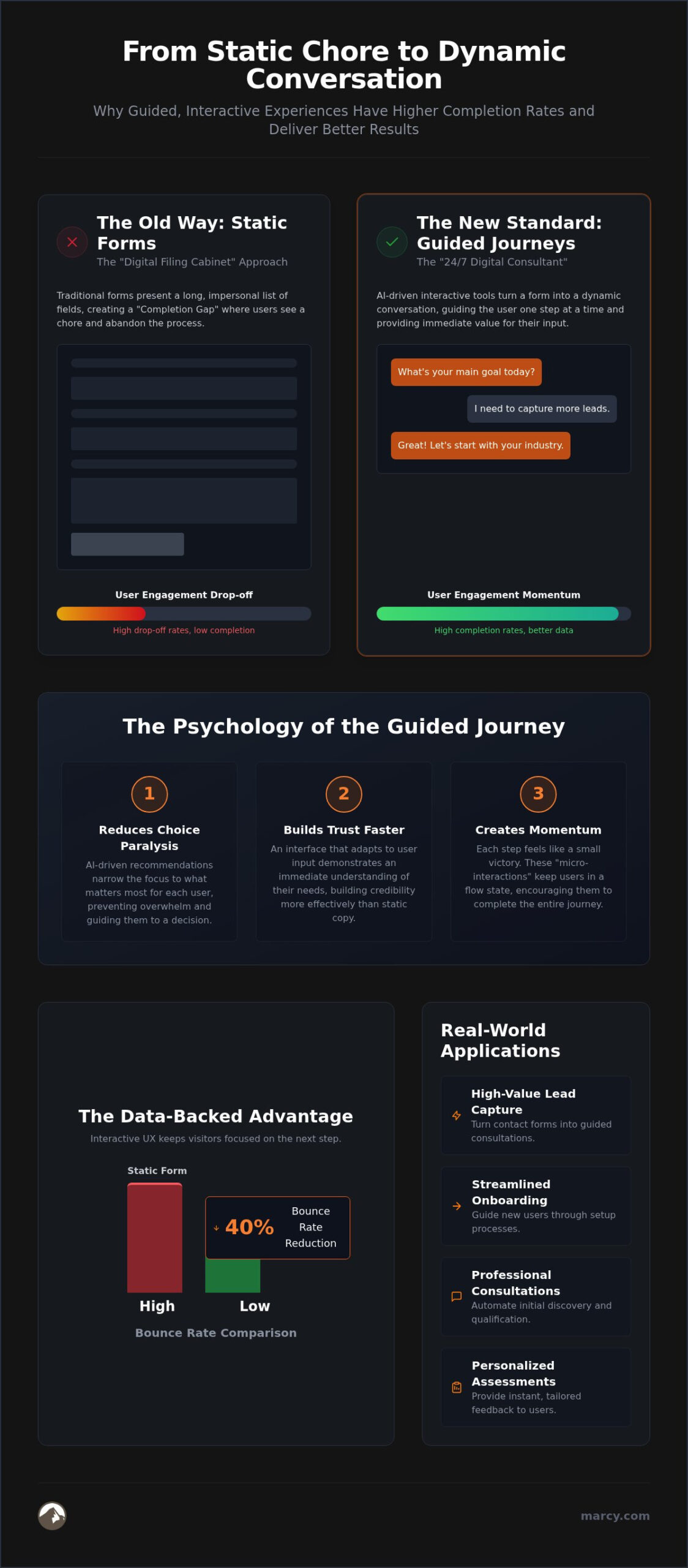
Static forms are the primary killers of lead generation. We call this the “Completion Gap.” When a visitor sees a long, uninspired list of fields, they see a chore. In 2026, high-performing websites use interactive elements to replace these hurdles. By implementing AI for user experience design, you transform a passive form into a dynamic conversation. This keeps users in a “flow state” where they receive immediate value for every piece of information they provide. It’s the difference between a cold interrogation and a warm introduction.
Engagement isn’t just about clicks; it’s about micro-interactions that build momentum. Every step in a guided journey should feel like a small victory for the user. When an interface adapts to individual input rather than a broad persona, the relevance skyrockets. To understand the broader impact of these changes, looking at the real-world applications of AI in UX helps illustrate how these tools are being deployed at scale to drive meaningful business results.
The Psychology of the Guided Journey
Why do users respond so much better to a guided experience? It’s because people naturally prefer a consultative approach over a “search and find” model. Choice paralysis is a real threat to your conversion rates. When visitors are presented with too many options, they often choose none. AI-driven recommendations solve this by narrowing the focus to what matters most to that specific individual. These interactive elements build trust faster than static marketing copy because they demonstrate an immediate understanding of the user’s needs. If you’re ready to modernize your digital presence, exploring AI Powered Solutions is the first step toward a higher-converting site.
Comparing Completion Rates and ROI
The data-backed advantages of guided assessments are impossible to ignore. Traditional contact fields are easy to ignore; an interactive assessment is an invitation to participate. Some industry professionals report that interactive UX can reduce bounce rates by 40% or more by keeping the visitor focused on the next small step. This isn’t just about short-term engagement. The long-term value of the data you collect through these AI interactions is immense. You aren’t just capturing a name and email. You’re capturing intent, preferences, and specific pain points. This allows your sales team to enter conversations with a massive head start.
Real-World Use Cases: AI UX in Business Strategy
How does this actually look in the field? For many Columbus-based service providers and B2B firms, the transition to AI for user experience design is the key to unlocking hidden revenue. It isn’t just about making things look modern. It’s about functionality that drives ROI. By using AI assessments to segment audiences automatically, businesses can deliver hyper-relevant content to every visitor. This level of precision is what separates industry leaders from those still stuck with static templates. The goal is simple: turn every click into a meaningful data point.
Applying these strategies allows a business to function with the efficiency of a much larger enterprise. You aren’t just guessing what your audience wants. You’re letting the system reveal it through their actions. This proactive approach to web architecture ensures that your digital presence remains an active asset rather than a passive expense. It’s a fundamental shift in how we think about the relationship between a brand and its audience. When your website acts as a consultant, your business grows faster.
Lead Capture as a Professional Consultation
Why settle for a “Contact Us” button when you can offer a “Custom Strategy”? The traditional lead form is a barrier. AI-driven interfaces act as an initial screening layer, identifying high-value prospects during the very first interaction. Think of it as a digital concierge. For example, a local Columbus firm integrated these tools and saw lead quality increase by 60%. By asking the right questions and adapting the path based on responses, the site qualifies leads before a human ever picks up the phone. This saves time. It ensures your sales team focuses only on the most promising opportunities. Would you rather chase cold leads or speak with qualified partners? The answer is obvious.
Automated Onboarding and User Assessments
Complexity is the enemy of conversion. If your SaaS or service-based signup process feels like a hurdle, you’re losing money. Adaptive AI walkthroughs solve this by providing instant feedback during a user assessment. Instead of a generic welcome, the system guides the user based on their specific needs. This streamlined approach is a core part of effective AI powered digital marketing solutions. Without this front-end UX, even the best back-end strategy will struggle. It’s about making the entry point as frictionless as possible. When users feel understood from the first click, they stay. Retention starts with the very first interaction.
Implementing AI UX: Balancing Automation and Brand Voice
Can an algorithm truly capture the soul of your business? Not on its own. While automation provides the speed, your brand voice provides the connection. Effective AI for user experience design requires a “Human-in-the-Loop” philosophy. This means using machine learning to handle the heavy lifting while keeping creative professionals in charge of the strategy. Pure automation often leads to the “Uncanny Valley,” where digital interactions feel slightly off or robotic. This creepiness factor is a conversion killer. To avoid it, every AI-driven interaction must be grounded in your unique brand personality.
Starting small is the most effective way to transition without overwhelming your team or your budget. You don’t need to rebuild your entire site overnight. Instead, focus on integrating intelligent elements into your existing mobile responsive web design. This ensures that your guided experiences remain seamless across every device. When you balance technical precision with a human touch, you create a digital environment that feels both innovative and deeply reliable. It’s about scaling your expertise, not replacing it.
The Role of the Professional Web Designer
AI is a powerful tool, but it lacks the nuance of professional creative direction. Designers now use AI to test thousands of UX variations in a fraction of the time it used to take. They aren’t just picking colors; they’re setting “brand-guardrails” that ensure generative layouts stay consistent with your identity. This partnership allows for rapid prototyping without sacrificing quality. A designer’s eye ensures that the AI for user experience design serves the user’s intent rather than just following a mathematical pattern. Strategy always beats pure automation. If you want to see how this balance drives growth, explore our AI Powered Solutions to find the right fit for your brand.
Step-by-Step Integration for Small to Mid-Sized Firms
Implementation should be methodical and data-driven. Start by auditing your current conversion bottlenecks. Where are people leaving your site? Once you’ve identified a problem area, select one high-impact section for an AI upgrade. The pricing page or a complex service description is often the best place to begin. Replace a static table with an interactive calculator or a guided assessment. From there, use real-time user feedback loops to test and iterate. This constant cycle of improvement ensures your site evolves alongside your audience’s expectations. Don’t guess what works; let the data show you the way forward.
Partnering with a Columbus AI Design Agency for Growth
Marcy Design isn’t just another agency. We’ve led the Columbus market since 1986. That’s over 30 years of industry leadership. While others are just starting to learn about AI for user experience design, we’re already integrating it into high-impact strategies. Local Columbus businesses need more than just global tools. They need a partner who understands the local market dynamics and consumer behavior. We combine time-tested principles with 2026’s most advanced AI innovations to deliver results that matter. It’s about stability meeting innovation.
Our approach to website design prioritizes ROI above all else. We don’t build digital trophies. We build engines for business prosperity. By acting as your “friendly guide” through the complex world of AI transitions, we make high-level expertise feel approachable. You’ll get a dedicated team of specialists ready to tackle your most difficult challenges with high energy and professional precision. We understand the mechanics of business growth, and we’re excited to help you navigate this shift.
Strategic Advertising and Integrated UX
Your marketing efforts don’t exist in a vacuum. Even the most brilliant strategic advertising campaigns will fail if the landing page is a dead end. By using AI-optimized landing pages, we ensure that the promise made in your ad is fulfilled by the site’s experience. There’s a powerful synergy between proactive social media management and interactive site design. When your ads and your website speak the same language, your market share grows. We focus on driving that growth through superior digital experiences that convert attention into action.
Your Path to Digital Transformation
Ready to see what’s possible for your brand? A professional consultation with Marcy Design is a deep dive into your business goals. We don’t offer cookie-cutter templates. Instead, we provide custom AI Powered Solutions tailored to your specific needs. It’s time to stop letting your website be a passive brochure. Request an assessment of your current website UX to identify exactly where you’re losing potential customers. We can have your strategy prepared and ready for action by Wednesday of this week. Don’t wait for the competition to move first. Take the lead now and transform your digital presence into a guided consultant that works as hard as you do.
Future-Proof Your Digital Strategy Today
The era of the digital brochure is over. We’ve explored how guided journeys and predictive interfaces turn passive visitors into active partners. Implementing AI for user experience design isn’t about replacing the human touch; it’s about amplifying it to meet the high-speed expectations of today’s market. Whether you’re streamlining lead capture or automating complex onboarding, the ultimate goal is always measurable business growth. You have the power to turn your website into a 24/7 digital consultant that understands every visitor’s intent.
Since 1986, Marcy Design has served as Columbus-based experts helping local and national businesses navigate major technological shifts with creative precision. We specialize in AI website integration that prioritizes your ROI and preserves your unique brand voice. Don’t let static forms and generic templates continue to stifle your conversion rates. Our team of specialists is ready to help you build a site that doesn’t just look great but performs at the highest level. It’s time to take the lead in your industry with a site that thinks as fast as your customers do.
Take the next step toward a more engaging, results-oriented digital presence. We’re excited to act as your guide in this new landscape of intelligent design. Modernize your website with Marcy Design’s AI solutions and start your transformation today. The future of your user experience starts with a single, strategic choice.
Frequently Asked Questions
What is the difference between traditional UX and AI-powered UX?
Traditional UX is static and reactive, while AI-powered UX is dynamic and predictive. Instead of a fixed layout for every visitor, AI analyzes behavior in real-time to adjust content and navigation. This reduces the work a user has to do to find information. It transforms the site from a digital brochure into a guided consultant. By using AI for user experience design, you create an interface that evolves with the user’s intent.
Will using AI for UX design make my website look like everyone else’s?
No, AI tools actually enable greater customization than traditional templates. While basic AI generators might produce generic layouts, a professional agency uses these tools to build unique, brand-specific environments. AI handles the structural optimization, but the creative direction remains human-led. This ensures your site stands out while benefiting from data-driven performance. It’s about using technology to highlight your unique value proposition, not to hide it behind a generic grid.
How does AI improve website conversion rates specifically?
AI improves conversion by removing friction and personalizing the path to purchase. By replacing long, static forms with interactive assessments, you keep users engaged in a flow state. The system identifies high-intent behavior and presents the right call-to-action at the exact moment of decision. This targeted approach reduces bounce rates and ensures visitors don’t get lost in irrelevant content. Higher engagement naturally leads to better lead quality and measurable business growth.
Is AI UX integration expensive for small businesses in Columbus?
Integration is more accessible than most business owners realize. You don’t need a massive enterprise budget to start seeing results. Many firms begin by upgrading a single high-impact area, such as a lead capture form or a pricing calculator. This modular approach allows small businesses in Columbus to scale their investment as they see a return. Working with a local partner ensures your strategy is cost-effective and tailored to your specific market needs.
Can AI help with mobile-specific user experience design?
Yes, AI is essential for optimizing the limited screen space on mobile devices. It can prioritize buttons and content based on how a user typically interacts with their phone. Since mobile users often have higher urgency, AI predicts their needs to deliver a faster, more intuitive experience. This ensures your mobile web design isn’t just a shrunken version of your desktop site. It becomes a purpose-built tool for on-the-go conversion.
How do I ensure my AI-driven website stays true to my brand voice?
Maintaining your brand voice requires a human-in-the-loop strategy where designers set strict guardrails for AI interactions. You shouldn’t let an algorithm write your core messaging. Instead, use AI to deliver your professionally crafted content at the right time. By training models on your specific brand guidelines, the system learns to mimic your tone without losing the human touch. This balance ensures your automated consultations feel like an authentic extension of your team.
What are the best use cases for AI for user experience design in B2B?
In the B2B sector, the best use cases include interactive assessments, automated onboarding, and personalized content hubs. B2B sales cycles are often long and complex; AI simplifies this by acting as an initial consultant. It can qualify leads by asking strategic questions and then direct them to the most relevant case studies or white papers. This high-touch experience builds trust early in the relationship. It turns a standard website into a powerful sales enablement tool.
How long does it take to integrate AI features into an existing website?
The timeline depends on the complexity of the features, but basic integrations can often be completed in a few weeks. A simple AI-driven lead capture tool or a guided assessment can be deployed relatively quickly. More comprehensive overhauls that involve deep machine learning integration will take longer. We focus on a phased rollout to ensure you see immediate improvements while we build toward a full digital transformation. Efficiency and clarity are our top priorities.