
 614.224.6226
Why are you still treating every visitor to your website like they’re the same person? In an era where 80% of retailers are already leveraging generative AI, a static product page is essentially a “closed” sign to modern shoppers. You’ve likely felt the sting of low conversion rates and the exhaustion of manual segmentation. It’s a common struggle to scale without losing that vital human touch. We understand that your time is better spent on growth strategy than on micro-managing customer tags.
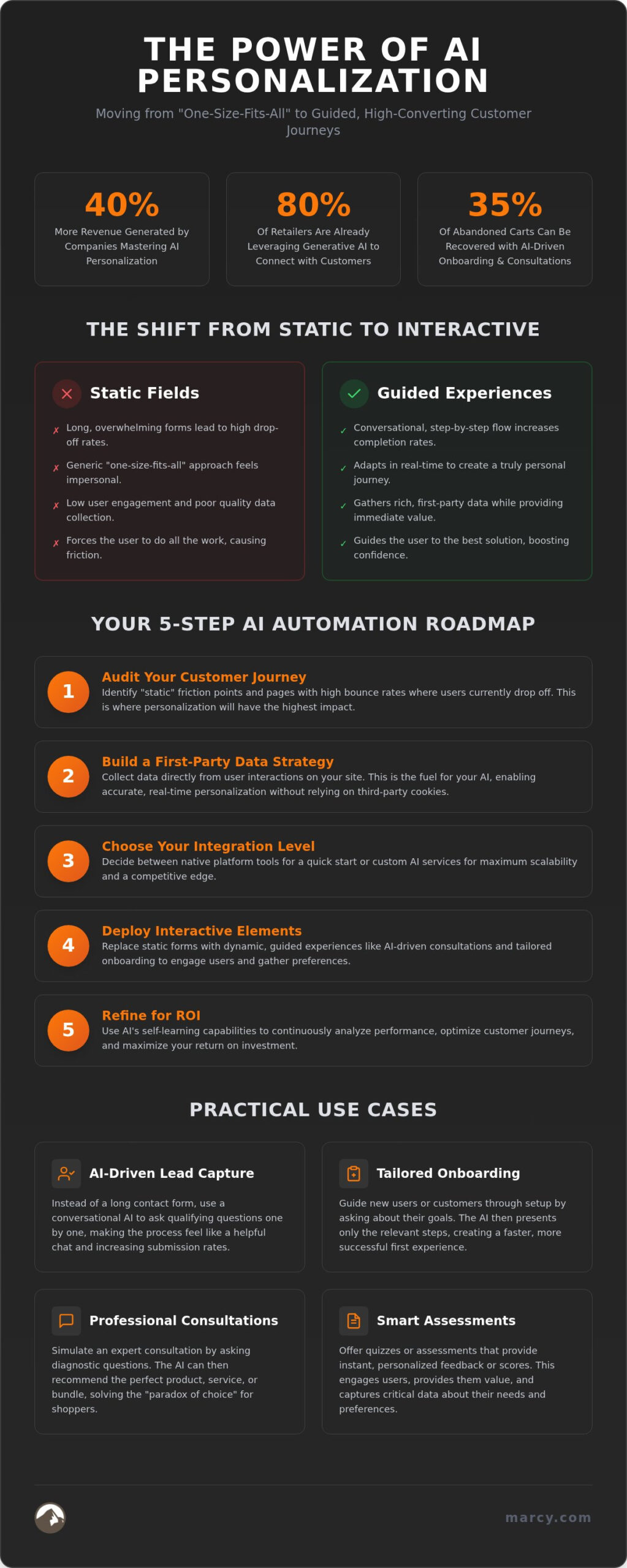
Implementing AI for ecommerce personalization is the definitive way to turn a generic catalog into a high-converting, interactive powerhouse. Companies that master this shift are already generating 40% more revenue than their competitors. This 2026 automation guide promises to show you how to build automated customer journeys that feel deeply personal and drive measurable ROI. We’ll walk you through the transition from “broadcast” selling to guided, agentic experiences. You’ll discover how interactive tools like AI-driven onboarding and professional consultations can recover 35% of abandoned carts while keeping your brand’s unique voice intact.
Key Takeaways
- Understand why the “one-size-fits-all” model is obsolete and how real-time behavioral data powers the next generation of online shopping.
- Follow a proven 5-step roadmap to implement AI for ecommerce personalization; it’s the key to moving from manual segmentation to high-impact automation.
- Learn to solve the “choice paradox” by replacing static product pages with interactive, guided experiences that significantly boost engagement.
- Explore practical use cases like AI-driven lead capture and tailored onboarding that turn casual browsers into dedicated buyers.
- See why a strategy-first approach is vital to ensuring your AI integration delivers measurable growth without losing your brand’s human touch.
What is AI for Ecommerce Personalization in 2026?
In 2026, a static online storefront is a liability. It’s that simple. Modern AI for ecommerce personalization is the automated delivery of tailored content, pricing, and messaging based on real-time user behavior. The “one-size-fits-all” approach died because shoppers now expect every click to be anticipated. If your site doesn’t adapt instantly, they leave. They want experiences that feel like they were built specifically for them, not a generic crowd.
We’ve moved beyond manual segmentation, where marketers spent hours grouping people by age or location. Today, predictive, self-learning models do the heavy lifting. This allows you to automate business with AI, reclaiming your time while significantly increasing accuracy. It’s about moving from reactive guesses to proactive precision. You aren’t just selling products anymore; you’re facilitating a guided journey that evolves with every interaction.
The Evolution from Basic Customization to AI-Driven Personalization
Remember when a “personalized” email just meant your first name was in the subject line? That’s basic customization, and in the current market, it’s not enough. AI-driven personalization is fundamentally different. It analyzes patterns humans often miss, such as the subtle relationship between a user’s scrolling speed and their likelihood to purchase a specific bundle. It looks at intent, not just history.
This shift relies heavily on Artificial Intelligence in Marketing to decode complex consumer data. Machine learning models now predict intent before a customer even types in the search bar. This level of sophistication isn’t a luxury anymore; it’s a standard consumer expectation. When AI for ecommerce personalization is done right, the customer doesn’t see the algorithm. They only see a store that understands exactly what they need.
Why Columbus Businesses are Leading the AI Transition
The competitive landscape in Ohio is shifting rapidly. Local brands are realizing that to beat national giants, they need a digital edge. This is why web design in Columbus, Ohio has evolved to include AI integration as a core requirement rather than an add-on. Our local business community is uniquely positioned to blend traditional midwestern values with bold innovation.
By leveraging these tools, local businesses are competing on a global scale. They’re using AI to provide a “boutique” feel at scale. It allows a mid-sized shop in the Short North to offer the same level of predictive service as a multi-billion dollar retailer. This localized dedication combined with high-tech innovation is what separates the leaders from the laggards. Investing in these systems now ensures your business remains relevant and prosperous for years to come.
How to Automate Your Business with AI Personalization: A 5-Step Guide
Automation is no longer just a way to save time; it’s a way to win. To successfully implement AI for ecommerce personalization, you need a structured framework that prioritizes the user experience. This isn’t about adding “bells and whistles” to a broken site. It’s about fundamentally retooling how your store communicates with every individual visitor. Follow this sequential roadmap to transform your operations.
- Step 1: Audit your customer journey. Identify “static” friction points where users drop off. If your bounce rate is high on a specific category page, it likely lacks relevance.
- Step 2: Build a first-party data strategy. In 2026, third-party cookies are a relic. You must collect data directly through interactions. For a deeper look at the mechanics, IBM’s Guide to AI Personalization offers an excellent technical overview of predictive models.
- Step 3: Choose your integration level. Decide between native platform tools or custom AI website integration services. Custom solutions often provide the scalability that growing brands require.
- Step 4: Deploy interactive elements. Replace long, boring forms with guided onboarding and professional consultations. These tools gather preferences while providing immediate value to the shopper.
- Step 5: Refine for ROI. AI is a self-learning system, but it still needs human oversight. Monitor your conversion rates and adjust your models to ensure they align with your business goals.
Identifying Automation Opportunities in Your Sales Funnel
Where are you losing money? Most businesses find that drop-offs occur when content feels generic or irrelevant. The secret is to use automation to enhance the human touch, not replace it. By automating the “discovery” phase, you help users find what they want faster. Intent-based automation is the key to 2026 ecommerce. It ensures that every discount, product suggestion, and email feels like a deliberate, thoughtful recommendation rather than a random blast.
Selecting the Right AI Integration for Your Platform
Choosing the right tech stack is a critical decision. While native tools on platforms like Shopify are accessible, they often lack the depth needed for a truly unique brand experience. Columbus businesses should prioritize scalable, professional web development that allows for deep AI integration. Your solution must be mobile-optimized; the 2026 shopper is browsing on the go and expects instant, personalized responses. If you’re ready to scale, exploring custom AI integrations can provide the competitive edge your brand deserves.
Interactive vs. Static: Why Guided Experiences Outperform Traditional Fields
Static websites are digital catalogs; interactive websites are digital consultants. In 2026, the “Choice Paradox” is a primary reason for high bounce rates. When a customer lands on a page with 300 products, they often feel overwhelmed and leave. Interactive AI for ecommerce personalization solves this by acting as a digital personal shopper. It filters the noise. It focuses on the individual. This guided approach transforms a passive browsing session into an active, high-value conversation that builds momentum toward a purchase.
The benefits of this shift are measurable. AI chat can deliver four times higher conversion rates compared to unassisted shopping. By replacing static fields with interactive tools, you don’t just capture data; you capture interest. These tools increase brand recall because the user feels seen and understood. Instead of shouting at a crowd, your website is finally speaking to a person.
The Psychology of the Guided Shopping Experience
Why do users prefer answering three targeted questions over scrolling through endless categories? It’s about cognitive load. Interactive elements build trust because they signal that the brand is listening. When AI simplifies complex choices through a professional consultation or a style assessment, it removes the friction of decision-making. This creates a stronger emotional connection. The shopper isn’t just buying a product; they’re receiving a solution tailored to their specific needs. It turns a transaction into a relationship.
Achieving Higher Completion Rates with AI-Powered Tools
Traditional static forms are notorious for low engagement. They look like work. In contrast, interactive multi-step assessments feel like a service. Real-time feedback loops keep users moving through the funnel by providing immediate value at each step. For example, an AI-powered onboarding process can adjust its questions based on a user’s previous answers. This ensures the experience remains relevant and engaging throughout. The completion gap between static and interactive ecommerce sites is massive, as interactive tools consistently produce higher engagement and deeper first-party data. If you want to see how these tools look in a professional environment, exploring modern website design strategies is the first step to closing that gap.
4 Practical Use Cases for AI Personalization in Ecommerce
Theory is only useful when it translates into tangible results. Implementing AI for ecommerce personalization allows you to move beyond abstract concepts and start solving real business challenges. By 2026, the gap between businesses that use these tools and those that don’t will be insurmountable. We’ve seen that AI chat can deliver 4X higher conversion rates compared to unassisted shopping. It’s time to put that power to work across your entire site. Whether you’re focused on capturing more leads or reducing return rates, these four practical use cases provide a clear path to growth.
Automating Lead Capture and Onboarding
Generic “10% off” popups have become white noise. Most shoppers close them before they even finish loading. AI changes the game by offering the right incentive at the exact right moment. If a visitor spends time reading a detailed guide on sustainable fabrics, the AI triggers a lead capture form offering a “Sustainable Style Guide” instead of a random discount. This value-driven approach builds trust from the first interaction.
Onboarding should also adapt to where your users come from. For instance, a Columbus boutique could use AI to recognize a returning local shopper who clicked a local event ad. The site can then prioritize local pickup options or invite them to an in-store VIP night in the Short North. This level of detail makes the digital experience feel as personal as a face-to-face conversation. It ensures your welcome sequence is relevant to the specific needs of each individual, significantly increasing the likelihood of a first purchase.
Professional Consultations and Assessments at Scale
High-ticket sales often require a “discovery” phase that usually demands human intervention. You can automate business with AI by deploying virtual consultants that handle this initial heavy lifting. These tools ask the right questions about budget, style preferences, and specific use cases. They provide a curated list of recommendations that feel like they came from a professional advisor. This is especially vital for B2B or luxury retail where the “Choice Paradox” often leads to abandoned carts.
Assessments and “Product Finder” quizzes are equally transformative. They don’t just provide a single product; they suggest personalized bundles that solve a customer’s entire problem. This strategy is highly effective at reducing return rates because customers feel confident in their purchase. When you integrate these tools into your ecommerce website development, you’re building a system that acts as a 24/7 sales team. Since 93% of customer questions can now be resolved by AI without human intervention, these tools allow you to scale your expertise without increasing your headcount.
Ready to see these tools in action on your own site? Explore our AI Powered Solutions to discover how we can build a custom, high-converting journey for your brand.
Implementing AI Personalization: Your Strategic Roadmap for 2026
Software is a tool. Strategy is the solution. Too many businesses fail because they prioritize software selection over strategic planning. If you implement AI for ecommerce personalization without a clear roadmap, you risk creating a fragmented experience that alienates your audience. Your brand strategy must be the driver. AI is simply the high-performance engine that allows that strategy to scale across thousands of unique customer journeys. It’s about building a foundation that supports long-term prosperity rather than chasing a temporary trend.
Success in 2026 is measured by two critical metrics: Conversion Rate (CR) and Customer Lifetime Value (CLV). Research indicates that AI personalization in ecommerce can increase customer lifetime value by 33%. You aren’t just looking for a quick sale. You’re building a system that fosters deep loyalty and recurring revenue. By focusing on these measurable outcomes, you ensure that every AI integration serves your bottom line. We’ve seen that AI-led personalization can boost retail profits by up to 15% while simultaneously reducing marketing costs by nearly 20%. These aren’t just numbers; they’re the markers of a business that understands the mechanics of growth.
The Role of Local Expertise in Global AI Trends
Why should you work with a Columbus web design company? Local expertise provides a context that global SaaS platforms simply cannot match. A Columbus-first approach helps us understand the specific market nuances of the Midwest while applying global technology trends. At Marcy Design, we’ve spent 40 years balancing bold innovation with time-tested principles. We don’t chase every passing fad. Instead, we integrate solutions that are grounded in stability and business growth. We invite personal interaction and direct dialogue to bridge the gap between complex technical AI and your real-world business goals. Our veteran team is ready to help you navigate these shifts with confidence.
Next Steps: Moving from Awareness to Action
Transitioning to an AI-powered model requires a heroic approach. It involves tackling complex integration challenges with high energy and precision. You can’t afford to stay in the research phase forever. The market is moving too fast. We recommend starting with a comprehensive audit of your site’s current AI potential. This identifies where static fields are costing you money and where interactive tools can drive higher engagement. We’ll show you how to replace traditional friction points with guided experiences that produce better results for your end-users.
Our team of specialists is ready to guide you through this transformation. We focus on creating automated journeys that feel personal, authentic, and high-converting. Don’t let your competition set the pace. It’s time to move from awareness to action with a partner who understands the mechanics of success. Ready to lead your industry? Contact Marcy Design for a strategic AI consultation today.
Future-Proof Your Ecommerce Strategy Today
The transition from static catalogs to interactive, guided experiences is the defining shift of the 2026 market. By implementing AI for ecommerce personalization, you aren’t just following a trend; you’re building a resilient, high-converting ecosystem that respects your customer’s time and intelligence. We’ve explored how moving toward automated consultations and assessments can transform your ROI and customer loyalty. It’s time to bridge the gap between technical complexity and your actual business goals.
Marcy Design stands as Columbus, Ohio’s leader in strategic web growth, bringing 40 years of digital design excellence to every project. We are specialists in high-impact AI integration, ready to help you navigate these technological shifts with confidence and clarity. Our team is dedicated to ensuring your brand remains a bold innovator in an increasingly automated world.
Ready to transform your online store into an automated powerhouse? Scale Your Business with AI-Powered Ecommerce Solutions and lead your industry with a store that thinks as fast as your customers do. Your journey toward measurable growth starts with a single strategic step. We look forward to building your future together.
Frequently Asked Questions
How does AI for ecommerce personalization actually increase sales?
It boosts sales by predicting shopper intent and delivering the right product at the exact moment of peak interest. By reducing the “Choice Paradox,” it guides users to checkout faster without the friction of endless browsing. Companies that master these strategies generate 40% more revenue from personalization activities than average players. It’s about turning passive browsers into active buyers through hyper-relevance and timely incentives.
Is AI personalization too expensive for a small business in Columbus?
No, it’s an investment in scalable growth rather than a simple cost. Modern AI for ecommerce personalization tools are designed to be modular, meaning you can start with high-impact elements like AI-driven lead capture. Local Columbus businesses often see a measurable ROI that offsets setup costs by reducing manual segmentation labor and increasing conversion rates. It’s about working smarter to compete with national retail giants.
Can I automate my business with AI without losing my brand’s voice?
Yes, because you define the parameters and tone for every automated interaction. AI acts as an extension of your existing strategy, not a replacement for it. By using custom-trained models, your automated customer journeys reflect the same “friendly guide” persona you use in your local shop. It ensures a consistent, high-energy brand experience across thousands of digital touchpoints simultaneously without requiring 24/7 human oversight.
What is the difference between interactive elements and static fields?
Static fields are passive placeholders, like a standard search bar or a generic product description. Interactive elements are dynamic tools, such as style assessments or virtual consultations, that respond to user input in real-time. These “guided” experiences produce better results because they actively engage the shopper. They replace the mental work of browsing with the personalized service of discovery, leading to much higher completion rates.
How long does it take to implement AI website integration services?
The timeline varies based on the complexity of your current tech stack and the depth of the integration. A focused implementation of specific AI tools can often be completed within a few weeks. However, building a comprehensive, custom-designed ecosystem typically takes longer to ensure every model is properly tested and refined for maximum ROI. We prioritize a methodical yet energetic flow to get your systems live efficiently.
What happens if I don’t implement AI personalization by 2026?
You risk becoming obsolete as consumer expectations shift toward hyper-relevance. By 2026, 80% of retailers are already using or piloting generative AI. Without these tools, your site will feel slow, generic, and disconnected from the modern shopper’s needs. You’ll likely see a steady decline in conversion rates as competitors offer the “personal shopper” experience that users now demand as a standard part of their journey.
Do I need a special ecommerce platform to use AI personalization?
While platforms like Shopify offer native tools, you don’t need a specific brand of software to begin. Custom-built solutions often provide the best results for businesses looking to scale beyond generic templates. Professional web development allows you to integrate AI into almost any modern architecture. The key is choosing a partner who understands how to bridge the gap between technical code and your specific business growth goals.
How do I ensure my AI-powered personalization is mobile-optimized?
Mobile optimization must be baked into the strategic design phase, not added as an afterthought. Since 2026 shoppers are primarily mobile, your interactive tools must be lightweight and instantly responsive. This means ensuring that AI chat and assessments function perfectly on smaller screens without lagging. Fast-paced, intentional design ensures that your personalized journeys are seamless across all devices, capturing sales wherever your customers happen to be browsing.