
 614.224.6226
A rebrand runs in eight stages: decide why, audit what you have, define who you serve and where you stand, choose the scope, build the identity and messaging, plan the rollout, launch, then measure. Skip the first three and the rest becomes a logo swap that changes how you look but not what customers believe. This guide walks through each stage for owners of small and midsize companies, manufacturers and nonprofits who need the result to show up in leads and sales, not only in a new color palette.
TL;DR
- Rebrand only for a business reason: a merger, a new market, a changed offer, a damaged reputation or a legal conflict. Boredom is not a reason.
- A refresh updates how you look and sound. A rebrand changes positioning, and sometimes the name. Pick the scope before you hire designers.
- The work in order: reason, audit, audience and positioning, scope, identity and messaging, rollout plan, launch, measurement.
- The website is where most rebrands succeed or fail. Plan the redirects and search visibility before launch day.
- Budget more time than you expect. A launch is the midpoint, because every sign, document and listing has to follow.
Table of Contents
- What a rebrand is, and what it is not
- Brand refresh or full rebrand?
- When it is time to rebrand
- The rebranding process, step by step
- What the logo decision looks like
- What it costs in time and money, and what goes wrong
- Why a rebrand belongs with your website
- How we can help
- Our view: a rebrand should earn its keep
- FAQ
- Sources
What a rebrand is, and what it is not
Your brand is the picture customers hold of your company: what you do, who you do it for, how you sound and whether they trust you. A logo and a color palette are the visible part. Rebranding is the deliberate change of that picture.
That makes it different from a redesign. A new website template or a fresh logo can be part of a rebrand, but on their own they only change the surface. If your customers still hear the same promise from the same voice, nothing has been rebranded.
It also makes it a business project, not a creative one. The output is a documented position, a name and identity that express it, and a plan to put it in front of every audience you have. If you want to see how we think about the basics first, our piece on whether branding matters to a business covers the foundation.
Brand refresh or full rebrand?
This is the first decision, and it sets the budget and the calendar.
| Brand refresh | Full rebrand | |
|---|---|---|
| What changes | Logo details, colors, fonts, imagery, tone of voice | Positioning, audience, name, messaging, visual identity |
| What stays | Name, core promise, audience | Little is guaranteed to stay |
| Typical trigger | Look is dated, new products need a consistent style | Merger, new market, new business model, reputation damage |
| Risk | Low: customers still recognize you | Higher: customers must relearn who you are |
| Rough timeline | Weeks to a few months | Many months, often a year or more |
The timeline row is a working range, not a promise. One 2026 guide puts a focused visual refresh at three to six months and a full rebrand with a name change at 12 to 18 months, including naming, legal clearance and phased rollout. Your own range depends on how many places carry your brand: a ten-person services firm with one website moves faster than a manufacturer with trucks, trade-show booths, catalogs, distributor portals and product labels.
A useful test: if your customers’ problem and your answer to it are the same, but you look tired, refresh. If your answer, your audience or your name no longer fits, rebrand.
When it is time to rebrand
There are good reasons and weak ones. A 2026 decision guide lists the justified triggers: a merger or acquisition that leaves incompatible brand promises, a severe reputational event, expansion blocked by the old name, a real strategic repositioning, or legal exposure such as a trademark conflict. The same guide says a new executive’s wish for a fresh start or general internal boredom do not qualify.
Bank guidance for business owners makes a similar point from the customer side: large mergers often bring a rebrand, and shifts in customer perception or outside pressures like new regulations can prompt one too. Typical goals from a 2026 ecommerce guide include differentiating from competitors, reflecting changes in the business, reaching new audiences and improving company image.
Translate those into signs you can see in your own company:
- You sell something your name or website no longer describes, such as a manufacturer that now offers services or a retailer that now sells wholesale.
- Your best prospects describe you in a way you do not recognize.
- Your sales team apologizes for the website or the brochure before meetings.
- You are entering a new region, industry or customer segment and the old identity limits you.
- Two brands have been merged, or one has been inherited, and customers are confused.
If none of these applies and the honest reason is that the logo feels old, a refresh is the right size of project.
The rebranding process, step by step
1. Write down the business reason and the goal
One sentence for why, one measurable sentence for what success looks like. “Win more mid-size distributors,” “stop losing bids to competitors who look bigger,” “merge two brands under one name without losing repeat customers.” Every later decision gets checked against it.
Keep the decision group small. Designing by committee is one of the most common ways a rebrand stalls, so name three to five people who decide and everyone else who gives input.
2. Audit what you have
Collect every place your brand appears: website, social profiles, email signatures, proposals, packaging, vehicles, signage, trade-show materials, directory listings, vendor portals, invoices. This list matters twice: it shows what is inconsistent today, and it becomes your launch checklist later.
Then ask the people who matter. Talk to ten to fifteen recent customers, a few lost prospects and your own sales and service staff. Ask what they thought of you before they bought, why they chose you and what they would tell a friend. Look at your analytics, too: which pages bring in leads, which search terms find you, which pages nobody reads.
3. Define your audience and your position
Decide who you are for, in specific terms. “Small businesses” is not an audience. “Ohio manufacturers with 20 to 200 employees that sell through distributors” is. If you serve more than one group, rank them, because the identity has to work hardest for the first.
Then write the positioning: who you serve, what you do for them, why you are the better choice, and the proof. Proof means things a buyer can check: years in business, awards, certifications, named results. This is also where you set messaging: a short promise, three supporting points, and the words you will and will not use. Companies that skip this step usually end up with a rebrand that looks different and says the same things.
4. Choose the scope
Now, with the reason, audit and positioning in hand, decide: refresh, partial rebrand or full rebrand. A partial rebrand might keep the name and change the look and the message. A full rebrand may change the name, which adds trademark searches, domain decisions, legal filings and new registrations. A name change is the most expensive and slowest option, so make it only when the old name genuinely blocks the strategy.
5. Build the identity and the messaging
This is the stage most people picture as the whole project. It produces:
- A logo system: primary mark, simplified version for small spaces, one-color version.
- Color palette with exact values for print and screen.
- Typography for headlines, body text and documents.
- Photography and illustration direction.
- Voice and tone: how you sound in a proposal, an email, a social post.
- Brand guidelines that put all of this in one document, so a vendor or new hire can apply it correctly without asking.
Test the work with real customers before it is final. Show two directions to a handful of the people you interviewed in step 2 and ask what each says about the company. A color that looks great in a meeting can read as the wrong industry to a buyer.
6. Plan the rollout
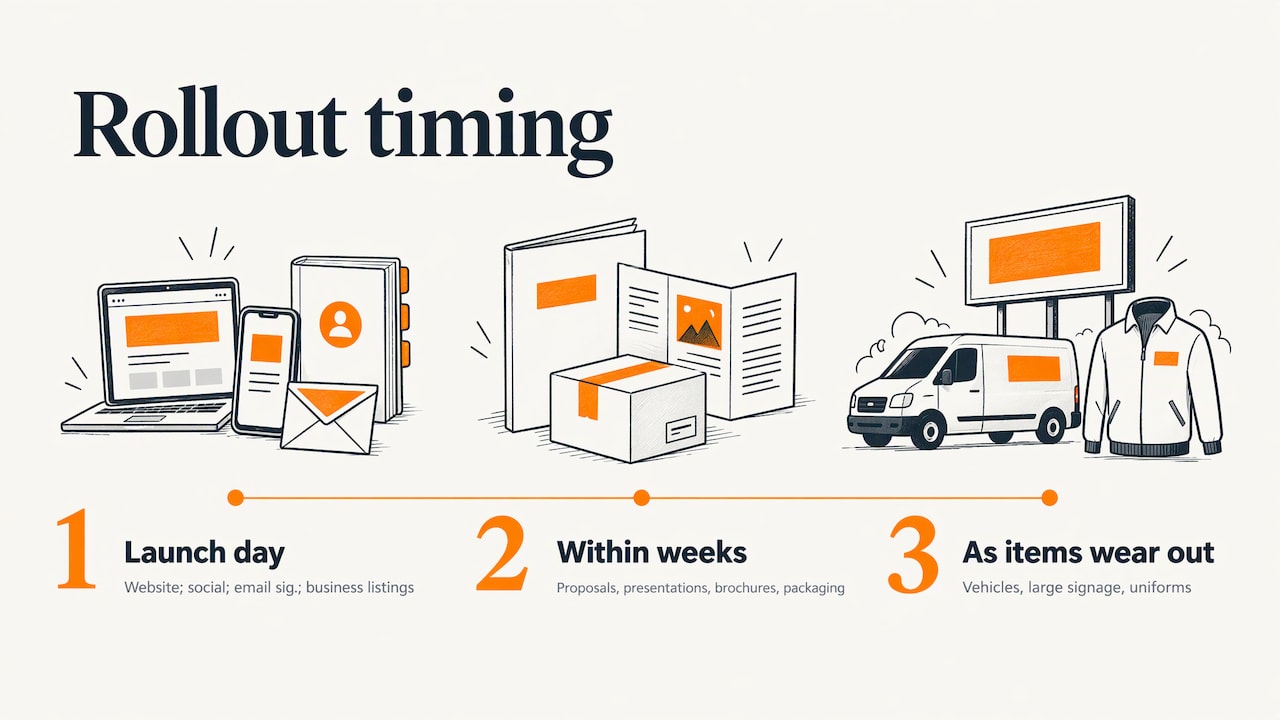
Turn the audit list from step 2 into a schedule. Sort every touchpoint into three groups: replace on launch day (website, social profiles, email signature, business listings), replace within weeks (proposals, presentations, brochures, packaging), and replace as it wears out (vehicles, large signage, uniforms).
Plan the website first, because it is the touchpoint every customer sees. If your domain, page addresses or page structure change, plan the redirects at the same time. Google’s own documentation on site moves with URL changes covers domain changes, how to map old addresses to new ones and how to use Search Console during the move. Permanent redirects, correctly mapped page by page, are the core of keeping your search visibility through the change.
7. Tell people before you launch
Brief your employees first. They are the first to be asked “what’s going on with the new logo?” and they should have a two-sentence answer. Then tell your best customers and distributors directly, before the public announcement, with a plain explanation of what is changing and what is not: same people, same quality, same phone number.
A good announcement says why the change helps the customer. “We are now one company serving you from one place” works. “We are excited to unveil our fresh new look” does not tell anyone anything.
8. Launch, then measure
Launch the website and digital touchpoints together, so that no customer sees two brands at once. Then track results against the goal you wrote in step 1. Useful measures include:
- Branded search volume and organic traffic, compared with the months before launch.
- Number and quality of inbound inquiries.
- Customer retention and repeat orders.
- Sales feedback: are prospects describing you the way your new positioning says?
- Share of materials updated, as a simple progress count.
Read results over several quarters, not weeks. Search engines and customers both take time to adjust.
What the logo decision looks like
A logo is the most visible part of a rebrand and usually the most argued over. There are two honest options.
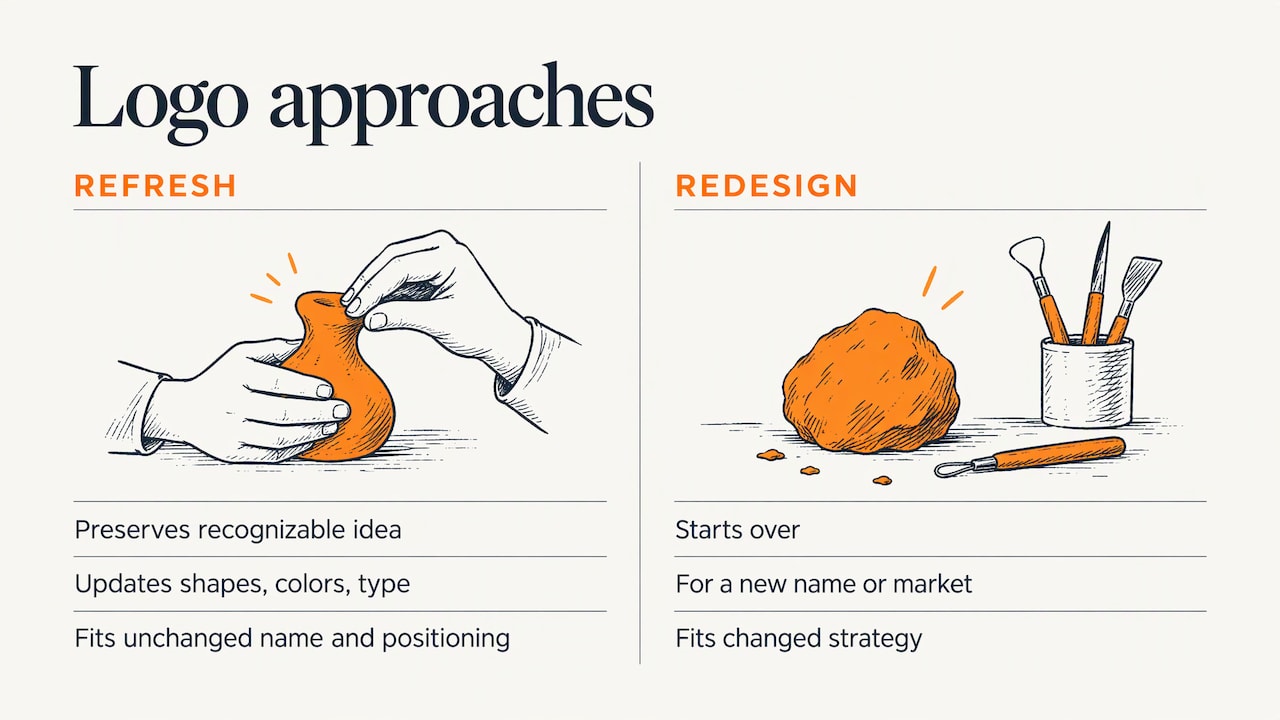
A logo refresh keeps the recognizable idea and cleans it up: simpler shapes, better proportions, updated colors, a typeface that reads well on a phone screen. Customers should say “that looks like you, only sharper.” Choose this when your name and positioning are right and recognition has value.
A logo redesign starts over because the old mark no longer fits the business: a new name, a new market, or a symbol that carries meaning you want to leave behind. Choose this when the strategy has changed.
Whichever you choose, check the mark at the sizes it will actually live at: a favicon in a browser tab, a social profile photo, an embroidered cap, a 40-foot trailer panel. And never design the logo before you have the positioning. A logo is the answer to a question, and the question comes first.
What it costs in time and money, and what goes wrong
Rebrands are rarely cheap. An Elon University study of well-known rebrands notes that Dunkin’ announced a $100 million campaign in 2018 to drop “Donuts” from its name, and that Pepsi spent $1 million on a redesigned logo in 2008 and took three years to roll it out company-wide. Your scale is very different, but the pattern holds: the design is a fraction of the total, and replacing signs, packaging, uniforms and printed materials takes the time and cash.
The mistakes we see described most often, and how to avoid them:
- No reason beyond taste. Go back to step 1. If you cannot state the business case, wait.
- Underestimating the timeline. Add the approvals, legal checks and rollout, not only the design.
- Forgetting the website’s search visibility. Changed addresses without redirects can erase years of ranking. Our overview of what SEO is and why it matters explains what you are protecting.
- Forgetting third-party places. Google Business Profile, directories, marketplace listings, vendor and distributor portals, LinkedIn, trade associations. Use the list from your audit.
- Treating launch as the finish line. Consistency over the following year is what makes the new brand real.
Our article on common branding mistakes goes deeper on the missteps that cost small businesses the most.
Why a rebrand belongs with your website
For most B2B companies, the website is the brand’s busiest storefront. Prospects judge you there before they ever call, and every rebrand decision about voice, proof and positioning shows up on those pages. Treating the identity and the website as one project keeps them consistent and avoids paying twice.
If you sell online, the same applies to your store, product pages and checkout. Our guide to corporate branding for ecommerce shows how brand decisions carry into product pages and the buying path.
How we can help
Marcy Design has been in business for more than 38 years and has won over 230 awards. We are based in Columbus, Ohio, and our work covers branding, custom website design, SEO, social media, email marketing, photography and video, so the identity, the site and the marketing built on it come from one team. You can see how we approach branding campaigns in Columbus, or look at our brand management and creative services and our website design service.
If you are weighing a refresh against a full rebrand, we can talk through your situation and the scope that fits it.
Book a free consultation to talk through your rebrand with our team.
Our view: a rebrand should earn its keep
We have worked with companies across many industries for decades, and the rebrands that pay off share one trait: they start with a business problem, not a design preference.
A new logo does not win a bid. A clear promise, backed by proof, shown consistently on a website that is easy to use, does. That is why we treat branding, the website and search visibility as one connected piece of work rather than three separate purchases.
Our approach is tailored solutions and user-focused design with measurable results. For a rebrand, that means we want to know what you need the brand to do for your sales before we draw anything, and we want you to be able to check afterward whether it did.
If you are a small business, a manufacturer or a nonprofit, you do not need a giant rebrand. You need the right-sized one, finished properly.
Greg
FAQ
How long does the rebranding process take?
It depends on scope. A focused visual refresh can take a few months, while a full rebrand with a name change can run 12 to 18 months once legal clearance and phased rollout are included. The more physical materials and locations you have, the longer the rollout.
What is the difference between a brand refresh and a rebrand?
A refresh updates the look and voice, such as logo details, colors and fonts, while your name, audience and promise stay. A rebrand changes the strategy underneath: positioning, messaging, and often the name. Decide which you need by asking whether your strategy changed or only your appearance.
When should a company rebrand?
Rebrand when something real has changed: a merger, a new market, a new offer, a reputation problem or a trademark conflict. Boredom or a leadership change is not a sound reason. If the logo is simply dated, a refresh is usually enough.
Will a rebrand hurt my search rankings?
It can if page addresses or the domain change without proper redirects. Mapping every old page to its new one with permanent redirects, and following Google’s site move guidance, protects your visibility. Plan this before launch day, not after.
Do I need to change my logo to rebrand?
Not always. A rebrand is about positioning and messaging first. Some companies keep the logo and change everything around it, others refresh it lightly, and others redesign it entirely. The strategy decides.
Sources
- When to Rebrand: A 2026 CMO Decision Guide, CMO Mag
- How To Know It’s the Right Time for a Business Rebrand, Truist
- Rebranding Guide: When To Rebrand, Shopify
- Rebranding: When to Do It and How to Get It Right, Scalarly
- Site Moves and Migrations, Google Search Central
- Rebranding study, Elon University