
 614.224.6226
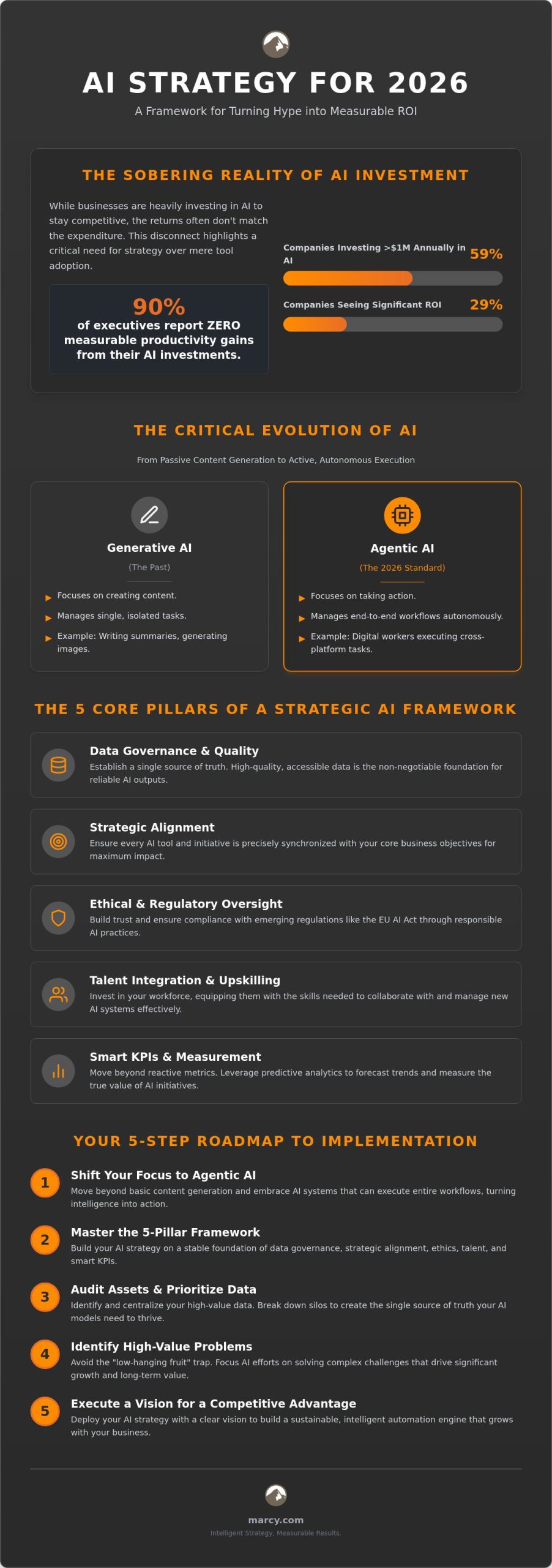
Did you know that while 59% of companies are currently investing at least $1 million annually in artificial intelligence, only 29% report seeing significant returns? It’s a sobering reality. Most leaders feel the crushing pressure to keep up with competitors, yet they’re drowning in tool choices and complex new regulations like the EU AI Act’s August 2026 transparency mandates. You’re likely worried that your next big move might just be another expensive experiment. We understand that frustration. Successfully implementing AI in business strategy requires more than just buying a license for the latest chatbot. It demands a fundamental, strategic shift from experimental pilots to a fully integrated digital core.
You deserve a strategy that works as hard as you do. This guide provides the master framework you need to integrate AI into your operations for long-term value and measurable ROI. We’ll move beyond the hype to explore agentic AI and essential workforce up-skilling. You’ll gain a clear roadmap to align these powerful tools with your specific business goals. Let’s turn the fear of falling behind into a sustainable competitive advantage through intelligent automation.
Key Takeaways
- Discover the critical shift from content-focused Generative AI to action-oriented Agentic AI. This evolution allows your systems to manage entire workflows rather than just single tasks.
- Master the essential framework for implementing AI in business strategy to ensure every tool you deploy aligns perfectly with your core objectives.
- Build a foundation of reliable data governance. This step is non-negotiable for leaders who want to avoid technical debt and ensure high-quality, actionable outputs.
- Learn why focusing on “low-hanging fruit” often leads to poor ROI. We’ll show you how to identify high-value problems that drive real growth and long-term value.
- Follow our 5-step roadmap to audit your current assets and execute a vision that delivers a sustainable competitive advantage through intelligent automation.
The Evolution of AI in Business Strategy for 2026
True leadership in 2026 isn’t about collecting the latest software. It’s about alignment. We define AI strategy as the precise synchronization of machine intelligence with your core business objectives. Since the start of The AI Boom, many companies have rushed to adopt every new model that hits the market. This frantic pace has led to a startling reality. Nearly 90% of executives report seeing zero measurable productivity gains from their investments. They fell into the urgency trap. They prioritized speed over vision, resulting in disjointed tools that don’t talk to each other. Leaders often gravitate toward “low-hanging fruit” like basic text summaries. These offer quick wins but exceptionally low ROI. Implementing AI in business strategy requires a shift from passive content generation to active, autonomous execution.
From Tools to Transformation
Buying a software license doesn’t give you a competitive edge. It gives you an expense. Real transformation happens when you move from a tool-first approach to an AI-first mindset. This requires leadership to re-evaluate every internal process through the lens of machine capability. It’s not about asking “what can this tool do?” but rather “how can intelligence reshape our output?” If you’re simply layering AI over broken processes, you’ll just get faster at failing. You must build a foundation where data flows seamlessly and tools serve specific business outcomes. AI strategy is a long-term value creator, not a quick fix for systemic inefficiency.
The Role of Agentic Enterprises
We’re moving beyond the era of simple Generative AI. While previous years focused on making content, 2026 is about taking action. Agentic AI refers to systems designed to manage end-to-end workflows autonomously. These aren’t just chatbots answering questions. They’re digital workers capable of making decisions and executing tasks across different platforms. In the Columbus market, staying ahead means moving faster and more accurately than the competition. Strategic AI implementation redefines efficiency by allowing these agents to handle complex, cross-functional tasks without constant human oversight. This isn’t just basic automation. It’s a total re-architecture of how business value is created. Implementing AI in business strategy means building a scalable engine that grows with your vision.
Core Pillars of a Strategic AI Framework
Precision is the new currency in the 2026 business environment. Implementing AI in business strategy isn’t a single event; it’s a continuous architectural process. To avoid the high failure rates seen in previous years, leaders must anchor their vision in five core pillars. These pillars ensure that your machine intelligence doesn’t just exist; it performs. You can’t build a high-performance engine on a cracked chassis. Success requires a structural foundation built on data governance, strategic alignment, ethical oversight, talent integration, and smart KPIs. Managing these pillars effectively allows your organization to move from reactive pilot programs to proactive, value-driven execution.
For growing enterprises, the SBA’s guide to AI for small business offers a helpful starting point for understanding basic risk management and ethical considerations. However, true competitive advantage comes from how you uniquely map these capabilities to your specific pain points. If you’re unsure where your data stands, our team can help you build AI powered solutions that turn raw information into a measurable competitive edge.
Establishing Data Quality and Accessibility
“Garbage in, garbage out” is a cliché for a reason. It’s the primary reason AI projects fail to deliver ROI. If your underlying data is fragmented or inaccurate, your AI will simply produce errors at a higher velocity. You must audit your digital assets before you sign a vendor contract. Start by identifying where your high-value data lives. Is it trapped in legacy spreadsheets? Is it scattered across different departments? Centralizing this information is the only way to build a cohesive strategy. Data silos are the enemy of progress. You need a single source of truth to fuel reliable machine learning models.
Smart KPIs: Measuring What Matters
Traditional metrics like “last month’s sales” are reactive. They tell you what happened, not what will happen. Smart KPIs leverage predictive analytics to forecast trends before they manifest. For a Columbus-based ecommerce brand, this might mean tracking “Predictive Customer Lifetime Value” instead of just “Average Order Value.” AI allows you to see around corners. It redefines performance benchmarks by analyzing thousands of variables in real-time. This level of insight transforms marketing from a guessing game into a precision science. When you’re implementing AI in business strategy, your success metrics must evolve alongside your technology.
Long-Term Value vs. The Urgency Trap
Leaders often feel a desperate need to “do something” with AI. This desperation creates the urgency trap. They pick the easiest tools. They hope for a miracle. But speed without a plan is just a faster way to waste budget. Implementing AI in business strategy requires patience and precision. If you rush, you’ll accumulate technical debt that will haunt your infrastructure for years. It’s time to stop thinking about AI as a band-aid. Start seeing it as a revenue engine. You must balance immediate efficiency with future-proof scalability to ensure your investments actually pay off.
The psychological shift from cost-cutting to revenue generation is critical. Most businesses use AI to trim expenses. They automate a few emails or summarize meetings. While these save time, they rarely move the needle on the bottom line. True value comes from using machine intelligence to identify new market opportunities or create superior customer experiences. Are you building a better version of your current company, or are you building the company of the future? A vision-led approach ensures that every dollar spent today supports your growth tomorrow.
The Pitfalls of Reactive AI Adoption
The most common mistake is over-investing in standalone chatbots without any backend integration. These tools feel helpful, but they exist in a vacuum. This leads to “Shadow AI,” where different departments use uncoordinated tools that don’t share data. According to data from the National Bureau of Economic Research (NBER), productivity gains from AI often remain stubbornly modest during the initial adoption phase. This happens because companies focus on isolated tasks rather than systemic improvements. Without a unified framework, you’re just adding complexity without increasing output.
Building for Sustainable Growth
Success requires prioritizing clarity of purpose over the latest tech trend. You don’t need every new model. You need the right model for your specific goals. Stanford Online suggests a four-part framework for AI strategy that emphasizes problem definition and foundational data infrastructure. This alignment is what separates the winners from the 90% of failed projects. When you’re implementing AI in business strategy, you must align every initiative with your company’s 5-year vision. Professional partners play a vital role here. They help you avoid common traps and ensure your technology stack is built to last. Don’t just follow the crowd. Lead with a strategy that creates lasting prosperity.
A 5-Step Roadmap for Implementing AI
Vision without a roadmap is just a hallucination. Successfully implementing AI in business strategy requires a methodical, five-step transition from curiosity to capability. You don’t need a hundred different tools. You need one cohesive system that drives measurable ROI. Most leaders fail because they start with the technology instead of the problem. We believe in starting with the outcome. By following a structured path, you can ensure that every machine intelligence investment you make today builds a foundation for the next decade of growth.
Step 1: The Strategic Audit
Before you write a single line of code or sign a vendor contract, you must look inward. Which business processes are truly ripe for automation? You’re looking for high-volume, repetitive tasks that consume your team’s creative energy. Identifying these “High-Value” problems early prevents you from wasting budget on tech that doesn’t move the needle. You also need stakeholder buy-in from the beginning. If your department heads don’t see the value, the implementation will stall before it starts. The Strategic Audit is the most critical step in the roadmap because it determines the trajectory of every subsequent investment.
Once you’ve identified your goals, Step 2 focuses on your data infrastructure. You must clean and organize your digital assets. AI is only as good as the information it consumes. Step 3 involves partner selection. You’ll need to choose between off-the-shelf software and custom AI solutions. While standard tools are faster to deploy, custom builds often provide the unique competitive advantage that Columbus businesses need to stand out. Step 4 is the “Pilot and Pivot” phase. Test your AI in a controlled environment. Gather data. Learn from the friction points and adjust your strategy before moving to a full-scale rollout.
Step 5: Digital Core Integration
The final step is embedding AI into your digital core. Your website isn’t just a brochure; it’s the primary execution point for AI strategy. It’s where your data meets your customer in real-time. Integrating AI into your ecommerce solutions allows for personalized customer journeys that traditional platforms can’t match. This level of automation turns your web presence into a 24/7 sales and marketing engine. For a deeper look at aligning your digital presence with these new standards, explore our Web Design Columbus Ohio: A Strategic Business Growth Guide for 2026. Implementing AI in business strategy at this level ensures your brand remains relevant and high-performing as the market evolves.
Ready to build a strategy that delivers real results? Contact Marcy Design today to discuss our AI Powered Solutions and start your journey toward a more intelligent business model.
Executing Your Vision with Marcy Design
Strategy is only as good as its execution. You can have the most sophisticated framework in the world, but if it doesn’t translate to your digital storefront, it won’t drive ROI. Marcy Design has been the cornerstone of business growth in Columbus since 1986. We’ve navigated every major technological shift over the last 40 years. Today, we’re helping leaders bridge the gap between high-level theory and high-impact design. Implementing AI in business strategy isn’t just about backend data; it’s about how your brand interacts with the world in real-time. We provide the technical expertise and the creative vision to turn machine intelligence into a measurable competitive advantage.
Local expertise matters when you’re dealing with global trends. While AI tools are universal, your market is specific. Columbus businesses face unique challenges and opportunities that a generic, out-of-the-box solution simply can’t address. We understand the local landscape. We know what your customers expect. By combining our deep-rooted history with cutting-edge 2026 technology, we ensure your AI initiatives feel like a natural extension of your brand. Our team acts as a dedicated specialist group, ready to tackle complex challenges with high energy and professional precision.
AI-Powered Solutions for Columbus Brands
Your website is your hardest-working employee. It should be intelligent. We specialize in custom AI website integration services that do more than just display information. They drive user engagement. We build AI Powered Solutions that personalize the customer journey the moment a visitor lands on your page. This level of sophistication extends to your advertising campaigns. By using predictive AI analytics, we help you spend your budget where it actually performs. You’ll move beyond guessing and start making data-driven decisions that grow your bottom line. We serve as your “Friendly Guide,” helping you navigate these complex technological shifts without getting lost in the jargon.
Your Next Steps Toward AI Leadership
The journey toward becoming an AI-first enterprise starts with a single, intentional conversation. Don’t let the “Urgency Trap” force you into expensive, standalone tools that don’t talk to each other. A professional consultation with our Columbus team can help you identify your high-value problems first. We’ll help you build a roadmap that aligns your technology with your 5-year vision. It’s time to stop experimenting and start executing. You deserve a partner who is as invested in your prosperity as you are. Let’s build something that lasts. Modernize your business strategy with AI-powered solutions from Marcy Design and secure your place as a leader in the 2026 market.
Mastering the Future of Intelligent Growth
The business environment of 2026 demands more than just technological awareness. It requires a fundamental re-architecture of your professional vision. We’ve explored the shift toward agentic AI and the critical necessity of a structured roadmap. By focusing on data governance and aligning machine intelligence with your core goals, you avoid the common traps that stall productivity. Successfully implementing AI in business strategy isn’t a race to buy the latest tool. It’s a deliberate journey toward long-term value and prosperity. Are you ready to move from experimentation to execution?
Marcy Design stands ready to lead the way. As a veteran-owned Columbus agency since 1986, we combine a long-standing legacy with deep expertise in AI website integration and proven success in strategic digital marketing. We bridge the gap between high-level strategy and high-impact results with high energy and professional precision. Let’s build a future where your business doesn’t just keep up; it sets the pace. Ready to lead? Partner with Marcy Design for AI-powered business growth.
Frequently Asked Questions
What is the first step in implementing AI in business strategy?
The first step is conducting a comprehensive strategic audit to identify your high-value business problems. You shouldn’t start with the technology; you must start with the objective. This audit involves looking at your current workflows and determining which repetitive tasks consume the most creative energy. By identifying these gaps first, you ensure your technology investments align with your long-term vision rather than just following a trend.
How much does it cost to integrate AI into a small business website?
The cost of AI integration depends entirely on the complexity of your objectives and whether you choose custom or off-the-shelf solutions. Every business has unique data structures and goals. A basic integration might focus on simple automation, while a comprehensive digital core transformation requires more investment. We recommend a professional consultation to determine the specific scope that delivers the highest ROI for your brand.
Can AI help with marketing automation for local Columbus businesses?
Yes, AI significantly enhances marketing automation for local Columbus brands by using predictive analytics to target customers more effectively. It allows you to move beyond basic email blasts to personalized customer journeys that respond to user behavior in real-time. Implementing AI in business strategy at a local level means you can compete with national brands by being faster and more precise in your customer engagement.
What are the biggest risks of implementing AI in my strategy?
The primary risks include technical debt from rushed implementation and potential compliance gaps with new regulations like the EU AI Act. If you layer AI over broken processes, you’ll simply fail faster. There’s also the risk of “Shadow AI,” where departments use uncoordinated tools that create data silos. Managing these risks effectively requires a foundation of strong data governance and a vision-led approach.
How do I measure the ROI of my AI initiatives?
You measure ROI by moving from reactive metrics to “Smart KPIs” that track efficiency and revenue growth in real-time. Don’t just look at time saved; look at how AI increases customer lifetime value or identifies new market opportunities. High-performing organizations track how these tools improve output quality and team productivity. This data-driven approach ensures your AI initiatives are generating measurable wealth for the company.
Is my business too small to benefit from a strategic AI roadmap?
No business is too small to benefit from a strategic roadmap. In fact, smaller organizations often pivot faster than large corporations. A roadmap provides the scalability you need to grow without accumulating unnecessary technical debt. Implementing AI in business strategy allows small businesses to automate end-to-end workflows, effectively giving you the specialist power of a much larger team without the overhead.
What is the difference between Generative AI and Agentic AI?
Generative AI focuses on creating content like text or images, while Agentic AI focuses on autonomous action and workflow execution. Think of Generative AI as a writer and Agentic AI as a digital worker. Agentic systems manage complex, cross-functional tasks from start to finish without constant human intervention. This shift from content to action is the defining trend for business leaders in 2026.
How do I ensure my team doesn’t resist AI implementation?
Resistance is best managed through early stakeholder buy-in and a clear focus on upskilling. Frame AI as a tool that empowers your team to become “super-users” rather than a replacement for their expertise. When employees see that AI handles the drudgery and frees them for creative work, adoption happens naturally. Education is your best defense against fear; dedicated learning time ensures everyone moves forward together.