
 614.224.6226
What if your most complex B2B procurement process felt as effortless as ordering a coffee from your phone? In 2026, the global B2B e-commerce market is projected to reach nearly $6.8 trillion, yet many distributors still force partners through friction-filled onboarding and static, exhausting quote forms. You know the frustration of watching a high-value lead abandon a tiered pricing table because it’s too difficult to navigate. It’s time to stop losing revenue to outdated interfaces. Strategic AI integration for B2B ecommerce isn’t just a luxury anymore. It’s the engine that drives modern, high-converting digital experiences.
At Marcy Design, we’ve spent decades helping Columbus businesses turn technical hurdles into competitive advantages. This article will show you how to replace static fields with interactive, guided tools that boost completion rates and automate lead capture. We’ll examine real-world use cases for professional consultations and streamlined onboarding, all while staying compliant with the latest data privacy regulations relevant to B2B operations. By the time you finish this guide, you’ll have a clear roadmap to transform your complex operations into a seamless journey that keeps your clients coming back.
Key Takeaways
- Learn why switching from static fields to interactive, guided experiences reduces buyer fatigue and boosts completion rates across your procurement site.
- Discover how strategic AI integration for B2B ecommerce automates complex tasks like tiered pricing and dynamic contract visualization to streamline operations.
- Master the art of frictionless account onboarding and lead capture through design strategies that prioritize personalization and user engagement.
- Gain insights into architecting massive product taxonomies into intuitive navigation systems that meet the high-speed demands of 2026 business buyers.
- Explore how a results-oriented design approach can turn your most complex operational hurdles into a seamless, high-converting digital journey.
The Evolution of B2B Ecommerce Design Standards
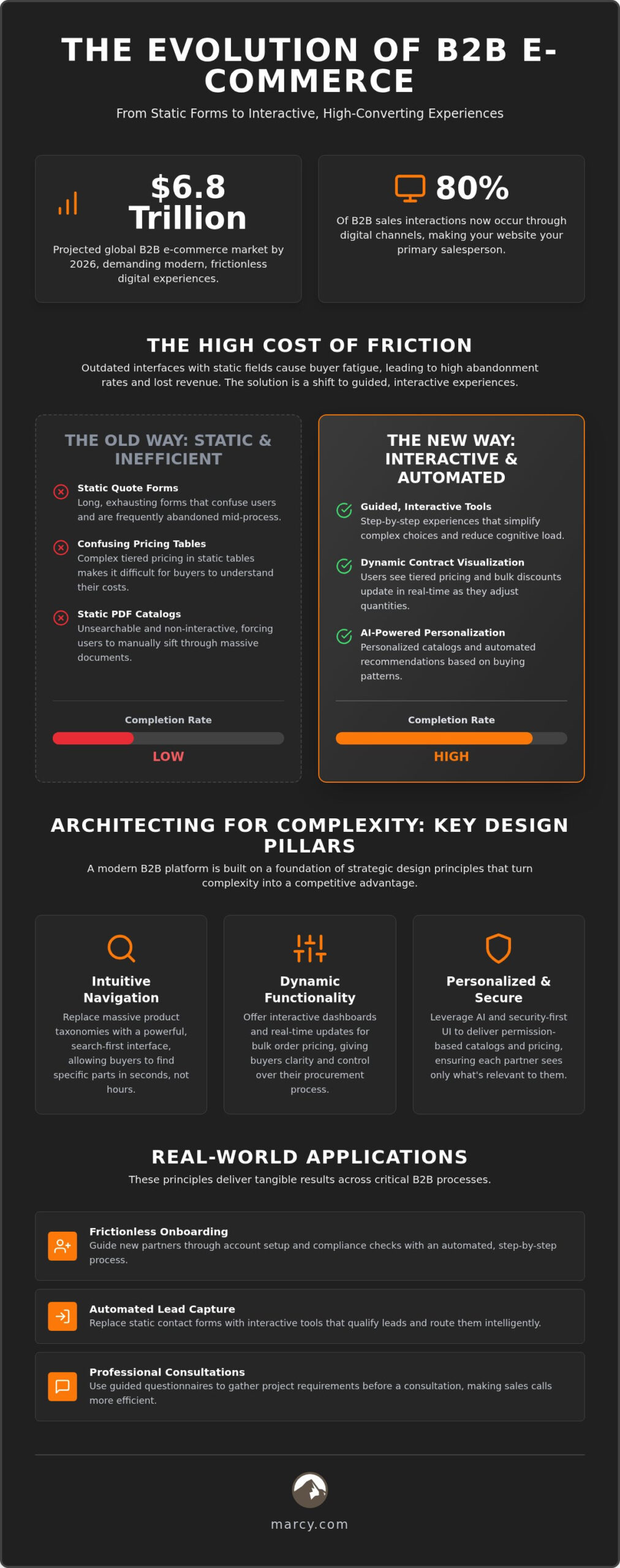
B2B buyers aren’t just looking for products anymore; they’re looking for partners. By 2026, the global B2B e-commerce market is projected to reach nearly $6.8 trillion. This massive growth has fundamentally changed the rules of digital engagement. Modern design is no longer about simple order taking. It’s about strategic customer enablement. Professional web design serves as the foundation for long-term account loyalty by removing friction from every interaction. When your portal is difficult to use, you aren’t just losing a single sale; you’re losing a high-value relationship. High-performing companies now prioritize AI integration for B2B ecommerce to ensure their platforms are as fast and intuitive as the retail sites their buyers use at home.
80% of B2B sales interactions now occur through digital channels. This means your website is your primary salesperson. If it isn’t helping your customers solve problems, it’s getting in their way. Effective design in 2026 focuses on reducing cognitive load and making the complex feel simple. This shift from digital order taking to strategic enablement is what separates market leaders from those left behind. We’ve structured this guide to be actionable by Wednesday so your team can begin the transformation immediately.
B2B vs. B2C: Why Design Logic Differs
Why does design logic differ so much between business and consumer sectors? It starts with the audience. B2C shoppers often make emotional, impulse-driven purchases. In contrast, B2B procurement involves multiple decision-makers, complex approval workflows, and bulk order efficiencies. Your interface must cater to the procurement officer, the department head, and the end-user simultaneously. This requires a sophisticated mobile responsive web design that functions perfectly across devices. It allows a warehouse manager to check inventory on a tablet while an executive reviews a contract on a smartphone. Efficiency is the ultimate currency here. If you don’t provide it, your competitors will.
The 2026 Standard for Professional Portals
The era of the static PDF catalog is dead. The 2026 standard demands dynamic, permission-based environments. Modern portals use security-first UI design to manage restricted pricing and proprietary product views for different accounts. You can’t afford to show the same catalog to every visitor. By leveraging AI website integration services, you can deliver personalized catalogs and automated recommendations based on historical buying patterns. This level of sophistication is exactly how Marcy Design helps Columbus distributors scale. Don’t let your technology hold your growth hostage. Build a portal that works as hard as your sales team does. It’s time to move beyond static fields and embrace the future of interactive commerce.
Architecting for Complexity: Essential Design Pillars
Managing a catalog with 50,000 SKUs isn’t just a data storage challenge. It’s a findability crisis. If a buyer can’t locate a specific industrial component in three clicks, they’ll call a competitor. Designing for this level of scale requires a strategic roadmap for AI in B2B that prioritizes user intent over raw data volume. We replace massive, multi-level product taxonomies with intuitive, search-first navigation. This ensures that even the most technical procurement officer can filter through complex specifications without feeling overwhelmed. By the time your team reviews these strategies this Wednesday, you’ll see how a well-structured architecture transforms a digital catalog into a high-speed sales tool.
Functional utility must always lead the way in industrial design. While brand identity matters, a buyer in a machine shop cares more about a “Quick Order” button than a flashy hero image. AI integration for B2B ecommerce allows you to move beyond static spreadsheets and offer interactive dashboards. These tools provide a guided experience, showing buyers exactly what they need based on their specific contract terms. Instead of a static PDF price list, interactive elements allow users to visualize how bulk order quantities impact their tiered pricing in real time. This clarity directly leads to higher completion rates and fewer abandoned carts.
Dynamic Pricing and Bulk Management
Visualizing volume discounts shouldn’t clutter your user interface. We design clean, dynamic tables that update instantly as quantities change. Real-time inventory sync indicators are critical for high-volume buyers who need certainty before committing to a purchase order. We also customize the checkout flow to handle credit terms and PO numbers naturally. This replaces the traditional, friction-filled payment process with a streamlined experience tailored to B2B financial workflows. If you’re ready to modernize your portal, our team is here to help you integrate these advanced AI solutions into your existing platform.
Mobile Optimization for the Industrial Buyer
B2B buying doesn’t just happen at a desk. It happens in warehouses, on construction sites, and in the field. This is why web design in Columbus Ohio must prioritize mobile-first speed and touch-friendly interfaces. Procurement teams often need to pull up complex specification sheets or blueprints on a tablet while standing next to a piece of machinery. We ensure these high-resolution documents load instantly and remain legible on smaller screens. A responsive design isn’t just a “nice to have” feature. It’s a fundamental requirement for maintaining account loyalty in a mobile-driven 2026 marketplace.
Interactive Tools vs. Static Fields: Boosting Completion Rates
Traditional static fields are where B2B revenue goes to die. When a procurement officer faces a fifteen-field quote request form, completion rates plummet. This is the phenomenon of form fatigue. It happens because static fields demand too much effort for too little immediate value. Strategic AI integration for B2B ecommerce replaces these roadblocks with conversational, guided interfaces that feel like a professional consultation. Instead of staring at a blank text box, your buyers interact with a system that understands their intent. This shift reduces cognitive load and keeps the momentum of the sale moving forward.
The psychology is straightforward: humans prefer a path that offers constant feedback. Interactive elements transform a chore into an engagement. By replacing “Order Taking” with “Solution Discovery,” you position your brand as a helpful guide rather than a digital warehouse. This approach is particularly effective for complex onboarding processes where data requirements are high. We help you break these massive tasks into bite-sized, interactive steps that produce better results for the end-user and higher quality data for your sales team. Our goal is to have these actionable strategies ready for your implementation by Wednesday.
Personalized Guided Experiences
How do you help a buyer select the right technical specifications from a million possible combinations? You don’t give them a search bar; you give them a wizard. These interactive tools act as a digital bridge between a customer’s problem and your product solution. By leveraging AI powered ecommerce solutions, you can create dynamic configurators that adjust in real time based on user input. This level of personalization ensures that the buyer only sees what is relevant to their specific industrial application. It’s a sophisticated way to manage massive taxonomies without overwhelming the visitor.
The Interactive Advantage for Lead Capture
Consider the difference between a static quote request form and an interactive pricing calculator. The static form feels like an interrogation; the calculator feels like a service. Interactive tools provide immediate value to the user, which naturally leads to higher completion rates. We recommend designing interactive B2B assessment tools for procurement teams to evaluate their needs. This process accomplishes three things simultaneously:
- It captures high-intent lead data without the friction of traditional forms.
- It provides the buyer with an immediate, personalized recommendation.
- It automates the initial lead qualification process for your sales department.
These real-world use cases prove that interactivity is a superior engine for growth. Whether you are streamlining lead capture or improving account onboarding, the results are clear. Guided experiences win every time. Stop asking your buyers to do the heavy lifting. Use intelligent design to carry the load for them.
Strategic Implementation: Onboarding and Consultations
Onboarding is the digital handshake of the B2B world. It’s the moment you prove your platform can handle the weight of a corporate partnership. Designing a frictionless B2B account onboarding process requires more than just a login screen. It demands a sophisticated balance between data collection and user experience. In 2026, your onboarding must also account for new data privacy laws in states like Indiana and Kentucky. We use AI integration for B2B ecommerce to automate these compliance checks while keeping the user moving. By Wednesday, you can have a strategic plan to replace your static registration forms with a dynamic, guided journey. If you’re ready to modernize your first impression, explore our AI powered solutions to see how we automate these complex workflows.
Strategic lead capture isn’t about asking for more information; it’s about asking for it more intelligently. Traditional forms often feel like an interrogation. Interactive assessments, however, feel like a professional service. When you provide a buyer with a procurement efficiency score or a custom technical recommendation, you aren’t just capturing a lead. You’re starting a consultation. This shift from passive data entry to active engagement is what drives higher retention and superior UX. Our goal is to transform your website from a catalog into a strategic asset that fuels your sales team with high-intent data.
Designing the Onboarding Journey
Corporate account registration shouldn’t feel like a tax audit. We reduce friction by integrating real-time tax verification and permission-based access directly into the interface. Instead of a long, static form, we provide interactive onboarding checklists. These tools guide new clients through the setup process step-by-step, ensuring they don’t miss critical configurations. Once the account is established, we integrate digital marketing strategies to nurture the new relationship. This ensures your partners feel supported and informed from the very first click.
Lead Capture for Professional Consultations
High-impact landing pages for B2B strategic assessments are the ultimate conversion magnets. They offer immediate value to the buyer, which naturally encourages them to share their project details. We recommend using professional marketing materials to support these digital leads, creating a cohesive brand experience across all touchpoints. Consider the automated B2B consultation booking flow as a real-world use case. It allows a qualified lead to move from an assessment directly into a specialist’s calendar. This removes the “wait and see” period that often kills B2B deals, keeping the momentum of the sale alive and well.
The Marcy Approach: Columbus Expertise Meets AI Innovation
Marcy Design stands as a veteran entity in a rapidly shifting landscape. Since 1986, we’ve provided Columbus web design that balances technical expertise with a deep-rooted connection to our local community. We understand the specific challenges Ohio-based distributors face when scaling complex operations for a global market. While massive software vendors offer generic, distant solutions, we act as a friendly guide. This partnership approach produces better results because we understand your specific business mechanics. We don’t just build websites; we create engines for prosperity. Our team handles the heavy lifting so you can focus on high-level strategy.
Our specialists leverage AI integration for B2B ecommerce to turn technical debt into digital assets. We replace the clunky, static interfaces of the past with intelligent, interactive tools that anticipate buyer needs. This isn’t about chasing trends for the sake of novelty. It’s about grounding innovation in time-tested principles that drive growth. By Wednesday, your team can begin implementing a strategy that shifts your platform from a simple catalog to a high-converting powerhouse. We’re proud of our history and excited about the technological shifts that allow us to tackle your most complex hurdles with high energy.
AI-Powered Scalability
Scaling requires more than just adding products. It requires future-proof infrastructure. Marcy Design builds systems that grow with you. We integrate custom AI solutions for predictive B2B ordering and inventory management, ensuring your data is machine-readable and ready for the shift toward agentic commerce. This “Bold Innovator” mindset allows our partners to stay ahead of the curve while maintaining the reliability their clients expect. We focus on guided experiences that outperform traditional, static versions in every key metric. By making the complex feel simple, we help you secure higher completion rates and better user retention.
Your Strategic Growth Partner
We offer more than just code. Our capabilities span from high-impact advertising campaigns to robust ecommerce builds. Every project starts with a results-oriented design consultation. We look at the “why” and “how” of your procurement process to identify where friction is costing you money. Whether it’s streamlining lead capture or redesigning an onboarding flow, we tackle complex challenges with professional precision. It’s time to stop settling for a vendor relationship and start a strategic partnership. Contact us today for a B2B digital audit and strategy session that will transform your digital presence and drive measurable success.
Secure Your Future in the B2B Digital Market
Scaling complex operations in 2026 requires a shift from passive order taking to active customer enablement. You’ve seen how replacing static fields with interactive tools like wizards and calculators reduces buyer fatigue. These guided experiences don’t just capture data; they build trust. By prioritizing seamless onboarding and high-value assessments, you transform your platform into a strategic asset. Successful AI integration for B2B ecommerce is the key to managing massive taxonomies and personalized pricing with ease.
Marcy Design is your results-oriented strategic growth partner. With over 30 years of Columbus web design expertise, our specialized AI and ecommerce integration specialists are ready to tackle your most complex challenges. We understand the local landscape and the global demands of modern trade. It’s time to move beyond traditional limitations and embrace a bolder digital vision. Ready to scale your B2B operations? Contact Marcy Design for a strategic consultation. We’re excited to help you turn these actionable insights into measurable prosperity by Wednesday.
Frequently Asked Questions
How does B2B ecommerce web design differ from B2C?
B2B design focuses on account-based logic and volume efficiency rather than individual emotional impulse. While B2C is built for a single shopper, B2B interfaces must support multiple decision-makers and permission-based pricing. It’s about streamlining a professional procurement journey. You need tools that handle bulk ordering and contract visualization without cluttering the screen. This ensures your partners find technical specifications quickly and accurately.
What are the essential features of a modern B2B ecommerce website?
Modern B2B sites require tiered pricing displays, real-time inventory sync, and quick-order functionality. You should prioritize interactive onboarding checklists and permission-based account portals. These features allow different departments within a single company to manage their specific procurement needs. A robust architecture also includes dynamic contract visualization and automated tax verification. These elements turn your site into a helpful guide that manages complex operational hurdles for your clients.
Why are interactive tools better than static forms for B2B lead capture?
Interactive tools produce higher completion rates because they reduce cognitive load by breaking complex tasks into bite-sized steps. Static forms often lead to B2B form fatigue and lead abandonment. When you use a pricing calculator or a technical assessment, you provide immediate value to the buyer. This guided experience feels like a professional consultation rather than a data entry chore. It’s a superior engine for high-quality lead capture.
How can AI improve my B2B ecommerce user experience?
AI integration for B2B ecommerce improves the user experience by delivering personalized product recommendations and predictive ordering patterns. It moves your platform from simple search to solution discovery. AI agents can handle autonomous quoting and configuration, which speeds up the procurement cycle significantly. By automating back-office tasks like inventory management, you allow your team to focus on strategic growth. This innovation ensures your infrastructure is future-proof for 2026.
What is the importance of mobile responsive design in B2B procurement?
Mobile responsive design is critical because procurement happens in warehouses and on construction sites, not just at desks. Buyers need to access blueprints and specification sheets on tablets or smartphones while in the field. If your site doesn’t load instantly on mobile, you risk losing account loyalty. We ensure your interface is touch-friendly and optimized for high-speed performance. This accessibility is a fundamental requirement for modern industrial buyers.
How long does a custom B2B ecommerce development project take?
Custom B2B projects vary based on complexity, but we focus on delivering actionable milestones quickly. We can have a strategic implementation plan ready for your review by Wednesday. This ensures your team stays on a fast-paced, intentional schedule. A full build typically involves phases for discovery, architecture, and AI integration. We work efficiently to ensure your digital transformation happens without disrupting your current operations or revenue streams.
Can Marcy Design integrate my ERP or CRM with a new B2B web design?
Yes, Marcy Design specializes in connecting your website with existing ERP and CRM systems. We ensure that your inventory data, customer tiers, and order history sync perfectly across all platforms. This integration removes manual data entry and reduces errors in high-volume procurement. By linking your back-office tools with your front-end design, we create a unified ecosystem. It’s the most effective way to automate complex operational workflows.
Why should I choose a Columbus-based web design company for B2B?
Choosing a Columbus-based company like Marcy Design gives you a partner with a deep-rooted connection to the Ohio business community. We’ve been a veteran agency in this area since 1986. We combine localized dedication with world-class expertise in AI integration for B2B ecommerce. You get the benefit of a friendly guide who is easily accessible for direct dialogue. We’re heroic specialists ready to tackle your local and global challenges.