
 614.224.6226
The best About Us pages answer three questions fast: who you are, what you can do for the visitor, and why they should trust you with the job. The examples below show how different companies do it. Under each is the move you can borrow, and the last sections turn those moves into a page you can write this month. If you would rather have a Columbus team build and write it with you, our website design team does that every week.
TL;DR
- An About Us page is a first-round interview: visitors want to know who you are, what you do for them and why they should care.
- Strong examples lead with a clear pitch, then prove it with history, people, customers and numbers.
- Most companies miss the chance. Research from Nielsen Norman Group says users expect clear, authentic and transparent About Us content.
- Use a simple order: pitch, story, people, proof, next step. Keep it short enough that nobody feels they are reading a chore.
- Small businesses and manufacturers gain the most from showing real people, real facilities and real customer names.
Table of Contents
- What an About Us page is for
- Seven About Us page examples worth studying
- The elements that make an About Us page work
- How to write an About Us page, step by step
- A simple structure to start from
- Special cases: manufacturers, nonprofits and ecommerce
- How the About Us page fits the rest of your site
- Common mistakes to fix first
- Our perspective
- Let us build it with you
- FAQ
- Sources
What an About Us page is for
An About Us page is the part of your website that tells visitors who you are, what you do and why you do it. Salesforce’s small-business guide describes its job as giving the reader enough reassurance to take the next step toward becoming a customer.
That makes it a sales page, even though it never reads like one. Buyers use it to check you out before they call. A purchasing manager comparing three machine shops, or an owner comparing three accountants, will open it to answer one question: are these people real, and are they good at this?
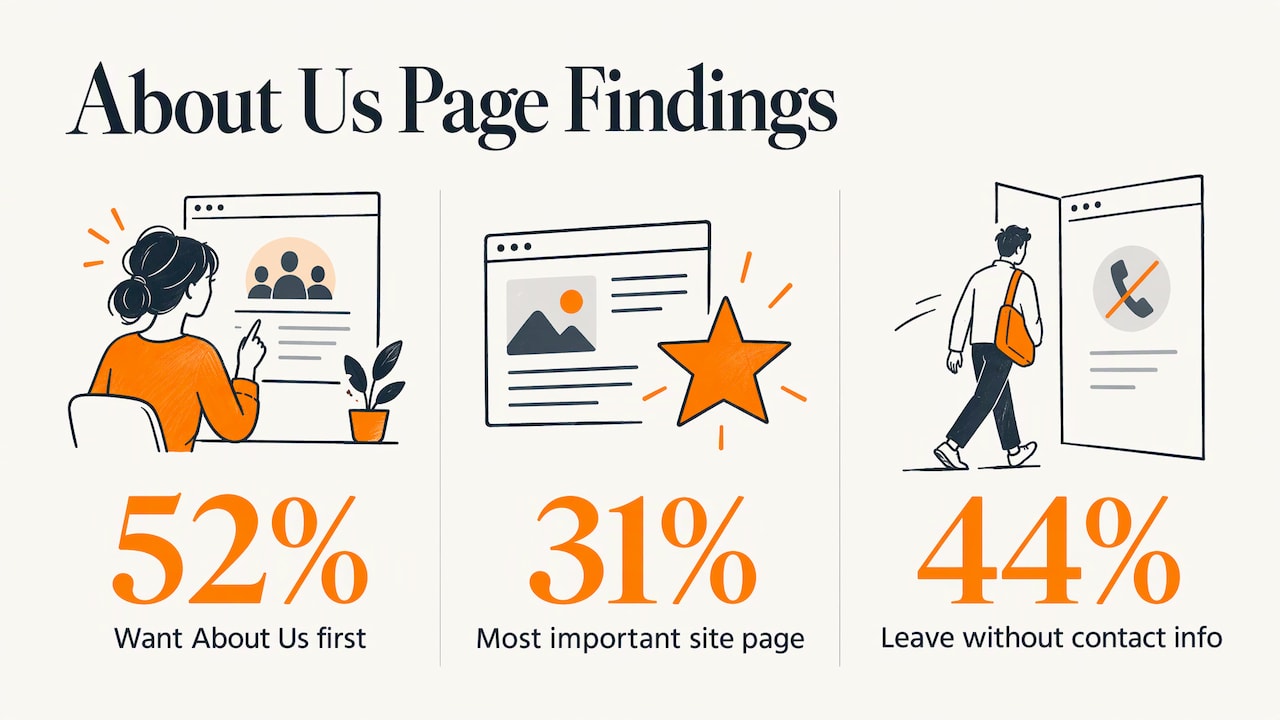
The numbers back up how often it gets opened. Salesforce reports that 52% of people want to see the About Us page first when landing on a website, and that 31% call it the most important part of a site. The same guide says 44% of visitors leave when there is no contact information, so the page should also tell people how to reach you.
Seven About Us page examples worth studying
The examples differ in industry and style. What they share is that each one picks a single idea and builds the page around it.
1. Equals: a point of view as the headline
The spreadsheet company Equals frames its product with a big idea: the spreadsheet is like a bicycle of the mind, an interface that was discovered rather than invented. The team then argues that the way to fix decades of failed spreadsheet replacements is to connect the spreadsheet to live data and let AI take initiative.
What to borrow: a belief your customers can agree or disagree with. A page that takes a position is more memorable than one that lists services. For a local business, the belief can be small: “A website should answer a buyer’s question in under ten seconds.”
2. Relace: one number and one argument
Relace opens with a hard figure, 30 trillion tokens served in the last 30 days, and a clear argument about why efficiency wins when a product is a commodity. The founders say inference is the defining infrastructure problem of the next decade.
What to borrow: a figure that proves scale, paired with a reason you exist. A manufacturer might use parts shipped per year or on-time delivery rate. Use only numbers you can back up, and say what period they cover.
3. K-Swiss: a timeline that builds authority
The footwear brand K-Swiss splits its page into three parts, as one examples roundup describes it: Our Story, a timeline from the 1966 founding through product releases and accolades; Our Athletes, with Venus Williams as social proof; and Our Collaborations.
What to borrow: a timeline works when it shows milestones the customer cares about. Founding year, first big customer, new equipment, certifications and awards all qualify. Cut anything that only matters inside the company.
4. The manufacturer’s page: capability, certifications, a quote button
Industrial buyers read About Us pages for evidence of capability. They look for years in business, equipment, certifications, the industries served and a person to call. A strong manufacturing page puts a request-for-quote button where the reader will already be thinking about it, and shows the plant, the floor and the team in real photos rather than stock images.
What to borrow: put the facts a buyer’s checklist asks for on the page itself, so the buyer does not need to hunt for them or email to confirm.
5. The founder-led small business
For a small company, the owner is the brand. America’s SBDC puts it plainly in its guidance: the owner’s passion, competence, credibility and tenacity are what fuel the business, which is why the page matters so much.
What to borrow: a real photo of the owner, a short story of why the company started, and a first-person voice. Two or three paragraphs are enough.
6. The trust-first page
The approach in the E-E-A-T school of thought is to show experience, expertise, authority and trustworthiness on the page itself. In practice that means named people with credentials, links to professional profiles, certifications, press coverage and customer proof.
What to borrow: anything that proves a claim. “Experienced” is a claim. “Serving Ohio manufacturers since 1987” is a fact.
7. The values page
Salesforce notes that about 64% of people choose brands that share their values. Pages that do this well turn values into behavior: not “integrity” but “we quote the full cost up front.”
What to borrow: two or three values, each with one sentence showing what it looks like in your daily work.
The elements that make an About Us page work
Buffer’s 2024 resource on small-business pages lists nine common elements: a brief company description, company history, mission statement, core values, social proof, social media links, a call to action, the people behind the company, and photos, including behind-the-scenes images from early days.
You do not need all nine. A page with four done well beats nine done thinly. Here is how to decide:
| Element | Include when | Skip or shrink when |
|---|---|---|
| Pitch (what you do, for whom) | Always, at the top | Never |
| Story or timeline | You have years of history or a clear founding reason | The history is a list of internal events |
| People | Buyers deal with named individuals | Staff turnover makes bios stale quickly |
| Social proof | You have customer names, logos, reviews or awards | You cannot name or verify them |
| Values | They change how you work | They are generic words like “quality” |
| Call to action | Always, at the bottom | Never |
Nielsen Norman Group’s research report on corporate sites finds that users expect About Us content to be clear, authentic and transparent, and that well-designed content can drive new business partnerships and job applications. It also concludes that companies still miss critical opportunities to connect with visitors. That gap is your opening.
How to write an About Us page, step by step
Here is a routine you can run in an afternoon.
Step 1: Write the pitch first
Salesforce advises leading with an elevator pitch that explains what you do, what makes you unique and why people should care. Write two sentences. The first names who you help and with what. The second names what is different about how you do it.
Where it goes wrong: opening with “Founded in 1994, we are a leading provider of solutions.” It says nothing a competitor could not also say. Replace it with something only you can say.
Step 2: Tell the story the customer cares about
The same guide recommends a short visual timeline rather than a dry chronological history. Pick four to six moments. For each, ask: would a customer care? A new certification, a move to a bigger plant or a first-of-its-kind product usually passes. A change of office does not.
Step 3: Show the people
Add photos of real people, with names and roles. G2 frames the About Us page as a first-round interview where customers ask “Who are you?”, “What can you do for me?” and “Why should I care?” and recommends being honest and open about the company and the people behind it. A short anecdote, including a challenge you overcame, helps visitors see themselves in your story.
Step 4: Add proof
The Search Engine Journal guide suggests using reviews, client logos, case studies and testimonials as social proof, and keeping the page short and sweet. It also says to convey your vision and mission without literally writing “Our mission is.” Salesforce recommends one or two testimonials with the customer’s name, job title and company, and notes that about 85% of consumers trust online reviews as much as personal recommendations.
Only use testimonials you have permission to publish, with the full attribution. An anonymous quote carries far less weight.
Step 5: Write for the reader, not about yourself
Turn every “we” statement into a benefit. “We have 20 employees” becomes “A team of 20 means your order has a named person behind it from quote to delivery.” G2 cites the 2023 Edelman Trust Barometer finding that 71% of people say trusting brands has become more important than it was in the past. Plain, honest writing is how you earn it.
Step 6: End with a next step
Give the reader somewhere to go: a quote request, a phone number, a consultation form. A page that builds trust and then stops wastes the trust it built.
Step 7: Edit for length
Salesforce’s advice is to keep the page long enough to reassure but short enough not to feel like a chore. For most small businesses that is 300 to 600 words plus images. If you need help with the writing itself, our professional writing team works with businesses on exactly this kind of copy.
A simple structure to start from
- Headline and pitch. Who you help and how.
- Story. Why you started, plus a short timeline.
- People. Owner and key team members with photos.
- Proof. Customer names, certifications, awards, one or two testimonials.
- Values in practice. Two or three, each shown as behavior.
- Next step. Contact details and a clear button.
A sample opening for a small manufacturer: “We machine precision parts for Ohio food-processing and packaging companies. Most of our customers have worked with us for over a decade, because the person who quotes your job is the person who runs it.” Replace every detail with your own true ones.
Special cases: manufacturers, nonprofits and ecommerce
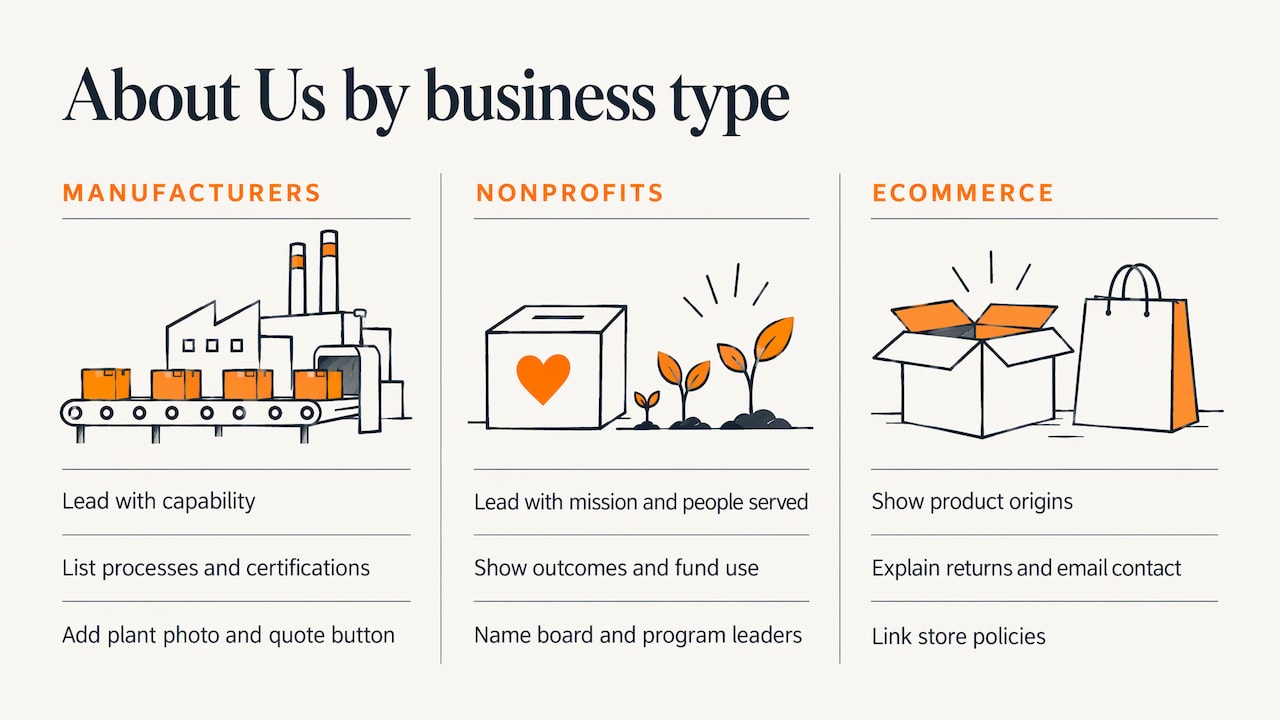
Manufacturers. Lead with capability. List the processes, materials, certifications and industries you serve. Add a plant photo and a quote button. Buyers often forward the About Us page to colleagues, so make it understandable to someone who has never spoken to you.
Nonprofits. Lead with the mission and the people it serves, then show outcomes and how donations or grants are used. Named board members and program leaders add credibility.
Ecommerce brands. Shoppers visit the page to decide if the store is real. Show where products come from, how returns work and who answers the email. Link to your policies from the page.
How the About Us page fits the rest of your site
The page does not work alone. It should link to your services, your case studies and your contact page. It should also match the tone of your home page. If you are weighing a bigger redesign, our guide to conversion-centered web design explains how pages like this one support the rest of the site, and our guide on improving website conversion rate covers the next step.
Common mistakes to fix first
- Starting with the founding year. Start with the customer’s problem.
- Stock photos of handshakes. Use real photos of your people and your place.
- Empty values. If a value does not change a decision, cut it.
- No contact path. Add a phone number, form or button at the bottom.
- Never updating it. Revisit the page once a year: new team, new certifications, new customer names.
Our perspective
We have been building websites for businesses for more than 38 years, and the About Us page is the one that owners put off the longest and visitors open the most.
Our view is that it should be written as part of the whole site, not bolted on. The story, the proof and the next step all connect to what the home page and service pages promise. When they match, visitors feel they are dealing with one organized company.
We also believe the page should reflect real people and real results. Our own work has earned more than 230 awards, and we would rather show clients what that work looks like than describe it in adjectives. Your page can do the same with your customers, your plant, your team and your numbers.
Start with the pitch, tell the part of your story the customer cares about, and finish with an easy way to reach you.
Greg
Let us build it with you
Marcy Design is a Columbus, Ohio agency that combines custom website design, professional writing, photography, video production and branding under one roof. That means the page, the words and the photos of your team can come from the same people. See our website design services, or book a free consultation to talk through your site.
If the About Us page is part of a larger rebuild, our branding work helps make sure the story you tell is consistent everywhere customers meet you.
FAQ
What should be included on an About Us page?
Start with a short statement of who you help and what you do. Then add your story, the people behind the company, proof such as customer names, awards or testimonials, and a clear next step. Salesforce also suggests covering your vision and how you plan to grow.
How long should an About Us page be?
Long enough to reassure the reader and short enough not to feel like a chore. For most small businesses, 300 to 600 words with real photos is a good range. Manufacturers with many certifications or processes can add a scannable list.
What are some ideas for an About Us page?
Use a timeline of milestones, a founder’s story, a team gallery with short bios, a values section that describes behavior, customer logos and testimonials, or a short video from the owner. Choose the two or three that prove something your customers want to know.
Why does an About Us page matter for sales?
Visitors use it to decide whether to trust you. Salesforce reports that 52% of people want to see it first, and that customers who visit it spend 22.5% more than those who do not. Those are survey and research figures, not guarantees, but they show visitors read this page before they buy.
Sources
- Salesforce: Tell Your Story, 8 Tips for Your Small Business About Us Page
- Nielsen Norman Group: Presenting Company Information on Corporate Websites
- G2: Your About Us Page Should Stand Out
- Search Engine Journal: About Us Page Examples
- America’s SBDC: Once upon a website
- Buffer: About Us Page Examples for Creators and Small Businesses
- Equals: About
- Relace
- About Us Page Examples roundup