
 614.224.6226
A good retargeting strategy shows the right follow-up ad to the right past visitor, at the right stage of their decision, and then measures whether those ads caused extra sales. It only works when the website, the tracking, the creative and the budget are planned together. That is how we approach it at Marcy Design, the Columbus, Ohio agency behind this guide: retargeting is one part of a connected advertising and website plan, not a stand-alone switch you flip.
Below you will find what retargeting is, how to build the funnel, how to set it up, which numbers to watch and which privacy rules apply to US businesses.
TL;DR
- Retargeting shows ads to people who already visited your site or engaged with your brand but did not convert. “Remarketing” is the term most often used for the same idea.
- Split visitors by intent: casual browsers, comparison shoppers and people who nearly bought each need a different message.
- Google Ads needs at least 100 active users in an audience within 30 days before it will serve ads to it, so small sites should start with broad segments.
- Cap frequency, refresh creative and test with a holdout group so you measure real lift, not just last-click credit.
- Honor opt-out signals such as Global Privacy Control where state law requires it.
Table of Contents
- What retargeting is and how it works
- Why the strategy matters more than the tool
- Building a retargeting funnel
- How to set up a retargeting campaign
- Best practices that keep retargeting profitable
- Privacy rules every US advertiser should know
- Retargeting by business type
- How we work with retargeting
- Get retargeting planned with the rest of your marketing
- FAQ
- Sources
What retargeting is and how it works
Most people who visit a business website leave without buying or filling out a form. Retargeting is a way to bring them back. According to Search Engine Land’s retargeting guide, it is a digital marketing strategy that uses display advertising to re-engage people who have shown interest in your brand but have not converted.
The same guide breaks the mechanics into four steps:
- Track behavior. A small piece of code, called a pixel or tag, and a browser cookie record that someone visited a page.
- Segment. Tracked visitors are grouped by what they did or how strong their interest looked.
- Personalize. Each group gets a message that fits where it is in the buying journey.
- Deliver. The ads run on the platforms and devices you select.
The terms “retargeting” and “remarketing” are often used interchangeably. Some marketers reserve “remarketing” for email and customer-list follow-up, while “retargeting” means ads based on site behavior. For planning purposes, the same strategy applies to both. If you want to see how the Google side of this looks for a business like yours, our short piece on Google remarketing covers when it tends to fit.
Why the strategy matters more than the tool
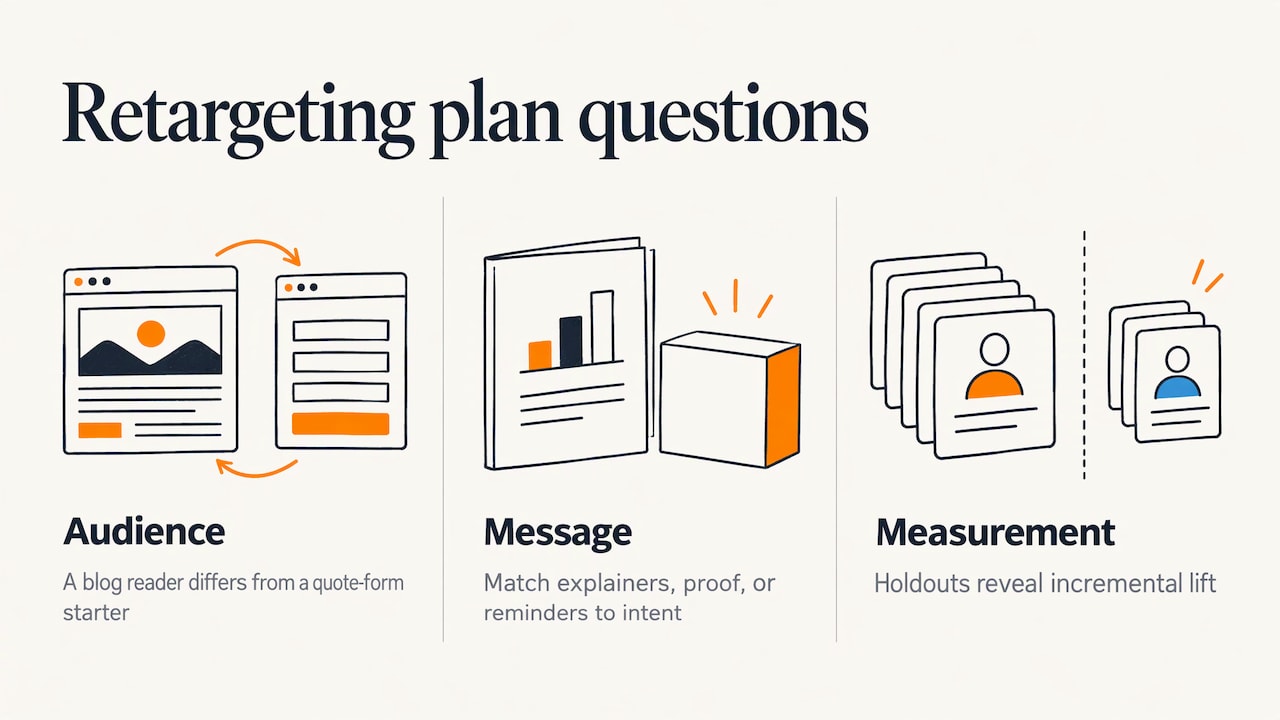
Anyone can install a pixel. What separates a campaign that earns its budget from one that follows people around the internet is the plan behind it. Three questions shape that plan.
Who is worth following up with? A visitor who read one blog post for twenty seconds is not the same as someone who opened your pricing page and started a quote form. Treating them identically wastes money and annoys the people least likely to buy.
What should each group see? A first-time browser may need a useful explainer. A comparison shopper may need proof, such as a case study or a testimonial. A person who abandoned a form may only need a direct, simple reminder.
How will you know it worked? Search Engine Land points out that retargeting is often the last step before a conversion, which makes it easy to overestimate its return. Its guide recommends holdout-group testing, where a share of your audience is deliberately not shown the ads, so you can compare results and see the true incremental lift.
Those three questions are also why retargeting tends to perform best alongside search, social and a website built to convert. Our article on digital advertising channels explains why we usually begin with search and one platform before adding more.
Building a retargeting funnel
A funnel is simply the path from first visit to purchase or inquiry. Retargeting funnels divide visitors into stages so each stage gets its own audience, message and time window. A practical three-stage version looks like this.
Stage 1: Awareness (low intent)
Who: people who landed on your site, viewed one page and left, or read a single article.
What to show: helpful, educational content: a guide, a short video, a checklist. The goal is to earn a second visit, not to push a sale.
Window: short. These visitors cool off quickly, so a window of roughly a week is a sensible starting point.
Stage 2: Consideration (medium intent)
Who: visitors who viewed several pages, spent real time on service or product pages, or watched a video.
What to show: answers to the objections a buyer raises: case studies, testimonials, comparisons, a clear description of how your process works. A manufacturer might show a spec sheet or a capabilities overview. A service business might show a client story.
Window: longer, often two weeks or more. B2B buying cycles are slower than consumer ones, so a manufacturing company or a professional services firm may reasonably extend this window.
Stage 3: Conversion (high intent)
Who: people who viewed pricing or contact pages, added something to a cart, or started a form without finishing it.
What to show: a direct next step. For ecommerce, that may be the product they left behind plus a reason to finish. For lead generation, it may be a simple invitation to request a quote or schedule a call.
Window: short and focused. These people are close to deciding.
Exclude people who already converted
The most common waste in retargeting is showing “buy now” ads to people who already bought. Build an exclusion audience of recent customers and form submitters, and apply it to every campaign. You can also create a separate campaign for existing customers with a different aim, such as a related product or a reorder reminder.
Where you have a strong lead process behind the funnel, retargeting works as a feeder to it. Our guide to B2B lead generation shows how follow-up advertising fits with the rest of a lead program.
How to set up a retargeting campaign
Here is the setup order we recommend, with the places where campaigns most often go wrong.
1. Fix the website first
Retargeting sends people back to a page. If that page loads slowly, is hard to use on a phone or asks too much of a visitor, the ads will simply pay to repeat a bad experience. Make sure your key pages have one clear action, and that your forms and checkout work. A site that is designed around conversion gives every retargeting dollar more to work with. Our website design work starts from that principle.
2. Install tracking and confirm it fires
Add the platform’s tag to every page, and set up events for the actions that matter: form submissions, calls, add-to-cart and purchases. According to Google Ads Help, Google signals must be enabled in Google Analytics 4 and the relevant cookies need to be present for audiences to populate. Test each tag before you spend anything.
3. Build audiences that are big enough
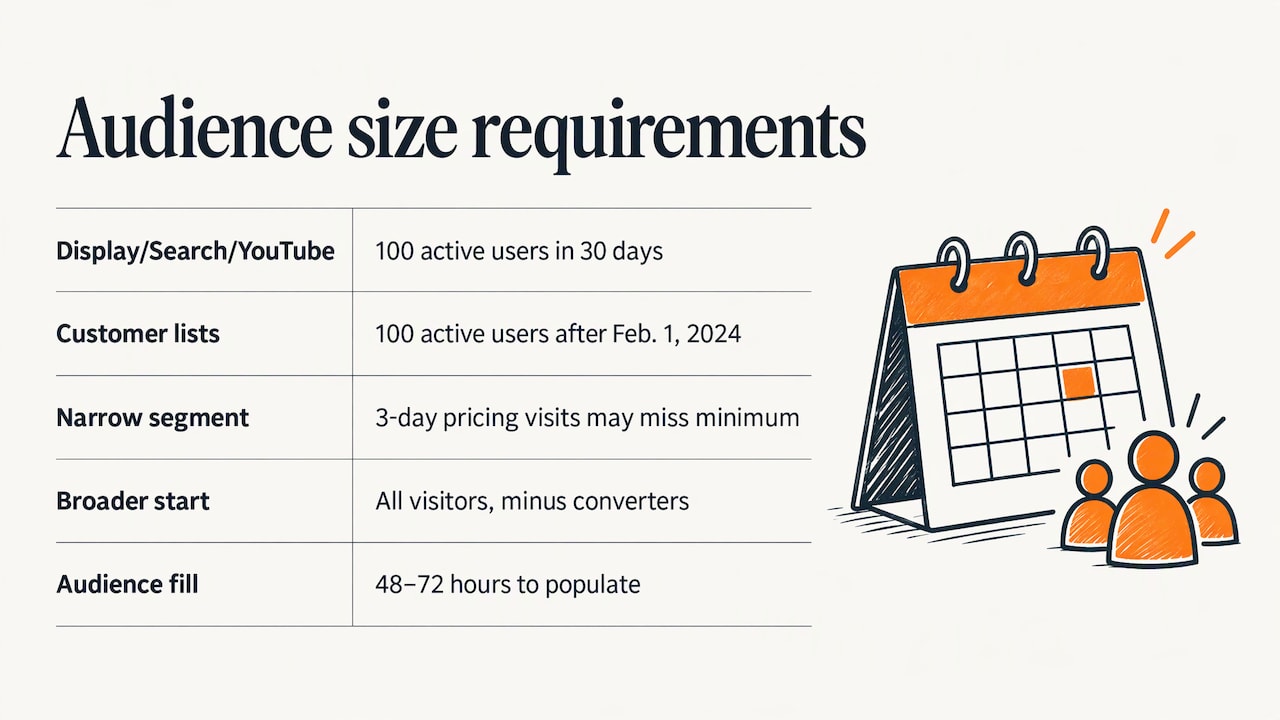
Google Ads Help states that a data segment needs at least 100 active visitors or users within the last 30 days to be used on the Display Network, Search Network and YouTube. Customer lists uploaded or refreshed after February 1, 2024 also need 100 active users. This matters for smaller sites: if your traffic is modest, a narrow segment such as “visited the pricing page in the last three days” may never reach the minimum. Start with broader segments, such as all visitors in the last 30 days minus converters, and split them further as traffic grows.
The same Google page notes that a new remarketing audience can take 48 to 72 hours to fully populate, so do not judge the setup on day one.
4. Write ads for each stage
Match the message to the funnel stage. Use your real photography, real client results and plain language. Rotate several versions, because the same image shown repeatedly stops working. If you do not have strong visuals or copy, that is a gap to close before launch: creative is usually what decides results once targeting is in place.
5. Set budget, window and frequency
Decide how long people stay in each audience and how often they see the ads (more on frequency below). A common beginner mistake is a large daily budget against a tiny audience, which exhausts the audience within days. If that happens, lower spend or lengthen the window.
6. Launch, wait and review
Give the campaign enough time to gather data, then review by stage rather than as one blended number. Our advertising budget article is a useful place to decide how much to commit before launch.
Best practices that keep retargeting profitable
Control frequency
Seeing the same ad too often turns interest into irritation. Search Engine Land’s remarketing guide recommends keeping frequency under 8 to 10 views per user per week and refreshing creative when click-through rates fall or costs rise. For smaller audiences, a tighter cap is usually wiser. Watch for three fatigue signals: falling click-through rate, rising cost per result and fewer conversions from the same spend.
Our article on why ads lose their effectiveness walks through the creative side of this problem.
Keep the message consistent
A visitor who clicked a search ad, then sees a retargeting ad in a different style, then lands on a page with a third look, loses trust. Keep the visual identity, offer and tone aligned from one campaign to the next. We cover this in how consistent your advertising is.
Use more than one audience type
Site visitors are only one source. Customer lists, people who engaged with your social content and people who watched your video can all feed separate audiences. Our piece on advertising audiences explains two that are easy to overlook.
Measure real lift, not just credited conversions
Platforms usually credit the last ad a buyer clicked. Because retargeting ads often appear right before purchase, they can look better than they are. Run a holdout test: leave a small portion of the audience unexposed and compare conversion rates between the two groups. The difference is the lift your ads created.
For reference, Search Engine Land’s remarketing guide gives these benchmark ranges:
| Metric | Benchmark range |
|---|---|
| Impression share | 70 to 90% |
| Click-through rate, display | About 0.7 to 2% |
| Click-through rate, search and social | 2 to 5% or more |
| Conversion rate | 2 to 10% is respectable |
| Return on ad spend | 4:1 is considered healthy for many industries |
Treat these as starting points. Your own numbers, tracked over time against your own margins, are the benchmark that matters. If you want a framework for tying ad results to revenue, our digital marketing ROI calculator guide is built for exactly that.
Privacy rules every US advertiser should know
Retargeting depends on tracking, and tracking is regulated. There is no single federal rule, but state laws apply to US businesses depending on where their customers live.
- Opt-out signals. In September 2025, the California Privacy Protection Agency announced a joint investigative sweep with the Colorado and Connecticut attorneys general, aimed at businesses that do not honor Global Privacy Control, a browser setting that tells sites a visitor opts out of the sale or sharing of their data. Under the CCPA, once a business receives an opt-out request it cannot sell or share that person’s personal information, and it must wait at least 12 months before asking them to opt back in.
- Minors. A 2025 state privacy law recap notes that Connecticut bans targeted advertising and the sale of personal data for consumers under 18, and that Oregon restricts targeted advertising and profiling for consumers under 16. If any of your audience could include minors, exclude them.
- Sensitive categories. Google Ads Help notes that sites flagged for sensitive content, such as health topics, may be restricted from certain advertiser-built audiences.
In practice: keep a clear cookie and privacy notice, make opting out as easy as opting in, and make sure your consent tool actually stops the tags from firing when someone opts out. If you operate in a regulated field or collect sensitive data, have an attorney review your privacy policy and consent setup.
Retargeting by business type
Small service businesses
Traffic is often limited, so start with one audience: all visitors in the last 30 days, minus anyone who already contacted you. Show proof, such as reviews, project results and a clear contact action.
Ecommerce stores
Abandoned cart and product-viewer audiences are the core. Add a customer-list audience for repeat purchases. Fast site search and a smooth checkout matter as much as the ad itself. Our custom ecommerce guide for small business covers the foundation.
Manufacturers and B2B companies
Buying cycles are long and involve several people. Use longer windows, and show content for each role: specifications for engineers, capabilities and lead times for purchasing, credentials for management. Retargeting here keeps your company in front of a buyer between the first visit and the request for quote.
Nonprofits
Retarget people who visited donation, event or volunteer pages with a single clear action, and exclude people who just gave.
How we work with retargeting
Marcy Design has been in business for more than 38 years and has won over 230 awards. Advertising, digital marketing, lead generation, website design, SEO and ecommerce are all services we offer, which means the pieces a retargeting plan depends on can sit under one roof: the site people return to, the ads that bring them back and the lead process that follows.
Our view
Retargeting gets treated as a button in an ad platform. We see it as a conversation with someone who has already shown interest, and a conversation only goes well when you know what that person needs next.
That is why we start with the website and the audience, not the ad. If the page people return to is clear and built to convert, and the message matches where they are in their decision, each ad has a real job to do. Add frequency limits, fresh creative and an honest measure of lift, and retargeting becomes a steady, accountable part of your marketing rather than a line item you hope is working.
For small businesses, manufacturers and nonprofits alike, the strongest results come when design, advertising and lead generation are planned as one program. That is the way we build them.
Greg
Get retargeting planned with the rest of your marketing
If you want retargeting built around a site and an advertising plan designed to work together, our team can help. Marcy Design offers advertising, digital marketing and lead generation, along with the website design and development that give those campaigns somewhere strong to send people.
See our advertising and marketing services or talk with us about lead generation for your business in Columbus and across the US.
FAQ
Is retargeting still effective?
It can be, when it is aimed at the right audiences and measured honestly. Privacy changes have reduced how much data is available, so audiences are smaller and consent matters more. Judge it by incremental lift from a holdout test and by return on your own spend, not by platform-credited conversions alone.
How many people do I need before I can retarget?
For Google’s networks, an audience needs at least 100 active users in the last 30 days. If your site has less traffic, use a broad audience, such as all visitors in the last 30 days, and refine it as traffic grows.
How often should someone see my retargeting ads?
Keep it under roughly 8 to 10 views per person per week at the most, and start lower for small audiences. If click-through rates drop or costs climb, swap in new creative or lengthen the window so you reach more people.
What is the difference between retargeting and remarketing?
The terms are used almost interchangeably. Retargeting usually means ads shown to past site visitors, while remarketing can also include email and customer-list follow-up. The planning steps are the same: track, segment, personalize and deliver.
Sources
- What Is Retargeting? Strategy, Examples & Tools, Search Engine Land
- What Is Remarketing? Strategy, Benefits & Best Practices, Search Engine Land
- About your data segment compatibility, Google Ads Help
- California Privacy Protection Agency announces joint investigative sweep
- Privacy Law Recap 2025: State Comprehensive Consumer Privacy Laws