
 614.224.6226
Trade show marketing works when the show is treated as one campaign with three parts: promotion before the doors open, a booth built to start conversations, and a follow-up routine that begins within days. The booth is the smallest part of that. Most of the return comes from the goal you set, the materials that carry your message, and how fast and how well you follow up. Those are brand, content and website jobs as much as event jobs, and that is where we help businesses build the whole campaign, not just the display.
TL;DR
- Set one primary goal (usually qualified leads) and work backward from the revenue you need to the conversations you must have.
- Start promoting 3 to 4 months out: targeted outreach, your booth number, demos and pre-booked meetings.
- A booth that says what you do, who you help and what problem you solve from the aisle beats a bigger booth with a vague message.
- Capture more than a badge scan: the reason for the visit and a clear next step.
- Export and sort leads within 48 hours, then measure cost per lead and pipeline at 30, 60 and 90 days.
Table of Contents
- Start with the goal and the budget
- Before the show: promote your presence
- Booth ideas that start conversations
- Capturing and qualifying leads at the booth
- After the show: follow up fast and by segment
- Measuring whether the show was worth it
- How we approach trade show marketing
- Our perspective
- FAQ
- Sources
Start with the goal and the budget
A trade show marketing strategy is a plan that connects what you do before the show, at the booth and afterward to a business objective. The most common objective is lead generation. An industry report from the Center for Exhibition Industry Research (CEIR) found that lead generation ranked as the most popular and important exhibiting goal, with brand awareness second. The same report notes that exhibitors struggle to generate quality leads, follow up well and trace leads to sales.
That last point is the one to plan around. Pick your goal before you pick your booth. A practical way to do it is to work backward:
- Decide how much revenue the show should influence.
- Divide by your average deal size and your close rate to get the number of opportunities you need.
- Estimate how many qualified conversations it takes to produce one opportunity.
That gives you a target for staff, a target for follow-up and a number you can defend afterward.
Budget comes second. Event planning guidance lists booth setup, staffing, venue-related costs and catering among the main budget lines. For a small business or a manufacturer, add the items people forget: printed and digital materials, product photography and video for the booth, travel, shipping, staff training and the time to process leads afterward. If a cost does not support pipeline, positioning or a partnership, question it.
Before the show: promote your presence
The booth shouldn’t be the first time a buyer hears from you. The Marketing Blueprint presented to exhibitors at IMTS, the large US manufacturing show, recommends that 3 to 4 months out you launch targeted outbound, promote your booth number and demos, and schedule meetings.
Here is what that looks like in practice:
- Segment your email list. The Automate show’s exhibitor playbook suggests short, personalized invitations that say what visitors will see, learn and receive. A customer, a lapsed contact and a cold prospect should get different emails.
- Book meetings in advance. Contact local prospects and existing customers to set appointments, and send a reminder before the event starts, as AFCEA TechNet’s exhibitor guidance advises.
- Use short video. A 30-second clip of the product in use, shared on social media and on your website, gives people a reason to stop by.
- Schedule social posts ahead. Queue the posts for the show’s duration so your team’s time at the booth goes to people, not to posting.
- Give the show a home on your website. A simple page with your booth number, what you will demonstrate and a meeting request form turns interest into a booked conversation. See our guide to online lead generation for how a page like that earns its place.
Booth ideas that start conversations
The most searched booth question is how to stand out. The research points to a few reliable answers, and none of them depends on a huge footprint.
Say what you do from the aisle
The International Association of Exhibitions and Events (IAEE) advises that a booth should communicate from the aisle what you do, whom you help, what problem you solve and why it matters. It recommends strong sightlines, large back walls or endcaps, and signage that guides rather than overwhelms. Walk the aisle yourself and test one thing: can a stranger read your headline from 15 feet?
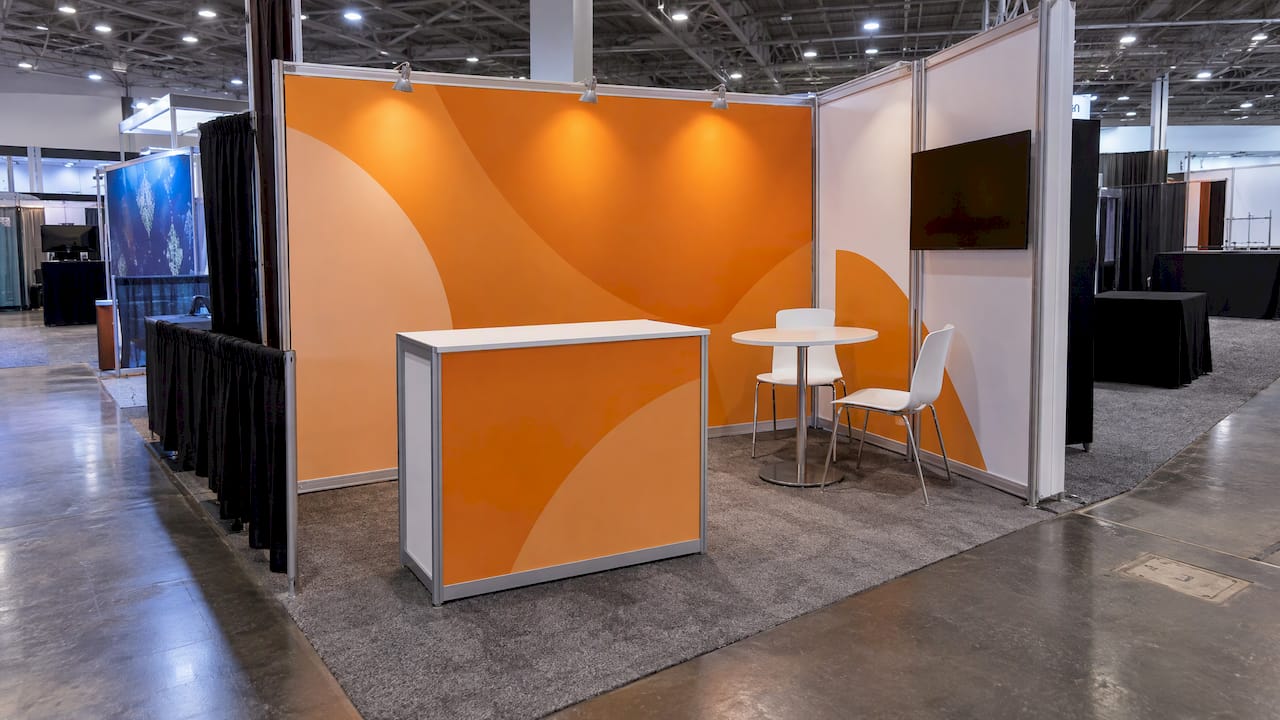
That is a messaging and design problem, and it is solved before the show. Our piece on marketing materials for trade shows covers how graphics, handouts and display content can work as one experience instead of separate pieces.
Give people something to do
IAEE’s guidance on in-booth tactics lists interactive product demonstrations, tutorials or mini-workshops, touchscreens and video walls, games, contests and giveaways. It treats digital elements as support for in-person engagement, not a replacement for it. Demonstrations and real conversation stay at the core.
A few documented examples show what that looks like:
- A veterinary health company’s themed exhibit combined staff-led product stations, a trivia activity and a prize. 1,205 people visited at least one station, up 250% on the prior year.
- At World of Concrete 2026, hands-on workstations staffed by experts, competitions on a large screen and live art drew attention. That is a useful model for manufacturers and trades, where seeing the product work is the pitch.
- A natural-products brand’s open exhibit with oversized garden elements and photo-worthy design generated 3,272 attendee posts, which shows how a visual hook can extend your reach beyond the show floor.
Staff it like a conversation, not a pitch
IAEE reports that younger professionals respond to friendly, consultative staff, while hard selling, staff on phones and premature badge scanning discourage stops. Train your team to ask a question before they pitch, stand at the booth edge instead of behind a table, and keep phones and office work out of show hours, as IAEE’s exhibitor interview recommends.
Capturing and qualifying leads at the booth
A badge scan tells you a name. It does not tell you why the person stopped. CEIR’s report says lead quality improves when you capture more information than the badge contains and secure a clear next action. It also found that fewer than 10 percent of exhibitors use customer qualifiers, so a simple set of questions is an easy way to get ahead of the booth next to you.
A workable qualification routine fits on a card:
- What brought you to the show? This shows whether the person is researching or buying.
- What are you trying to solve right now? This gives you the follow-up topic.
- What is your timeline? This separates this quarter from next year.
- Who else is involved in the decision? This identifies the buyer.
- What is the next step? A call, a quote, a sample or a demo, written down.
Grade each lead A, B or C on the spot. An A has a real problem, a timeline and authority. A C is a friendly visitor with no need yet. The grade decides who gets a call on Monday and who gets a newsletter.
CEIR also recommends giving booth staff specific lead targets, naming a lead captain and holding staff accountable for leads per shift. It suggests rewarding the person who captures the most leads with the most qualifying information. Where the show offers a lead retrieval system, the report recommends renting it.
For the broader picture of how leads move from first contact to customer, our B2B lead generation guide walks through it.
After the show: follow up fast and by segment
Most trade show money is lost in the two weeks after the event, when the leads sit in a bag. The IMTS blueprint sets a clear rhythm: export and segment leads within 48 hours, send tailored follow-up and route hot leads to sales. Then, from two to eight weeks after the show, run segmented nurture, repurpose show content and track pipeline and conversions.
Here is a simple version:
| When | What happens | Who it goes to |
|---|---|---|
| Within 48 hours | Personal email or call that refers to the conversation | A leads |
| Week 1 | Tailored email with the demo, sample or case study discussed | A and B leads |
| Weeks 2 to 3 | Nurture emails by interest or industry | B leads |
| Week 4 | Handoff of warm leads to sales for a decision | B leads that engaged |
| Ongoing | Newsletter and content | C leads |
The personal note matters. Refer to something the visitor said, attach the one thing you promised, and propose a specific next step. Content repurposed from the show, such as booth photos, demo videos and a short recap, gives your emails something to say that is not just a sales pitch. Photography and video you plan before the show can serve for months afterward.
Measuring whether the show was worth it
The IMTS blueprint measures post-show success on four dimensions: leads and their quality, engagement, pipeline generated and conversion rates. Start with the simplest number, cost per lead. CEIR calculates it by dividing total exhibition investment by leads captured, so a $25,000 investment that produces 50 leads equals a $500 cost per lead.
Cost per lead is a starting point, because a $500 lead who buys a $200,000 machine is a good lead. So track further down the funnel:
- Qualified leads (A and B) as a share of all leads.
- Meetings booked and opportunities created.
- Pipeline dollars and closed revenue tied to the show.
CEIR also recommends setting three firm reporting dates, such as 30, 60 and 90 days, and loading them into your CRM (the system where you track customer contacts and deals) so the reviews happen on schedule. B2B sales cycles are long, and a show held in March may not close until the fall. Our marketing ROI guide explains how to set up that kind of tracking.
How we approach trade show marketing
Marcy Design is a Columbus, Ohio agency with more than 38 years in business and over 230 awards. A trade show touches many things we do: branding, marketing materials, photography, video production, email marketing, lead generation and website design. We can build the message on your display, the leaflets people take home, the landing page that books meetings and the email sequence that follows up, so they look and sound like one company. You can see how we think about this in our article on trade show marketing and on making trade show materials more effective.
If you want a partner for the full campaign, our lead generation services and marketing and branding work are the place to start. We work with small businesses, manufacturers and organizations that want measurable results from their marketing.
To talk through an upcoming show, book a free consultation.
Our perspective
Most exhibitors plan the booth and improvise everything else. In our experience as a marketing agency, that is backwards. The booth is a few days. The message, the materials, the website and the follow-up work for months.
We believe a trade show succeeds when your brand says the same clear thing in every place a buyer meets it: the aisle, the handout, the landing page and the inbox a week later. That is why we approach a show as a campaign built on tailored, user-focused design and tied to measurable business results, not as a one-off display.
For a manufacturer or small business, the question to ask before you book a show is simple: what will we do with 100 conversations? If the answer is a plan with a message, materials, a lead routine and a measurement date, the show is an investment. We would be glad to help you build that plan.
Greg
FAQ
How much does a trade show booth cost?
The total depends on the show, the booth size and what you build. The booth space itself is only one line. Staffing, display and graphics, shipping, travel, lead capture and follow-up also belong in the budget. Get the space fee from the show organizer’s exhibitor prospectus, then add your own costs.
How do I attract people to my trade show booth?
Start before the show with targeted invitations and booked meetings. At the booth, use a clear headline readable from the aisle, a live demonstration or hands-on activity, and staff who ask questions instead of pitching. Giveaways and contests work best when they connect to your product.
What is a trade show strategy?
It is a written plan that links your show goal to your pre-show promotion, booth experience, lead capture and follow-up. The goal usually comes first, such as qualified leads or booked meetings, and everything else is built to support it.
How soon should I follow up with trade show leads?
Within 48 hours is the standard in the IMTS exhibitor blueprint. Send hot leads a personal message first, then move warmer leads into a sequence over the following weeks.
How do I know if a trade show was worth it?
Compare your total cost with the leads, meetings, opportunities and revenue it produced. Review at 30, 60 and 90 days, because B2B deals often close well after the show ends.
Sources
- CEIR Industry Insight Report on lead quality and sales conversion
- Cvent: Trade Show Planning, 15 Essential Steps
- IMTS Marketing Blueprint
- Automate Exhibitor Marketing Playbook 2025
- AFCEA TechNet Exhibitor Best Practices
- IAEE: Designing for Discovery
- IAEE: Maximizing Attendee Engagement, In-Booth Tactics
- IAEE: Raise Your ROI Like You Mean It
- Exhibitor: Beefing up Booth Traffic
- Exhibitor: Sowing Seeds
- Event Marketer: Six Trade Show Booth Ideas from World of Concrete 2026