
 614.224.6226
An email nurture sequence is a short run of automated emails, sent after a lead takes a specific action, that teaches, builds proof and then asks for a sales conversation. It works when each message has one job, the timing follows the buyer’s problem and the sequence stops the moment a human conversation starts. If you want it built, connected to your website and measured, our email marketing team in Columbus does that work for B2B companies.
This guide covers the full build: choosing the trigger, segmenting, setting length and cadence, a day-by-day example, the call to action for each email, and the numbers to watch.
TL;DR
- A nurture sequence starts from a behavior (a download, a pricing visit, a webinar sign-up), not from a calendar date.
- Length is set by the size of the ask: the bigger the decision, the more education the lead needs before you ask for it.
- Give every email one job and one call to action, and move from teaching to proof to a clear next step.
- Stop the sequence when the lead replies, books a meeting or buys, so automation never talks over your sales team.
- Test one variable at a time and judge results by clicks, meetings and opportunities, not opens alone.
Table of Contents
- What an email nurture sequence does for a B2B company
- Choose the trigger before you write a word
- Segment simply, then personalize where it pays
- How many emails, and how far apart?
- A seven-email B2B example, day by day
- What each email should say
- Build the exit conditions
- Measure it and improve it
- Common mistakes that sink a sequence
- Build the sequence with Marcy Design
- Our perspective
- FAQ
- Sources
What an email nurture sequence does for a B2B company
Most B2B buyers who raise a hand are not ready to talk to sales. They downloaded a guide, attended a webinar or looked at a pricing page. They have a problem and a loose idea of the solution, but no budget approval and often no shortlist. A nurture sequence covers the gap between that first interest and a real conversation.
It differs from a newsletter in three ways:
- It is triggered. The first email is sent because of something the lead did.
- It is ordered. Email three builds on email two. A newsletter issue stands alone.
- It has an exit. The sequence ends when its goal is met, such as a booked call, or when the lead changes status.
It also differs from a plain drip campaign in how much it listens. A basic drip sends the same emails on the same days to everyone. A good nurture sequence adapts: a lead who clicks the case study can move faster, and a lead who ignores three emails can be paused and moved to a slower, lighter track.
The business case is straightforward. Sales cycles in B2B are long, and most leads need repeated, relevant contact before they are ready. Follow-up is where deals are usually lost, because it depends on a person remembering to do it. A sequence makes the follow-up happen every time, in the right order, for every lead.
Choose the trigger before you write a word
The trigger decides who enters the sequence and what they already know, so it decides the first email. Strong B2B triggers include:
- Downloading a guide, checklist or buyer’s guide
- Registering for or attending a webinar or event
- Requesting pricing without booking a meeting
- Starting a free trial or using an interactive tool such as a calculator
- A change in lifecycle stage, or an old opportunity going quiet
Each of these calls for a different opening. Someone who used a cost calculator has shown a specific concern, and your first email should speak to that concern and not to your company’s history. Someone who downloaded a broad guide needs a welcome, the guide itself and a hint of what is coming.
A common mistake is a single “new subscriber” sequence for everyone. A lead who came from a pricing request and a lead who came from an educational download are in different places. Build one sequence per major trigger, even if the later emails overlap.
Your website decides how many good triggers you have. If every page has the same generic contact form, you only get one kind of lead. Pages built around specific offers, such as a guide per audience, a calculator or a comparison, give you triggers you can nurture precisely. Our article on lead generation website design shows how those entry points are structured.
Segment simply, then personalize where it pays
Segmentation means sending different messages to different groups. In B2B the most useful dimensions are:
- Buying stage: early research, comparing options or ready to decide
- Role: an owner cares about growth and risk, an operations manager about workload, a finance lead about cost
- Industry or company size: a manufacturer and a nonprofit have different constraints and different examples
- Use case: what the lead said they wanted to solve
Start with buying stage plus one other dimension. Every extra dimension multiplies the number of versions you must write, test and maintain, and small teams stall under that weight. Two dimensions give you a handful of tracks, which is manageable. Add a third only when the data shows a clear difference in response.
Agree with your sales team on definitions before you build. What counts as a marketing-qualified lead? When does a lead become sales-qualified, and who follows up? If marketing and sales disagree, leads get emailed by automation while a rep also calls, which is exactly the experience that makes prospects tune out. Our piece on whether marketing should support sales or sit apart from it covers how to set that boundary.
How many emails, and how far apart?
There is no universal number. Length depends on the main ask. CXL’s framework for nurturing B2B leads ties the length of the sequence to the friction of the ask, how close the prospect is to seeing value and how much the prospect still has to learn. Asking for a free resource download needs almost no nurture. Asking a finance director to sign a six-figure contract after one guide download needs a lot.
For practical planning, think in these ranges:
| Main ask | Typical sequence | Spacing |
|---|---|---|
| Book a short call after a guide download | 5 to 7 emails | Every 3 to 5 days |
| Request a demo or proposal after a webinar | 4 to 6 emails | Tighter early, then weekly |
| Re-engage a lead who went quiet | 3 to 4 emails | Every 7 to 14 days |
| Long, high-stakes purchase | 8 or more emails, plus a slower follow-on track | Widening gaps over several weeks |
These are working defaults from standard practice, not laws. The rule underneath is simple: front-load value, space the later messages so you stay present without crowding the inbox, and let engagement speed things up or slow them down. If a lead clicks a case study, move the meeting invitation forward. If a lead has opened nothing for three emails, pause and switch to a monthly track rather than pushing on.
A seven-email B2B example, day by day
Here is a sequence for a lead who downloaded a practical guide. It runs 24 days and ends in a human conversation. Adjust the topics to your industry.
Day 0: Deliver and orient. Send the guide immediately. In two or three sentences, say what is inside and what the next few emails will cover. One call to action: open the guide.
Day 3: Frame the problem. Pick the single most common mistake your buyers make and explain it plainly, with a short example. One call to action: read a short article or use a checklist.
Day 7: Help them diagnose. Offer a quick self-assessment, a short list of questions or a worksheet that lets the lead see where they stand. One call to action: complete it.
Day 10: Compare approaches. Lay out the realistic ways to solve the problem, including in-house, a specialist, a tool or a partner, with honest trade-offs on time, cost and risk. One call to action: review the options.
Day 14: Show proof. Share a case study from a company similar to the lead in size or industry. Lead with the situation and the result, then what was done. One call to action: read the case study.
Day 18: Remove the friction. Answer the question buyers ask right before they commit: how long it takes, what the first month looks like, who is involved, what happens if priorities change. One call to action: reply with a question.
Day 24: Offer the next step. Invite the lead to a short conversation, and make it easy: a booking link, a clear agenda and a promise of what they will leave with. Offer a lighter option too, such as choosing which topics they want to keep receiving.
For comparison, CXL walks through an eight-message plan for a company that begins with a report download. It runs on days 1, 2, 5, 8, 9, 12, 14 and 18 and moves from reinforcing the download through education and social proof to a demo request and longer-term engagement options. Different business, same arc: teach, prove, then ask.
What each email should say
Every strong nurture email follows a few rules.
One job, one call to action. If an email tries to get the lead to read an article, watch a video and book a call, most will do none. Pick one action and make it the only button or link that matters.
Lead with the lead’s problem. The opening line should be about something the reader is dealing with, not about your company. “Most teams we talk to underestimate the handoff between marketing and sales” earns more attention than “We are excited to share.”
Earn the pitch. Nurture content should build the habit of opening and reading by being useful, build awareness of the problem and prove your claims before the main conversion ask. A sales pitch in email one wastes the trust you have not yet built. A pitch that arrives on email seven, after five useful messages, reads as the natural next step.
Use a human sender. A named person at your company, with a real reply address, outperforms a generic brand sender and gives leads an easy way to start a conversation.
Keep it short. Most nurture emails work at 100 to 200 words with one link. The detail lives on the page you link to.
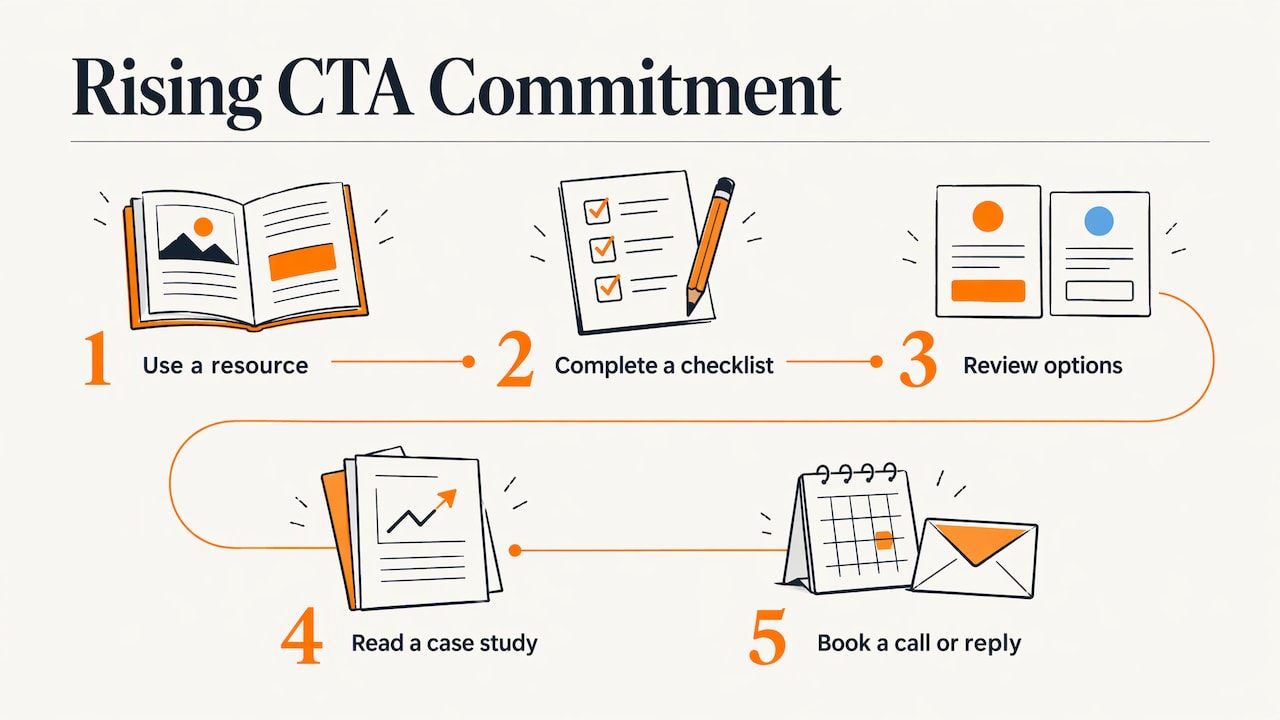
The call to action should climb in commitment as the sequence progresses. A sensible ladder is: use a resource, complete a checklist, review options, read a case study, then book a call or reply. Early on, the ask is small and nearly free. By the end, the lead has received enough value that a conversation feels worth the time.
Build the exit conditions
An automated sequence needs rules for when to stop. Without them, it keeps emailing a prospect who has already replied, booked a meeting or become a customer, which undermines the relationship your sales team is building.
Set exits for at least these events:
- The lead replies to any email in the sequence
- The lead books a meeting or completes a contact form
- The lead’s pipeline stage changes in your CRM
- The lead buys
- The lead unsubscribes, which should be honored immediately
Also build a path for the lead who goes through the whole sequence and does nothing. Do not leave them in limbo and do not keep mailing them at the same pace. Move them to a lower-frequency track of useful content, and set a rule for when to re-enter the sequence, for example after a return visit to your pricing page.
If your emails go to US recipients, follow the CAN-SPAM requirements for commercial email: an accurate sender, a physical postal address and a working unsubscribe. Have your counsel or marketing lead confirm your setup against the current FTC guidance.
Measure it and improve it
A nurture sequence is never finished. Review it on a schedule, such as monthly at first, and judge it by outcomes that connect to revenue.
Match the metric to the stage of the buyer:
- Early emails: content views, click-through rate and engagement
- Middle emails: clicks on case studies and comparisons, replies and engagement scores
- Final emails: meetings booked, opportunities created and conversion from marketing-qualified to sales-qualified
Open rate is a weak guide on its own, because privacy features on mail apps inflate it. Click-to-open rate, replies, meetings and opportunities tell you more.
When you change something, change one thing. Test one subject line, one call to action or one send time at a time, with a written hypothesis. If you change three things and results improve, you will not know why.
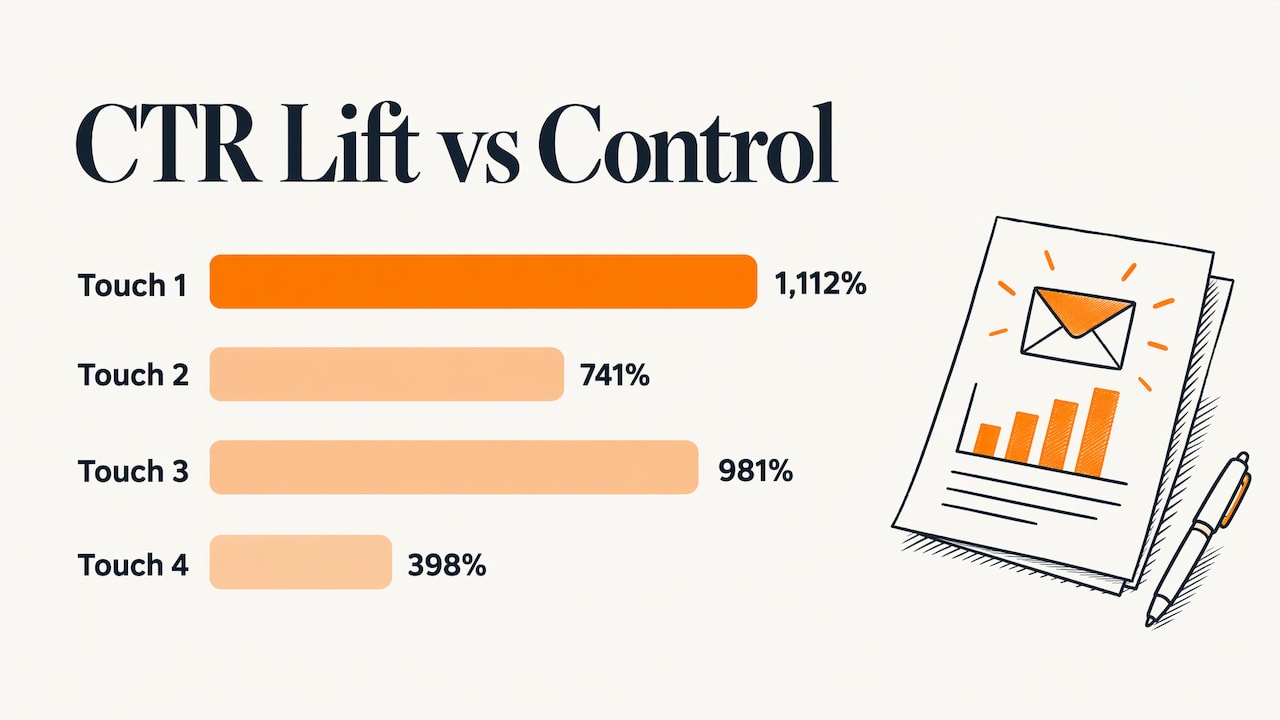
Segmenting by buyer persona can produce large gains. MarketingSherpa’s case study of a publishing company reported that a persona-based program had click-through rates 1,112%, 741%, 981% and 398% higher than a legacy-contact control group on four successive touches. That is one company’s result in 2014, not a promise, but it shows why relevance to the reader is worth the effort.
Read the sequence against your sales data too. If leads from the sequence book meetings but few become opportunities, the final emails may be attracting the wrong people, or the earlier emails may be setting expectations your sales team does not meet. The fix is in the content, not the send schedule.
Common mistakes that sink a sequence
- Pitching on day one. The lead has not yet had a reason to trust you.
- One sequence for everyone. A blended audience gets messages that fit nobody.
- No connection to the website. If the email links to a slow, cluttered or hard-to-read page, the sequence loses the click it earned. Landing pages should match the email’s promise and load well on a phone.
- No owner. A sequence written once and never reviewed goes stale, and its examples and links age.
- Ignoring sales feedback. The reps who talk to these leads know which objections come up. Feed those into emails five and six.
The content itself is the other half of the work. A sequence is only as good as the guides, case studies and checklists it points to, which is why it belongs inside a wider content marketing strategy and a broader B2B lead generation plan.
Build the sequence with Marcy Design
A nurture sequence touches several things at once: the offer that attracts the lead, the form and landing page that capture it, the writing, the email design and the reporting. We have been in business for more than 38 years and have won over 230 awards, and our services cover email marketing, professional writing, website design and lead generation under one roof, so those pieces are planned together instead of handed between vendors.
If you already have leads going cold, or a website that collects contacts and then does nothing with them, start with a conversation about what you sell, who buys it and where deals stall.
See our lead generation services, or contact the team to talk through your sequence.
Our perspective
Most companies we meet do not have a lead problem. They have a follow-up problem. Someone downloads a guide, and then nothing happens for three weeks, until a salesperson remembers to call.
We think a nurture sequence should be treated like part of the website and the sales process, not as a separate email project. The landing page, the offer, the writing and the emails all need to say the same thing in the same voice. That is why we plan them together: design, writing, email and lead generation are all services we provide.
Our approach is built on tailored solutions and measurable results. For a manufacturer, that might be a technical guide followed by a case study from a similar plant. For a nonprofit, it might be a donor-facing story sequence. The format changes, but the principle does not: give people something useful, prove you understand their situation and make the next step easy.
After 38 years of helping businesses grow, our advice is simple. Write fewer, better emails, tie each one to a single action and let your sales team step in the moment a prospect raises a hand.
Greg
FAQ
What is an email nurture sequence?
It is a series of automated emails sent to a lead after a specific action, such as a download or a webinar sign-up. Each message provides useful content that builds trust and moves the lead closer to a sales conversation. The sequence ends when the lead takes the goal action or replies.
How many emails should a nurture sequence have?
It depends on the ask. A call booking after a guide download often takes five to seven emails over three to four weeks. Higher-stakes purchases justify more education and a longer run. Let engagement guide you: speed up for leads who click and slow down for those who do not.
What should the first nurture email say?
Deliver what the lead asked for right away, then say in a sentence or two what the next emails will cover. Keep a single call to action, usually opening the resource. Save any sales ask for later in the sequence.
What is the difference between a nurture sequence and a drip campaign?
A drip campaign sends a fixed series on a fixed schedule. A nurture sequence uses the same automation but responds to behavior: it starts from a trigger, adapts to clicks and replies, and stops when the lead is ready to talk to sales.
Can you give an example of a B2B nurture sequence?
For a guide download: send the guide on day 0, a practical tip on day 3, a self-assessment on day 7, a comparison of approaches on day 10, a case study on day 14, an answer to the biggest objection on day 18 and a call invitation on day 24.
Sources
- After the Lead Magnet: How to Nurture B2B Leads (CXL)
- B2B Email Marketing: How a publishing company used persona-based automation (MarketingSherpa)
- CAN-SPAM Act: A Compliance Guide for Business (FTC)