
 614.224.6226
An AI content workflow is a repeatable sequence that takes a topic from research to brief to draft to published piece, with AI doing part of the work at each stage and a person accountable at the end. The workflow matters more than the tool. A business that picks a model first and a process second usually ends up with more content and the same results. A business that designs the process first gets faster, more consistent work that still sounds like itself.
This guide walks through the stages, what is worth automating, where people must stay in charge, and how to tell whether any of it is paying off. It is written for owners and marketing leads at small and mid-sized companies, including manufacturers and nonprofits, who publish on a website and need to do more with the team they have.
TL;DR
- An AI content workflow has defined stages (research, brief, draft, edit, publish, repurpose, measure). AI handles the structured, repeatable parts; people own strategy, accuracy and brand voice.
- Start with one content type, pilot three to five pieces, and track production time, revision time, quality and search performance before expanding.
- Give the AI a real brief: voice guidance, source material, keywords, audience and call to action. Weak inputs produce generic drafts.
- Every piece needs a human accuracy check, a brand-voice check and an SEO check before it goes live.
- Google does not penalize AI content as such. It penalizes content made to manipulate rankings rather than help people.
Table of Contents
- What an AI content workflow actually is
- The stages of a working workflow
- What to automate and what to keep human
- How to build your first workflow in five steps
- Quality control: the review gates that matter
- Risks to plan for
- Our perspective
- Measuring whether the workflow is working
- Where we can help
- FAQ
- Sources
What an AI content workflow actually is
The traditional content sequence is research, outline, writing and editing, often with different people on each stage, as Search Engine Land describes it. An AI workflow keeps that sequence and changes who or what does each step. A model might cluster keywords, summarize competitor pages, produce an outline or write a first draft. A person approves the brief, edits the draft and signs off.
Two things define how any given workflow behaves: the data you feed it and the metric you grade it on. Profound’s explanation of workflow configuration makes the point that changing those inputs changes what the process optimizes for, whether that is search rankings, sessions or citations in AI answer engines. A workflow tuned to publish 30 posts a month and a workflow tuned to win the three queries that bring in qualified leads are different machines, even if they use the same software.
That is why the first question is never “which AI tool?” It is “what is this content supposed to do for the business, and how will we know?”
The stages of a working workflow
Practitioner guides tend to land on a similar set of stages. AL Studio’s breakdown names seven: research, briefing, drafting, editing and QA, publishing, repurposing, and optimization. Here is how each looks in a small-business setting.
1. Research
This is where AI saves the most time with the least risk. It can analyze search results, pull the questions people ask, group keywords into topics and spot gaps where competitors have content and you do not. The output is a list of options for a person to judge, not a decision.
2. Briefing
The brief is the most important document in the workflow. It states the audience, the one thing the reader should do or understand, the target keyword, the sources to use, the voice, and the call to action. One quality framework recommends approving a concise brief before any generation happens, which is cheaper than rewriting a draft built on the wrong idea.
3. Drafting
Treat the AI as a first-draft writer. Give it the brief, an excerpt of your style guide, your own source material (product sheets, past articles, service descriptions) and the persona it is writing for. The more of your real knowledge it can see, the less it invents.
4. Editing and QA
A human edits for accuracy, voice and usefulness. This stage is not optional, and we cover what it should include below.
5. Publishing
AI can generate metadata, suggest internal links, draft alt text and format the piece for your content management system. A person still decides what goes live and when.
6. Repurposing
One solid article can become a newsletter section, several social posts, an FAQ block and a video script. This is repeatable, structured work, which is where automation does well.
7. Optimization
After publication, track what the piece does, then refresh or expand what performs. AI can flag pages that have slipped and suggest updates; you decide which ones deserve the effort.
What to automate and what to keep human
Not every task benefits equally. A rough sorting that holds up across the guides we reviewed:
| Task | Automation fit | Who decides |
|---|---|---|
| Keyword clustering, question extraction | High | Marketer reviews the list |
| Outlines and first drafts | High, with a good brief | Editor |
| Metadata, alt text, FAQ drafts | High | Editor spot-checks |
| Repurposing into social and email | High | Marketer approves |
| Translation and localization | Medium to high | Native-speaking reviewer |
| Brand and policy compliance checks | Medium | Human final call |
| Performance reporting | Medium | Marketer interprets |
| Content strategy and priorities | Low | Leadership |
Vendor documentation backs up the high-fit rows. Contentful’s AI Actions page lists copy, summaries and translations, adapting existing content for different audiences and channels, and preparing content for publishing with metadata, alt text and FAQs. Its help documentation adds quality checks for spelling, grammar and brand alignment.
The pattern is consistent: AI is strongest on structured, repeatable work with plenty of context. It is weakest where the question is “what should we say, and why does it matter to our customers?” That is judgment, and it belongs to you.
How to build your first workflow in five steps
You do not need a platform migration. Most small businesses can stand up a working workflow in a month by following a short path, similar to the one in Averi’s 30-day playbook.
- Audit what you do now. List every step between “we should write about this” and “it is live,” and who touches it. Mark the steps that are slow, repetitive or inconsistent.
- Pick one content type. A blog post, a product description set or a monthly newsletter. One repeatable workflow beats five half-built ones.
- Insert AI at the first-draft stage. Build a standard input package: brief, voice notes, sources, keywords, persona and call to action.
- Assign roles. One person writes or prompts, one edits, one checks SEO. In a small shop that may be two people wearing three hats, but the roles should still be distinct.
- Pilot three to five pieces. Complete the quality checklist on each before publishing, and record production time, revision time, quality and search performance.
If revision time is higher than writing from scratch would have been, the brief or the sources are the problem, not the model. Fix the inputs, then run another pilot.
A worked example for a manufacturer
Say an Ohio industrial supplier wants product-category pages and a monthly technical article. The research step clusters the search terms buyers use for each product family. The brief pulls in the spec sheets and an engineer’s notes as source material. The AI drafts the page. A technical person confirms every dimension, tolerance and compliance claim, because a wrong number on a spec page costs real orders. The editor then trims the marketing fluff, and the repurposing step turns the article into a short email to existing buyers. The AI saved hours on the drafting and formatting; the engineer’s ten minutes of review is what makes the page trustworthy.
Quality control: the review gates that matter
The most common failure in AI content is not bad prose. It is confident, smooth, wrong prose. Guidance from different directions converges on the same fix: put people in the loop at defined points.
Search Engine Land advises that a regular editor check conformity with brand standards, a fact-checker verify accuracy, and nothing publish without human review. Stanford’s marketing and communications guidelines treat AI output as a draft and a starting point, and keep the user personally responsible for accuracy and policy compliance. They also say to protect personal, confidential and privileged information, respect copyright and trademarks, log automated actions and inputs, and identify AI-generated or manipulated content when leaving that out could mislead.
A practical pre-publish checklist, adapted from the Averi playbook:
- Accuracy: every statistic, date, price and claim verified against a primary source; no source, no claim.
- Brand voice: tone matches your style guide; calls to action and offers are current.
- SEO: headings, metadata, internal links and external sources reviewed.
- Originality: the piece says something specific to your business, not a blend of what every competitor already says.
- Privacy: no customer data or confidential information was pasted into a tool that should not hold it.
For anything high-stakes (legal, medical, financial or safety content), add a qualified professional to the review, not just an editor.
Risks to plan for
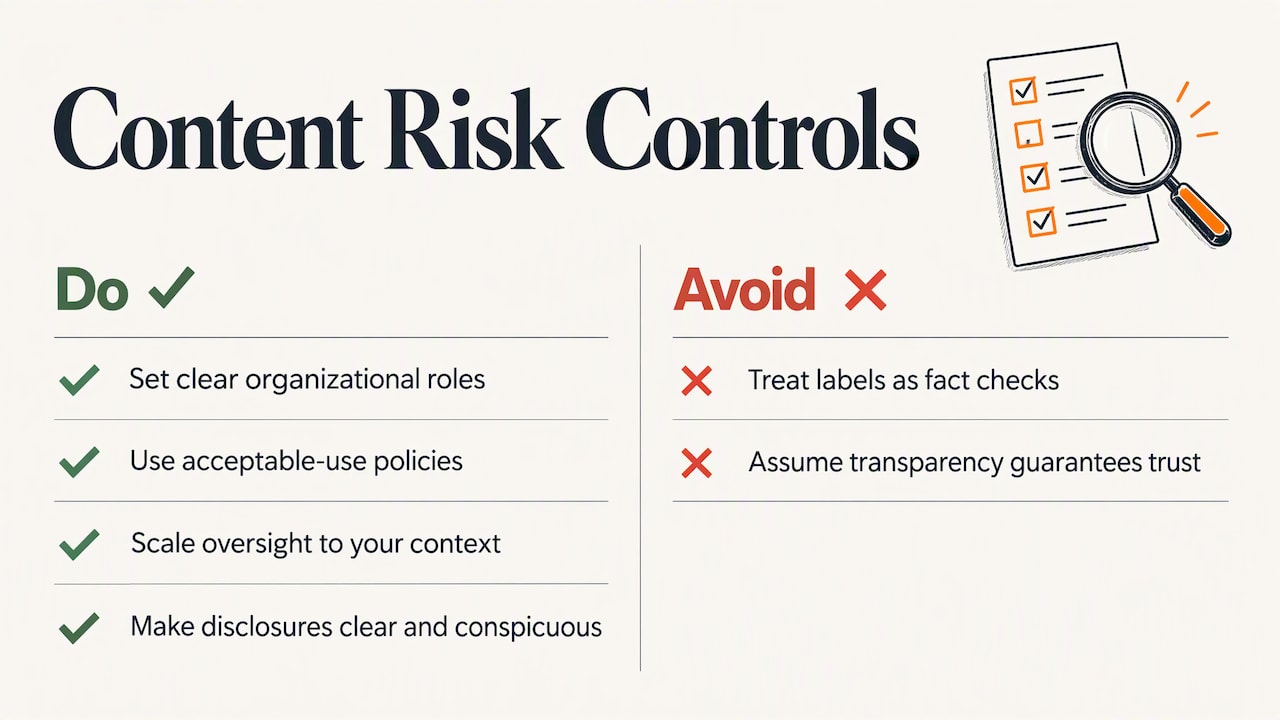
The NIST Generative AI Profile names several risks that apply directly to content teams: confabulation (the model states false things fluently), data privacy, harmful bias or homogenization, information integrity and information security. It recommends clear organizational roles, acceptable-use policies and oversight that includes leadership, legal and compliance, scaled to your context and risk tolerance. For a ten-person company that can be a one-page AI-use policy and a named owner.
Provenance labels and detection tools help, but NIST’s report on synthetic content cautions that technical transparency does not guarantee trustworthiness and can create a false sense of legitimacy. A label is not a substitute for checking the facts.
Disclosure is a separate question. If AI-assisted content makes advertising claims or involves sponsorships and endorsements, the FTC’s guidance on online disclosures says disclosures must be clear and conspicuous, judged by placement, proximity to the claim, prominence and whether the reader can avoid them. Ask your attorney how it applies to your specific content.
What Google says about AI content
Google’s published position is that using automation, including AI, to generate content with the primary purpose of manipulating rankings violates its spam policies, while AI used to produce helpful content is not the problem. The takeaway for a workflow: the method is not what gets judged. Usefulness, accuracy and originality are. A workflow that mass-produces thin pages invites trouble; one that helps a skilled person publish better pages faster does not.
Our perspective
We have been building websites and marketing for businesses for more than 38 years, and we have watched plenty of “this changes everything” tools arrive. AI is a real shift, but the lesson from every earlier one holds: the tool amplifies the strategy behind it. A business with a clear message and a sharp sense of its customers gets faster. A business without them gets louder and no clearer.
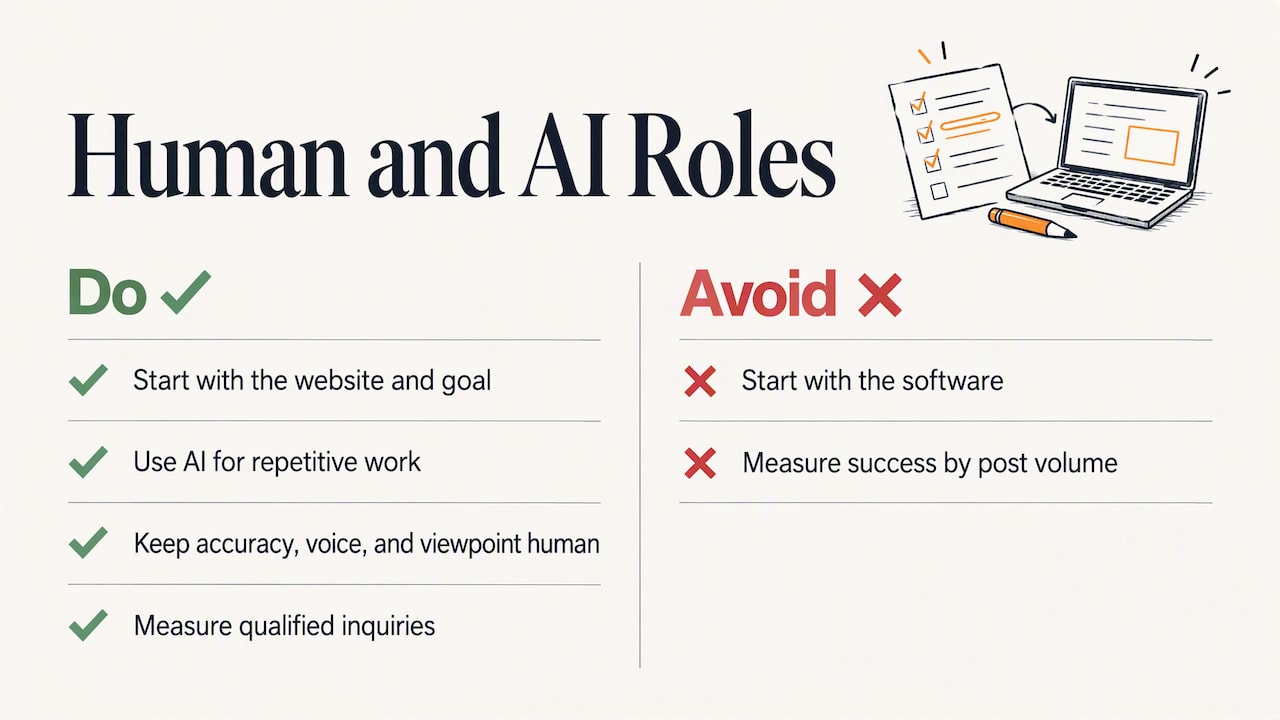
When we advise clients, we start with the website and the goal, not the software. Which pages need to win? What does a qualified lead look like? Who on your team knows the subject best? Then we place AI where it removes drudgery (research, first drafts, formatting, repurposing) and keep people on the parts customers can feel: accuracy, voice and the point of view that makes you different from the next company. Content that sounds like everyone is content that earns nothing.
One warning from experience: speed is the easy metric and the wrong one. Measure whether the content brings in the right inquiries, not how many posts went out.
— Greg
Measuring whether the workflow is working
Tie measurement to the goal you set at the start. Profound’s framing is useful here: a search-focused workflow is judged by rankings and sessions, while one aimed at answer engines is judged by whether those engines cite your content. For most small businesses we would add a third layer, which is business outcomes: form submissions, quote requests, calls.
Track these from the pilot onward:
- Production time per piece, from approved brief to publish.
- Revision time, meaning how long editing takes. Rising revision time signals weak briefs.
- Quality scores from your checklist, such as the number of factual corrections per draft.
- Search performance, covering impressions, rankings and organic sessions on the pages involved.
- Lead quality, meaning whether the traffic produces inquiries your sales team wants.
Give a new piece a few months before judging it on search; rankings do not move overnight. Refresh pages that rank on page two before writing new ones.
Where we can help
A workflow lives on your website, so the site has to be ready to receive it: clean structure, fast pages, search-friendly templates and accessible design. At Marcy Design we build custom websites and run SEO solutions, digital marketing and AI-powered marketing work for businesses across Columbus and Central Ohio, and we can help you design the brief templates, review gates and publishing process around your own team.

If you want a second opinion on where AI fits in your content, talk to our team. For more on the framework side, see our guides to AI content creation for small business, AI marketing automation and choosing AI tools for digital marketing.
FAQ
Can AI replace my content writer?
Not safely. AI is dependable for structured, repeatable work, but strategy, accuracy and brand voice still need a person who knows your customers. The better framing is a writer or editor who produces more because the research, formatting and repurposing are automated.
Will Google penalize content written with AI?
Google’s guidance says the problem is using automation mainly to manipulate search rankings, not the use of AI itself. Pages that are accurate, original and useful to readers are treated on those merits. Thin, mass-produced pages are the risk.
What should I give an AI tool to get a usable draft?
A brief with the audience and goal, excerpts from your style guide, your own source material, target keywords, the persona and the call to action. Grounding the draft in your real documents reduces invented details. Even then, a person must verify every factual claim.
How many pieces should I test before scaling?
Pilot three to five pieces of a single content type and track time, revision effort, quality and search results. If the numbers improve and the quality checklist passes consistently, add a second content type. If not, fix the brief and sources first.
Do I need to tell readers that content was made with AI?
There is no single rule for every case. Stanford’s guidance suggests identifying AI-generated or manipulated content when leaving it out could mislead, and the FTC expects clear disclosures where advertising claims or endorsements are involved. Check with your attorney for your situation.
Sources
- How to build an AI content workflow from the ground up (Search Engine Land)
- How to build an AI content workflow (Profound)
- How to Automate Content Creation With AI Workflows (AL Studio)
- How to build an AI content workflow from brief to publishing (AITIFICER)
- AI Actions (Contentful)
- AI Actions help center (Contentful)
- AI Content Workflow Playbook (Averi)
- AI guidelines for marketing and communications (Stanford)
- NIST Generative AI Profile
- NIST: Reducing Risks Posed by Synthetic Content
- FTC .com Disclosures
- Google Search’s guidance about AI-generated content