
 614.224.6226
What if your most polished marketing piece gets attention but leaves people unsure what to do next? That’s the challenge with high impact marketing materials: strong visuals matter, but they need to lead somewhere useful. A brochure, ad, or landing page can look professional and still miss its mark when the message is unclear or the next step is hard to find.
The right format depends on what your audience needs. A static asset can communicate one focused message quickly. An interactive experience can ask relevant questions, tailor what someone sees, and guide them through a decision. Used thoughtfully, both can make the journey clearer without overwhelming people.
In this article, you’ll learn how to match materials to audience needs and business goals, choose between static and interactive formats, and measure results by meaningful actions rather than design preference alone. We’ll cover practical uses for lead capture, onboarding, consultations, and assessments, along with ways to make guided experiences personal and easy to follow. For Columbus businesses, Marcy Design brings creative materials together with advertising and digital experiences to help connect attention to action.
Key Takeaways
- High impact marketing materials pair visual appeal with a clear goal and an easy next step.
- Choose static or interactive formats based on the decision your audience needs to make and how much guidance would help.
- Build a guided experience by defining the audience, choosing a task, mapping the steps, creating focused content, and reviewing the result.
- Keep questions relevant to the user’s purpose, then measure whether the material supports the action it was designed for.
- Align campaign materials with social channels and digital destinations so each touchpoint works toward the same goal.
What Makes Marketing Materials High Impact?
High impact marketing materials help the intended audience understand a message and take a relevant next step. They may be polished and visually distinctive, but impact isn’t the same as decoration. Design earns its place when it makes the purpose clearer, directs attention to useful information, and supports a specific communication goal.
Start by connecting four decisions: who the material is for, what they need to hear, where they’ll encounter it, and what you want them to do. A social post, a campaign landing page, and a consultation form serve different moments, even when they share a central message. For Columbus organizations, Marcy Design connects these decisions through its work in strategic marketing materials and campaigns.
Start with the audience and the action
Before choosing a format or writing copy, consider what the audience already knows, what questions they have, and what action would genuinely help them. Someone encountering your organization for the first time may need a simple explanation. A person comparing options may need a clear distinction between services. A ready-to-talk prospect may need an easy way to request a consultation.
These are different goals, and each calls for a different emphasis:
- Awareness: Introduce a business or service with a concise message that gives new audiences a reason to learn more.
- Consideration: Help someone evaluate an option by explaining how it addresses a need or what the process involves.
- Response: Make a next step clear, such as booking a consultation or submitting an inquiry.
The same service can be presented differently for each audience need. An awareness ad might lead with the problem it addresses. A page for someone evaluating options can explain the approach and answer likely questions. A follow-up asset can focus on what to include in an inquiry. Relevance earns attention, clarity builds understanding, and a useful next step turns both into action.
Design clarity matters more than decoration
Good hierarchy helps readers see what matters first. Give the main message visual priority, use concise copy to explain it, and organize supporting details so they’re easy to scan. A readable layout reduces the effort required to understand the offer and helps people find the action that fits their needs.
For example, a consultation page might open with a direct description of who the consultation is for, followed by a short explanation of what to expect. A prominent “Request a consultation” button gives interested readers a clear route forward. The design supports the goal without competing with it.
Visual appeal can invite a closer look, but it can’t guarantee attention, understanding, or response on its own. Review each material by asking: Can the intended audience recognize its purpose? Is the central message easy to find? Is the next step clear and appropriate? If the answer is yes, the design is doing more than looking good. It’s helping the message work.
How Interactive Marketing Materials Create a Guided Experience
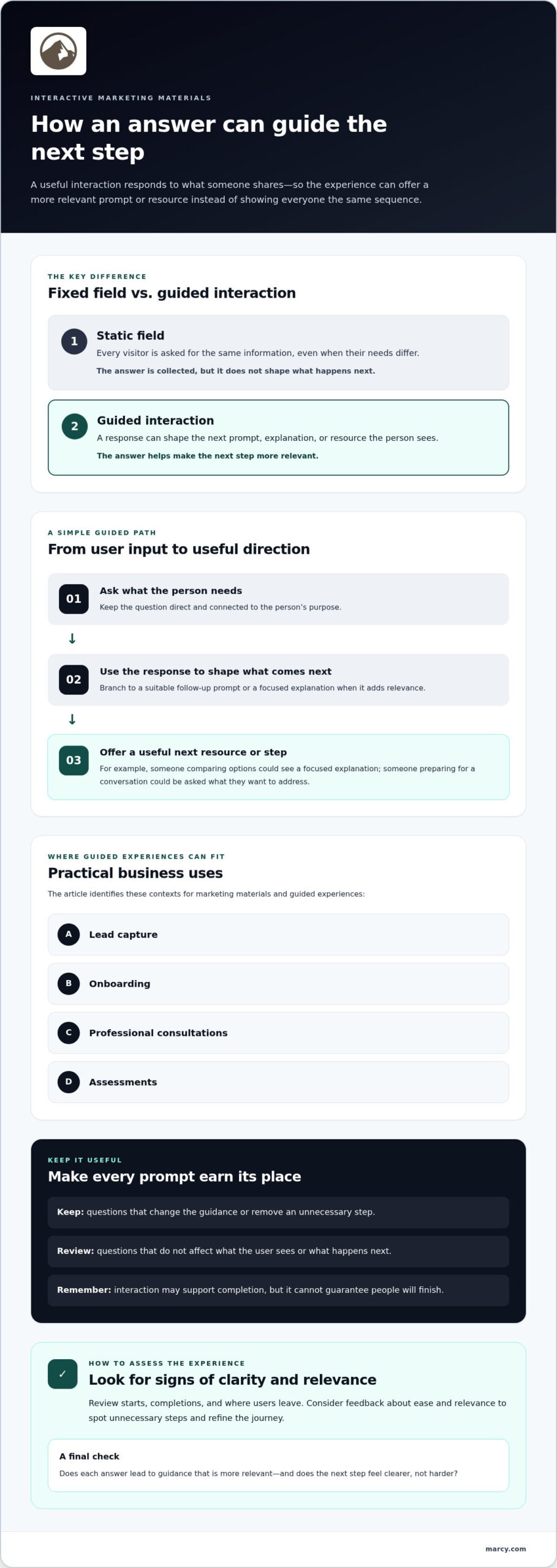
Interactive marketing materials respond to a person’s input or choices. Unlike a static field that simply collects an answer, an interactive prompt can use that answer to shape what the person sees next. This lets a business tailor guidance to what users say they need, rather than showing everyone the same sequence. As the American Marketing Association’s marketing insights emphasize, understanding the audience is central to effective marketing.
Participation should have a purpose. A question that leads to a more relevant explanation can make the experience feel engaging and help users move forward. Extra prompts that don’t change the guidance can do the opposite. Thoughtful interaction may support completion by removing irrelevant steps, but it can’t guarantee that people will finish.
Interactive elements versus static fields
A fixed form might ask every visitor for the same information, even when their needs differ. A guided sequence can first ask what someone hopes to accomplish, then show a suitable next prompt or resource. If a user wants to compare options, the experience might offer a focused explanation. If they’re preparing for a conversation, it can ask what they’d like to address.
Branching questions make this possible by adapting the next step to a person’s response. Use them only when they add relevance or remove friction. If an answer doesn’t affect what the user sees or what happens next, the question may be unnecessary.
Personalization without unnecessary complexity
Useful personalization responds to information people choose to share. A new customer, for example, might select the area they want to understand first and receive a relevant onboarding resource. Keep each prompt direct, explain its purpose when needed, and make the result feel helpful rather than like a sales tactic. A few meaningful choices can be more engaging than a long sequence of generic fields.
Interaction should make the next step clearer, not make the user work harder. To assess whether it does, review starts, completions, and where users leave, then consider feedback about ease and relevance. These signals can help teams identify unnecessary steps and refine the journey. Marcy Design connects digital marketing strategy with online experiences, helping keep the interactive path aligned with the campaign’s purpose.
Interactive or Static Marketing Materials: Which Format Fits?
Neither format wins by default. The right choice depends on the decision your audience faces, the information they need, and how much guidance will help them move forward. A concise overview may be ideal when people need a consistent message they can review at their own pace. A guided experience may suit a situation where their answers should shape what they see next.
Use this comparison to start:
| Format | Purpose | User effort | Adaptation |
|---|---|---|---|
| Static | Share a consistent message or reference | Read, scan, or review | Same content for each reader |
| Interactive | Guide a decision or gather input | Choose options or answer prompts | Next steps can reflect responses |
The comparison isn’t a verdict. It’s a way to connect a format to a task. A static asset can make a next step unmistakable, while an interactive experience can create needless work if it asks for input without offering useful guidance. Strong marketing materials are chosen for their role in the audience journey, not simply because one format feels more modern.
When static materials are the clearer choice
Choose static materials when the audience needs a focused overview, a message to revisit, or reference information that doesn’t depend on individual answers. A one-page service summary, campaign email, or event handout can present the same essential details to everyone. Keep the hierarchy clear: lead with the main point, organize supporting information, and make the appropriate next step easy to find.
Static doesn’t mean passive or unclear. A concise campaign email can explain an offer and feature one relevant link. A service overview can answer common questions before inviting readers to learn more. These formats work well when consistency and ease of review matter more than personalization.
When a guided interactive experience fits
Interactive formats make sense when a person’s choices should influence the guidance they receive. An assessment can ask about a user’s priorities and direct them to relevant information. A consultation pathway can help prospective clients identify the discussion they need before sending an inquiry. In each case, the exchange should give something useful back to the user.
Keep the experience focused. Use plain-language prompts, avoid asking for details that don’t support the goal, and make every step easy to follow on mobile as well as desktop. If the same result could be delivered in a clear paragraph or short form, added interaction may not be worthwhile. If input meaningfully changes the next recommendation, a guided path can be a better fit.
Before selecting a format, describe the audience’s decision in one sentence. Then ask whether the material needs to explain, remind, compare, or guide. That simple test helps teams choose high impact marketing materials for the task, while leaving room to combine static and interactive elements when each contributes a distinct benefit.
Build a Guided Marketing Experience Around Real Business Needs
A guided experience works best when it’s designed around a real task, not around the technology itself. Use this sequence to turn an audience need into a clear, useful journey:
- Define the audience. Identify who will use the experience and what they’re trying to accomplish.
- Choose the task. Decide whether the material should help someone make an inquiry, get oriented, prepare for a discussion, or understand their needs.
- Map the steps. Outline the shortest path from the starting point to a useful outcome, including where an answer should change what comes next.
- Create the content. Write direct prompts and explain why requested information is relevant.
- Review the journey. Check clarity, ease of use, accessibility, and whether each step supports the intended purpose.
Keep questions closely tied to what the person came to do. If someone wants information about a consultation, ask only for details that help frame that discussion. Avoid collecting unrelated information or making users repeat details they’ve already provided. This keeps the experience focused and respects the audience’s time.
Apply guided materials to common workflows
Different business tasks call for different journeys. A lead-capture experience can invite a brief description of someone’s needs before asking how to follow up. Onboarding can introduce new customers to the next relevant stage, rather than presenting every instruction at once. For a professional consultation, a few focused questions can help the person organize priorities. An assessment can use responses to direct users toward information that reflects their stated concerns. In each case, the answers should shape a useful next step, not create extra data collection for its own sake.
Review the experience before launch
Walk through the journey as if you were encountering it for the first time. Does each question make sense in context? Can users tell what to do next? Remove steps that don’t serve the goal, and check that instructions and response options use familiar, straightforward language.
Test the experience on a mobile device as well as a larger screen. Check that text is readable, controls are easy to use, and users can understand where they are in the process. Consider accessibility too: content should be understandable, and interactive controls should be usable by people with different needs and ways of navigating. Don’t rely on appearance alone to judge whether the experience works.
Before launch, decide what evidence will help you evaluate it. Depending on the purpose, that might include starts, completions, points where people leave, or whether the next step is relevant to their needs. Use what you learn to refine the journey instead of assuming it’s effective because it looks polished. That disciplined approach helps turn high impact marketing materials into a more thoughtful part of the customer experience.
Marcy Design connects strategic materials with broader marketing goals. Explore Marcy Design marketing services to see how that approach can support your audience journey.
Connect High-Impact Materials to a Cohesive Marketing Strategy
A marketing asset does its best work when it feels connected to the rest of the audience journey. A social post, campaign message, and landing page don’t need identical wording, but they should make the same promise and point toward a consistent next step. If a campaign invites people to explore a service, the destination should continue that conversation instead of introducing a different offer or unclear action.
This connection matters across channels. Social content can introduce an idea, campaign materials can reinforce it, and a website can provide the details or action people need. Digital marketing services can help connect campaign content with its online destination, keeping the message and audience journey aligned.
Keep the audience journey consistent across channels
Start with one core message and adapt its presentation to each channel. A social post may need a concise hook; a landing page can provide context and address questions. Keep the audience, offer, and intended action consistent, so each touchpoint feels like a natural continuation. Design choices should support that continuity, from familiar language to a clear visual relationship between campaign assets and the destination.
For example, if a campaign asks business owners to explore a service, its social content can introduce the need, while the landing experience explains the approach and makes the next step clear. A cohesive journey doesn’t mean repeating the same copy everywhere. It means honoring the same purpose at every point.
Turn the strategy into a practical creative brief
A clear brief gives creative decisions a business purpose. Before work begins, capture the essentials:
- Audience: Who needs this material, and what do they already understand?
- Goal: What should the material help them know or do?
- Message: What central idea should remain consistent across channels?
- Format and content: Which assets are needed, and what information or action belongs in each?
- Success measures: What evidence will show whether the materials supported their goal?
Use the brief to keep a project focused while leaving room for creative thinking. Agency collaboration can connect design decisions to campaign priorities, website destinations, and broader business objectives. Marcy Design is a Columbus-based creative agency that brings marketing materials and advertising campaigns together with web design and digital marketing capabilities. That integrated perspective can help teams plan assets as part of a coordinated effort, rather than as isolated pieces. Explore marketing materials and campaign support as part of that planning.
With a shared message, a well-matched destination, and clear measures, each asset has a defined role in the larger strategy. Ready to bring those pieces together? Discuss your marketing materials with Marcy Design.
Make Your Next Marketing Move Count
Your next opportunity may be a single touchpoint that’s almost working: a campaign message that needs a clearer destination, or a digital experience that could better support the audience’s decision. Choose one place to improve, make a focused change, and observe how people respond. Deliberate refinements can help your marketing evolve with what your audience actually needs.
Keep the goal practical. Give each asset a clear role, make its next step feel natural, and use what you learn to guide future creative decisions. That’s how high impact marketing materials become part of a stronger, more consistent connection with your audience, not just another item in a campaign.
For Columbus businesses ready to connect their marketing materials with a clear digital destination, discuss your marketing materials with Marcy Design.
Frequently Asked Questions
Are interactive marketing materials better than static ones?
Neither format is automatically better; the best fit depends on the audience’s task. A downloadable checklist can make a useful reference, while an online assessment may help someone sort through options by answering questions. Consider how the material will be used: Is the reader looking for information to revisit, or would their answers change the guidance they need? Choose the simplest format that supports that purpose, then check whether users can complete the intended task comfortably.
Can interactive materials help with lead capture?
Yes, a guided flow can make lead capture more relevant by letting people describe what they’re looking for before submitting an inquiry. For instance, a Columbus-area company could ask whether a visitor is exploring a service or preparing to discuss a specific project, then request only details useful for that follow-up. Make it clear why each field is included and what happens after submission. Track where people leave the form and review whether the inquiries fit its purpose.
How can marketing materials support customer onboarding?
Onboarding materials can orient customers by showing what to expect after they begin working with a business. A welcome page, for example, might point to the first useful resource, explain where updates will appear, and identify the next milestone in plain language. Keep reference details easy to return to, even if the main experience is guided. Ask a new customer to walk through the materials and note any point where they’re unsure what to do.
What should a marketing materials brief include?
A practical brief should identify the intended audience, business objective, central message, desired response, channels, and required content. Add any context that affects the work, such as audience concerns or existing campaign language. For a consultation flow, specify what information the team needs to prepare a useful conversation and what users should understand before they submit. Agree on how the work will be reviewed, so feedback can focus on the brief’s goals rather than personal design preferences.
How do you measure whether marketing materials are working?
Choose measures that reflect the specific job of each asset. For an awareness campaign, review whether people engage with the content or visit its destination; for an inquiry form, examine completed submissions and their relevance. A step-by-step experience may also be reviewed for where users pause or exit. Pair these signals with direct feedback, since numbers alone don’t explain confusion or motivation. Use the findings to decide what to retain, clarify, or test next.