
 614.224.6226
What if the clearest sign of a trustworthy marketing agency isn’t a bold promise, but a plan you can understand? If “marketing agency I can trust Columbus” is the question behind your search, it’s reasonable to want more than a polished pitch. You need to know who will do the work, how progress will be shared, and whether the activity connects to your business goals.
A strong fit starts with clarity. The agency should ask thoughtful questions about your business, explain how its capabilities relate to your needs, and make the working relationship easy to understand before you commit. Use this guide to prepare for agency conversations and compare your options.
You’ll find practical ways to assess an agency’s transparency, people, process, reporting, and fit. Use the questions and comparison points to make discussions more productive and decide on a clear next step with confidence.
Key Takeaways
- Look for a marketing agency I can trust Columbus businesses can assess through clear discovery, relevant expertise, open communication, and defined measurement.
- Evaluate how an agency moves from planning to review and refinement, not just the finished work in its portfolio.
- Compare agencies on experience, scope, communication, measurement, and ownership to make proposals easier to judge.
- Define your essential services first, then use the same questions and criteria to compare potential partners.
- Consider Marcy Design’s Columbus roots and range of capabilities as points to explore when assessing fit, not as a promise of results.
How to Recognize a Marketing Agency You Can Trust in Columbus
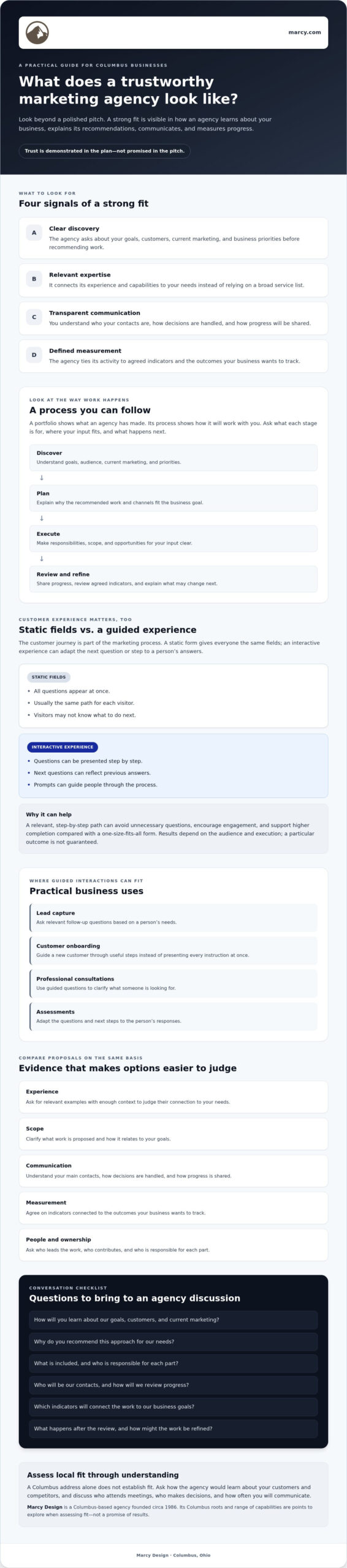
Choosing a marketing partner is a significant decision. Look beyond the pitch: trust should show up in how an agency learns about your business, explains its recommendations, and follows through. If you’re searching for a marketing agency I can trust Columbus, look for evidence in four areas:
- Clear discovery: The agency asks about your goals, customers, current marketing, and business priorities before recommending work.
- Relevant expertise: It explains how its experience and capabilities relate to your needs, rather than relying on a broad list of services.
- Transparent communication: You know who your main contacts are, how decisions are handled, and how progress will be shared.
- Defined measurement: The agency connects its activity to agreed indicators, such as the outcomes your business wants to track.
A service list tells you what an agency may do, not whether it understands your situation or can work effectively with your team. Confident sales language isn’t a plan, either. Before comparing proposals, it can help to understand digital marketing and the range of channels and planning involved. Then ask why the agency recommends a particular approach for your goals.
What should a trustworthy agency explain before work begins?
Expect a useful conversation about goals, audience, scope, responsibilities, and communication. When an agency asks who your customers are, what you want them to do, and what has or hasn’t worked, it is checking its understanding rather than simply filling time. Ask what happens next, who is responsible for each part, and how you’ll review progress. A documented next step is more useful than a general promise of growth.
How can Columbus businesses check local fit?
Local fit is about understanding, not simply having a Columbus address. Ask how the agency would learn about your customers and competitors, and request relevant examples with enough context to judge their connection to your needs. Discuss practical expectations, too: who attends meetings, who makes decisions, and how often you’ll communicate. Marcy Design is a Columbus-based agency founded circa 1986. Its Columbus marketing services page is one place to explore its stated capabilities. Use that information as a starting point, then assess whether the proposed people and process suit your business.
Evaluate an Agency’s Marketing Process, Not Just Its Portfolio
A portfolio shows what an agency has made. Its process shows how it will work with you. Ask how a project moves from discovery and planning to execution, review, and refinement. Each stage should have a purpose, a point for your input, and a clear next step.
Look for a plan that connects business goals to the proposed work. If you want to attract qualified enquiries, ask how the recommended channels and customer experience support that aim, and how progress will be reviewed. You can explore whether an agency’s digital marketing services align with your needs, then ask how they would support your specific objectives.
The process also shapes the experience customers have with your business. A static form presents the same fields to everyone. An interactive experience can adapt questions or next steps to a person’s answers, making the path more relevant. By avoiding unnecessary questions and guiding people one step at a time, it may encourage engagement and support higher completion compared with a one-size-fits-all form. Results depend on the audience and execution.
| Consideration | Static fields | Interactive experience |
|---|---|---|
| Effort | All questions appear at once. | Questions can be presented step by step. |
| Personalization | Usually the same path for each visitor. | Next questions can reflect previous answers. |
| Feedback | Visitors may not know what to do next. | Prompts can guide people through the process. |
When do interactive experiences add value over static forms?
They’re useful when the next step depends on what someone tells you. Lead capture can ask relevant follow-up questions based on a person’s needs. Onboarding can guide a new customer through useful steps instead of displaying every instruction at once. A consultation request or assessment can use guided questions to clarify what someone is looking for. These approaches may make the experience more engaging and support completion, but they don’t guarantee a particular outcome.
What does transparent collaboration look like?
Ask who leads the work, who provides input, and how feedback is handled. Agree on a communication rhythm and request progress updates in plain language. A useful distinction: Activity reporting shows what was done; goal-related reporting explains what it means for the business. For a broader perspective on evaluating an agency’s business strategy, consider whether its approach supports an ongoing client partnership, not just a polished presentation.
Compare Columbus Marketing Agencies Using Evidence and Clear Criteria
A fair comparison starts with the same questions for every agency. Use the criteria below to look past presentation style and judge whether each partner can explain its fit, responsibilities, and approach. If you’re looking for a marketing agency I can trust Columbus, ask for evidence you can understand and verify, not just confident claims.
| Criterion | What to look for | Question to ask |
|---|---|---|
| Relevant experience | Examples that resemble your audience, challenge, or project type, with business context. | What was the client trying to achieve, and what role did your team play? |
| Scope | A clear description of included work, responsibilities, and what falls outside the proposed project. | What will your team deliver, and what will you need from us? |
| Communication | Named points of contact, agreed ways to share updates, and a clear feedback path. | Who leads the work, and how will questions and decisions be handled? |
| Measurement | Measures connected to the goals you agree on, explained in plain language. | How will we know whether the work is moving toward our objectives? |
| Ownership | Clarity about who controls accounts, assets, and approvals during and after the engagement. | What access and materials will our team retain? |
Which questions reveal whether an agency understands your goals?
Ask how discovery will connect customer needs to channel and experience choices. If your challenge is improving the quality of enquiries, invite the agency to explain how it would investigate the audience, identify relevant touchpoints, and decide what to test. The answer should show its reasoning, not force your situation into a predetermined package. Thoughtful follow-up questions can also show whether the agency is listening.
Before approaching agencies, clarify what your business is aiming for. The Small Business Administration offers guidance to develop a comprehensive business and marketing plan, including market analysis and marketing strategy. A clear business goal makes it easier to judge whether a proposed approach fits.
How should you assess claims, case studies, and reporting?
Ask whether an example can be attributed to a client and discussed with permission. Then clarify the agency’s role, the work involved, the goal, and what the reported results actually measure. Attractive visuals can demonstrate craft, but without context they don’t show whether the work addressed a business need similar to yours. Look for a clear explanation of how the evidence relates to the proposed work.
Ask follow-up questions if you hear unsupported guarantees, unexplained metrics, or vague statements about ownership. If campaign planning is part of your scope, review the agency’s marketing and advertising capabilities as one starting point for a fit discussion. Compare the stated capabilities with your criteria, then ask how the proposed work would support your goals.
Use This Step-by-Step Checklist Before Choosing a Columbus Agency
A consistent process makes it easier to compare agencies on fit, not presentation. Before you approach a marketing agency I can trust Columbus, separate essential services from optional capabilities. For example, decide whether you need advertising campaigns now or whether website design is central to the project. This keeps proposals focused on your priorities.
- Define your needs. Write down your business goal, audience, current challenge, essential services, and what success would mean internally.
- Shortlist agencies. Look for relevant capabilities and experience, then consider whether each agency’s working approach seems compatible with your team.
- Ask consistent questions. Give each agency the same brief and ask who will lead the work, how recommendations are developed, and how progress will be discussed.
- Compare proposals. Review scope, deliverables, responsibilities, communication expectations, and how measurement connects to your goals.
- Confirm the fit. Clarify assumptions, dependencies, decision-makers, and next steps before agreeing to proceed.
How do you prepare for an agency consultation?
Bring your goals, audience context, current challenges, and existing marketing materials. Identify who will make decisions and what a successful outcome would look like for your business. Ask how the consultation will turn those details into a practical scope. A useful discussion should help both sides identify what needs to be done, what information is still needed, and which capabilities are relevant. Not every possible service needs to be part of the project.
What belongs in a fair agency comparison?
Compare proposals against the same needs and requested deliverables. Check what each agency assumes your team will provide, who approves the work, and what could affect timing or scope. Communication expectations and progress measures should be clear, too. If one proposal includes optional capabilities and another doesn’t, separate those from the essentials before judging the overall fit.
If a website is central to your project, examine the proposed work in that context. Marcy Design’s web design Columbus Ohio overview can help you explore its stated capabilities as you prepare questions about your website needs. Compare the agency’s explanation with your brief: does it address your audience, required functionality, and business priorities, or only the visual direction?
Before deciding, read each proposal once for the big picture and again for specifics. If responsibilities, measurement, or next steps remain unclear, ask for clarification. A good comparison should leave you with a practical understanding of what you’re choosing and why.
Explore a Columbus Agency Partnership That Fits Your Goals
A sound agency choice comes down to more than location or a long service list. Look for a partner whose capabilities match your priorities, whose process is clear, and whose team can explain how you’ll work together and assess progress. That’s how to evaluate a marketing agency I can trust Columbus businesses can consider, without treating an agency’s history or promises as proof of future results.
Marcy Design is an independent Columbus-based agency founded circa 1986. Its service range includes website design and ecommerce solutions, advertising campaigns, marketing materials, social media management, and AI-powered solutions. These are distinct capabilities, not a checklist every business needs. Start with the challenge you’re trying to solve, then explore the service information most relevant to that goal. If AI is part of your plans, review Marcy Design’s AI-powered digital marketing solutions and ask how the capability might fit your needs.
Which Marcy Design services may match your needs?
If your priority is an online store or website, focus your questions on website design and ecommerce. If you’re planning a campaign, ask about advertising; if you need materials to communicate your offer, explore marketing materials. Social media management and AI-powered solutions may be relevant to other goals. Choose only the capabilities that connect to your priorities, and ask how any proposed work would be scoped and assessed.
What should happen in your first conversation?
Bring your goals, audience, current challenges, and project priorities. Explain what you’ve tried and what you need to decide next. A productive first discussion should help both sides assess fit and clarify possible next steps, not steer you toward a predetermined solution. Ask what information the agency still needs, who would be involved, and how recommendations would relate to your objectives.
A first conversation can help you understand the proposed approach, identify any gaps, and decide whether the partnership makes sense for your goals. It doesn’t need to commit you to a particular service or solution.
Choose Your Next Marketing Partner with Confidence
A trustworthy agency makes its value visible before the work begins. Look for clear discovery, a process you understand, evidence relevant to your needs, and communication that connects progress to agreed goals. When comparing proposals, focus on scope and responsibilities, not just presentation or promises.
The right fit also depends on your business priorities. Marcy Design is a Columbus-based agency founded circa 1986, with capabilities across web development, ecommerce, advertising, and digital marketing. Its local presence and service range are useful starting points for a conversation, not guarantees of a particular outcome.
If you’re still asking, “Is this the marketing agency I can trust Columbus?”, bring your goals, audience, and current challenges to the discussion. Ask how the agency would approach your needs, what the next steps could be, and how you’ll evaluate fit together.
Start a conversation with Marcy Design to discuss your business priorities and explore whether its capabilities align. Bring clear questions so you can assess the proposed approach and decide whether it suits your goals.
Frequently Asked Questions
How can I tell if a marketing agency is trustworthy?
A trustworthy agency makes its process and responsibilities clear before work begins. Notice whether it asks about your goals, audience, current challenges, and desired outcomes before recommending services. Ask who will lead the work, how you’ll receive updates, and what the agency will measure. Relevant examples should include enough context to understand the agency’s role. Vague promises, unexplained metrics, or unclear ownership are reasons to ask more questions.
What should I ask a marketing agency before hiring it?
Ask how the agency would approach your specific business challenge, who will do the work, and what it needs from your team. Clarify what’s included in the proposed scope, how feedback and decisions will be handled, and how progress will be reported. Ask how the agency connects its recommendations to your business goals. These questions help you understand the working relationship before committing, rather than relying on a polished presentation or broad promises.
How do I compare marketing agencies in Columbus?
Give each Columbus agency the same brief and compare its relevant experience, proposed scope, communication, measurement, and responsibilities. Look for examples that relate to your audience or challenge, and ask what the agency contributed and what the results mean. A visually impressive portfolio isn’t enough without business context. Compare how each agency explains its recommendations and next steps, then decide which approach best fits your goals and the way your team works.
Should I choose a full-service marketing agency or a specialist?
Choose based on the capabilities your business needs, not the size of an agency’s service list. A specialist may suit a focused project that calls for one particular capability. An agency with a broader range may be worth considering if your needs span areas such as website design, ecommerce, advertising campaigns, marketing materials, and social media management. Confirm which services are genuinely relevant, who will handle them, and how the work will be coordinated.
Are interactive marketing experiences better than static forms?
Interactive experiences can be more useful when questions or guidance should adapt to a person’s answers, but they aren’t automatically better for every task. A static form may work for a straightforward enquiry. A guided lead-capture experience, onboarding flow, consultation request, or assessment can present relevant questions step by step, helping users understand what to do next. Consider your audience, the effort required, and whether personalization supports engagement and completion without adding unnecessary complexity.
What should a marketing agency proposal include?
A clear proposal should describe the goals it addresses, the scope of work, expected deliverables, responsibilities on both sides, communication expectations, and how progress will be measured. Check assumptions and dependencies, such as materials or decisions your team must provide. Ask the agency to explain unfamiliar metrics and how they relate to your agreed objectives. If optional services appear, distinguish them from essential work so you can compare proposals on a consistent basis.
How do I know whether a marketing agency is right for my Columbus business?
The right agency understands your priorities, can explain its recommendations, and sets expectations your team can work with. In conversations, share your goals, audience, challenges, and decision-making needs. Then assess whether the agency listens, asks useful follow-up questions, and describes clear next steps. For a local option, Marcy Design is a Columbus-based agency founded circa 1986, with capabilities across web development, ecommerce, advertising, and digital marketing. Treat that as a starting point for assessing fit, not a guarantee of results.