
 614.224.6226
Ecommerce SEO is the work of making your store easy for Google to understand and easy for shoppers to find, so product and category pages earn organic traffic without paying for every click. It rests on three things: a site structure search engines can follow, product and category pages that answer what shoppers type, and a platform fast and clean enough to keep both happy. Those three are built into a store, not bolted on afterward, which is why a store designed and developed with search in mind has a head start over one that is patched later.
This guide walks through each piece in the order we would tackle it for a small business or manufacturer, and ends with how to measure results and where abandoned cart recovery fits.
TL;DR
- Ecommerce SEO means optimizing product pages, category pages, site structure and content so high-intent shoppers find you without ads, per Search Engine Land.
- Structure comes first: menus lead to categories, categories to subcategories, subcategories to products, all with plain HTML links.
- Every product page needs original copy, descriptive URLs and Product structured data that matches what shoppers see.
- Measure organic revenue and conversion rate, not just rankings, using Google Analytics 4 and Search Console together.
- Abandoned cart recovery is a separate email discipline. It lifts sales from visitors SEO already brought in.
Table of Contents
- What ecommerce SEO covers
- Start with site structure
- Product page SEO and optimization
- Category page SEO
- Ecommerce keywords: match intent, not just volume
- Technical basics that protect everything else
- Measuring ecommerce SEO
- Abandoned cart recovery: a separate job
- Our perspective
- Let Marcy build a store that searches well
- FAQ
- Sources
What ecommerce SEO covers
Google describes its ecommerce best practices as sharing your product data and site structure so Google can find and parse your products and show them in Search and other Google surfaces. That is the technical core. The commercial point is simple: someone searching for a specific product is close to buying, and a well-built page puts you in front of them at that moment.
It helps to split the work into three areas:
- On-page: titles, headings, descriptions, image alt text and product copy.
- Technical: speed, mobile usability, URL structure, and whether Google can crawl and index your pages.
- Off-page: links from other sites and brand mentions that signal authority.
A store that is strong on one and weak on the others stalls. Beautiful product copy on a page Google cannot reach earns nothing.
Start with site structure
Structure is where most small stores lose ground, and it is the hardest thing to fix after launch.
Google recommends linking from menus to category pages, from category pages to subcategories, and from subcategories to products, using HTML links. The same page notes that Googlebot generally does not type into your site search box. A product that can only be found by searching your own store may never be discovered. If some products cannot be reached through navigation, a sitemap or a Google Merchant Center feed fills the gap.
Three practical rules follow:
- Keep it shallow. Important categories and best sellers should sit within a few clicks of the homepage.
- Use descriptive URLs. Google’s URL guidance for ecommerce prefers words in the path, such as a product name, over an opaque ID number. It also asks you to limit alternative URLs that return the same content and to avoid session IDs and tracking codes in URLs.
- Plan filters deliberately. Color, size and sort options can multiply URLs that show nearly identical content. Decide which filtered views deserve to be indexed and which should point back to the main category page.
If you sell wholesale or to other businesses, the same logic applies with extra layers such as account-specific catalogs. Our guide to B2B ecommerce features that matter for manufacturers covers how those requirements shape the build.
Product page SEO and optimization
Product pages are where the sale happens, so they deserve the most careful work. A solid product page does the following.
Titles, headings and copy
Search Engine Land advises product titles that echo the way customers talk, a meta description that gives a reason to click, and one clear H1 with organized subheadings. Write the copy yourself. Manufacturer descriptions are copied across hundreds of stores, so they give Google no reason to rank yours. Describe who the product is for, what it does, the specifications buyers compare, and the questions customers ask before ordering. Reviews and short FAQs on the page add useful, original content.
Images
Show the product in use, not just on white. Give each image a descriptive file name and alt text that says what is in it, in plain language. Compress images so they do not slow the page down.
Structured data
Structured data is code that labels the facts on a page for search engines. Google’s Product structured data documentation explains that it lets price, availability, review ratings and shipping information appear in richer search results. It describes two markup types: product snippets for pages that do not sell directly, and merchant listings for pages where shoppers can buy. The markup must match what a visitor actually sees on the page. Google also recommends marking up your return policy at the organization level.
Internal links and out-of-stock items
Link to each product from its category and from relevant blog posts or buying guides. When an item is temporarily out of stock, keeping the page live and clearly marked is usually better than deleting it, because you keep the page’s history and can offer a restock notice instead of losing the visit.
A quick product page checklist
| Element | What to do |
|---|---|
| URL | Short, descriptive words, no session or tracking parameters |
| Title and H1 | Customer language, one H1 per page |
| Description | Original copy covering use, specs and fit |
| Images | Product in use, descriptive alt text, compressed |
| Structured data | Price, currency, availability, reviews, matching the visible page |
| Internal links | From the category, related products and relevant articles |
If you are choosing between a product page and an article for a keyword, look at what Google already ranks. Kyle Risley of Shopify suggests that mostly product pages in the results means a product page fits, while guides and articles mean shoppers are still learning and a blog post fits better.
Category page SEO
Category pages usually target broader, higher-volume searches than single products, so they often bring the most organic traffic. Treat each as a landing page, not a list of thumbnails:
- Name the category the way shoppers search for it.
- Add a short introduction at the top or a descriptive block below the products that explains how to choose between them.
- Link to the most important subcategories and best sellers.
- Keep the URL stable. Changing category URLs without redirects throws away the ranking you earned.
We pair this with a keyword map: one primary phrase per category and product, so your own pages do not compete against each other.
Ecommerce keywords: match intent, not just volume
Good ecommerce keyword research starts from how people buy. Shoppers move from broad terms (a product type) to narrower ones (a specific material, size or use) to brand and model searches. The narrow terms have lower volume but convert better, which is where a small store can win against larger retailers.
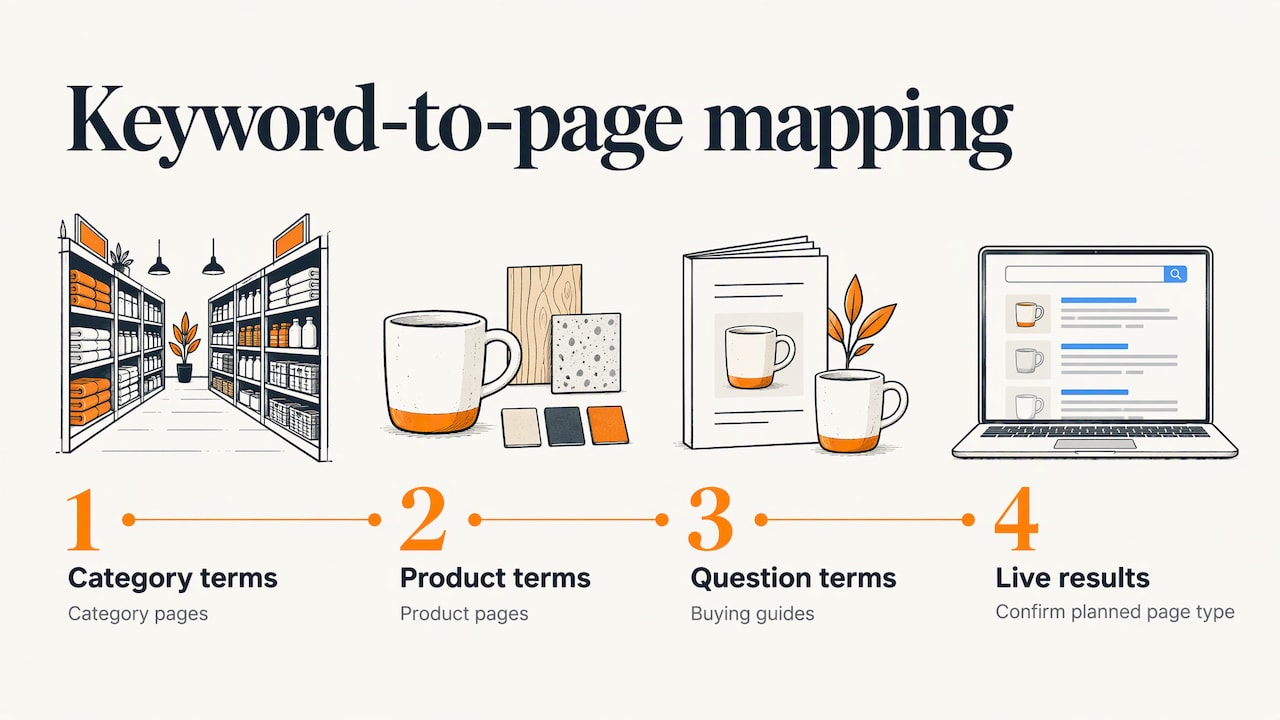
Build your list in layers: category terms for category pages, specific product and attribute terms for product pages, and question-style terms for buying guides. Then check the live results for each. If the page that ranks is a different kind of page than the one you plan to build, rethink the target.
Technical basics that protect everything else
Technical problems quietly cap the value of good content. The essentials:
- Crawlability and indexing. Submit an XML sitemap in Google Search Console and make sure your robots.txt file is not blocking product or category pages. Keep cart, checkout and login pages out of the index.
- Canonical tags. These tell Google which version of a page is the main one when several URLs show the same product.
- HTTPS and mobile. The whole store should be secure and comfortable on a phone.
- Consistent data. Prices and availability should match across your site, your Merchant Center feed and any marketplace listings.
- Speed and Core Web Vitals. Core Web Vitals are Google’s measures of loading, responsiveness and visual stability. Heavy images, scripts and apps are the usual culprits. See our guides on improving ecommerce site speed without hurting the shopping experience and Core Web Vitals optimization.
- Accessibility. Clear headings, alt text and keyboard-friendly navigation help shoppers and search engines alike. More on that in our web accessibility service.
On a platform like Shopify, many of these are handled by themes and settings, but themes and installed apps still affect speed and duplicate URLs. The same audit applies to any platform: compare the pages you publish, the pages a crawler can reach and the pages Google has indexed, and investigate every gap.
Your own site search matters too. Shoppers who use it convert at a high rate when it works well, and the queries they type show you what your catalog is missing. We cover this in site search for ecommerce.
Measuring ecommerce SEO
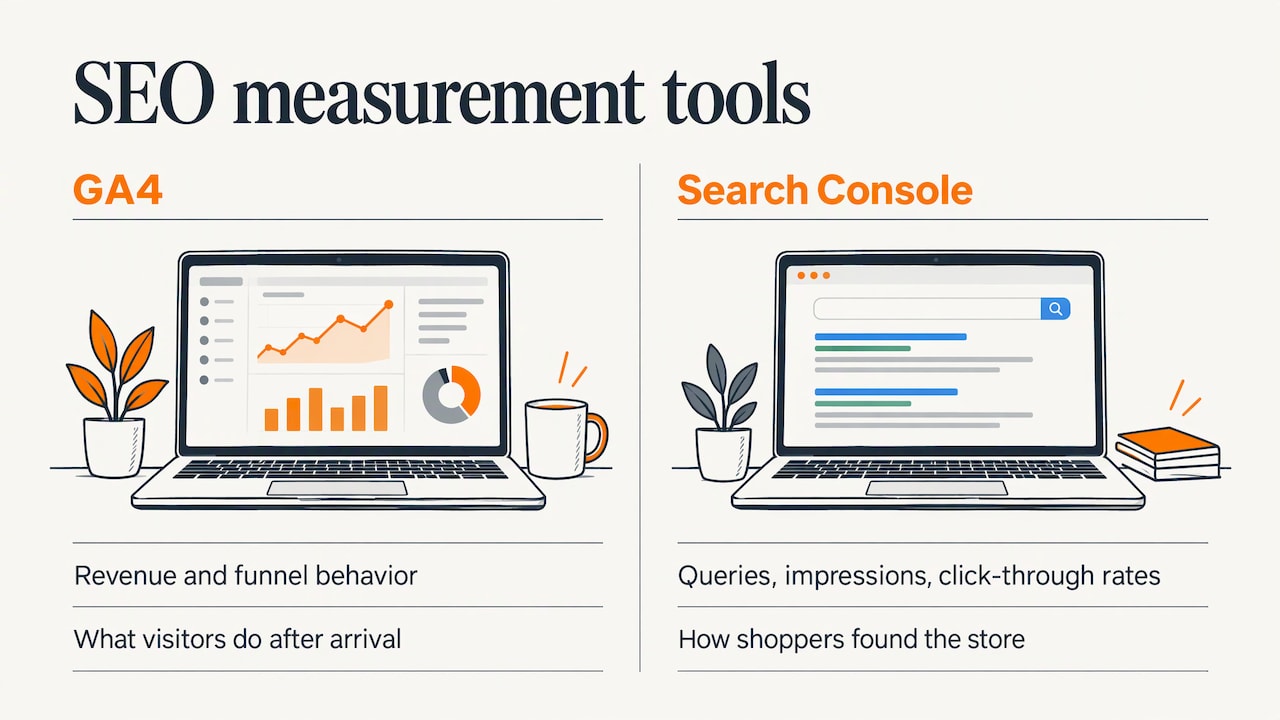
Rankings alone do not pay the bills. Track organic sessions, revenue from organic search and conversion rate. Search Engine Land recommends using Google Analytics 4 for revenue and funnel behavior and Search Console for queries, impressions and click-through rates. One shows what visitors do after they arrive, the other shows how they got there.
Google’s Search Console documentation says the Search performance report shows trends in impressions and clicks, and you can use it to debug a traffic drop. Look at category pages, product pages and blog content separately, because they behave differently.
Expect attribution to be messy. Customers often search first and buy later through another channel, so count assisted conversions as well as last-click sales, and judge SEO over months, not days.
Abandoned cart recovery: a separate job
Abandoned cart recovery is not SEO. SEO brings shoppers to the store. Recovery emails win back some of those who left without paying, so the two work best together.
eMarketer’s November 2026 report says 39% of US shoppers abandon carts because of second thoughts or unexpected shipping costs, fees or taxes, and 33% use carts as temporary wishlists. Its advice is to tailor reminders to the shopper’s stage and barrier and to manage frequency rather than send blanket nudges.
Practical steps:
- Remove the cause first. Show shipping costs and taxes early. This reduces abandonment before any email is needed.
- Send a timely reminder. A short, useful message soon after the cart is left works better than one that arrives days later.
- Vary the message. Someone parking items for later needs a different note than someone who balked at shipping.
- Limit the series. Watch unsubscribes and cut the number of messages if they rise.
Our email marketing service covers automated campaigns like these.
Our perspective
Most ecommerce SEO problems we see start at the build, not the content. A store designed around how people browse and search is far easier to rank than one where search was an afterthought.
That is why we treat SEO, design and development as one project. Navigation, URLs, templates and page speed decide what Google can understand and what shoppers will tolerate. Product copy and keywords then have something solid to stand on.
After 38 years in business, one lesson holds: tailored beats generic. A manufacturer with thousands of parts, a nonprofit with a small shop and a local retailer each need a different structure, and a template rarely fits any of them.
Measure what matters: organic revenue and qualified leads, not vanity rankings. That is how we judge our own work.
Greg
Let Marcy build a store that searches well
Marcy Design is a Columbus, Ohio agency with more than 38 years in business and over 230 awards. We design and build custom ecommerce web applications and offer SEO solutions, so structure, speed and search visibility are planned together from the first sketch. Whether you are launching a new store or fixing one that is not getting found, tell us about your project and we will respond with a plan.

You can start with our project intake form, or read our custom ecommerce guide for small business first.
FAQ
What is the first thing to fix in ecommerce SEO?
Fix structure and indexing first. Make sure every product you want to sell is reachable through category navigation and appears in your sitemap. Then work on product and category page content. Better copy on pages Google cannot reach does nothing.
How long does ecommerce SEO take to show results?
Expect months, not days. Google has to crawl and reassess your pages, and new content takes time to earn rankings. Track organic revenue and impressions in Search Console and Analytics so you can see progress before sales move.
Do small stores need structured data?
Yes. Product structured data lets Google show price, availability and ratings alongside your listing, and it must match what shoppers see on the page. It is one of the most direct ways to make a product page easier for Google to read.
Is abandoned cart recovery part of SEO?
No. It is an email and remarketing practice that follows up with shoppers who already visited. It complements SEO by recovering some of the sales that organic traffic did not close, and it works best when shipping costs and taxes are clear early.
Does the platform matter for ecommerce SEO?
It matters for how much control you have over URLs, templates, speed and markup. A custom build gives the most freedom to shape those details around your catalog and your customers.
Sources
- SEO Best Practices for Ecommerce Sites, Google Search Central
- Ecommerce Website Navigation Structure, Google Search Central
- Ecommerce URL Structure Best Practices, Google Search Central
- Intro to Product Structured Data, Google Search Central
- How To Use Search Console, Google Search Central
- Ecommerce SEO: Boost Rankings & Drive More Sales, Search Engine Land
- Abandoned carts offer retailers a second chance, eMarketer