
 614.224.6226
A brand positioning statement is a short internal sentence or two that says who your customer is, what category you compete in, what you do better than the alternatives, and why anyone should believe it. It is not a tagline and it is not copy for your website. It is the decision tool behind your website, your ads and your sales conversations. If you can write it in plain words and your team agrees it is true, every later marketing choice gets easier.
This guide gives you the definition, the parts, two templates, a worked example for a Columbus manufacturer, and a way to test the result. Branding is core to what we do at Marcy Design, and we have been doing it for more than 38 years, so we have written this the way we would walk a client through it.
TL;DR
- A positioning statement is an internal document. It guides your messaging but is rarely published word for word.
- Every strong statement has four jobs: name the target customer, the category you compete in, the difference that matters, and the proof.
- Pick one customer group and one difference. A statement that tries to serve everyone says nothing.
- Test it on outsiders: if they can’t repeat it, it isn’t clear, and if they don’t believe it, it isn’t credible.
- Swap a competitor’s name into your statement. If it still reads true, keep working.
Table of Contents
- What a brand positioning statement is, and what it is for
- The four parts every statement needs
- Two templates you can fill in
- How to write yours, step by step
- A worked example: a Columbus-area manufacturer
- How to tell whether your statement is any good
- Positioning statement, value proposition, mission: which is which
- Our perspective
- Putting your statement to work
- FAQ
- Sources
What a brand positioning statement is, and what it is for
Harvard Business School Online describes positioning as claiming “mental real estate” in your customers’ minds. The statement itself is not public-facing. Think of it as the North Star that guides the messages you do put in front of customers.
That internal role matters. The statement is written for the people who make marketing decisions: the owner, the sales team, the designer, the writer, the agency. According to a Harvard Business Publishing core reading by Jill Avery, positioning statements are strategic documents for an internal managerial audience, unlike slogans. The same reading notes that in most categories customers face a flood of look-alike options, and positioning is what keeps a brand from getting lost among them.
In practice, a good statement settles arguments before they start. Should the homepage lead with price or with expertise? Should the trade-show booth show products or results? Should the next ad go to purchasing managers or to owners? If the answer is in the statement, nobody has to guess.
The four parts every statement needs
A textbook excerpt from Wiley’s Thinking Strategically about Your Brand says a formal statement includes four elements: target, frame of reference, point of difference and reason to believe. In plain terms:
- Target. The specific customer you are built for, and the situation they are in. “Small businesses” is too broad. “Machine shops with 20 to 200 employees that still quote by phone” is a target.
- Frame of reference. The category you want to be compared within. This tells the customer what kind of thing you are, and therefore which alternatives you are being weighed against.
- Point of difference. The one benefit that matters to the target and that competitors don’t offer, or don’t offer as well.
- Reason to believe. The proof: a result, a process, a credential, years in business, customer outcomes.
The Avery reading arrives at the same structure with different labels: for whom, what value, why and how (the evidence), and relative to whom (the competitive set). Different sources use different names, but the logic is the same. Skip any one part and the statement becomes a wish rather than a position.
Two templates you can fill in
HBS Online offers this template, built on a simpler value-proposition line:
For [target market], our brand is the only one among all [competitive set] that [unique value claim] because [reasons to believe].
Its earlier building block is: “We help [target audience] do [customer need] by [brand attribute].” Start with that shorter line if the full template feels like too much.
The Wiley excerpt shows the same structure in practice, with Apple’s statement: for consumers who want to feel empowered by the technology they use regardless of skill, Apple offers devices that make you feel smarter because they combine leading-edge technology with an intuitive feel. It also gives Miller Lite’s: for 21-to-34-year-old males with blue-collar occupations, Lite is the great-tasting beer that lets you drink more without feeling filled up because it has fewer calories than regular beer. Both name a target, a category, a difference and a reason. Both also match the benefit to something the customer actually wants.
For most business-to-business companies, a plainer version works:
For [specific buyer] who [specific problem], [company] is the [category] that [main benefit]. Unlike [typical alternative], we [difference], because [proof].
How to write yours, step by step
The HBS Online guide frames the process in five steps: define your audience, understand your competition, articulate your differentiators and reason to believe, craft the statement, and sharpen it against real-world examples. Here is how that plays out for a small business or a manufacturer, with the places it usually goes wrong.
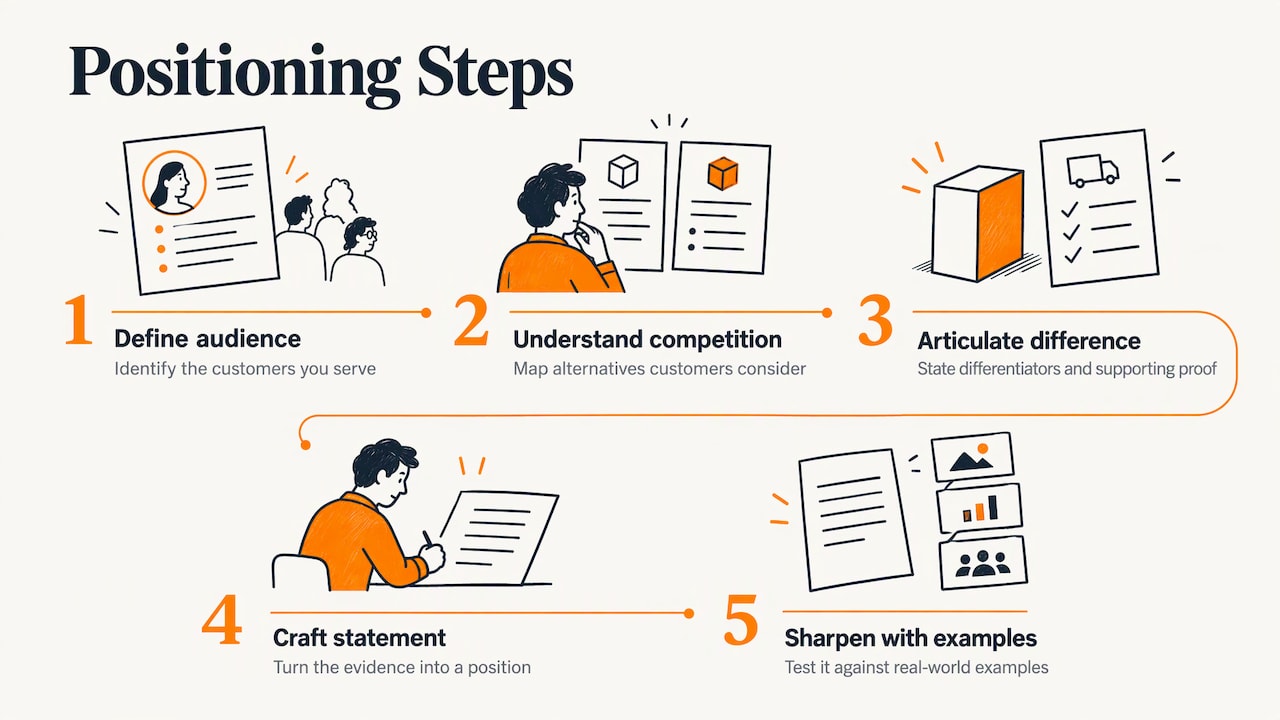
Step 1: Choose one customer
List your last ten best customers: the ones who paid on time, referred others and were pleasant to work with. Look for what they share. It might be industry, size, the problem that brought them to you, or the moment they called. Write the target as that pattern.
Where it goes wrong: owners name every group they would happily serve. The result is a statement that fits everyone and persuades no one. If you honestly serve two very different buyers, write two statements. Branding is a lot easier to evaluate when you are not trying to serve everyone at once, and it is a conversation we have with clients regularly in our branding work.
Step 2: Name the real alternatives
Your competition is not only the company down the road. It is also the customer’s current habit: doing it in-house, using a spreadsheet, buying from the incumbent supplier, or doing nothing. Write down what your target would do if you did not exist. That list is your frame of reference.
Where it goes wrong: picking a flattering category. Calling yourself “a full-service solutions provider” tells nobody what you are. Choose the category your buyer would type into a search box.
Step 3: Find one difference you can prove
Compare yourself to the alternatives from step 2 and look for the point where you are clearly better on something your target cares about. It might be speed, specialization, quality, risk reduction or experience. Pick one. Then find the proof: a number, a certification, a track record, a named result.
Where it goes wrong: listing three differences because all three feel true. A statement carries one idea well. The rest belong in sales conversations and on service pages.
Step 4: Write it, then cut it
Fill in the template. Read it aloud. Then cut every adjective that a competitor could also use: “innovative,” “quality,” “customer-focused,” “solutions.” What remains should sound like something a person would actually say.
Step 5: Test it before you build on it
See the testing section below. A statement that has not been tested is a draft, and drafts get expensive when they are printed on trucks, trade-show banners and a new website.
A worked example: a Columbus-area manufacturer
The following is an illustration we wrote to show the method, not a real company’s statement.
Imagine a custom metal-fabrication shop in central Ohio. Its owner first writes: “We provide high-quality, customer-focused fabrication solutions for all industries.” Every competitor could say the same, and none of it can be checked.
Then the owner works through the steps. The best customers are equipment makers who need small production runs of welded assemblies and have been burned by overseas suppliers missing deadlines. The alternatives are large contract shops that prioritize big orders and offshore vendors. The shop’s provable difference is that it quotes within one business day and has shipped on time on nearly every order for several years (a figure the owner would pull from real records).
The statement becomes:
For equipment manufacturers that need short runs of welded assemblies on a firm schedule, [Shop] is the Ohio fabricator that quotes in one business day and ships on the date promised. Unlike large contract shops that push small orders to the back of the line, we treat a 50-piece run as a priority, because on-time delivery records back it up.
Notice what changed. The target is specific. The category is concrete. The difference is something a buyer cares about, and the proof is something the shop can show. This also tells the web designer what to put on the homepage, tells the sales team what to lead with and tells the owner which trade shows are worth the booth fee.
How to tell whether your statement is any good
The Wiley excerpt recommends showing the statement to people outside the company and asking when they would use the brand, why it is better and whether they believe the claims. If they can’t grasp it, it lacks clarity. If they don’t believe it, it lacks credibility. Three quick tests put that into practice:
- The swap test. Replace your name with a competitor’s. If the statement still reads as true, it isn’t differentiated. The Wiley excerpt uses this same check for distinctiveness.
- The finish-the-sentence test. Complete: “Our brand is the only ___ that ___.” If you can’t finish it briefly and truthfully, you haven’t found the real difference yet.
- The customer test. Read the statement to three current customers and one person who chose a competitor. Ask whether it describes what you do exactly or only roughly, and which part they doubt.
A MarketingProfs 12-point B2B positioning health-check adds useful questions: does the statement solve a pressing customer problem, is it unique, is it believable and provable, and does it carry through all your marketing communications? It recommends rerunning the check each quarter and watching competitors’ sites for anyone moving into your position.
That last point is where many companies stumble. The statement may be right, but the website, brochure and sales deck say something else. Positioning only works when it shows up in every place a customer meets you. Our article on how strong branding affects your bottom line covers why consistency matters.
Positioning statement, value proposition, mission: which is which
These three get mixed up constantly. Keep them separate:
| Who it is for | What it answers | Public? | |
|---|---|---|---|
| Positioning statement | Your team | Who we serve, what category, why we are different, why believe us | Usually internal |
| Value proposition | The customer | What is in it for me? | Yes |
| Mission statement | Everyone | Why does the company exist? | Yes |
The order matters in practice. Decide the position first. Then write the value proposition, which is the customer-facing argument that grows out of it. Then the headlines, taglines and website copy come from the value proposition. If you write the headline first, you are positioning by accident.
Our perspective
Most owners come to us when something feels off. The website looks fine, the brochure looks fine, yet leads are thin or the wrong kind of customer keeps calling. Nine times out of ten, the missing piece is not a design problem. It is that nobody has decided, in one sentence, who the company is for and why it is the better choice.
That is why we treat positioning as the first step of branding rather than a document that follows it. After more than 38 years and over 230 awards, we have found that the design, the writing, the photography, the video and the website all get easier and sharper once the position is settled. The statement tells every creative decision what to do.
Our branding and marketing work covers the whole chain: brand management, a custom website, SEO, lead generation, writing, photography and video. A clear position at the start means each of those pieces says the same thing, which is what makes a brand feel consistent to a customer.
If you write your own draft using the steps above, you will be ahead of most of your competitors. If you want a team that does this for a living to pressure-test it and turn it into a brand, that is what we are here for.
Greg
Putting your statement to work
Once you have a statement that passes the tests, use it as a filter. Every website page, ad, email and proposal should be consistent with it. If a page promises something the statement doesn’t, either the page is wrong or the statement needs updating. Review it when your business changes: a new product line, a new customer segment, a new competitor.
If you are building or rebuilding a website, bring the statement to the first meeting. A custom website design built from a clear position makes decisions about layout, headlines and calls to action quicker, because the team has a reference point. For manufacturers, the same statement shapes how products, capabilities and quote requests are presented to buyers.
We offer brand management and the creative work that carries a position into the market: photography, video, writing and advertising, described on our marketing and branding page. If you would like a conversation about your own positioning, you can book a free consultation with our Columbus team.

FAQ
What is an example of a brand positioning statement?
The Wiley brand-strategy excerpt cites Apple’s: for consumers who want to feel empowered by technology regardless of skill, Apple offers devices that make you feel smarter because they are sophisticated yet intuitive. It works because it names a target, a category, a point of difference and a reason to believe. The manufacturer example above shows the same structure at small-company scale.
How long should a positioning statement be?
Two to four sentences is enough. The goal is something your whole team can remember and repeat accurately. If it needs a paragraph of qualifications, you probably have more than one target or more than one difference in it, and it is better to choose one.
Should I publish my positioning statement on my website?
Usually not word for word. HBS Online notes the statement is not public-facing. What customers should see is its effect: headlines, service descriptions and proof points that all point in the same direction. Your value proposition is the customer-facing version.
How often should I update it?
Review it at least once a year, and sooner if you add a major offering, enter a new market or see a competitor move into your space. MarketingProfs suggests a quarterly health-check on whether the statement still holds and whether your marketing still reflects it.
Can a small business really have a positioning statement?
Yes, and small businesses often benefit most, because they can’t outspend larger competitors and have to be clearly better at one thing for one group of customers. A specific statement does that job.
Sources
- How to Craft the Perfect Brand Positioning Statement, Harvard Business School Online
- Thinking Strategically about Your Brand, Wiley textbook excerpt
- Core Reading: Brand Positioning, Jill Avery, Harvard Business Publishing
- Marketing Strategy: A 12-Point B2B Positioning Health-Check, MarketingProfs