
 614.224.6226
A B2B Instagram strategy works when it treats the platform as a place where buyers get to know your people and your expertise, not as a lead-capture form. Decision-makers rarely buy from a feed. They do notice who looks credible, who explains things well and who looks like a company they would enjoy working with. At Marcy Design, a Columbus, Ohio agency with more than 38 years in business, we build social media programs around that idea, and the plan below is the one we would hand a friend running a manufacturing firm, a professional services company or a nonprofit.
TL;DR
- Instagram is a discovery and consideration channel for B2B. Pair it with LinkedIn, your website and email, and judge it by pipeline contribution, not last-click sales.
- Set up a business profile that says who you help in 150 characters and links to a page built to convert.
- Mix expertise (carousels, short Reels), people (Stories, behind-the-scenes) and a small share of promotion. Roughly 5 value posts, 3 community posts and 1 promotional post is a workable ratio.
- Post on weekdays, with the strongest window reported as Tuesday through Thursday, 11 AM to 6 PM.
- Choose goals first (awareness, traffic or leads), then match each metric to its goal.
Table of Contents
- Is Instagram worth it for a B2B company?
- Decide whether it fits your buyers
- Set up the profile as a storefront for buyers
- Content that earns attention from business buyers
- A posting ratio you can actually follow
- When to post
- Measure what Instagram actually does for B2B
- A 90-day starting plan
- Our perspective
- How Marcy Design can run this for you
- FAQ
- Sources
Is Instagram worth it for a B2B company?
B2B means business-to-business: companies that sell products and services to other businesses. Your buyer is a purchasing manager, an operations director or an owner, and that person also has a personal phone with Instagram on it.
The numbers support giving it a place in the mix. HubSpot’s 2026 Social Media Marketing Report found Instagram leads platform adoption at 79.56%, while LinkedIn remains the dominant B2B platform at 42.08%. The same report found that 41% of B2B marketers say it is hard to tie social activity to business outcomes. That is not a reason to skip Instagram. It is a reason to define success properly before you start.
Martech.org’s February 2026 guide describes Instagram as supporting B2B awareness, buyer validation and high-intent engagement. Buyer validation is the useful phrase: a prospect who got your name from a referral or a trade show often looks you up on social to see whether you are real, current and good at what you do. A tidy, active Instagram profile answers that quickly.
If you already run LinkedIn, see our practical LinkedIn B2B plan. Instagram does a different job: it shows the human and visual side that a text-heavy feed cannot.
Decide whether it fits your buyers
Before you commit staff time, answer three questions. The Rhode Island Small Business Development Center’s platform guidance frames them well: who your customer is and where they spend time online, what content you can produce regularly, and whether your goal is traffic, awareness or leads. It advises focusing on one or two platforms that fit those goals.
Applied to B2B, that looks like this:
| Question | Instagram fits well when | Lean on other channels when |
|---|---|---|
| Who buys? | Owners, marketers and managers who also browse socially | Buyers are reachable only through procurement portals |
| What can you show? | Products being made, projects delivered, a team at work | Your offer has nothing visual and no one can explain it on camera |
| What is the goal? | Awareness, credibility and a steady flow of profile visits | You need immediate, trackable form fills this quarter |
Manufacturers often underestimate the first two rows. A CNC shop floor, a packaging line or a finished installation is the kind of footage that stops a scroll, and buyers comparing suppliers want to see capability. Service firms can show process, workshops and the people behind the work.
Set up the profile as a storefront for buyers
Your profile is the page a prospect lands on after seeing one post. Treat it as a small landing page. HubSpot’s profile optimization guide recommends:
- A public business profile, which also gives you Insights (Instagram’s built-in analytics) and contact buttons.
- A recognizable, searchable username that matches your brand elsewhere.
- Your full business name in the name field, so searches for you find you.
- A square, on-brand logo as the profile photo.
- A bio of up to 150 characters that states who you are and what you do.
- A trackable link, with UTM parameters (tags added to a URL so your analytics show which post sent the visit), changed whenever you have a new offer.
Write the bio for a buyer, not for followers. “Precision metal fabrication for Ohio OEMs. See our work, request a quote” tells a purchasing manager more than a slogan does. Add a clear call to action and make sure the link goes to a page that matches the post that brought them there. A generic homepage loses the thread; a focused landing page keeps it. Our guide to lead generation website design shows what that destination page needs.
Content that earns attention from business buyers
Lead with short video
HubSpot’s 2026 Instagram Engagement report found Reels ranked first for reach, likes, shares and ROI, and that B2B marketers were the group most likely to name Reels as their highest-ROI format. A Reel does not need studio polish. A 20-second walkthrough of a finished project, a quick answer to a question customers always ask, or a time-lapse of a build can all work.
If you sell to buyers in other countries, subtitles and translated audio widen the audience for the same clip. AI video dubbing guides explain how multilingual versions of a video are produced.
Use carousels to teach
Carousels are swipeable multi-image posts, and they suit B2B because they carry substance. Martech.org recommends them for methods, research, case studies and FAQs. A six-slide carousel on “How to spec a custom enclosure” or “Five questions to ask before an ERP integration” demonstrates expertise without asking for anything.
HubSpot’s 2026 Instagram marketing report found about 45% of marketers post educational content and 30% say it generates their highest ROI. Teaching one small thing well builds trust faster than a sales pitch.
Show offers, but not only offers
The same report found 54% of respondents said product or service content, such as demos and teasers, delivers the highest ROI. It also found 36% said being too salesy has cost them followers. HubSpot’s report on Instagram challenges found B2B marketers split evenly: 35% said product or company offerings generated the most ROI and 35% said funny content did. The practical reading is that buyers want substance and personality together.
Use Stories for people and process
Stories are posts that disappear after 24 hours. Martech.org suggests them for behind-the-scenes, employee and values content, and for conversation through comments and direct messages. Introduce the estimator, show a delivery leaving the dock, or post a poll about a trade-show topic. It is low-effort content that makes your company feel reachable.
HubSpot’s B2B Instagram tips add that prospects want to see real people and stories behind the branding, and that extremely polished content can feel cold. Professional photography and video still matter for your hero posts and your profile, but they work best alongside candid material.
A posting ratio you can actually follow
The 5-3-1 rule is a content ratio. As HubSpot’s report FAQ defines it, for every 5 informational or entertaining posts you publish 3 interactive or community-focused posts and 1 promotional post. Its purpose is to keep a feed from feeling like an advertisement.
For a B2B company posting three times a week, a nine-post cycle runs about three weeks:
- Five value posts: two carousels, two short Reels answering customer questions, one project breakdown.
- Three community posts: a Story poll, a team or customer spotlight, a reply to a comment turned into a post.
- One promotional post: a service launch, a capability, a case study with a clear call to action.
Treat the ratio as a starting point. If your audience responds more to project breakdowns than to polls, shift the balance.
When to post
HubSpot’s posting-time guide reports that B2B brands see the strongest engagement Tuesday through Thursday, between 11 AM and 6 PM, and that weekends underperform because decision-makers are less likely to engage with professional content in personal time. It also suggests placing the single promotional post in a peak window and spreading educational and community content more flexibly across the week.
These are benchmarks across many accounts. Your own Insights will show when your followers are online, so use the published windows to start and your data to refine.
Measure what Instagram actually does for B2B
Set the goal first, then choose the metric. Awareness goals point to reach and views. Profile goals point to profile visits and the share of visitors who follow. Traffic and lead goals point to link clicks and the form submissions that follow them, tracked with the UTM link in your bio.
Be realistic about the middle of the funnel. HubSpot’s engagement report notes that 33% of marketers struggle to drive website traffic from Instagram, and that the platform has historically worked more for discovery and consideration than conversion. It advises testing organic content first, then amplifying the posts that perform with paid promotion through Meta Ads Manager when you need broader reach or lead generation.
That is also why last-click reporting undersells social. In HubSpot’s social report, attribution expert Giunta says social often influences the pipeline long before it appears in a conversion report, so B2B teams should define what success means for them and measure contribution to pipeline. Practically:
- Add “How did you hear about us?” to your contact form and include Instagram as an option.
- Track branded search and direct traffic alongside social visits.
- Ask new customers in the first call whether they looked at your social profiles.
For a fuller framework, read our guide to measuring marketing ROI, and for the next step after a visit, our B2B lead generation guide.
A 90-day starting plan
Days 1 to 15: Choose your goal. Switch to a business profile, rewrite the bio, set up a UTM link and a matching landing page. Collect 15 to 20 photos and clips you already have: projects, team, equipment.
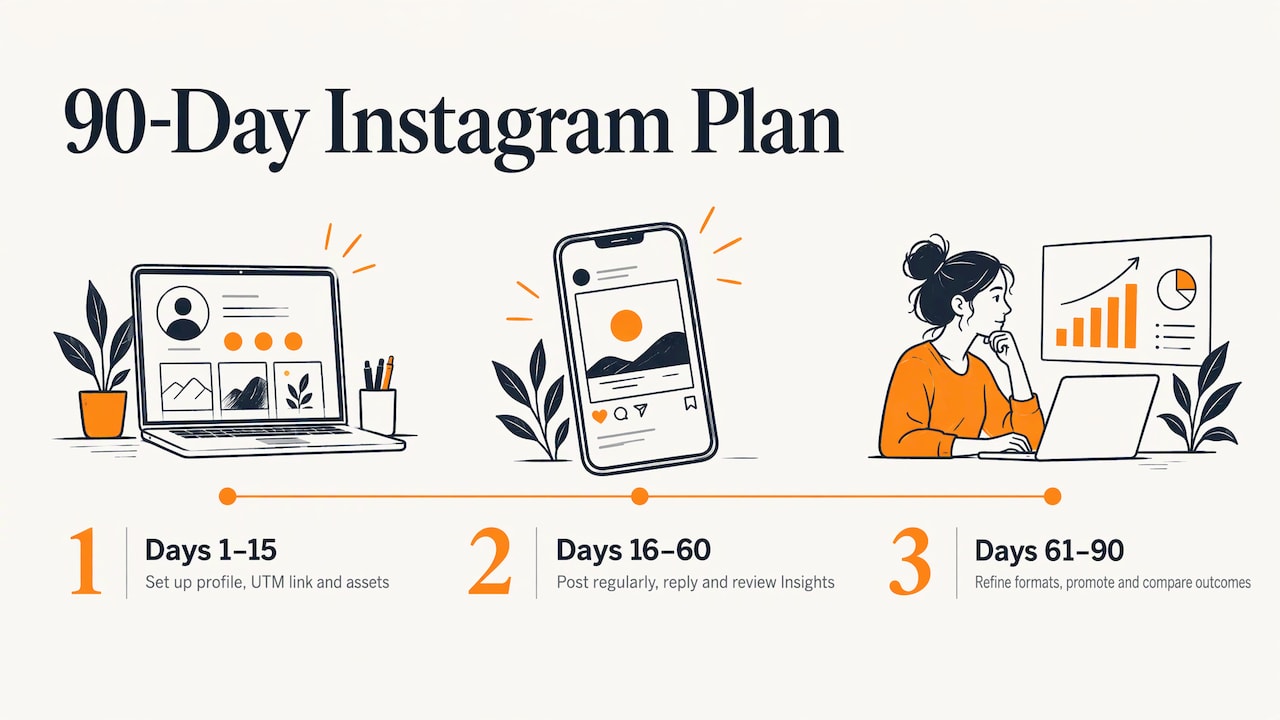
Days 16 to 60: Post three times a week using the 5-3-1 mix. Reply to every comment and message within a business day. Review Insights every two weeks and note which format drew the most reach and the most profile visits.
Days 61 to 90: Double down on the two best formats. Promote one strong post to a defined audience. Compare form fills and branded searches against the first month, and decide whether to expand.
Our social media engagement checklist gives a deeper list of habits for the second and third month.
Our perspective
Most B2B companies come to us asking whether Instagram “works.” The better question is what job you want it to do. For a manufacturer or a professional services firm, the job is usually credibility: a buyer should look you up and find a company that is active, capable and easy to talk to.
That is why we pair social with the rest of the brand. The photography, the video, the website a prospect lands on and the writing under each post all have to tell the same story, and a profile that points to a weak page wastes the attention it earned. Our work across branding, social media, video production, photography and web design exists so these pieces fit together.
After more than 38 years in business, our view is simple: measure contribution, not just clicks, and keep the content honest and useful. Buyers remember the company that taught them something and showed them real people.
Greg
How Marcy Design can run this for you
Planning, shooting, writing, posting and reporting is a steady weekly job, and it competes with the work that actually runs your company. Our team in Columbus handles social media campaigns alongside creative photography, video production and professional writing, and connects them to your website and lead generation so the attention Instagram earns lands somewhere built to convert.
If you want a plan for your own buyers, book a free consultation and we will talk through your goals and your audience.
FAQ
Does Instagram work for B2B marketing?
Yes, as a channel for awareness, credibility and consideration. It is most effective when you show real expertise and people, and when you judge it by contribution to the pipeline rather than direct sales alone. LinkedIn remains the dominant B2B platform, so many companies use both.
What should a B2B company post on Instagram?
Short Reels, educational carousels, project and process content, Stories of your team and a small share of promotional posts. HubSpot’s research reports Reels as the top format for B2B marketers’ ROI, while educational content is the highest-ROI type for about 30% of marketers.
What is the 5-3-1 rule for Instagram?
It is a content ratio: five informational or entertaining posts, three interactive or community posts and one promotional post. It keeps your feed useful rather than sales-heavy, and you can adjust it to what your audience responds to.
How do I measure B2B results from Instagram?
Match metrics to goals: reach and views for awareness, profile visits and follows for profile performance, tracked link clicks for traffic. Add a form field asking how leads found you, and watch branded search, because social often influences deals before a conversion shows up.
Sources
- Business-to-business (B2B)
- HubSpot’s 2026 Social Media Marketing Report
- B2B marketing on Instagram: What you need to know
- Which Social Media Platform Is Right for My Business?
- The Anatomy of a Perfect Instagram Profile
- HubSpot Instagram Engagement report
- The HubSpot Blog’s 2026 Instagram Marketing Report
- The Pros and Cons of Instagram Marketing
- 6 Expert B2B Instagram Tips
- When is the best time to post on Instagram in 2026?