
 614.224.6226
A marketing funnel is the path a stranger takes to become a customer, and the best examples match one specific piece of content or one offer to each step of that path. Below you will find examples for a small business, a B2B company, an online store and a manufacturer, plus the numbers to watch at each stage. The funnel only pays off when the website at its center is built to move people forward, which is why we design the site and the funnel together at Marcy Design in Columbus.
TL;DR
- Most funnels have three stages: awareness (top), consideration (middle) and conversion (bottom). Many add a fourth for retention after the sale.
- Each stage needs its own content, channel and call to action. A blog post cannot do a demo’s job.
- B2B and manufacturing funnels run longer, with more decision-makers, so they lean on proof: case studies, specifications, ROI tools and quotes.
- Pick a few metrics per stage and work backward from revenue, not from clicks.
- Your website is where every stage meets. If it does not guide visitors, the funnel leaks.
Table of Contents
- What a marketing funnel is, and how its stages map to the buyer’s journey
- Marketing funnel examples by stage
- A small business funnel example
- A B2B marketing funnel example
- An ecommerce funnel example
- A manufacturing funnel example
- Full-funnel marketing: connect the stages
- Which metrics to track at each stage
- Why the website decides how well your funnel works
- Promo: build the funnel and the site together
- Perspective
- FAQ
- Sources
What a marketing funnel is, and how its stages map to the buyer’s journey
The funnel is a simplified picture of how interest narrows. Many people hear about you, fewer compare you with others, and fewer still buy. Search Engine Land’s guide describes the common stages as awareness, interest, decision and action, often grouped into top, middle and bottom of the funnel (ToFu, MoFu, BoFu). Prospects who are searching for a problem sit at the top. People exploring solutions sit in the middle. Those reading reviews before choosing sit at the bottom.
You will see other versions: five stages that split out interest and intent, or six for ecommerce. They describe the same path with finer cuts. For a small team, three stages plus retention is enough to plan with.
A customer journey map is a different tool. Lucidchart explains that the funnel shows progression, while a journey map lists the specific touchpoints and admits that real buyers move back and forth and repeat steps. Use the funnel to decide what to build. Use the journey idea to remember that people do not follow it neatly.
Marketing funnel examples by stage
The table shows what each stage typically looks like in practice. The content types follow the formats Amplitude lists for each stage.
| Stage | The buyer’s question | Example content and channels | Typical call to action |
|---|---|---|---|
| Awareness | “I have a problem. What is going on?” | Blog posts answering broad questions, SEO, social posts, YouTube, podcasts, events | Read more, subscribe |
| Consideration | “What are my options?” | Email sequences, webinars, whitepapers, case studies, comparisons, explainer videos | Download, register, compare |
| Conversion | “Why you, and why now?” | Demos or free trials, clear pricing pages, retargeting ads, abandoned-cart emails | Book a call, request a quote, buy |
| Retention | “Was this the right choice?” | Onboarding, review requests, loyalty programs, referrals | Refer, reorder, upgrade |
Here is what each row looks like when it is working.
Awareness: be the answer to the first search
The top of the funnel is about being found by people who do not know you yet. A plumbing-supply distributor publishes a plain-language article on why commercial water heaters fail early. A local bakery posts short videos of its morning production. Both are answering a question, not pitching.
Two cautions apply here. Awareness is easy to underfund because its payoff arrives months later, and impressions alone do not tell you whether anyone remembers you. Track the things that point to real interest: new-visitor traffic, brand searches and social engagement.
Search is the backbone of most awareness efforts, because it catches people at the moment they are looking. Our SEO solutions and on-page SEO work are built for exactly this stage.
Consideration: give people a reason to stay in touch
The middle of the funnel turns a visitor into a known contact. The usual trade is useful content for an email address: a checklist, a buyer’s guide, a webinar seat. Then a short email series keeps the conversation going. If you want to build that series well, see our guide to an email nurture sequence.
Example: a nonprofit offers a free guide on grant-writing deadlines. Subscribers receive three emails over two weeks, each linking to a story about a program the organization funded. By the third email the reader understands the mission and the next step: join the monthly briefing.
Useful signals at this stage are email sign-up rates, gated download completion, return-visitor percentage, webinar registration and email click-through rates.
Conversion: remove the last doubt
Bottom-of-funnel content answers the final objections. Amplitude lists free trials or demos, well-designed pricing pages, retargeting based on cart or demo-page visits, abandoned-cart emails and limited-time offers. It also points out that form length, button placement or unclear pricing can make prospects walk away just before converting.
That last point is a website problem, not an advertising problem. If a prospect clicks your ad, reads your case study and then meets a confusing contact form, the funnel has failed at its most expensive step. Our guide on how to improve website conversion rate covers those fixes.
Retention: the stage that is easy to forget
After the sale, the funnel keeps working through onboarding, review requests, loyalty programs, referrals and win-back emails. For businesses with repeat orders or subscriptions, this is where most of the profit sits. Track repeat purchase rate, customer lifetime value (the revenue you expect from a customer over the whole relationship) and referral rate.
A small business funnel example
Forbes Advisor walks through a pet-supply store: a customer who abandons a cart gets a coupon, and after buying receives personalized recommendations and a review request. It is simple, and it works because each message fits the moment.
Here is the same logic for a local service business, such as an HVAC contractor in the Columbus suburbs:
- Awareness: a page and short video on “why your furnace short-cycles” that ranks for the questions homeowners type in Dublin, Hilliard or Westerville.
- Consideration: a seasonal maintenance checklist, downloaded in exchange for an email address, followed by two emails with customer stories.
- Conversion: a booking page with clear service areas and a short form.
- Retention: a reminder email each autumn and a request for a review after every visit.
None of this needs a large budget. It needs a site that loads fast, reads clearly on a phone and has one obvious next step on every page.
A B2B marketing funnel example
B2B buyers research in detail, involve several people and take longer to decide. Search Engine Land notes that products costing thousands of dollars may need more touchpoints to warm up an audience. HubSpot’s B2B funnel walkthrough describes the usual shape: educational content first, proof such as case studies and webinars next, then consultations, pricing tools and sales support near the decision. Its example tracks traffic and engagement early, email activity and meetings in the middle, and conversion rates and proposal acceptances at the end.
A worked version for a professional-services firm:
- Top: an SEO article, a LinkedIn post and a short video, all on one problem the buyer has. Our plan for LinkedIn B2B marketing shows how to run that channel.
- Middle: a webinar and a case study with real results, followed by a nurture email series addressed to the roles involved, such as the operations lead and the finance approver.
- Bottom: a consultation offer, a scoping call and a proposal. Track how many meetings become proposals and how many proposals are accepted.
What ties it together is lead capture and follow-up. Our B2B lead generation guide goes through that handoff from marketing to sales in detail.
An ecommerce funnel example
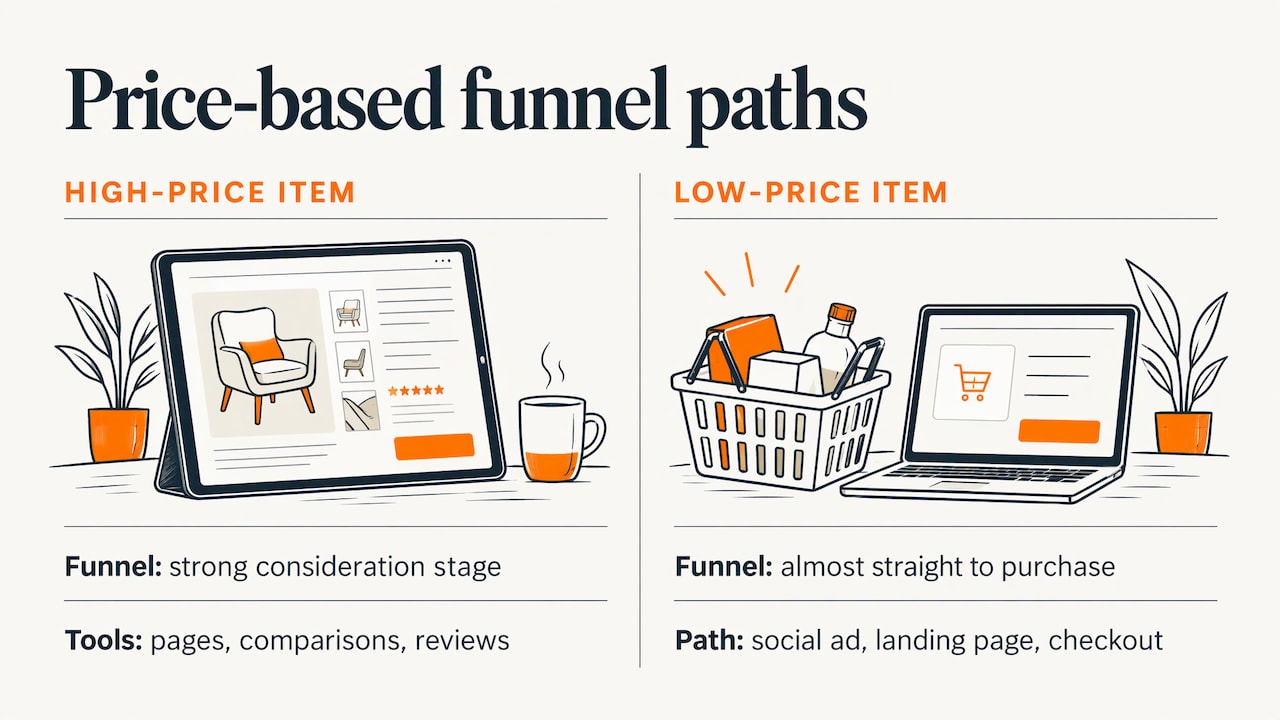
Online stores compress the funnel, and price decides how much of it you need. A high-price, specialized item needs a strong consideration stage with detailed product pages, comparisons and reviews. A low-price impulse item can go almost straight from a social ad to a landing page to checkout.
A store selling handmade jewelry might use striking social imagery for awareness, styling articles and a newsletter for interest, videos of the making process and customer testimonials for consideration, an abandoned-cart email that restates the quality of the piece, and one-click checkout for the purchase. Amplitude’s ecommerce version is similar: discovery through social or search at the top, product pages and reviews in the middle, and streamlined checkout with clear shipping information plus cart-abandonment emails at the bottom.
Checkout speed and clarity matter as much as any ad. If you are planning a store, our custom ecommerce guide for small business explains what to build first, and our ecommerce web application service covers the build.
A manufacturing funnel example
Manufacturers sell high-value, specification-driven products to teams of buyers. Amplitude’s industrial example uses technical whitepapers and industry-event networking at the top, detailed specifications and ROI calculators in the middle, and personalized quotes with implementation timelines at the bottom.
In practice that looks like this:
- Awareness: a technical article on tolerances or materials, written for the engineer who searches for it, and a booth presence at a trade show.
- Consideration: downloadable spec sheets and CAD files, a comparison of your process against alternatives, and a case study from a customer in a similar industry.
- Conversion: a request-for-quote form that asks for the details your estimators need, followed by a fast reply with timelines.
- Retention: reorder tools, account pages and scheduled check-ins.
Because manufacturing buyers rarely move in a straight line, give each stage both gated content, which asks for an email address, and open content that anyone can read. Some buyers will self-serve for weeks before they raise a hand. Our guide to B2B ecommerce features for manufacturers and our B2B ecommerce strategy cover the online ordering side.
Full-funnel marketing: connect the stages
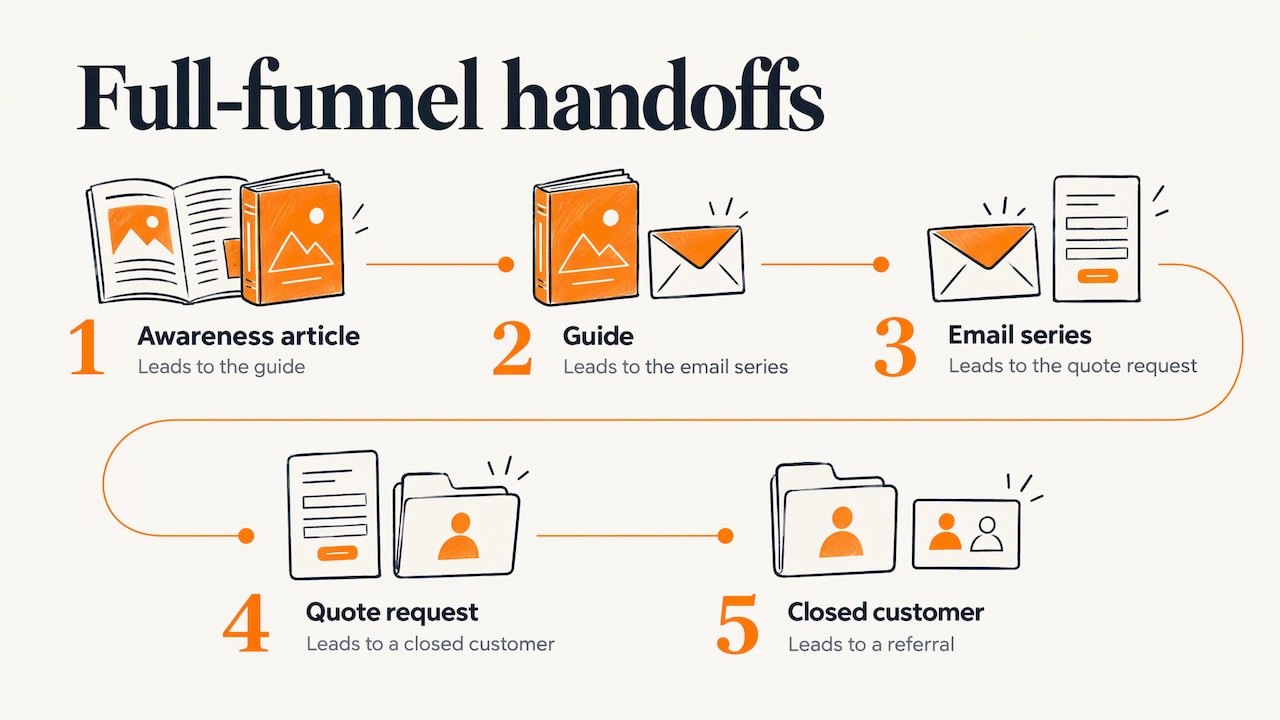
A full-funnel approach plans all stages as one system. The awareness article leads to the guide, the guide leads to the email series, the series leads to the quote request, and the closed customer leads to a referral. Each stage hands the person to the next with a clear call to action.
Search Engine Land recommends looking at which touchpoints convert later in the funnel and which bottom-stage actions are most valuable, weighing transaction value, retention and the likelihood of repeat purchase. That tells you where to put more budget. If customers who attended a webinar close at twice the rate of those who did not, the webinar deserves more promotion.
A practical way to start is to write your funnel on one page with four columns, one per stage, and fill in three things for each: the content you have, the call to action it points to, and the number you will watch. Gaps jump out quickly. Most small businesses discover they have plenty of awareness content and nothing in the middle.
Which metrics to track at each stage
Do not track everything. Shopify’s marketing-plan guidance is to set business outcomes first, such as revenue, customer acquisition cost or repeat purchase rate, then choose a small set of stage metrics that explain progress toward them. Amplitude’s lists give you the menu:
- Awareness: reach, new-visitor traffic, brand search volume, social engagement.
- Consideration: email sign-up rate, return-visitor percentage, webinar attendance, email click-through rate, and the share of leads that sales accepts as qualified.
- Conversion: conversion rate, customer acquisition cost, average order value, cart abandonment rate.
- Retention: retention rate, repeat purchase rate, customer lifetime value, churn.
Also watch the rate at which people move from one stage to the next and how long they take. A stage with a sharp drop is where to spend your next hour. To connect these figures to dollars, use our marketing ROI guide and the digital marketing ROI calculator guide.
Why the website decides how well your funnel works
Every stage ends up on your site. Awareness content lives there, the lead magnet is a page, the quote request is a form, and the customer login is part of it. A funnel built on a slow, confusing or inaccessible website pays for visitors and then loses them.
That is why we treat the funnel and the website as one project. Our walkthrough of a business website sales funnel shows how the pages fit together, and our content marketing strategy guide covers what to publish at each stage.
Promo: build the funnel and the site together
Marcy Design is a Columbus, Ohio agency with more than 38 years in business and over 230 awards. We handle website design, SEO, lead generation, email marketing, content and video, so awareness, nurture and conversion are planned together rather than by separate vendors.
If you want a funnel mapped to your own buyers, start with our lead generation service or reach us through marcy.com.
Perspective
Most funnels we are asked to fix do not fail at the top. The traffic is there. They fail because the website treats every visitor the same: one menu, one generic contact page, no reason to come back.
Our view is that a funnel is a design problem as much as a marketing one. The article, the landing page, the form and the follow-up email should feel like one conversation. That is why our approach is to tailor the site to the people you want to reach and to the stage they are in, then measure what happens.
After more than 38 years of working with businesses of all kinds, including manufacturers, nonprofits and veteran-owned companies, we have found the pattern holds: clear structure, useful content at each step, and numbers tied to revenue beat clever tactics.
Greg
FAQ
What are the stages of a marketing funnel?
The most common model has three stages: awareness, consideration and conversion. Many businesses add retention after the sale, and some models split the stages further into interest, intent and purchase. They describe the same path with different levels of detail.
What is the difference between a marketing funnel and a sales funnel?
The marketing funnel covers how people find you and become interested, so it leans on content, search and email. The sales funnel covers what happens once a lead is qualified: calls, proposals and closing. In a B2B company the two overlap at the middle stage, so they should share definitions and data.
How is a B2B marketing funnel different?
It runs longer and involves several decision-makers, so it needs more proof and more touchpoints. Expect case studies, webinars, consultations and pricing tools rather than a single buy button. The measures that matter are meetings booked and proposals accepted, not only clicks.
Do small businesses need a full funnel?
No, but you need every stage covered in a simple form. One helpful article, one reason to share an email address, one clear way to buy or book, and one follow-up after the sale is a complete funnel. You can grow it from there as you see which stage loses the most people.
Sources
- What is a marketing funnel? Complete beginner’s guide, Search Engine Land
- Marketing Funnel vs Customer Journey Maps, Lucidchart
- Marketing Funnels: What They Are And How They Work, Amplitude
- Sales Funnel Template and Examples for Small Business, Forbes Advisor
- Inside the B2B Marketing Funnel, HubSpot
- What Is a Marketing Plan? How to Write One, Shopify