
 614.224.6226
A B2B ecommerce strategy is the set of decisions that determine how your company sells to other businesses online: which customers use your portal, what catalog and prices each one sees, how an order reaches your back-office systems, and who approves it on the buyer’s side. The strongest plans start narrow, prove one thing with real orders, and then expand. This guide walks through how to build that plan, with examples, marketing tactics and the numbers to watch.
TL;DR
- Decide who you are selling to and how (self-serve, sales-assisted or marketplace) before you pick a platform. Technology follows the plan.
- Connect the site to inventory, pricing, ERP, CRM and accounting. A polished storefront on disconnected systems just moves manual work online.
- Roll out in stages: one segment first, then deeper catalog and contract pricing, then new markets and channels.
- Market to qualified accounts with intent-driven SEO, email, account-based campaigns and segment-specific landing pages.
- Measure against the goal of each sales motion, such as digital revenue mix, quote-to-order time and repeat purchase rate.
Table of Contents
- What a B2B ecommerce strategy actually covers
- Step 1: Choose your selling model and your first segment
- Step 2: Design the buying experience around buyer friction
- Step 3: Connect the storefront to your operations
- Step 4: Roll out in stages
- Real-world examples worth learning from
- Marketing your B2B ecommerce site to qualified buyers
- Measuring whether it works
- Our perspective
- How Marcy Design can help
- FAQ
- Sources
What a B2B ecommerce strategy actually covers
Shopify’s enterprise guide describes the goal as making the whole B2B buying process easy, personal and smooth, so buyers can help themselves and your team spends less time on routine orders. That is the useful definition. It is not a website project. It is a plan for customers, catalog, pricing, fulfillment and the people who touch each order.
The stakes are real. According to the Census Bureau’s e-commerce statistics, manufacturing e-commerce shipments made up 67.3% of total manufacturing shipments in 2018. That figure counts all electronic orders, including those placed through older systems, but it shows how much business-to-business selling already runs digitally. Buyers are also doing more on their own: Gartner data cited by Elastic Path says buyers complete an average of 67% of their purchase journey before talking to a sales rep.
BCG’s analysis of B2B e-commerce pitfalls makes the same point from the executive side: no platform delivers success by itself. Advantage comes from a holistic strategy covering traffic and marketing, hybrid buying journeys, products, pricing, navigation, operations and technology.
Step 1: Choose your selling model and your first segment
Before you open a platform demo, answer four questions in writing:
- Who buys first? Pick one customer segment, such as existing distributors, repeat maintenance buyers or contractors, not “all customers.”
- What do they buy? Start with the products they reorder most, where part numbers and specs are already clean.
- How do they buy? Some accounts want to self-serve. Others need a rep for configuration, negotiated terms or large quotes.
- What does success look like in 90 days? A concrete outcome, such as orders flowing into your ERP with no re-keying.
Shopify’s KPI guide separates three motions, and it helps to choose which one you are building: self-serve, sales-assist or marketplace/hybrid. Each has its own goal and its own scorecard.
| Motion | Best for | What the site must do |
|---|---|---|
| Self-serve | Repeat orders, standard catalog, smaller tickets | Fast reorder, account pricing, clear stock and shipping, saved payment terms |
| Sales-assist | Complex or high-value deals, configured products | Quote requests, rep handoff, quote-to-order tracking, shared account history |
| Marketplace or hybrid | Wide assortment, third-party sellers | Seller onboarding, assortment management, two-sided reporting |
Most manufacturers and distributors end up hybrid. The portal handles routine reorders so your sales team can spend time on accounts that need them.
Step 2: Design the buying experience around buyer friction
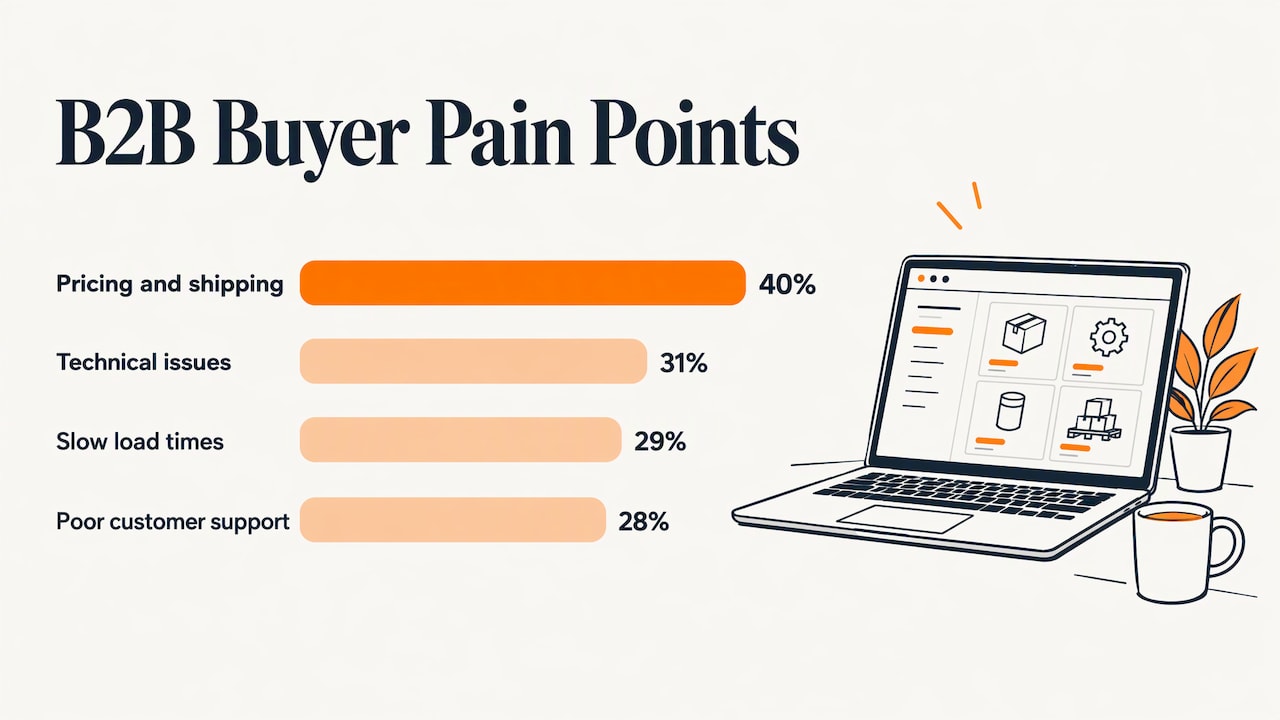
B2B buyers are less patient with poor sites than many sellers assume. In BigCommerce’s Global B2B Buyer report, the top pain points were inaccurate pricing and shipping costs (40%), slow load times (29%) and poor customer support (28%), and 31% of respondents said technical issues kept them from completing an online purchase.
That gives you a practical design checklist:
- Account-specific pricing and catalogs. Show each buyer their contract price, not a generic list price.
- Search by part number and specification. Buyers often know exactly what they need.
- Accurate shipping and availability at the product level. This addresses the biggest complaint above.
- Flexible payment terms. Shopify’s best-practices guide lists self-service portals, account-based personalization, flexible payment options and mobile-first experiences as foundations.
- Speed. Slow pages cost orders. Our piece on improving ecommerce site speed without hurting the shopping experience covers the trade-offs.
- Reorder and approval flows. Business buyers often need a purchasing manager to approve an order, so build that step into the process.
For a deeper look at the design side, see our strategic guide to B2B ecommerce web design.
Step 3: Connect the storefront to your operations
This is where many projects stall. Wise’s guide lists the integrations a B2B store typically needs: product information, inventory availability, pricing rules, CRM account records, order management, accounting and invoicing, tax calculation, payments, shipping and tracking, and returns or support. The point is that orders, invoices, payments and tax records match without someone retyping them.
A workable order of operations:
- Clean your product data. Consistent names, specs, units and images.
- Map your pricing logic. Tiers, contract prices, volume breaks and customer groups.
- Connect inventory and ERP first. Orders that reach the ERP untouched are the clearest early proof the model works.
- Add CRM, accounting and shipping. Then layer on tax and payment workflows.
- Plan the exceptions. Backorders, partial shipments, returns and credit holds.
If your catalog or ordering rules are unusual, a custom build may fit better than a template. That is the kind of work our ecommerce web application services are built around.
Step 4: Roll out in stages
Virtocommerce describes a three-stage rollout that holds up well in practice. Stage one focuses on one segment and one market, with real orders reaching the ERP without manual intervention. Stage two adds catalog and pricing depth, including contract terms and volume structures. Stage three expands to new markets, channels and brands, with repeatability as the gate before each expansion.
In plain terms:
| Stage | Scope | Gate to move on |
|---|---|---|
| 1. Prove it | One segment, core products | Orders reach the ERP with no manual steps |
| 2. Deepen it | Wider catalog, contract pricing, volume rules | Accounts reorder without calling |
| 3. Extend it | New regions, channels, brands | The process repeats without special handling |
BCG adds a cultural point: e-commerce rewards real-time, data-driven decisions and a test-and-learn approach, with marketing, sales, supply chain and digital teams working together. Put one owner in charge and give each team a stake.
Real-world examples worth learning from
These examples come from vendor case studies, so treat the results as each company’s own reported outcomes.
- Mueller, a building materials manufacturer. It added self-service project checklists and online quote requests. Liferay reports a 73% average increase in monthly quotes and a 250% jump in site traffic.
- Grainger and Fastenal. The same guide describes Grainger’s part-number and specification search and Fastenal’s site tied to branch stock, pickup, shipping and on-site vending. Both show that the strategy reaches beyond the website into inventory and logistics.
- Wastequip’s Mountain Tarp. The parts commerce experience reportedly delivered 40% growth in ecommerce sales and 83% growth in organic and direct traffic.
- ARCA Supply. After integrating its store with its inventory system, the company reports saving about 20 hours a week that went into manual imports, data entry and customer notifications.
The pattern is consistent. The wins come from removing manual work and letting buyers do routine tasks themselves, not from a redesign alone.
Marketing your B2B ecommerce site to qualified buyers
A portal does not fill itself. B2B marketing is narrower and more intent-driven than consumer marketing. These tactics work together:
- Intent-driven SEO. Target product specs, part numbers and phrases like “wholesale [product]” rather than broad terms. Our SEO solutions team builds this kind of program, and on-page SEO fundamentals are the place to start.
- Registration as a conversion. Treat account sign-up like a lead form. Gating wholesale prices behind login can qualify visitors and give them a reason to register, according to b2bridge’s marketing guide.
- Email. Shopify reports that email is the preferred channel for 73% of B2B marketers. Reorder reminders, new-product notices and abandoned-cart nudges all use data your store already collects.
- Account-based campaigns. For high-value accounts, personalize content to each stakeholder’s problems, as marketers quoted in HubSpot’s B2B ecommerce article recommend, and lead with problem-solving over feature-selling.
- Segment landing pages. Give each industry its own page with its own statistics, examples and testimonials.
- Paid search and retargeting. Focus on commercial-intent keywords, and retarget visitors who viewed products but did not register.
- Lead capture for the sales-assist side. Our four-step process for online lead generation shows how to connect traffic to qualified conversations.
Once traffic arrives, conversion work matters. Our guide to improving website conversion rate applies directly to registration and quote forms.
Measuring whether it works
Pick KPIs that match your motion. Shopify’s KPI guide suggests:
- Self-serve: webstore adoption rate, digital revenue mix, cart-to-checkout rate, checkout-to-paid rate and repeat purchase rate.
- Sales-assist: speed to first response, quote-to-order cycle time, win rate by stage, average selling price by channel and opportunity age.
- Marketplace or hybrid: gross merchandise value, take rate, seller retention and buyer-to-seller ratio.
The same guide also recommends watching customer acquisition cost, average order value, conversion rate and profit margin regularly. Set a baseline before launch, review monthly, and use each stage gate from the rollout plan as a checkpoint.
Our perspective
We have been building websites and marketing programs for businesses for more than 38 years, and the B2B projects that pay off share one trait: the site was designed around how the buyer’s company actually purchases.
That means starting with the customer, the catalog and the order process, then choosing technology that fits. It also means treating design, development, SEO, email and lead generation as one system. A portal with excellent design but no search visibility goes unnoticed. A well-promoted site that is hard to use loses the buyer at checkout.
Our approach is tailored and user-focused, with technical implementation and measurable results as the standard. For manufacturers, that usually means a staged build: prove the core ordering experience, then expand. We think that is the most dependable way to turn an ecommerce investment into growth.
Greg
How Marcy Design can help
If you are planning a B2B portal or rebuilding an underperforming one, our team can handle the strategy, design, development and marketing under one roof. We build custom ecommerce web applications and support them with SEO, email and lead generation, so the store is found and used.

To talk through your catalog, customers and goals, start at marcy.com and send us a proposal request. For a closer look at buying considerations, read our buyer’s guide to ecommerce website development services.
FAQ
What is the first step in a B2B ecommerce strategy?
Define your first customer segment and the products they reorder most. Then decide whether that segment will self-serve or need a sales rep. These two choices shape your platform, integrations and KPIs.
How long should a B2B ecommerce rollout take?
It depends on catalog size, integrations and approval rules, so we scope each project individually. A staged plan is safer than a single launch: prove one segment with real orders reaching your ERP, then add depth and new markets.
Which systems should a B2B store connect to?
At a minimum, inventory, pricing, order management or ERP, CRM, accounting, tax, shipping and payments. Wise’s integration list covers these, along with returns and support tickets.
How do you market a B2B ecommerce site?
Combine intent-driven SEO, email, account-based campaigns, segment landing pages and retargeting. Treat account registration as a conversion event, and use order data to personalize follow-up.
Do small and mid-sized manufacturers need B2B ecommerce?
Buyers increasingly research and purchase on their own, so a self-service option helps companies of any size. Starting with one segment and a focused catalog keeps the first phase manageable. Our custom ecommerce guide for small business covers what to plan.
Sources
- How To Build a Successful B2B Ecommerce Strategy (Shopify)
- Manufacturing, Not Online Shopping, Ranks No. 1 in E-Commerce (U.S. Census Bureau)
- Ecommerce for Manufacturers (Elastic Path)
- Steering Clear of Seven B2B E-Commerce Pitfalls (BCG)
- 28 B2B Ecommerce KPIs (Shopify)
- Global B2B Buyer report (BigCommerce)
- B2B Ecommerce Best Practices (Shopify)
- Effective B2B E-commerce Strategy (Wise)
- B2B eCommerce Strategy: How to Build and Execute One (Virtocommerce)
- What Makes a B2B Ecommerce Experience Great (Liferay)
- Wastequip B2B eCommerce Case Study (OroCommerce)
- ARCA Case Study (BigCommerce)
- 15 B2B Ecommerce Marketing Strategies (b2bridge)
- B2B Ecommerce Marketing: 11 Strategies (Shopify)
- Getting B2B Ecommerce Right (HubSpot)