
 614.224.6226
A strong Franklinton arts district web developer can help turn your website into a clear path from first visit to next step, whether visitors want to ask a question, explore a service, or begin onboarding.
It’s reasonable to want a site that reflects your business and makes it easy for people to act. A polished brochure-style website and a guided customer experience serve different purposes. Interactive features, such as a lead-capture form, assessment, or consultation flow, can tailor the experience to a visitor’s needs. The right approach depends on your goals and how your business works.
This guide offers practical criteria for comparing developers, from local understanding and interactive functionality to project scope and ways to evaluate the finished site. Marcy Design is a Columbus-based agency offering website design, ecommerce solutions, and AI-powered solutions. As you compare options, look for a partner who can turn your business identity into a useful experience for visitors.
Key Takeaways
- Choose a Franklinton arts district web developer who can connect your business goals to the tasks visitors need to complete.
- Verify an agency’s location and ask for relevant project examples rather than assuming it has worked with district businesses.
- Compare static pages with interactive options to decide where visitor choices could make your website more useful.
- Before requesting a proposal, map your audience, primary goal, visitor task, and the pages needed to support that journey.
- Evaluate each partner’s process, communication, ongoing support, and evidence of relevant work before setting project scope.
What a Franklinton Arts District Web Developer Should Understand About Your Business
Choosing a developer involves more than finding someone who can build an attractive website. You need a partner who understands what your business wants to accomplish and what visitors need to do next. A site for an artist, venue, or neighborhood business should express a distinct identity while making practical tasks, such as asking about a service or finding event information, easy to complete.
Be precise about location, too. An agency that serves Franklinton isn’t necessarily based in the district. Verify location claims and ask how the team will learn about your business and intended audience. Understanding Franklinton’s history and identity can provide useful context, but familiarity with the neighborhood doesn’t prove that a developer understands your specific audience or goals.
Turn business goals into clear website requirements
Before discussing layouts or features, define what the site needs to accomplish. Identify your priority audiences, the services or information they’re looking for, and the main action you want each visitor to take.
- Inquiries: Show prospective customers how to ask a question.
- Bookings or sales: Explain what’s available and make the next step clear.
- Event interest: Put essential event details and the next action within easy reach.
- Another action: Name it specifically, such as requesting information or starting onboarding.
Next, separate launch requirements from features that can wait. A must-have page or clear inquiry path may belong in the initial scope, while an optional feature can be considered later. Ask the developer to connect each design and functionality recommendation to a stated goal. If a suggestion doesn’t support an audience need or a defined action, ask why it belongs in the project.
Assess local understanding without assuming an agency’s address
Ask how the agency will learn about your business, audience, and service area. A useful discussion should address your priorities and the character of your organization, not rely on broad claims of neighborhood expertise. Request relevant work that shows how the developer handled similar needs, but don’t assume district-specific projects exist. For a wider view of how website planning can support business growth, see this Columbus web design growth guide.
A capable Franklinton arts district web developer should turn your answers into a focused plan: who the site serves, what visitors need, and which actions should be easiest to take. That clarity helps you compare proposals and keep the project aligned with your business.
Static Website Pages vs. Interactive Experiences: What Franklinton Visitors Need
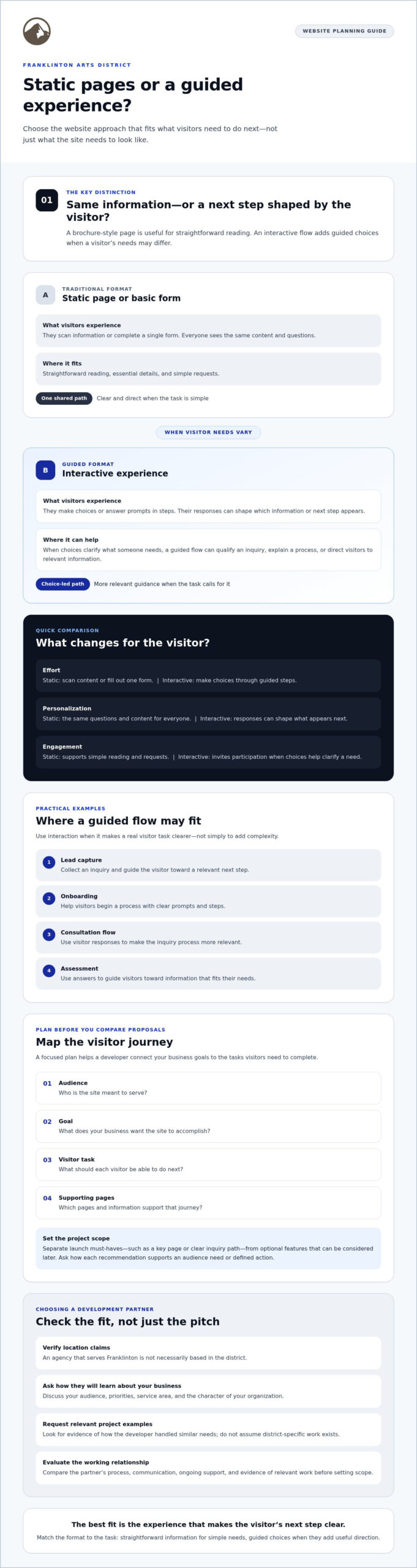
A static page presents the same information to every visitor. A basic contact form collects input but doesn’t change the next step based on a response. An interactive experience can respond to visitors’ choices and guide them toward relevant information or an action. The point isn’t to add complexity. It’s to choose an experience that makes the task clearer and easier to complete.
For context about the district’s mission and events, visit the official Franklinton Arts District website. Local context can help businesses make their own sites more relevant, but the format should still suit what visitors need to do.
| Consideration | Static page or form | Interactive experience |
|---|---|---|
| Visitor effort | Visitors scan information or complete a single form. | Visitors make choices or answer prompts in guided steps. |
| Personalization | Everyone sees the same content and questions. | Responses can shape which information or next step appears. |
| Engagement | Works well for straightforward reading and simple requests. | Invites participation when choices help clarify what a visitor needs. |
| Business purpose | Shares essential details or collects a basic inquiry. | Can help qualify an inquiry, explain a process, or direct visitors to relevant information. |
A guided flow can support follow-through when it breaks a decision into clear steps, offers relevant choices, and explains what to do next. This may make the task feel more manageable, but it doesn’t guarantee that visitors will complete it. The questions, audience, and implementation all matter.
When guided experiences can help visitors move forward
Consider a guided format when a visitor’s answers affect what information would be useful. For lead capture, a few relevant questions can give a business context for a follow-up conversation. Sequential onboarding prompts can explain a process, while an assessment can direct visitors to information related to their answers. In each case, the interaction should reduce uncertainty, not add steps without a clear purpose.
Match the interaction to the service and decision
A professional consultation may benefit from a guided path from initial interest to inquiry. But if visitors already know what they want to ask, a simple contact form may be clearer and quicker than a multi-step interaction. Start with the visitor’s task, then choose the simplest approach that helps them act. To review Marcy Design’s confirmed website design services, consider how the project scope might match the experience your business needs.
How to Compare Franklinton Arts District Web Developers
A polished portfolio is a starting point, not a complete reason to hire. Compare how each developer turns your needs into a clear scope, a useful visitor experience, and a manageable project. Use this checklist when speaking with a Franklinton arts district web developer or another Columbus-area agency.
- 1. Goals: Ask how the proposed site will support your priority action, such as inquiries, sales, bookings, or event interest. Each major recommendation should address a defined business need.
- 2. Relevant work: Request examples related to your audience, services, or project needs. Ask what the developer contributed and why particular design or functionality decisions were made. Don’t assume district-specific case studies exist.
- 3. Project process: Clarify the stages of the work, what you’ll need to provide, and how scope and deliverables will be documented. Ask how the developer will decide between a static page and an interactive flow for each visitor task.
- 4. Communication: Find out who your main contact will be, how decisions and feedback will be handled, and who needs to review or approve content and design.
- 5. Ongoing support: Ask what happens after launch, what support is included, and what falls outside the agreed scope. Get responsibilities and expectations in writing.
Not every page needs an interactive feature. Guided interactions can be scoped to a particular task, such as an inquiry or onboarding path, while other pages simply provide clear information. Compare proposals by their requirements, deliverables, and support for visitor tasks, not by the number of features listed.
Questions to ask before selecting a web developer
Ask who will define requirements, review content, and approve design and development decisions. Clarify how requested changes are handled, what testing takes place before launch, and what post-launch support is available. To help the developer estimate the scope, be ready to discuss your audience, priority pages, content readiness, and essential functionality.
Review experience, accessibility, and mobile usability
Explore examples on a phone as well as a desktop. Can visitors find the primary action, read important information, and complete a form without unnecessary friction? Ask how the developer considers different visitor needs, including people who use assistive technology. These checks help you judge whether a design works beyond its first impression.
Keep your comparison tied to evidence: relevant examples, a clear process, usable design, and a scope that fits your needs. That’s a more reliable basis for choosing a development partner than broad claims or an impressive feature list.
Plan a Website Project for Your Franklinton Business Step by Step
A clear project plan starts with a business outcome, not a list of features. Before contacting a Franklinton arts district web developer, map a simple visitor journey: who arrives, what they need to understand, and what they should be able to do next. This gives a developer practical context for shaping the site and estimating its scope.
- Set the business goal. Decide what the website should support, such as more inquiries, sales, bookings, or event interest.
- Name the audience. Identify the people you most want to reach and what they’re likely looking for.
- Define the visitor task. Specify the next step, such as requesting information, exploring an offering, or starting a process.
- Organize the pages. Give each priority page one main purpose, then arrange information in the order visitors need it.
- Choose the right interaction. Use a simple page or form for a straightforward task. Consider a guided sequence only if visitor choices make the next step clearer or more relevant.
For example, a lead-capture path may ask for context that helps a business respond to an inquiry. An onboarding journey may explain what happens at each stage. A consultation request or assessment could use prompts to direct visitors to relevant information. These are options, not requirements for every project. Choose based on the task and the value the experience adds for visitors.
Create a focused scope and visitor journey
For each priority page, write down its purpose and the action visitors should take. Sketch the route from arrival to that action, including what they need to know before submitting a request. Then separate launch essentials from later improvements. This keeps the initial project focused while leaving room to refine the experience as your needs become clearer.
Set expectations for collaboration and review
Decide who will supply content, gather feedback, and approve project decisions. Ask how the site will be reviewed for usability and mobile behavior before launch, and clarify how changes will be handled. After publication, agree on what information you’ll review to judge whether the experience is useful, such as whether visitors can find key details and complete the intended task. Choose measures that fit your goal rather than relying on an arbitrary benchmark.
With your goals and visitor journey mapped, you’ll be better prepared to discuss scope and priorities. Explore Marcy Design’s website design services as you consider what your project may need.
Choose a Columbus-Based Web Development Partner for Your Franklinton Project
The right partner should understand your audience and local context, define a clear project scope, create a usable visitor experience, and provide relevant evidence of past work. Keep those criteria in view as you compare proposals. A strong portfolio matters, but so does the developer’s ability to explain how the proposed website will support your goals without unnecessary complexity.
Marcy Design is a Columbus-based agency, not a firm based in the Franklinton Arts District. Founded circa 1986, it provides custom website design, mobile-responsive web solutions, ecommerce development, and AI-powered solutions. The right services depend on your project. Ecommerce may be relevant if you plan to sell online, while AI-powered solutions may address a specific business need. Neither automatically means that a particular interactive feature is included, so clarify functionality, scope, and deliverables directly.
Where Marcy Design may fit your project
If you’re evaluating a Franklinton arts district web developer, consider whether a Columbus-based agency can understand your audience and turn your priorities into a focused website plan. Review Marcy’s web design capabilities alongside other candidates, and ask how the proposed work would address your required pages, mobile use, and visitor actions. Look at relevant examples and project details rather than assuming an agency has district-specific case studies.
Prepare for a productive first conversation
Bring your business goals, priority audiences, and examples of the actions you want visitors to take. If you’re considering lead capture, onboarding, a professional consultation, or an assessment, explain what visitors should understand or accomplish at each step. Then discuss whether a simple page, form, or guided experience best suits the task and what belongs in the initial project scope.
Be ready to discuss the pages and services that matter most, the content you can provide, and how you’ll review the finished experience. Ask what evidence the agency can share about comparable work and how responsibilities, deliverables, and post-launch support will be defined. Clear answers help you make an informed choice and align expectations.
Have a website project in mind? Talk with Marcy Design about your website to discuss your goals, audience, and project scope.
Build a Website That Gives Visitors a Clear Next Step
Choosing a Franklinton arts district web developer involves more than design. Look for a partner who understands your business goals, defines a manageable scope, and supports recommendations with relevant project evidence. A static page may be the clearest way to share essential information. A guided experience may be useful when visitors benefit from relevant prompts or a more tailored path.
Before requesting a proposal, identify your priority audience, the actions you want visitors to take, and what your team needs to review after launch. These details help keep the project focused and make it easier to compare developers on fit, process, and usability rather than feature counts.
Marcy Design is a Columbus-based agency founded circa 1986. Its services include custom website design, mobile-responsive solutions, ecommerce development, and AI-powered solutions. Discuss your goals and required scope directly to determine whether its capabilities fit your project.
Ready to explore your options? Talk with Marcy Design about your website. Share your goals, audience, and project needs to start a conversation about the right website approach.
Frequently Asked Questions
What should I look for in a Franklinton Arts District web developer?
Look for a developer who asks about your business goals, audience, content, and desired visitor actions before recommending features. A Franklinton arts district web developer should explain whether a simple page or guided interaction best fits each task. Review relevant project examples, mobile usability, communication practices, project scope, and post-launch support. Verify the agency’s actual location rather than assuming it has an office in the district.
Do Franklinton businesses need an interactive website?
No, not necessarily. Interactive features can be useful when they help visitors complete a task, such as requesting a consultation or moving through onboarding. A clear static page may work better when visitors mainly need straightforward information. Start with what visitors want to accomplish, then choose the simplest experience that supports that goal. Don’t add interactions just to make a website appear more advanced.
How is an interactive website different from a static website?
A static page presents information in a mostly fixed format, while an interactive experience responds to visitor choices or input. A basic contact form collects information, while a guided assessment might ask follow-up questions based on earlier answers. Either approach can work. Compare them by asking which makes it easier for visitors to understand what they need and take the next step.
Can a guided website experience help capture leads?
A guided experience can make a lead inquiry more relevant by asking for information connected to a visitor’s needs. For example, a consultation request might ask which service the person is interested in and what kind of follow-up they need. Keep questions focused and explain what happens after submission. Whether this approach improves outcomes depends on the audience, design, and implementation, so don’t assume a particular completion-rate gain.
How do I compare web development proposals for a local business?
Compare proposals against the same goals, required pages, visitor actions, mobile needs, project responsibilities, review process, and support expectations. Ask each developer to spell out what’s included and what falls outside the proposed scope. Review relevant examples and consider how clearly the team communicates. More features don’t automatically make a proposal better. Prioritize the clearest fit for your business and visitors in Columbus.
Is Marcy Design located in the Franklinton Arts District?
Marcy Design is a Columbus-based agency, but its location in the Franklinton Arts District isn’t stated. Distinguish between an agency serving Columbus-area businesses and one with a physical office in the district. If location or service area matters to your decision, confirm those details directly with the agency. A neighborhood reference alone doesn’t establish a local address.
What should I prepare before contacting a web developer?
Prepare a short description of your business, priority audiences, current website challenges, and the action you want visitors to take. Note whether you’re considering lead capture, onboarding, consultation requests, ecommerce, or an assessment. Bring examples of website experiences you find useful and identify who will approve project decisions. You don’t need a full technical specification. A clear business goal gives your first conversation a practical starting point.