
 614.224.6226
LinkedIn works for B2B marketing when it is treated as one part of a system: a company page that explains what you do, content that earns attention from the people who buy, ads that put your best material in front of the right job titles, and a website that turns the visit into a conversation. Any one of those alone usually disappoints. Together they give a small or mid-sized company a steady stream of qualified inquiries. This guide covers each part in the order you would build it, and shows where a marketing partner saves you the most time.
TL;DR
- LinkedIn is the largest social network for businesses, and it lets you reach buyers by job title, industry, company and seniority, according to Martech.org’s 2026 guide.
- Start with a complete company page, then post two or three times a week and review results after 60 to 90 days before scaling.
- Plan for a buying committee, not one decision-maker: most B2B purchases involve several people who each need different proof.
- Judge LinkedIn by pipeline influence, not only form fills, because B2B buyers research for weeks or months.
- Manufacturers and other traditional industries should treat LinkedIn as a supporting channel next to search and a strong website.
Table of Contents
- Is LinkedIn good for B2B marketing?
- Build the foundation: your company page
- Plan for the whole buying committee
- A LinkedIn content strategy that earns attention
- LinkedIn lead generation: from attention to inquiry
- LinkedIn ads for B2B: how they work
- Measure what matters
- Where a marketing partner fits
- Promo: put LinkedIn traffic in front of a site that converts
- Perspective
- Company page best practices, in short
- FAQ
- Sources
Is LinkedIn good for B2B marketing?
Yes, for most companies that sell to other businesses. Martech.org’s October 2026 guide describes LinkedIn as the largest social network for businesses and an essential B2B channel, where companies show products, generate leads, build awareness and establish thought leadership. The reason is context. People open LinkedIn in a work mindset, so a post about reducing scrap rates or choosing a payroll platform lands with an audience that is already thinking about those problems.
The business goals it supports fall into four groups:
- Awareness: getting your name in front of people who will one day have a budget.
- Lead generation: collecting inquiries through ads, lead forms and conversations.
- Relationships: staying visible to prospects, partners and referral sources between projects.
- Credibility: showing that your people know the industry, which shortens the sales conversation.
One caution on fit. ZoomInfo’s 2026 lead generation playbook notes that buyers in construction, manufacturing, field services and many traditional small businesses are less active on LinkedIn, so it works best there as a supporting channel. If you sell to plant managers or purchasing teams, LinkedIn should feed your website, your search presence and your sales follow-up rather than carry the whole load.
Build the foundation: your company page
Every ad click, every post impression and every profile visit sends people to your page. If it is thin, you pay for attention and lose it.
A solid page has:
- A clear one-sentence description. Say who you serve and what you do for them. “Precision machining for medical device makers” beats “innovative solutions provider.”
- Consistent branding. The logo, cover image and tone should match your website so visitors recognize you when they click through.
- A working link and call to action button. Point it at the page that fits a first-time visitor, not just the home page.
- Specialties and industry filled in. These help the right people find you.
- Recent posts. An empty feed reads as an inactive company.
- Employees connected to the page. Your team’s profiles carry more trust than a logo does, and their activity amplifies yours.
The page is also a brand asset. Colors, voice and imagery that look different on LinkedIn than on your site or printed materials make a company seem less established. That is a brand management question as much as a social media one, and it is worth settling before you publish a single post.
Plan for the whole buying committee
A common mistake is targeting only owners and executives. A mid-market B2B purchase usually involves several people: someone who will use the product, someone who evaluates it technically, someone who controls budget and someone who signs. Each needs a different message.
A simple way to plan:
| Role | What they want to see | Content that fits |
|---|---|---|
| Executive or owner | Business impact, risk, return | Short case results, original research, event invitations |
| Director or VP | How peers solved the problem | Customer stories, benchmarks, roundtable invitations |
| Manager or end user | Whether it works day to day | Webinars, checklists, demonstrations, comparison guides |
| Technical evaluator | Specifications and integration detail | Spec sheets, short videos, FAQs |
Write down who is on the committee at your typical customer, what each person needs to see, and which messages should come from a named person at your company rather than from a paid ad. Then build posts and ads for each role.
A LinkedIn content strategy that earns attention
Content strategy on LinkedIn comes down to three decisions: what you talk about, in what formats, and how often.
What to talk about
Pick three or four themes tied to problems your buyers actually have. For a packaging manufacturer that might be lead times, material costs, sustainability requirements and quality control. Every post should belong to one of those themes. This keeps your page coherent and builds a reputation for something specific. If you want a framework for choosing themes and planning them across channels, our guide to building a content marketing strategy walks through it.
Formats worth using
Short-form video, document carousels, text posts, newsletters, articles and polls all work on the platform. Martech.org reports that 80% of B2B video viewers trust influencer-led videos more than other content types, which is a good argument for putting a real person from your company on camera: an engineer walking through a process, or an owner explaining a decision. A short video from the shop floor often outperforms a polished graphic.
How often to post
Consistency matters more than volume. A workable pattern for a small team is two posts a week for the first 60 to 90 days, then a review of what earned engagement, then a move to three to five weekly posts if you can sustain the quality. Skipping a month and then posting daily for a week does little.
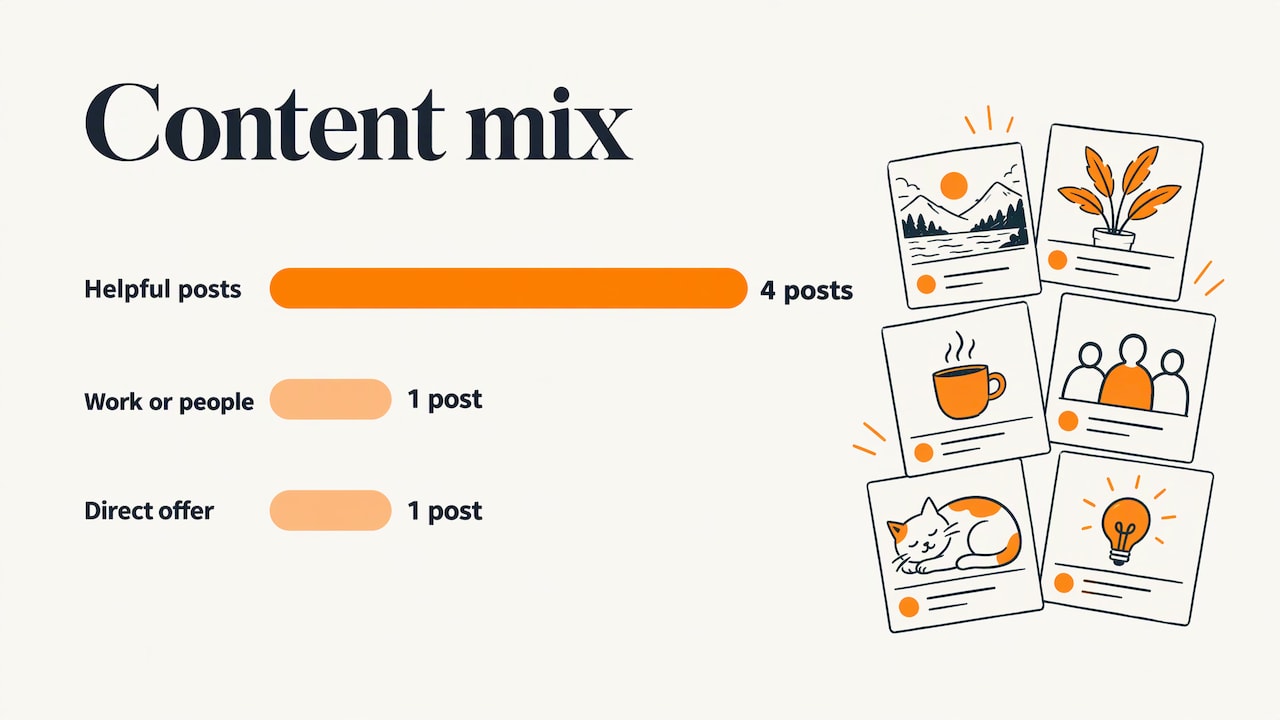
A useful balance is mostly helpful material, some soft promotion and a little hard promotion. For every six posts, aim for roughly four that teach or share something useful, one that shows your work or people, and one direct offer. Pages that only promote get ignored.
Refresh instead of starting over
Articles and newsletters stay discoverable. Revisit older pieces, update figures and add a new post pointing to the latest version. This is cheaper than inventing new topics every week.
LinkedIn lead generation: from attention to inquiry
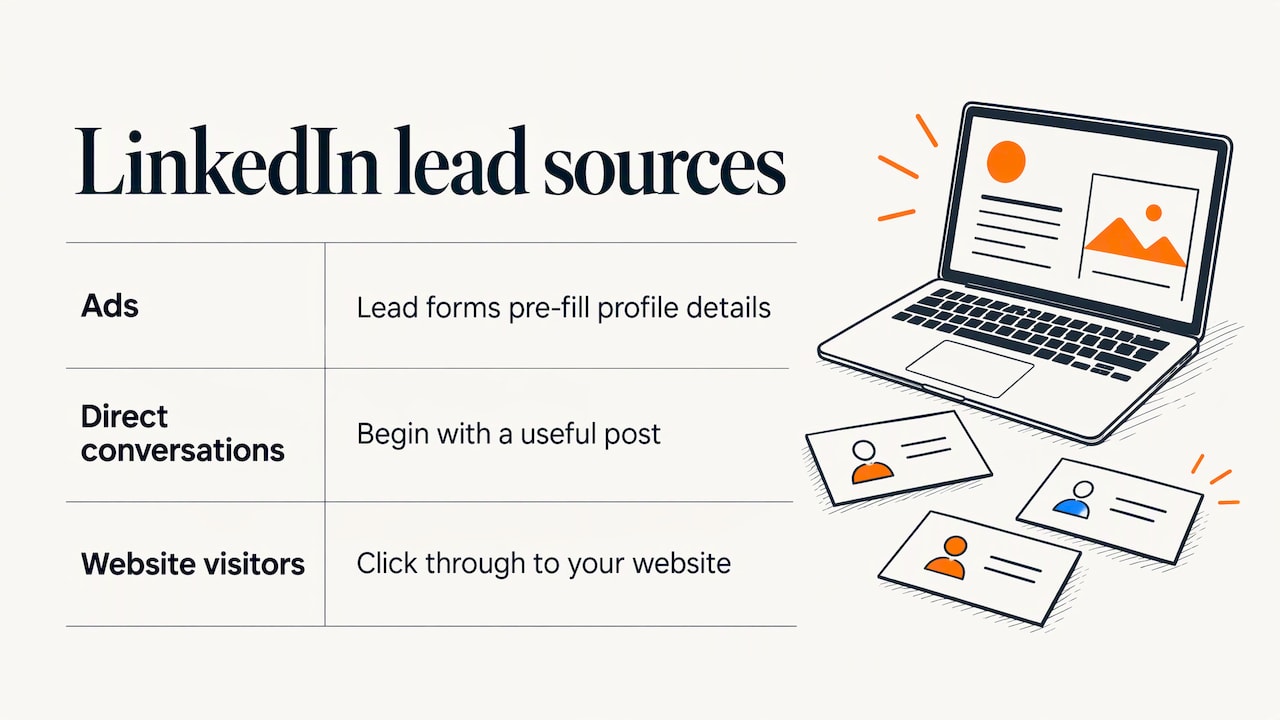
Leads come from three places on LinkedIn: ads with lead forms, direct conversations that begin with a useful post, and visitors who click through to your website.
Lead forms. LinkedIn’s forms pre-fill a person’s name, email and company from their profile, which lowers the effort of responding. Martech.org reports that you can now choose a lead generation objective when boosting a feed post, with a budget, audience and form template attached. It also describes a Qualified Leads Optimization feature, which asks you to report which leads were qualified so the system learns what a good lead looks like. LinkedIn recommends submitting at least five qualified leads every two weeks within 30 days, and the system needs about two weeks to reach full performance.
Qualifying. A form fill is not a sale. Decide in advance what makes a lead worth a call: company size, industry, role, project type, timeline. Add one or two qualifying questions to your form. A lead from a 15-person company that wants a project outside your range costs your team time, so shape the offer and the form to attract the right people.
Landing pages. If an ad sends people to a generic home page, most will leave. Send them to a page built for one offer, with a short form and proof of results. Our article on lead generation website design covers the layout that tends to convert, and the B2B lead generation guide covers the wider process of getting from a click to a qualified conversation.
Follow-up speed. A lead that waits three days has often already talked to someone else. Decide who responds, and how fast, before the campaign starts.
LinkedIn ads for B2B: how they work
LinkedIn ads let you choose who sees your message by attributes from member profiles, such as job title, industry, company, seniority and skills, as Martech.org explains. That precision is the platform’s main advantage over broad channels, and it is also why costs per click run higher than on many consumer platforms: you are paying to reach a defined professional audience.
Setting up a campaign
- Choose one objective. Awareness, website visits, engagement or lead generation. Mixing goals muddies your results.
- Define the audience. Combine industry, company size, function and seniority. Avoid going so narrow that the audience is tiny, and avoid targeting only the top titles. Several roles on the buying committee should see your message.
- Pick a format. Sponsored content in the feed is the usual starting point. Lead gen forms suit offers like a guide, a quote or a consultation.
- Set the budget and bidding. Cost per click is the most common model for Sponsored Content and text ads: you pay when someone clicks the headline, image or button, per an overview of LinkedIn’s auction pricing. Check LinkedIn Campaign Manager for the current minimums, since they change.
- Write for one reader. A specific problem and a specific offer outperform a company slogan.
- Send traffic to a matching page. Ad, offer and landing page should say the same thing.
Pair paid with organic
Ads work better when the people who see them have already seen your posts and your people. Running organic and paid together, rather than as separate projects, gives the same buyers repeated, consistent exposure. A buyer who has seen an engineer’s video, read a post and then sees an ad for a guide is far more likely to respond than a cold audience.
Measure what matters
LinkedIn rewards patience, so choose metrics that match your goal:
| Goal | Metric to watch |
|---|---|
| Awareness | Follower growth, impressions, profile views |
| Community | Engagement rate, comments |
| Traffic | Click-through rate, referral visits |
| Leads | Form completions, cost per qualified lead |
| Pipeline | Opportunities where the buyer saw your LinkedIn content |
The last row is the one companies skip. B2B buyers research in groups over months, and many convert later through search, direct visits or a sales call after LinkedIn has already shaped their opinion. If you only count direct form fills, LinkedIn will look worse than it is. Ask new customers how they first heard of you, add a “how did you find us” field to your forms, and note which opportunities involved a LinkedIn touch. Review everything monthly, and judge the channel over a quarter, not a week.
Where a marketing partner fits
Most owners can post twice a week. The hard parts are the ones that take sustained skill: a consistent brand across channels, writing that sounds like an expert rather than an ad, video that looks professional, ads that are tested and adjusted, and a website that converts the traffic you pay for. Marcy Design is a Columbus, Ohio agency with more than 38 years in business and over 230 awards, and our services cover each of those pieces under one roof: social media, professional writing, photography and video production, lead generation, and website design and development.
If you are a manufacturer, nonprofit or small business in central Ohio, that combination matters, because LinkedIn activity only pays off when the destination is built to receive it. A short video brochure is one example of an asset that works on LinkedIn, on your website and in a sales meeting.
Promo: put LinkedIn traffic in front of a site that converts
If your LinkedIn page is active but your website does not turn visitors into inquiries, the website is the first thing to fix. We design and build custom websites, handle SEO and lead generation, and produce the content that feeds your social channels. Start with our website design service or tell us about your project through the project intake form.
Perspective
After nearly four decades helping businesses market themselves, we have watched channels come and go. The pattern is the same each time: companies chase the channel and neglect the foundation.
LinkedIn is a good example. It gives you access to the right people, but it cannot make a weak message strong or a confusing website clear. We would rather see a company post two useful things a week and send readers to a page that is built to answer them than see a flurry of activity that leads nowhere.
That is why we treat brand, content, video, search and the website as one project. The photograph on your LinkedIn page, the headline in your ad, and the first screen of your landing page should feel like the same company speaking. When they do, every dollar of paid reach works harder, and every organic post builds on the last.
For manufacturers in particular, LinkedIn is one place buyers form an opinion. Search, referrals and trade relationships matter just as much, and your website is where all of them meet.
Greg
Company page best practices, in short
A quick checklist you can run this week:
- Rewrite your description to name your customer and the problem you solve.
- Add a real person to your posts at least once a month.
- Reply to comments within a business day.
- Use a single, trackable link for each campaign so you can see what produced a lead.
- Encourage employees to share and comment, since their networks are larger than yours.
- Review analytics monthly and drop the formats that never earn engagement.
FAQ
Is LinkedIn good for B2B marketing?
For most B2B companies, yes. It is the largest business-focused social network and lets you target by job title, industry, company and seniority. Companies selling to traditional industries like manufacturing should pair it with search and a strong website, since those buyers are less active on the platform.
How often should a business post on LinkedIn?
Start with two posts a week and measure for 60 to 90 days. If engagement grows and you can keep the quality up, move to three to five posts a week. A steady schedule beats occasional bursts.
How do I know if LinkedIn ads are working?
Track the metric that matches your goal: clicks for traffic, form completions for leads, and qualified leads or opportunities for revenue. Because B2B buyers often convert later through other channels, also record how new customers first heard of you and whether they saw your LinkedIn content.
What should I put on my website for LinkedIn visitors?
Give them a page that matches the post or ad they clicked: one offer, a short form and proof such as results or a customer story. Sending everyone to the home page wastes the click.
Sources
- Marketing on LinkedIn: What you need to know (Martech.org)
- LinkedIn Lead Generation: The 2026 Playbook for B2B Teams (ZoomInfo)
- How Much Do LinkedIn Ads Cost? (OfficeConsumer)