
 614.224.6226
What makes the difference between a basic storefront and a store customers want to use? Often, it is a well-guided shopping journey, not a longer list of features. Choosing ecommerce website development services means thinking beyond getting products online. Your store should make browsing, choosing, and buying straightforward while fitting the workflows behind the scenes.
That balance is easy to miss. A polished front end may still leave customers unsure what to do next, while a capable build can overlook daily operations or future plans. This guide offers a practical framework for comparing partners and shaping project scope around customer needs, business workflows, and growth goals.
You’ll learn what to assess in a development partner, how to plan an intuitive shopping experience, and what to ask about future growth. We’ll also explore when guided, interactive experiences can make next steps more relevant than static pages, from product discovery and lead capture to onboarding, professional consultations, and assessments. For Columbus businesses, Marcy Design’s ecommerce solutions and custom website development may be worth considering. Discuss your specific needs and deliverables during project discovery.
Key Takeaways
- Use a comparison framework to assess each stage of a partner’s work, from discovery and design to testing and support.
- Evaluate ecommerce website development services by how well they connect your business goals, customer needs, and day-to-day workflows.
- Consider interactive journeys for tasks where customers benefit from relevant prompts, such as choosing a product or completing an assessment.
- Plan your project in sequence: define goals and requirements, map customer tasks, test the experience, and prepare for launch.
- Compare Columbus-based and remote partners on strategy, technical fit, communication, and support rather than assuming location alone determines the right fit.
What Ecommerce Website Development Services Should Actually Deliver
Ecommerce website development services cover the planning, design, and construction of an online store, including the customer-facing shopping journey and the functions needed to support online sales. The scope should start with your business goals, customer needs, and operational requirements, not a preset list of features. A store selling a small range of products may need a different structure from one with complex product choices or order processes.
The term Online shopping describes the broader activity, but a development project turns that activity into a specific experience: customers find products, understand their options, place orders, and receive relevant follow-up. The details at each step shape what the project needs to deliver.
What is included in an ecommerce development project?
A well-defined project commonly moves through discovery, information architecture, visual design, development, testing, and launch planning. Discovery clarifies priorities and business workflows. Information architecture organizes pages and product categories so shoppers can find their way. Design establishes how the experience looks and works, while development builds the agreed scope. Testing checks key customer journeys before launch.
Some deliverables are central to the store, such as product pages, cart behavior, and checkout. Others are optional, including integrations with other business systems, marketing support, or ongoing improvements after launch. Platform choice and integrations should follow verified requirements, such as how products are managed and orders are handled. Ask which items are included, which are separate, and who is responsible for each. Not every provider includes every service.
How does an ecommerce website differ from a basic business website?
A basic business website may primarily explain what an organization does and help visitors get in touch. An ecommerce website has an added task: guiding customers from product discovery through checkout and post-purchase communication. That creates more decisions to plan, from how shoppers compare product information to what happens when they add, change, or remove items in a cart.
The build also needs to account for the work behind the storefront. Product details, for example, must be organized clearly for customers while supporting the business’s process for managing products and orders. The right scope connects both sides rather than treating design and operations as separate concerns.
If you’re comparing an online store with a broader business website, explore professional website design services to consider your wider site needs. Then define what the ecommerce experience must do, and confirm the specific deliverables with each potential development partner.
How Interactive Ecommerce Experiences Guide Customers Beyond Static Pages
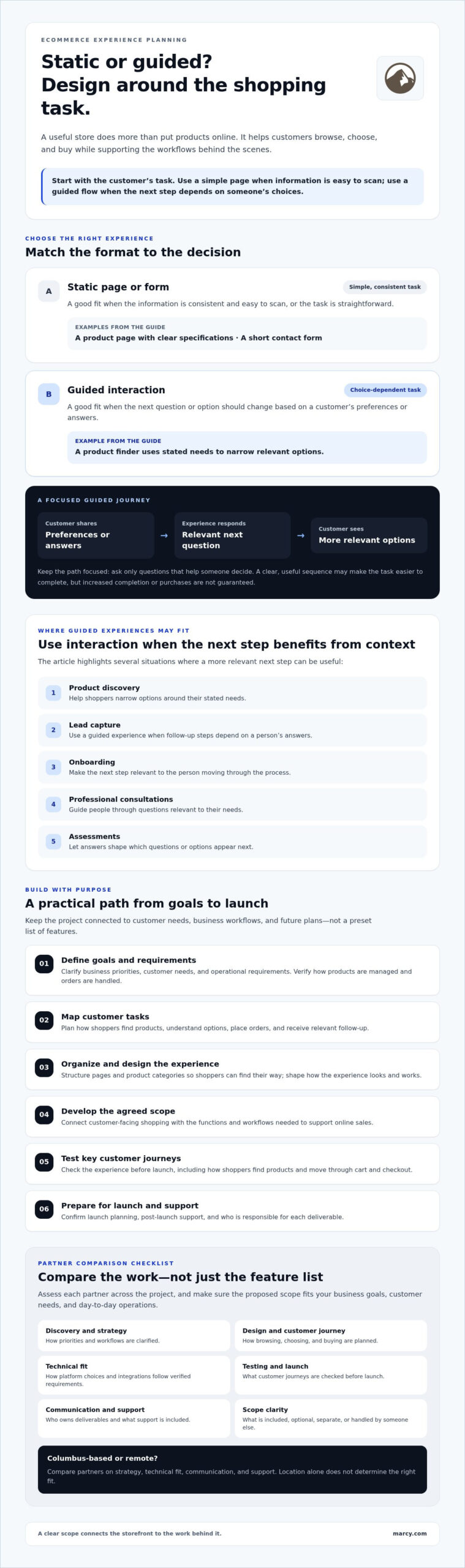
A static page presents the same information to everyone. An interactive flow responds to a shopper’s choices, showing relevant next questions or options. That distinction matters when customers need help narrowing choices, but interaction isn’t automatically better. Strong ecommerce website development services match the experience to a real customer need instead of adding features for novelty.
| Experience | May fit best when | Example |
|---|---|---|
| Static page or form | Information is consistent and easy to scan, or the task is simple. | A product page with clear specifications or a short contact form. |
| Guided interaction | The next step depends on a customer’s preferences or answers. | A product finder that uses stated needs to narrow relevant options. |
When does an interactive shopping journey help more than a static page?
Consider guided product discovery when shoppers face several choices and aren’t sure which details matter. A sequence of branching questions can tailor suggestions to their stated needs, making exploration more relevant than sorting through one broad list. If each step is clear and useful, customers may also find it easier to complete the task. That’s a potential benefit, not a guaranteed increase in completion or purchases.
Keep the path focused. Ask only questions that help someone decide, explain why a choice matters, and make it easy to review or change answers. A straightforward product page may serve customers better when they already know what they want.
Where can guided experiences support customer and business workflows?
Guided information gathering can help customers share what they need without facing a long, generic form. A lead-capture flow, for example, might ask about a visitor’s needs before requesting contact details, making the inquiry more useful to the team. Onboarding can gather information step by step, while a professional consultation flow can collect context before a conversation. An assessment can organize responses and clarify a relevant next step.
In each case, consider whether an interactive path is more helpful than static fields and whether the questions support both the customer and the business process. For related AI context, see this E-Commerce Strategy guide and explore Marcy Design’s AI-powered solutions. Discuss specific features and deliverables during discovery. The goal is a useful experience, not extra complexity.
How to Compare Ecommerce Website Development Services and Partners
Comparing proposals is easier when you look past the feature list. A useful evaluation shows how a partner will connect your business processes to both the customer-facing store and the work your team handles behind the scenes. Use this matrix to compare scope, responsibilities, and what each provider can confirm.
Discovery: How will the team learn about your customers, business priorities, and workflows? Look for a clear link between discovery findings and the proposed scope.
Design: How will the store help customers find products and understand their options? Ask how design decisions account for mobile shopping.
Development: What will be built, and which project requirements does each part address? Request relevant work examples and ask what the provider contributed.
Integrations: Which connections to other systems are needed, and who will confirm their requirements? Verify the platforms and integrations directly rather than assuming they’re included.
Testing: How will the team check key shopping tasks across devices and user scenarios? Ask what happens when a test reveals an issue.
Support: What post-launch help is part of the agreement, and what remains your team’s responsibility? Clarify ownership of updates and ongoing improvements.
Which questions reveal whether an agency understands your ecommerce goals?
Ask how discovery connects customer needs and business priorities to project scope. Then get specific: who provides product data and content, who coordinates integrations, and who makes decisions during delivery? Ask the team to explain how a business process, such as handling an order, will work for staff and what customers will experience. Clear answers make responsibilities easier to compare.
Also ask how the partner will test key shopping tasks, such as finding a product, reviewing its details, and completing checkout, across relevant devices and scenarios. A clear testing approach helps you understand how the team will assess the experience, not just how it will look.
How should you evaluate interactive functionality and future flexibility?
For each proposed interactive element, ask what customer problem it solves. Compare it with a simpler static page: will guided questions make choices clearer, or add unnecessary steps? The right option depends on the task. As you assess the customer journey, Harvard Professional & Executive Development offers guidance on positive customer experiences.
Finally, separate verified capabilities from assumptions. Ask what platforms, integrations, and post-launch support the provider can deliver, and confirm these details in the project scope. If you’re comparing ecommerce work with broader site needs, review professional website design services as part of your evaluation.
Planning Ecommerce Development: Discovery to Launch
A clear plan turns a large ecommerce project into manageable decisions. Start with customer and business needs, then define what the store must do before settling on specific features. This keeps the scope focused and gives your development partner a practical basis for recommending an approach.
What should an ecommerce project brief include?
Begin with a concise brief that describes the business objectives, target customers, products, and essential tasks customers should be able to complete. Include the processes your team needs the store to support, too. If a platform, integration, or workflow is not yet confirmed, mark it as a question for discovery rather than a fixed requirement.
- Set the goals: Describe what the store should help the business and its customers accomplish.
- Map customer tasks: Note key journeys, such as finding a product, requesting a consultation, or submitting an inquiry.
- Document products and workflows: Identify the product information customers need and how your team manages related work.
- List possible integrations: Record the systems involved and flag any details that need confirmation.
- Compare experience options: Share examples of static pages and guided interactions the team should evaluate.
Keep the choices focused. For example, if shoppers struggle to compare products, consider whether clearer product information is enough or whether a guided series of questions would help them narrow their options. Map any interactive flow to that specific task, and confirm that it is worth the added complexity.
How should teams test customer journeys before launch?
Turn the brief into a short list of journeys to review. Depending on your store, test product discovery, lead capture, onboarding, consultation requests, or assessments. Follow each task from its starting point to the next step. Check whether the questions make sense, whether responses lead to relevant information, and whether customers can tell what to do next.
Review the experience on both mobile and desktop. Product details should be easy to find, and interactive elements should be understandable and usable without forcing customers through unnecessary steps. If mobile shopping needs particular attention, ask the development partner how it will be addressed in the project scope and tested across the journeys that matter to your customers.
Use this plan to start a focused conversation with a partner. If you’re defining the broader site experience alongside your store, explore Marcy Design’s website design services as one point of reference for shaping your project scope.
Choosing Ecommerce Website Development Services in Columbus: A Clear Next Step
The right partner should connect business strategy to a useful customer experience, then explain how the project will be delivered and supported. As you compare ecommerce website development services, assess each provider on strategy, customer experience, technical fit, communication, and post-launch support. Local or remote, the right fit is the team that understands your needs and clearly defines its responsibilities.
What should a Columbus business confirm before selecting an ecommerce partner?
Start with relevant project experience. Ask the agency to explain what it handled on similar work and how that experience relates to your goals. Then clarify who will make decisions, share updates, supply product information, and coordinate any required integrations. A clear communication approach helps prevent assumptions from becoming gaps in scope.
Discuss how the team would support the customer journeys and business workflows your store needs. For example, can they explain how a shopper’s product choices connect to the information your staff needs to process an order? Ask which capabilities are included in the proposed work and which require another partner or separate service. Verify platforms, integrations, and specific deliverables directly.
A Columbus-based agency may offer the opportunity for local conversations and collaboration, but location alone doesn’t establish fit. Compare local and remote providers using the same criteria: how well they understand your requirements, communicate trade-offs, and define ownership throughout the project. Choose the relationship and working approach that best suit your team.
How can Marcy Design support an ecommerce conversation?
Marcy Design is a Columbus-based agency offering ecommerce development and custom website solutions. Those capabilities may be relevant if you’re planning a store around both customer needs and business goals. Discuss the platforms, integrations, interactive features, and project responsibilities you need during discovery rather than assuming they’re part of a standard scope.
If you’re considering a guided product journey, lead-capture flow, or another interactive experience, bring it forward as a requirement to assess. Discuss the customer task it should support, whether a simpler page could work, and how the project would account for the workflow behind it. That conversation can help clarify scope and potential fit before decisions are made.
To outline your goals and requirements, discuss your ecommerce website development goals with Marcy Design and explore whether its ecommerce and custom website capabilities align with your project.
Build Your Store Around What Customers Need Next
The strongest ecommerce website development services align the shopping journey with your business goals and the workflows that support it. Choose a partner who can explain what’s included, confirm technical requirements, and help you distinguish useful guided interactions from features that add complexity without a clear purpose.
Marcy Design is a Columbus-based agency offering ecommerce solutions and custom website development. As you plan your store, start with your priorities, customer needs, and essential requirements, then use those details to assess whether the partnership is a fit.
A clear conversation can help turn your ideas into a focused project plan. Your next online store can begin with a practical step forward.
Frequently Asked Questions
What do ecommerce website development services include?
Ecommerce website development services typically cover planning, design, and development of an online store, though each provider defines its scope differently. A project may include discovery, organizing pages and product categories, visual design, building the store, testing key shopping tasks, and launch planning. Platform setup, integrations, marketing support, and post-launch improvements may be separate. Ask for a written scope that identifies deliverables, responsibilities, and any capabilities that still need to be discussed.
How do I choose an ecommerce website development company?
Choose a company that can connect your business goals and customer needs to a clear project plan. Ask how it will learn your workflows, test shopping tasks, communicate progress, and divide responsibilities for content, product information, and integrations. Review relevant work examples and ask what the team contributed. Before agreeing, confirm the proposed platform, specific deliverables, and post-launch support rather than relying on assumptions or a broad service description.
Is custom ecommerce website development better than a template?
Neither approach is automatically better. A template can suit a store with straightforward needs and a familiar shopping journey, while custom development may be worth exploring when the business has distinct workflows or customer requirements that a standard setup doesn’t address. Compare options against your essential tasks, operational needs, and plans for the store. Ask what can be adapted, what limitations apply, and whether the added complexity of customization solves a real problem.
How much do ecommerce website development services cost?
The cost depends on the project’s requirements, so a useful estimate starts with a defined scope rather than a generic price range. Factors to clarify include design needs, product setup, platform selection, integrations, testing, and any support or improvements after launch. Ask providers to separate included work from optional items and explain the assumptions behind their proposals. Comparing written scopes helps you understand differences between quotes without treating different project plans as equivalent.
Can interactive features improve an ecommerce customer experience?
Interactive features can make a shopping journey more relevant when they respond to customer choices. For example, a guided product finder could ask about intended use and present suitable options, while a static page provides the same information to every visitor. Interaction may support engagement and personalization, but it won’t suit every task or guarantee a purchase. Use it where it helps customers decide, and keep simple tasks simple.
What should an ecommerce website development brief include?
An ecommerce brief should explain business objectives, target customers, product information, and the main tasks customers need to complete. Describe the workflows your team must support, plus any integrations or platform requirements you already know. Mark uncertain items for discovery instead of treating them as settled. Include examples of pages or guided experiences you want considered, and clarify who will provide content, product data, feedback, and project decisions.
Should I hire a local ecommerce development agency in Columbus?
A Columbus agency can be a good fit if its expertise, communication style, and project approach match your needs, but local isn’t automatically better than remote. Compare providers on strategy, customer experience, technical fit, responsibilities, and support. Marcy Design is based in Columbus and provides ecommerce solutions and custom website development. Ask how its capabilities align with your required customer journeys and business workflows, and discuss specific platforms, integrations, and deliverables directly.
Ready to discuss your project? Talk with Marcy Design about your ecommerce website development goals.